The most effective way to study Pride and Prejudice is to listen to the free audiobook first, then read the annotated edition. This two-pass system separates following the story from understanding the depth so you can focus on one at a time.
Listen First, Then Read
A two-pass reading system that halves cognitive load. Listen for the story, then read annotations for the depth.
| Phase | Total Time | Per Day | Duration |
|---|---|---|---|
| Pass 1 (listen) | ~12 hours | 45–60 min | 2–3 weeks |
| Pass 2 (read annotated) | ~8–10 hours | 30–45 min | 2–3 weeks |
Why the Two-Pass System Works
When you read a challenging text, your brain performs multiple tasks simultaneously: decoding 19th-century vocabulary and syntax, tracking a large cast of characters, following the plot through dialogue and indirect narration, understanding Regency-era social context, and recognising humour and irony. A first-time reader trying to do all five simultaneously is overloaded.
The two-pass system assigns each cognitive task to a separate pass. Pass 1 (listening) handles decoding words, tracking characters, and following the plot. Pass 2 (reading) handles social context, humour, and irony — plus revisiting the first three tasks with the help of annotations.
Pass 1: Listen to the Free LibriVox Audiobook
Your only goal during Pass 1 is to understand the story: who the characters are, what they want, and how everything turns out. Download the free LibriVox audiobook and listen through all 61 chapters during your commute, while cooking, or while walking. Do not take notes. Do not rewind. Do not pause to look something up.
The narrator’s voice imposes structure on Austen’s long sentences. More importantly, the narrator’s pace keeps you moving forward — you cannot stop, so you do not lose momentum.
By the end of Pass 1, you will know the full plot, each character’s personality and role, the relationships between characters, and the major turning points. You will not yet understand the social significance, Austen’s commentary on class, or why certain lines are funny. That is exactly the right place to be for Pass 2.
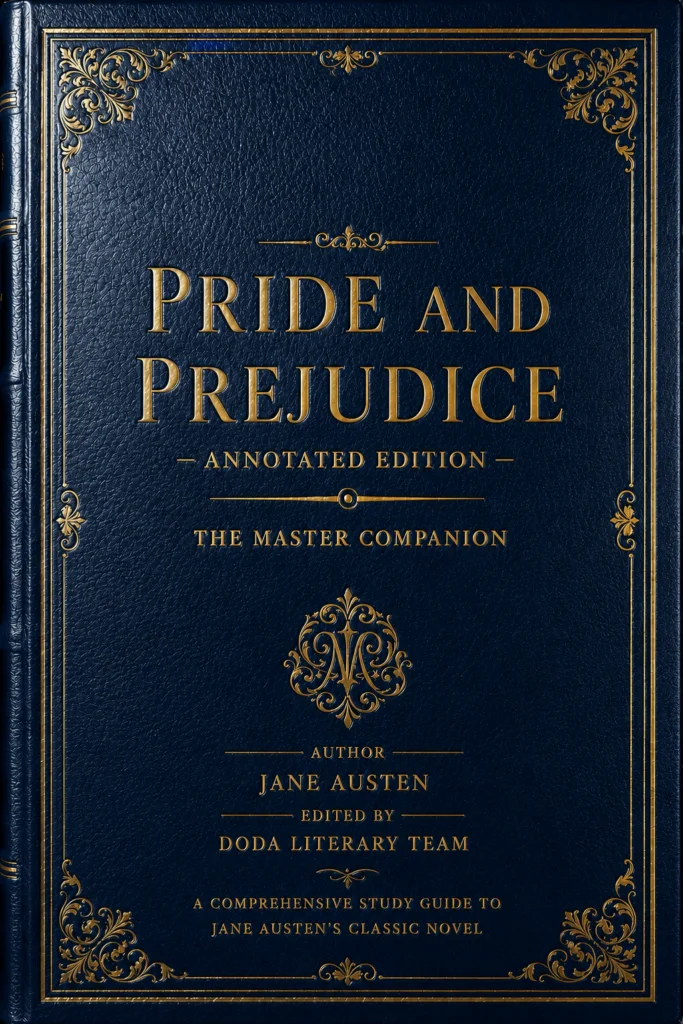
Ready for Pass 2? The annotated edition gives you the depth you need to truly understand the novel.
Get the Annotated EditionPass 2: Read the Annotated Edition
Now that the plot is in your head, you can focus entirely on depth. Read the annotated edition one chapter at a time. Read every annotation. Stop and think about passages that seem significant. Compare your understanding from Pass 1 with the new information the annotations provide.
The key insight is that Pass 2 has zero cognitive load from plot tracking. When Elizabeth reads Darcy’s letter, you are not wondering what it says — you already know. You can focus entirely on why the letter changes Elizabeth’s opinion and what that says about her character. Every annotation lands on prepared ground.
By the end of Pass 2, you will have full understanding of social context for every major scene, knowledge of vocabulary and customs Austen’s audience took for granted, recognition of narrative techniques, appreciation for the humour, and the ability to discuss the novel beyond the plot level.
Why This Produces Better Results
Most people who read Pride and Prejudice once come away with partial understanding. They know the plot well and the themes vaguely. A year later, they remember the gist but struggle to explain why the novel is a masterpiece. Readers who use the two-pass system come away with thorough, lasting understanding. The difference is not intelligence — it is the cognitive advantage of separating story comprehension from analysis.
Pass 1: Listen
Free LibriVox audio for story comprehension.
Pass 2: Read
Annotated edition for depth and analysis.
Reduced Load
Each pass handles half the cognitive tasks.
Better Retention
Two passes create stronger memory traces.
No Rush
4–6 weeks for complete mastery.
Free + Affordable
Audio costs nothing; annotations are budget-friendly.
🧭 What the Listen-First Method Really Is
At its simplest, the listen-first method is a commitment to separate the two very different jobs that reading Pride and Prejudice demands. The first job is following the story — who wants what, who is mistaken about whom, and how it all resolves. The second is understanding the depth — the Regency-era social rules, the satire, the irony, and the craft that make the novel a masterpiece rather than merely a pleasant story. Most first-time readers try to do both simultaneously, and the novel’s long sentences, large cast, and unfamiliar social codes make that genuinely taxing.
The method’s answer is to give each job its own pass. On the first pass you use your ears, letting a free audiobook carry the story while your brain is free simply to keep track of it. On the second pass you use your eyes, letting an annotated edition supply the depth now that the plot is no longer competing for attention. Because the two hardest things about the book are no longer competing, each becomes far easier than it would be if tackled together.
If you doubt that the difficulty really splits this way into story and depth, our guide to why Pride and Prejudice is hard to read lays out where the friction lives, and the audiobook-versus-reading comparison explains when each format has the edge.
📅 A Week-by-Week Plan
The two-pass system sounds abstract until you give it a calendar. Here is a realistic four-week schedule that fits around work, school, or family life.
Weeks 1–2 (Pass 1 — listen). Download the free LibriVox audiobook and listen for roughly 45–60 minutes a day. Do not take notes, do not rewind, do not pause to research — the entire point is momentum. Treat it like an episode-based show: one or two chapters a day, and by the end of week two the full story is in your head. At this stage you are not trying to be clever; you are simply building the map you will walk again.
Week 3 (Pass 2 — read, first third). Now start the annotated edition from the beginning. Because you already know where the story is going, you can slow down, read every annotation, and stop to think. Do not rush to be “back where you were” — this is a different pass for a different purpose.
Week 4 (Pass 2 — read, remainder). Finish the annotated reading, now zeroing in on the two structural heartbeats of the novel: Darcy’s first proposal and his letter. These deserve the slowest, most careful reading of all, because they are where Elizabeth’s (and the reader’s) whole understanding turns.
By the month’s end you will have the story and the depth, with every annotation landing on prepared ground.
🏛️ Historical & Cultural Context
Much of what the second pass should teach you is not really about the text at all — it is about the world Austen was describing, a world her original readers took entirely for granted. Consider the novel’s engine: the entail that will strip the Bennet daughters of Longbourn on their father’s death. To a modern reader this is a footnote; to Austen’s audience it was the urgent economic reality that made Mrs Bennet’s scheming comprehensible and made Elizabeth’s choices genuinely risky.
The same goes for the social rules that silently govern every scene. Walking unchaperoned, calling on someone who has not called on you, proposing to someone whose family is beneath yours — each carries weight that is invisible without context. This is why the second pass is best done in an annotated edition: the notes translate that forgotten social grammar back into English, and the beginner’s guide to Pride and Prejudice sets up the world and characters you will spend your two passes with.
📖 Why This Still Matters
There is a persistent myth that Pride and Prejudice is a light, comfortable read — and a matching myth that it is too difficult to enjoy. Both are wrong in the same way: the novel is enjoyable when you can hear its jokes and see its stakes, which are exactly the two things lost when you grasp story and satire at the same time. The listen-first method closes that gap, which is why it tends to produce readers who genuinely love the book rather than merely having finished it.
It is also genuinely low-cost. The audio pass is free, and the only real expense is a single annotated edition — the same trade-off our free-versus-paid resources guide recommends, and the LibriVox listen-along lets you keep reinforcing the text long after your two passes are done.
📖 Making Each Pass Count
- Protect Pass 1’s momentum — no notes, no rewinding, no fact-checking; the goal is understanding the story, not the details.
- Choose a quality recording — a free guide such as the free audiobook download points you to a clear, reliable LibriVox version.
- Don’t skim annotations in Pass 2 — they are the entire point of the second pass.
- Re-read the letter out loud — Darcy’s letter repays being spoken; its tone carries meaning silent reading can miss.
Frequently Asked Questions
Can I skip Pass 1 and just read the annotated edition?
You can, but you will get less out of the annotations. When trying to follow the plot, you will rush through the notes to get back to the story. Pass 1 removes this tension.
Can I do Pass 2 without an annotated edition?
You can read the plain text, but you will miss most of what makes the novel interesting. The plain text gives you words; the annotated edition gives you meaning.
What if I do not enjoy reading after listening?
Some people find that listening makes them want to read the annotated edition. Others find the audio was enough. Both outcomes are valid.
How long does the whole system take?
About 20 hours total spread over 4–6 weeks. Twenty hours for understanding one of the most celebrated novels in English is a reasonable investment.
Do I need to buy anything for Pass 1?
No. The LibriVox audiobook is completely free. You only need an annotated edition for Pass 2.
Is listening really as good as reading for a first pass?
For story comprehension, yes — often better. The narrator's pace keeps you moving forward through Austen's long sentences, and hearing the book removes the temptation to slow down and over-analyse too early. That is exactly what a first pass should do.
Can I swap the order and read first, listen second?
You can, but it works less well. Reading first means you will likely stop to puzzle over details and lose momentum; listening first keeps you moving so the plot lands cleanly before you add depth. The annotated reading naturally belongs after the story is secure.
What if I cannot find time to read in Pass 2?
Make the reading pass shorter and more focused rather than skipping it. Reading just the pivotal scenes — Darcy's proposal, his letter, Charlotte's engagement — with annotations is worth far more than a rushed full pass, and you can return for the rest later.
📚 Related Articles
Start Your Two-Pass System
- Download the free LibriVox audiobook now
- Get the annotated edition for Pass 2
- Master the novel in 4–6 weeks