The best way to experience Pride and Prejudice is to listen to the free LibriVox audiobook while you read the annotated edition. The audio carries you through the story at a steady pace, while the annotations explain everything you would otherwise miss.
Listen Along While Reading
Combine the free LibriVox audiobook with an annotated edition for a dual-input approach that addresses every barrier to understanding.
| Week | Chapters | Focus |
|---|---|---|
| Week 1 | 1–20 | Setup — characters and central conflict |
| Week 2 | 21–40 | Crisis — proposal, letter, awakening |
| Week 3 | 41–61 | Resolution — Pemberley, elopement, weddings |
Why This Combination Works Better Than Either Alone
Listening and reading simultaneously is not a compromise — it is a superior way to engage with a 200-year-old text. The audio solves the rhythm problem: Austen’s 30-to-80-word sentences become clear when spoken because the narrator’s voice groups words into natural breath units. The annotations solve the comprehension problem: when Elizabeth says Darcy is “not to be laughed at,” a footnote explains this is a significant character moment.
The two inputs work on different cognitive channels. The audio carries narrative — plot, dialogue, sequence. The annotations carry analysis — vocabulary, context, theme. Your brain processes both simultaneously because they arrive through different senses.
How to Set Up the Listen-Along
Step 1: Download the LibriVox audiobook. Individual MP3 files are best for chapter-by-chapter study. Step 2: Open your annotated edition to Chapter 1. Step 3: Press play and begin reading along, matching your pace to the narrator. Step 4: When you encounter an unfamiliar reference, pause the audio and read the annotation. Step 5: At the end of each chapter, mentally summarise what happened.
A good rule of thumb: do not pause for individual words you can guess from context. Pause for references you do not recognise or passages that feel significant but unclear. Aim for two to three pauses per chapter.
Start your three-week study plan today. The annotated edition is the perfect companion for the free audiobook.
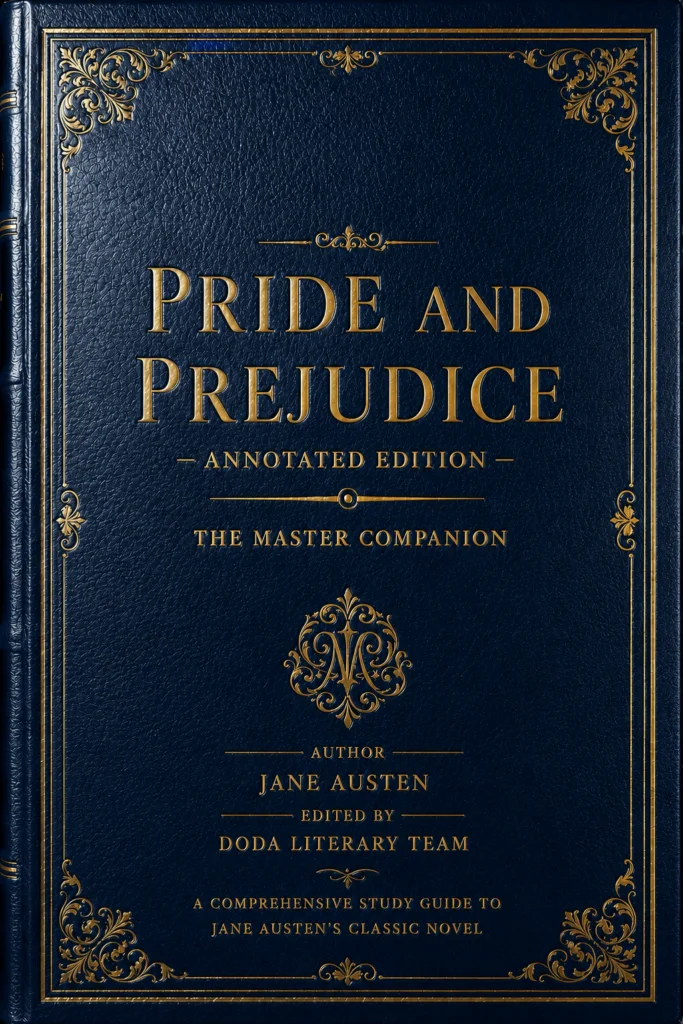
Get the Annotated EditionA Detailed Three-Week Schedule
Week 1: The Setup (Chapters 1–20). Meet the Bennet family and the Bingley party. Pay attention to Darcy’s first appearance at the Meryton assembly. Key chapters: 3 (the ball), 18 (Netherfield ball), 19 (Collins’s proposal).
Week 2: The Crisis (Chapters 21–40). The major turning points. Key chapters: 34 (Darcy’s proposal), 35–36 (Darcy’s letter and Elizabeth’s awakening).
Week 3: The Resolution (Chapters 41–61). Pemberley, the elopement, Lady Catherine’s confrontation, and the double wedding. Key chapters: 43 (Pemberley visit), 56 (Lady Catherine’s visit).
What the Annotations Add That Audio Misses
The audio gives you correct pronunciation, natural rhythm, subtle character differentiation, and emotional tone. The annotations give you word definitions, sentence-level analysis, social context, thematic connections, chapter summaries, and historical notes about Regency-era customs. Neither medium is complete alone. Together they are.
Hear the Rhythm
Audio reveals Austen's sentence structure through natural speech.
Read the Context
Annotations explain every unfamiliar reference and custom.
Dual Channels
Ears process story while eyes process analysis.
Pause and Learn
Pause audio, read annotation, resume — seamless.
Three-Week Plan
Structured schedule covers all 61 chapters.
Free + Affordable
LibriVox is free; annotations cost less than dinner.
🎧 How LibriVox Works (And What to Expect)
LibriVox is a volunteer-run project that produces free audiobooks from public-domain texts. Because Pride and Prejudice was published in 1813 and Jane Austen died in 1817, the novel is firmly in the public domain — anyone may record and share it without permission or payment. Volunteers read chapters at home, listeners proof-listen, and the finished files are published on the LibriVox website and hosted on the Internet Archive at no charge. No subscription, no account, no fee. You simply download or stream.
The practical details are worth knowing before you start. Recordings come as a single zip of chapter MP3s, an M4B audiobook file, or a streamable player. For a listen-along you want the individual chapter files, because you will be pausing at precise points and jumping back to the right chapter when you get lost. Because the readers are volunteers, quality varies — some chapters are excellent, some merely fine, and the narrator can change between chapters in the same book. That inconsistency is the trade-off for free. Many listeners find the slightly amateur warmth endearing; if you find it distracting, treat the audio as a rhythm aid rather than a performance and loosen your expectations for polish.
One useful hack: several recordings of Pride and Prejudice exist, produced at different times by different narrators. If one voice grates, you can simply switch versions without leaving the free ecosystem. Whichever you choose, the novel runs to roughly twelve hours of audio — a busy-sounding number that the three-week schedule below tames into three forty-minute sessions per week. For the direct download links and file formats, our free audiobook download guide has you covered.
🧭 Listening Strategies That Actually Stick
The three-week schedule is the scaffold; these strategies keep it from falling apart. The most common failure mode is eye-speed: you read faster than the narrator talks, your eyes run ahead, and within five minutes you are two pages lost. Fix it in one of three ways. Speed the playback up — most audiobook apps handle 1.25x completely cleanly, and many listeners settle perfectly between 1.15x and 1.3x. Slow yourself down instead, using a fingertip or a bookmark to hold your place. Or switch to a two-pass approach: listen to the chapter first without the book, concentrating only on the story, then read the annotations and the text afterward. That second mode is especially useful for the long conversational chapters where Austen’s dialogue needs to be heard rather than parsed.
Build a pause habit before you need one. Agree a rule with yourself now: pause for references you do not recognize and for passages that feel significant but unclear; do not pause for individual words you can guess from context. Two or three pauses per chapter is the sweet spot — each pause costs a minute or two, but the comprehension dividend is large.
End every session with a ten-second recap, and before you open the next chapter, try to restate in one sentence what happened in the previous one. It sounds trivial, but it is the cheapest way to keep the threads of a 61-chapter novel straight, and it makes the final week feel effortless instead of frantic. If you find yourself torn between listening and reading as your primary mode, our audiobook-versus-reading comparison weighs the two approaches side by side.
📖 How the Annotated Edition Fits the Method
The listen-along assumes you are pairing audio with text, so a moment on which text you use is worth it. A bare first-edition text works, but the annotations matter most at exactly the points where audio leaves you stranded: the narration tells you how a line sounds, and the annotation tells you why it matters. They interlock. When Elizabeth says Darcy is “not to be laughed at,” the narrator’s tone of voice does half the work and the annotation completes the other half. When the novel refers to entailment, to settlements, to the etiquette of calling on visiting families, the audio glides past while the note stops and explains.
The same logic applies if you want to build up to the original. Some readers — especially English learners — prefer to read a simplified retelling of a chapter first and then listen to the original audio, so that the listening pass is pure comprehension practice. That exact sequence is the subject of our original-versus-simple method, and the annotated edition supports both approaches: try the simplified text first, or go straight to the original with the annotations standing guard. Either way, the free audio and the annotated text do better together than apart — which is the whole argument for the listen-along in the first place.
Frequently Asked Questions
My eyes move faster than the narration. What can I do?
Increase playback speed to 1.15x or 1.25x, or switch to the listen-first approach where you listen without reading and study the text afterward.
I keep getting distracted and miss passages. How do I handle this?
Use chapter bookmarking in your audiobook app. If you lose focus, jump back to the start of the chapter rather than scrubbing through the audio.
The annotations are overwhelming. Do I need to read all of them?
No. Focus on vocabulary you do not know and context you cannot infer. Save thematic analysis for a second pass if needed.
Can I do this with a physical book?
Yes, but a tablet or e-reader works better. If using a physical book, a book stand keeps the pages open while your hands are free.
How long does each daily session take?
About 30–45 minutes for the recommended three to four chapters per day.
Is the LibriVox audiobook really free?
Yes. LibriVox audiobooks are free because the volunteers who read them donate their work and the underlying text is in the public domain. The files are hosted on LibriVox and the Internet Archive, with no account, subscription, or fee required.
Are LibriVox recordings good enough for classroom use?
Yes — teachers routinely use them because they are free to share and legally uncomplicated to assign. Because narration quality varies by chapter, assign a specific recording and listen to a sample first; the listen-first assignments work better with a narrator who reads slowly and clearly.
What if my audiobook app does not remember my place?
Download the chapter files rather than one continuous file, and keep a simple note of the chapter number in your reading notes. Jumping back to the start of the correct chapter beats scrubbing through a long file every time.
Listen and Learn Together
- Free LibriVox audiobook for the story
- Annotated edition for context and analysis
- Three-week structured schedule included