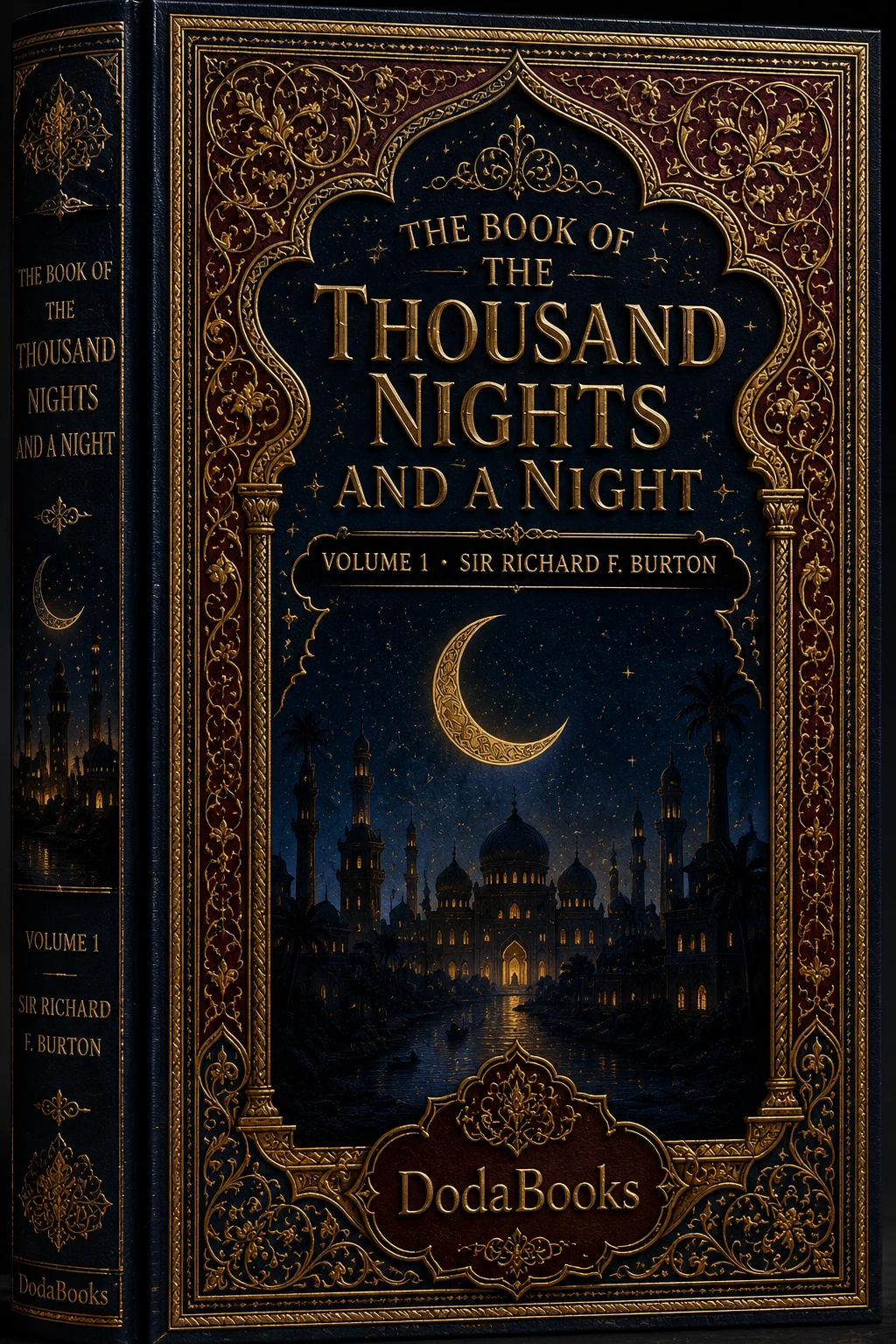
Here begins Volume 1 of Sir Richard F. Burton’s celebrated translation of the Arabian Nights Entertainments — the world’s most famous collection of Middle Eastern folk tales. Framed by the story of Scheherazade, who must tell a new tale each night to survive, these stories of magic, adventure, and wit have captivated readers for centuries.
🌙
Thousand Nights & a Night — Volume 1
The first volume of Burton's celebrated translation — where Scheherazade begins her thousand and one nights of storytelling, spinning tales of jinn, merchants, and magical adventures.
| Translator | Sir Richard Francis Burton |
| Published | 1885 |
| Genre | Folk tales, adventure, fantasy |
| Volume | 1 of 10 |
| Tales | 34 |
| Legacy | The most famous translation of the Arabian Nights; a landmark of world literature |
🌙 The Frame Story
The collection opens with the story of King Shahryar, who, betrayed by his first wife, marries a new bride each night only to have her executed at dawn. When the clever and learned Scheherazade volunteers to be his bride, she begins telling him a story on their wedding night — but leaves it unfinished at daybreak, compelling the King to spare her life so he can hear the conclusion. Thus begins the Thousand and One Nights.
This frame story is the genius of the collection. Scheherazade’s tales cascade within each other — a story within a story within a story — creating a nested narrative structure that has influenced literature from Chaucer to Borges. She survives not through force but through wit, storytelling, and the endless human hunger for what happens next.
📖 Tales in This Volume
Volume 1 introduces the opening tales of the cycle:
The Tale of the Merchant and the Jinni — A merchant is confronted by a jinni who demands his life for killing the jinni’s son with a thrown date-pit. Passers-by intervene with stories meant to soften the jinni’s heart.
The Fisherman and the Jinni — A poor fisherman catches a jar containing a vengeful jinni who threatens to kill him. The fisherman must outwit the spirit through a clever trick — convincing the jinni that no such powerful being could ever have been trapped in so small a vessel.
The Porter and the Three Ladies of Baghdad — A porter is hired by three mysterious women to carry provisions to their shuttered house. What follows is a strange and sensuous evening of storytelling and revelation.
The Tale of the Three Apples — A murder mystery unfolds when a fisherman finds a locked chest containing a woman’s body. The Caliph orders it solved in three days — an early ancestor of the mystery genre, long before the case-driven stories collected in The Innocence of Father Brown.
The Tale of Nur al-Din Ali and His Son — A sprawling tale of love, exile, and reunion across the medieval Middle East.
The Hunchback’s Tale — A comic and gruesome story of a hunchback who chokes to death on a fishbone, passing through the hands of a tailor, a doctor, a steward, and a Jewish merchant — each believing they killed him.
These tales intertwine and nest within each other, creating the kaleidoscopic narrative tapestry that makes the Arabian Nights unique in world literature.
🎭 Key Characters
Scheherazade
The brilliant and courageous storyteller who saves herself — and her kingdom — through the power of narrative. She is educated, witty, and possesses an inexhaustible store of tales. More than a character, she is a symbol of the transformative power of storytelling.
King Shahryar
The bitter king who, having been betrayed by his wife, has sworn to marry and execute a new bride each dawn. Scheherazade’s stories gradually heal his wounded heart, and his transformation from tyrant to loving husband mirrors the therapeutic power of narrative.
The Jinn
Supernatural beings made of smokeless fire, the jinn of the Arabian Nights are capricious, powerful, and deeply human in their emotions — they love, rage, bargain, and can be outwitted. They are among the most memorable characters in the collection.
📖 Literary Significance
The Arabian Nights is one of the most influential works of world literature. Its stories have been adapted, translated, and retold across every medium — from Disney’s Aladdin to the nested narratives of Italo Calvino. The frame story of Scheherazade is the archetype of the storytelling circle, inspiring Chaucer’s Canterbury Tales, Boccaccio’s Decameron, and countless others.
Burton’s 1885 translation was a landmark. Where earlier translators had bowdlerized the tales for Victorian sensibilities, Burton translated them complete and unexpurgated, with extensive anthropological footnotes that made the work a scholarly resource as well as a literary one. His translation remains the most famous English version, prized for its archaic vigor and its fidelity to the original Arabic.
The stories themselves are a window into the medieval Islamic world — its values, its humor, its social hierarchies, and its imagination. They are by turns magical, coarse, philosophical, and hilarious, and they reward reading at any age.
✨ What Makes the DodaBooks Edition Special
This is the complete 1885 text of Volume 1, carefully prepared for modern readers without distractions or clutter.
Zero Distractions
No ads, no license pages, no project boilerplate — just the original text, clean and uninterrupted.
Smart Typography
Curly quotes, em-dashes, proper ellipsis — typeset with care for a premium reading experience.
Chapter Navigation
Full table of contents with back-to-tale links in every section — jump between all tales effortlessly.
Cleaned & Polished
All Gutenberg boilerplate stripped, consistent formatting throughout the text.
No DRM
You own your copy — read on any device, anytime, forever.
Instant Download
EPUB format included, delivered instantly after purchase.
🏛️ A Story Older Than the Frame
The tales gathered in the Arabian Nights were not written in one place or one century. They are a living tradition that grew over more than a thousand years, carried across the Middle East, North Africa, and South Asia by storytellers who reshaped them at every telling. This long evolution is why the collection feels so vast: not one author’s vision but a whole civilization’s shared imagination. You are watching tales that traveled across continents before reaching print.
✒️ The Man Behind the Translation
If the stories are the heart of the book, the translator is its most colorful character. Sir Richard Francis Burton was among the most extraordinary Englishmen of the Victorian age, a linguist who spoke more than twenty-five languages and had lived in the lands that produced the tales. His 1885 translation deliberately broke with the polite, censored versions Victorians had grown up with, giving readers the full, unexpurgated text smothered in footnotes on Arab customs — an edition at once scholarly and scandalous. Readers still choose Burton’s version for the texture that sanitized retellings strip away.
🌍 Why These Tales Matter Today
The Arabian Nights has never left popular culture — its characters appear in Disney’s Aladdin, in the adventures of Sinbad, and in countless modern films. And the frame story of Scheherazade, who saves her life by telling a story that is never finished, has become the archetype of serialized storytelling. For Western readers the collection is also one of the great bridges across cultures: to read Volume 1 is to step into the medieval Islamic world.
🎓 How to Read This Volume
Because the tales nest inside one another, follow the frame and let the digressions carry you. When Scheherazade breaks off one story to begin another, lean into the structure — the embedding is the entire point. Our guide to The Count of Monte Cristo shows how later adventure fiction learned from this pattern. Read one or two tales per sitting and let Burton’s footnotes unlock customs a modern reader would miss. An edition like this removes all friction, so you can lose yourself in the storytelling the way readers have done for a thousand years.
❓ Frequently Asked Questions
Do I need to read the volumes in order?
Yes. While individual tales are self-contained, the frame story of Scheherazade and King Shahryar progresses across the volumes, and tales often reference earlier stories. Starting with Volume 1 gives you the proper foundation.
Is this the same as the Arabian Nights I read as a child?
Burton’s translation is the complete, unexpurgated version — meaning it includes adult material that was removed from bowdlerized children’s editions. Readers familiar with the sanitized versions will find a richer, more complex, and sometimes more shocking collection here.
How long does it take to read Volume 1?
At 554 pages in the DodaBooks edition, most readers finish in 10-14 hours. The tales are designed to be read one or two at a time — perfect for bedtime reading, fittingly enough.
Why is Burton's translation special?
Burton was a brilliant linguist who spoke over 25 languages and had lived in the Middle East. His translation preserves the full flavor of the original Arabic, including its humor, its poetry, and its unexpurgated content. His extensive footnotes on Middle Eastern customs and anthropology add a scholarly dimension no other translation offers.
Are there really 1001 nights?
Scheherazade tells stories for 1001 nights, but the number is symbolic rather than literal. The collection contains hundreds of tales of varying lengths, some spanning multiple nights, others complete in a single sitting. The “1001” signifies “a very great many” in Arabic literary tradition.
Is the Burton translation the best English version to read?
It is the most famous and the most complete. Burton gives you the full, unexpurgated text with scholarly footnotes, which is why his edition remains the standard for serious readers. If you want the richest and most faithful experience of the Nights, Burton’s version is the one to choose.
What happens at the end of the Thousand and One Nights?
Over the course of the collection, Scheherazade births several children and, after a thousand and one nights, finally presents them to the King and asks for her life. Moved by her stories and her devotion, Shahryar spares her and they rule together happily — the triumphant resolution of the frame story after all the nested tales conclude.
Why are there 10 volumes?
The full Arabian Nights is a massive collection, and Burton’s unexpurgated translation with its extensive footnotes runs to ten published volumes. Each volume groups a portion of the tales while continuing the frame story, so the volumes are best enjoyed in order as one continuous journey through the entire cycle.
📚 Related Articles
🌙 Begin the Thousand and One Nights
The first volume of Burton’s celebrated translation — where Scheherazade begins her legendary cycle of storytelling. The DodaBooks edition preserves the complete 1885 text in a clean, distraction-free format:
- ✅ Complete Volume 1 — every tale of the 1885 edition
- ✒️ Smart typography — curly quotes, em-dashes, proper ellipsis
- 📜 Full table of contents with tale navigation
- 🔒 DRM-free — read on any device, anytime
- 📥 Instant download — EPUB format