The Brothers Karamazov is Dostoyevsky’s final and greatest novel — part murder mystery, part philosophical dialogue, part family drama. The three Karamazov brothers — the passionate Dmitri, the intellectual Ivan, and the spiritual Alyosha — each embody different facets of the Russian soul, and their conflicts mirror the deepest questions of human existence.
📖
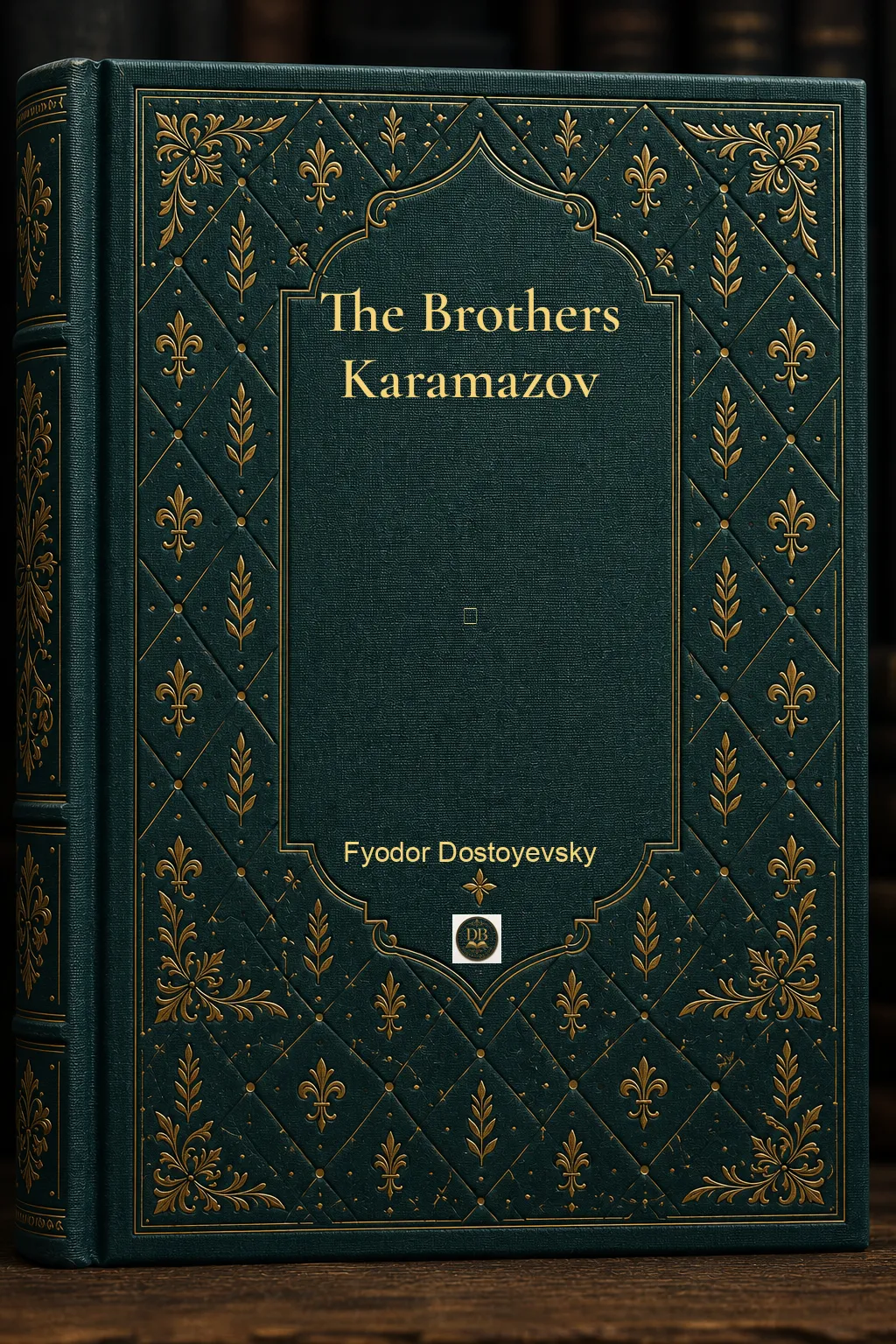
The Brothers Karamazov
Dostoyevsky's final and greatest novel — a profound exploration of faith, doubt, free will, and the eternal conflict between good and evil in the human soul.
| Author | Fyodor Dostoyevsky |
| Published | 1880 |
| Genre | Philosophical novel, murder mystery, family drama |
| Chapters | 96 (in 12 books) |
| Setting | 19th-century Russia — the town of Skotoprigonyevsk |
| Significance | Widely considered the greatest novel ever written |
📖 The Story
The novel opens with the Karamazov family in crisis. Fyodor Karamazov, a debauched and cynical father, has neglected his three sons. Dmitri, the eldest, is a passionate ex-army officer consumed by his rivalry with his father over both money and the beautiful Grushenka. Ivan, the intellectual, is a rationalist tormented by the problem of evil — if God does not exist, is everything permitted? Alyosha, the youngest, is a novice monk who seeks peace and spirituality under the guidance of the revered Elder Zosima.
When Fyodor is found murdered, all three brothers become suspects. The ensuing investigation and trial expose the family’s tangled web of jealousy, greed, and spiritual crisis. Through the legendary Grand Inquisitor parable — Ivan’s poem about Christ returning to Seville during the Inquisition — and the courtroom drama that follows, Dostoyevsky interrogates the nature of belief, the problem of suffering, and whether redemption is possible in a fallen world.
📖 Literary Significance
The Brothers Karamazov (1880) is the crowning achievement of Dostoyevsky’s career and one of the most influential novels ever written. It represents the culmination of his lifelong preoccupation with faith, reason, and the Russian soul.
The novel has shaped literature, philosophy, and theology for over a century. The Grand Inquisitor parable has been analyzed by thinkers from Freud to Sartre. The novel’s exploration of free will, suffering, and the nature of evil anticipated existentialism. Its deep psychological insight — each brother represents a different response to the human condition — influenced Freud, Nietzsche, and the entire trajectory of modern literature.
✨ What Makes the DodaBooks Edition Special
This edition presents Dostoyevsky’s masterpiece in a clean, distraction-free format.
Zero Distractions
No ads, no license pages — just the complete text, clean and uninterrupted.
Smart Typography
Curly quotes, em-dashes, proper ellipsis — typeset with care for a premium reading experience.
Book Navigation
Full table of contents with navigation to each of the 12 books and 96 chapters — easily jump between them.
Cleaned & Polished
All Gutenberg boilerplate stripped, consistent formatting throughout the text.
No DRM
You own your copy — read on any device, anytime, forever.
Instant Download
EPUB format included, delivered instantly after purchase.
📖 The Story in Full: Four Brothers and a Father
At the center of the novel is Fyodor Pavlovich Karamazov, a coarse, lecherous landowner who has spent a lifetime neglecting his children and squandering his money. He has three legitimate sons by two marriages — Dmitri (Mitya), the eldest, a passionate former army officer given to grand gestures and debts; Ivan, the intellectual, a brilliant and bitter rationalist; and Alyosha (Alexey), the youngest, a gentle novice monk whose faith anchors the whole book. There is a fourth figure at the edges: Smerdyakov, the family’s surly epileptic servant and rumored illegitimate son, treated by everyone as a lackey.
The plot is a murder mystery, but never a simple whodunit. Dmitri quarrels with his father over money and over the beautiful Grushenka, a coquette both men pursue. Believing Dmitri has killed Fyodor, the authorities arrest him at a village inn. The trial that follows — one of the great courtroom scenes in literature — lets Dostoyevsky stage his deepest arguments in public. The truth is stranger and more terrible than parricide: Smerdyakov confesses to Ivan shortly before hanging himself, identifying Ivan’s philosophy — if God does not exist, everything is permitted — as the real accomplice in the crime.
Every brother, Dostoyevsky insists, is implicated — Dmitri for the violence in his heart, Ivan for the ideas he unleashed, even the absent Alyosha for a responsibility no one can escape. All, in the novel’s famous phrase, are responsible for all. That is the sentence the whole book exists to prove.
🏛️ Historical Context: Russia at a Crossroads
Dostoyevsky wrote The Brothers Karamazov between 1878 and 1880, near the end of a life crammed with suffering. He had been sentenced to death as a young man for reading a banned pamphlet, reprieved at the scaffold, and spent four years in a Siberian prison camp followed by years of exile. Those experiences saturate everything he wrote afterward. He wrote, too, amid a country in upheaval: serfdom had been abolished in 1861, Western-style courts and jury trials were newly introduced, and radical students were turning against the Church and the Tsar. The Karamazov family’s collapse is, on one level, Dostoyevsky’s portrait of a Russia whose old bonds — faith, family, and community — were dissolving at once.
The novel also carries biographical pain. Dostoyevsky’s own father, a violent and domineering man, had reportedly been murdered by his serfs in 1839, and the theme of the son who wishes his father dead was personal before it was philosophical. While he worked on the book, his three-year-old son Alyosha died, and the grief is written into the chapters describing Zosima’s death. The novel is imagination built from the wreckage of a life.
🔥 Faith and Doubt: The Novel’s Great Argument
The intellectual heart of the novel is Ivan’s rebellion against a world he finds unbearable. His chapter-long prose poem, The Grand Inquisitor, imagines Christ returning to Seville during the Spanish Inquisition, where the Grand Inquisitor arrests him and explains why the Church does not need him: people are too weak for the terrible freedom Christ offers, and they want instead miracle, mystery, and authority. The famous line — “If the suffering children go to heaven, I’d rather return my ticket” — is Ivan’s refusal to accept a universe in which the innocent suffer. This rejection of God in the name of human suffering remains one of the most powerful arguments against faith ever written, and the novel gives it a full hearing.
Against Ivan stands Alyosha, and behind Alyosha stands the elderly monk Zosima, whose teaching is not argument but action: love others actively, in the concrete and the small, and the mystery will take care of itself. Zosima’s answer is deliberately humble — he has no refutation of Ivan’s logic, only a way of living. The novel refuses to declare a winner. Ivan ends the book sick and raving; Alyosha ends it beside a dead schoolboy’s grave, urging the children to be kind and brave. Dostoyevsky offers no certainty, only the choice each brother makes. That unresolved tension — faith and doubt held in honest balance — is why the book has spoken so powerfully to believers and atheists alike, and it links the novel to the same spiritual territory explored in St. Augustine’s Confessions.
🎓 Reading the Novel for the First Time
If the book’s size has put you off, set it aside: the novel rewards you immediately once you know a few things. First, the names. The Karamazov brothers each have two names — Dmitri is Mitya, Ivan is Vanya, Alyosha is Lyosha — and Dostoyevsky’s characters answer to a dozen name variants each; remembering that all the variants point to one person solves most beginner confusion. Second, the structure. The 12 books have a shape — family story, Zosima’s life, the murder, the trial — and the philosophical digressions, especially Book Five’s Grand Inquisitor, are the richest part; read them slowly. Third, expectations. This is not a thriller with a tidy reveal; the mystery is solved before the trial, which is really about guilt and the inability of any court to judge a soul. Read two or three books per sitting and you will finish amazed, not exhausted.
If you are new to Dostoyevsky, many readers find Crime and Punishment a gentler gate — shorter and more focused. Read it first, then come to this, the novel he called his crowning work.
❓ Frequently Asked Questions
Is this the best novel to start with Dostoyevsky?
It depends. The Brothers Karamazov is Dostoyevsky’s most ambitious and accomplished novel, but it is also his longest. Many readers prefer to start with Crime and Punishment (shorter, more focused) and then move to this. Either approach works — both are masterpieces.
What is the Grand Inquisitor?
A legendary chapter within the novel, presented as a poem written by Ivan. It imagines Christ returning to Seville during the Spanish Inquisition, where the Grand Inquisitor arrests him and explains why the Church does not need him. It is one of the most powerful critiques of organized religion and the problem of free will ever written.
Is this a religious novel?
It is a novel about religion — faith, doubt, the problem of evil — but it presents both sides with extraordinary fairness. The atheist Ivan’s arguments are as powerful as the believer Alyosha’s. Dostoyevsky does not give easy answers.
How long does it take to read?
At 1,169 pages, this is a commitment — most readers take 20-30 hours. But the novel is structured in manageable chunks, and the gripping murder plot and philosophical depth make it impossible to put down.
Who actually murdered Fyodor Karamazov?
Smerdyakov, the servant and rumored illegitimate son. He strangles Fyodor with a makeshift pillow, steals the money, and later confesses to Ivan before hanging himself — explaining that Ivan’s “everything is permitted” philosophy inspired the act. The court, unaware of this confession, convicts Dmitri instead.
Do I need to read Russian history before starting?
No. The novel builds its 19th-century Russian world from the inside; any detail you need — the trial system, the monastic culture, the class structure — is either dramatized or explained by the characters. A little context enriches the experience, but nothing is required to enjoy or understand it.
Why is the novel divided into twelve books?
Dostoyevsky serialized the novel over two years, and the twelve books gave clean installments plus a tight dramatic shape: family setup, Zosima’s teaching, the murder, the trial. Each book reads almost as a novella, keeping the huge novel navigable.
📚 Related Articles
📖 Read the Greatest Novel Ever Written
The Brothers Karamazov is one of the towering achievements of world literature — a profound exploration of faith, doubt, free will, and the eternal conflict between good and evil. The DodaBooks edition presents Dostoyevsky’s masterpiece in a clean, distraction-free format:
- ✅ Complete 12-book / 96-chapter text — every word of the classic
- ✒️ Smart typography — curly quotes, em-dashes, proper ellipsis
- 📜 Full table of contents with book and chapter navigation
- 🔒 DRM-free — read on any device, anytime
- 📥 Instant download — EPUB format