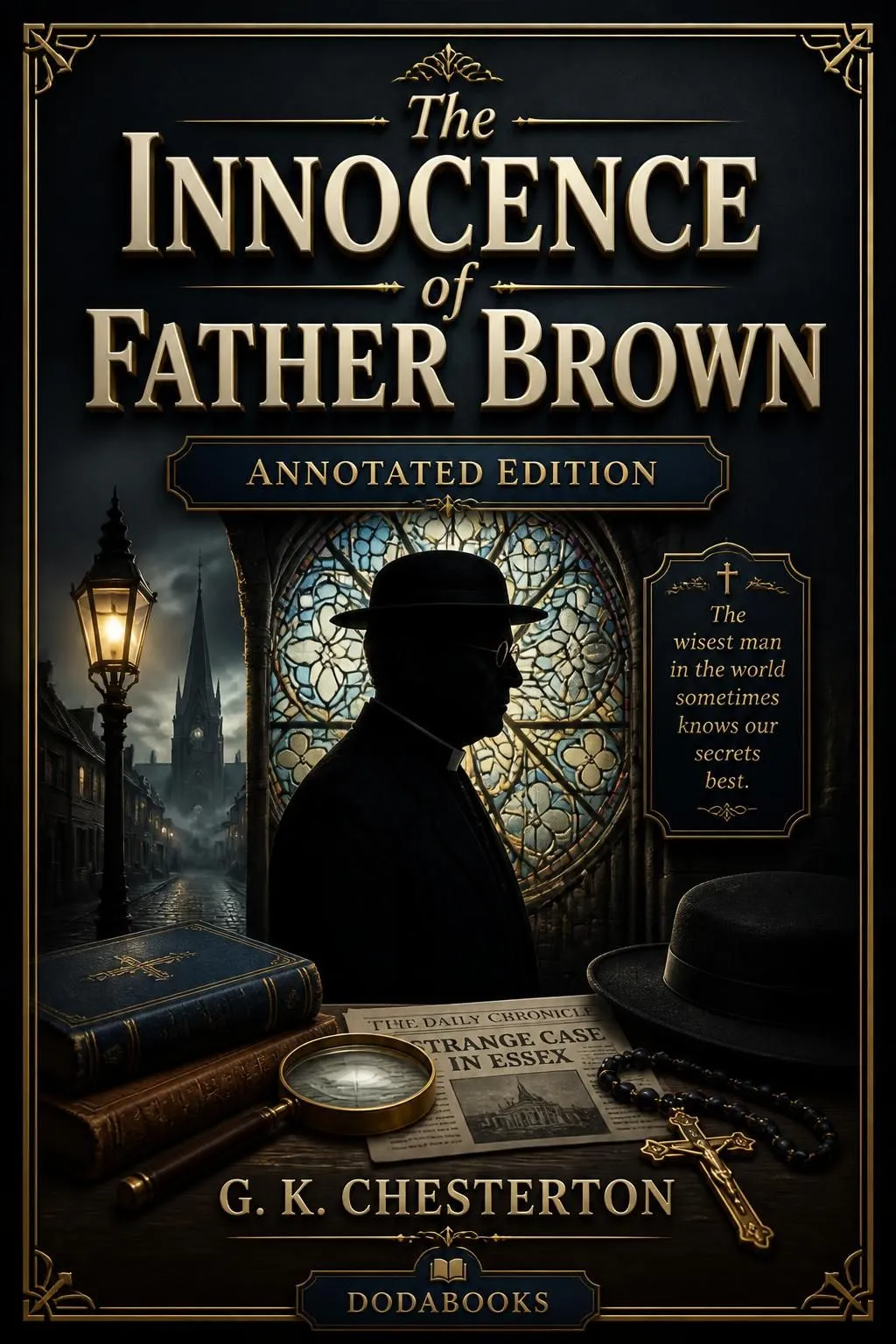
G. K. Chesterton’s The Innocence of Father Brown is the 1911 collection that gave detective fiction one of its strangest and most beloved heroes — a round, untidy parish priest who solves murders not with logic but with a profound understanding of evil. Twelve cases, each built like a paradox. This guide covers the stories, the method, and the DodaBooks Annotated Edition.
⛪
The Innocence of Father Brown
A priest who looks like a potato walks into a crime scene. Everyone thinks he is the obvious suspect. And then — quietly — he solves it, because he knows exactly how far a good man can fall. Twelve of the most paradoxical mysteries in fiction.
| Author | G. K. Chesterton |
| Published | 1911 |
| Genre | Detective stories, philosophical mystery |
| Stories | 12 cases |
| Best For | Mystery fans, ADCs, readers of paradox & wit |
| Reading Time | 6–8 hours |
⛪ The Priest Who Almost Never Misses
Father Brown is a country priest with a round face, spectacles, and an umbrella he doesn’t really need. He appears in a village; a murder follows him like a shadow; the genius detective on the scene is magnificently, catastrophically wrong; and Brown, almost apologetically, solves it — usually by saying something like: “That is the trick. I do not look as if I had ever been in a criminal court.”
The twist is that this is the detective’s whole method. Brown is not brilliant in the Holmesian way. He is brilliant because he has spent his life listening to confessions. He knows what a person will hide, what a person will pay, and above all what a person will not do — which lets him recognize the invisible enemy that the police detectives, who only know crime from the outside, cannot imagine. “I know the man you mean,” he tells one baffled constable. “I have seen him in the confessional.”
“His head was most laudably unobtrusive: he was not the sort of man who gets into trouble with the police.”
Paradox and the Perfect Crime
Each of the twelve stories is a machine built out of a single paradox, usually Cranky Chestertonian: the treasure that is not where it is hidden, the murder that has no murderer, the criminal seen by ten witnesses. Locate the “perfect crime” and Chesterton gleefully dismantles its perfection. That structure — premise, misdirection, twist — is the DNA of every modern mystery short story, and Chesterton is among its greatest practitioners.
Because he is writing theology as much as logic, every story is also about something bigger: guilt, pride, mercy, justice. No other detective in the genre carries the moral freight of Father Brown — and none rewards re-reading quite like these.
🔍 The Annotated Layer
Annotation Cards
Visible, color-coded notes beside each paragraph — read as you go.
The Method
How Brown solves each case — and how he differs from every other detective.
Faith & Sin
The theology woven quietly into every clue and character.
Victorian & Edwardian World
London, Europe, class, and crime in Chesterton's time.
Puzzle Craft
The misdirections and red herrings — mapped before the reveal.
Reading Lenses
Chapter guides, a Themes essay, and the full annotation index.
📘 Annotated Insight — The Detective Who Understands Criminals
In “The Blue Cross,” Brown’s rival a master criminal near the edge of a clever trick and says that he knows his exact next move. The annotations show the point: Holmes reads details, Brown reads desires. Where Sherlock detects the world’s surface, Father Brown detects what the world is hiding from itself — which is why Chesterton’s detective predicts crimes instead of merely solving them.
🕰️ The Legacy: Every Modern Detective Owes Him
The Father Brown stories influenced cozy mystery, the “unlikely detective” trope, and the entire Golden Age. Jorge Luis Borges collected the books and called Brown’s friend “the man who knows.” Agatha Christie, Dorothy L. Sayers, and even Poirot stand in their shadow. And in a century dominated by emotionless deduction, Father Brown remains the strangest challenge of all: the detective who solves crime by knowing evil from the inside, without ever committing it.
🏛️ Chesterton and the Edwardian Moment
To hear the stories at full power, it helps to know the man reading beside you. G. K. Chesterton was, in 1911, at the height of a literary stardom we have no modern equivalent for — a vast journalist, essayist, poet, and novelist whose essays appeared everywhere, whose opinions were argued in every drawing room, and whose sheer bulk made him a walking cartoon of Englishbookishness. He wrote the Father Brown stories partly to entertain, but also to fight a war: against the fashionable scientific materialism of his age, which liked to explain every human mystery away. Chesterton’s detective stories are the propaganda wing of his philosophy.
That polemic is quietly everywhere in the collection. The master criminal in “The Blue Cross” believes in a world without sin — and it is precisely his belief that betrays him. The paradoxes are Chesterton’s way of insisting that the universe runs on moral law, that free will and sin are real, and that a man who denies them is, ironically, the easiest man in the world to predict. You do not need to share the theology to enjoy the puzzles — but the moment you see that every mystery is a disguised argument, the stories get immeasurably richer.
✝️ The Theology Behind the Puzzles
Father Brown is a priest first and a detective second, and Chesterton never lets that slip. When Brown says he knows a criminal “in the confessional,” he is making a technical claim: a priest has heard what people do when they believe no one can see. That vantage point gives Brown something no logic-based detective possesses — an empirical map of human weakness.
This is why Brown so often solves the case by understanding the sin, not the signs. He can reconstruct a jewel thief’s lies because he has listened to such lies before. He can imagine an otherwise respectable villain committing a grotesque crime because he has heard worse. The stories repeatedly pit him against a self-styled “perfect crime,” and his answer is always the same: perfection is a fantasy because no criminal is perfectly rational, and no crime is perfectly clean of motive. He is the anti-Holmes, in the most productive sense — where observation reads surfaces, Brown reads the conscience underneath, and that is why his conclusions feel like recognitions rather than tricks.
🧭 How to Read Father Brown
Each of the twelve tales is short enough to read in a single sitting, which makes them ideal for one story a night. On a first pass, try to solve each puzzle before the reveal — but be warned that the method will rarely help you, because the clues are moral rather than material. On a second reading, the pleasure inverts: now you watch Chesterton, tracking how he hides his priest in plain sight, how he makes the impossible possible, and how he trusts his reader to laugh at his narrator’s pompous misdirection. Pay special attention to “The Blue Cross” (the perfect introduction) and the collection’s quieter domestic cases, where the “crime” is a broken heart rather than a broken lock. If you enjoy the paradox-engine, The Problem of Cell 13 gives you the purest logic-based counterpart of the era, while The Woman in White and Lady Audley’s Secret show the sensation tradition Chesterton was quietly reshaping — and The Green Mummy sits neatly in between.
Cartography of sin, misdirection, and divine mercy — all disclosed in the notes.
❓ Frequently Asked Questions
Are the Father Brown stories about religion coming-of-age readers would enjoy?
They’re mysteries first; the theology is carried lightly inside the puzzles. Plenty of secular detective fans adore them. If you like paradox and solution twists, you’ll be at home.
Is the style very old-fashioned?
Chesterton’s English is ornate, witty, and dense with ideas — part of the pleasure. The annotations smooth the difficult passages and translate references, so the wit stays without the stumbling.
How many stories make up the book?
Twelve complete tales, from “The Blue Cross” to “The Honor of Israel Gow” — each a model of the short detective form.
Is Father Brown a serious priest or a parody of detective priests?
Both, which is why he works. Chesterton genuinely believes that a man who listens to confessions knows more about criminals than any criminologist — and he wrote twelve stories proving it.
Are there more Father Brown books after this one?
Yes — Chesterton wrote five volumes. The Innocence is the first and the best-known, and it’s the perfect introduction.
How does Father Brown differ from Sherlock Holmes?
Holmes reads surfaces with trained observation; Brown reads consciences with lived knowledge. Chesterton built his priest deliberately against the logic-detective tradition — Brown rarely examines footprints, and he never needs to, because he already knows what kind of person would take that path.
Which story should I start with?
“The Blue Cross” — it’s the opening tale, it introduces Brown and his friend Flambeau in a single chase, and it contains the purest example of Chesterton’s trick of out-thinking the “perfect” criminal.
Is this a good first detective book for a new reader?
Very. The stories are self-contained, short, and built on a single dazzling idea each, so there’s almost no learning curve. You’ll know within two stories whether Chesterton’s particular flavor of paradox is yours.
📚 Related Articles
⛪ Solve Besides the Round Little Priest
Read the twelve stories that redefined the detective in the age of paradox:
- ✅ Complete 1911 text — all twelve cases
- 🗂️ Passage-specific annotation cards — visible, color-coded
- 🧠 The method decoded — why Brown can’t be beaten
- ⛪ The theology behind the puzzles explained
- 🔒 DRM-free — read on any device
- 📥 Instant download — EPUB format