Ann Radcliffe’s The Mysteries of Udolpho is the defining Gothic romance of the 18th century — a tale of terror, suspense, and a young woman trapped in a dark castle in the Apennines. Published in 1794, this five-volume novel captivated readers across Europe and established the conventions that would define Gothic fiction for generations.
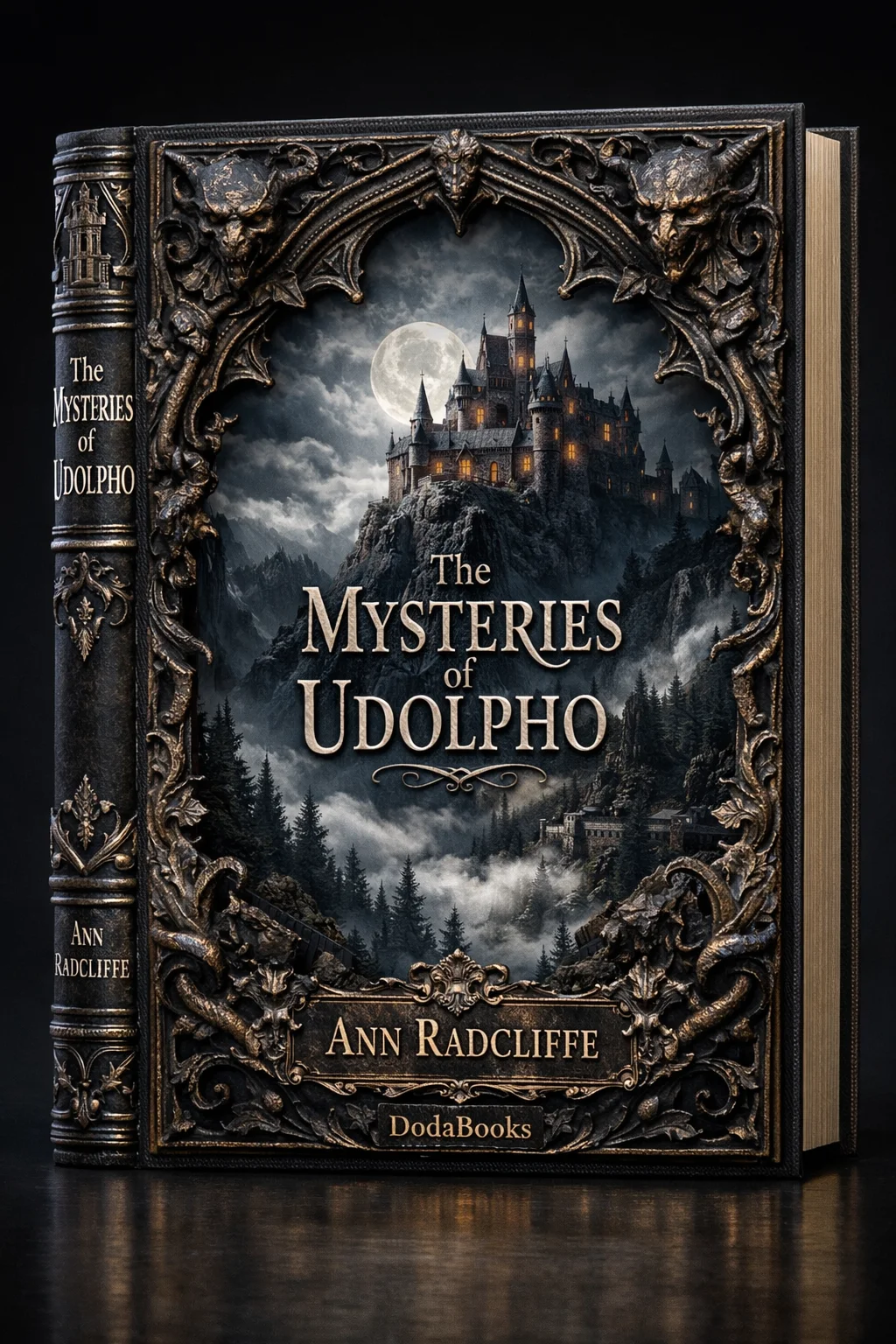
🏰
The Mysteries of Udolpho
The Gothic romance that defined a genre — terror, suspense, and a young woman's struggle for survival in a dark Italian castle.
| Author | Ann Radcliffe |
| Published | 1794 |
| Genre | Gothic novel, romance, mystery |
| Chapters | 58 across 5 volumes |
| Setting | 1584 France and Italy — châteaux, Apennines, and the Castle of Udolpho |
| Legacy | The most famous Gothic novel of the 18th century |
📖 The Story of Emily St. Aubert
The novel follows Emily St. Aubert, a young French woman of sensitivity and virtue, through a series of trials that test her courage, faith, and resolve. The story begins at La Vallée, Emily’s beloved family home in the south of France, where she lives in contentment with her father and mother. This pastoral idyll is shattered by the death of her mother and the subsequent decision by her father to travel.
On their journey, Emily meets Valancourt, a handsome and romantic young man with whom she falls deeply in love. But tragedy follows: Emily’s father dies, and she is left in the care of her aunt, Madame Cheron, who quickly marries the sinister Italian nobleman Montoni. Emily is dragged away to Italy and into the terrifying confines of the Castle of Udolpho.
Within Udolpho’s dark walls, Emily encounters mystery and horror. Locked rooms hide terrifying secrets. Montoni terrorizes his wife and prisoners alike. Strange sounds echo through the corridors at night. Emily must navigate the castle’s dangers while maintaining her virtue and her hope of eventually reuniting with Valancourt. The famous “terrible picture” — a scene Emily glimpses behind a black veil — remains one of Gothic literature’s most iconic moments.
As the novel unfolds through its five volumes, Radcliffe takes Emily on a journey across France and Italy, through châteaux and convents, past bandits and noblemen. The story builds toward revelations about the mysterious crimes and conspiracies that have haunted Emily since childhood, ultimately rewarding her virtue and resilience with justice and love.
🎭 Key Characters
Emily St. Aubert
The heroine of the novel — sensitive, virtuous, and courageous. Emily endures the loss of both parents, imprisonment in a Gothic castle, and countless dangers, yet maintains her moral integrity throughout. She embodies the ideal of feminine virtue that Radcliffe championed, but her emotional depth and intelligence make her far more than a passive heroine.
Montoni
The villain of the piece — a charismatic Italian nobleman who marries Madame Cheron for her fortune and subjects Emily to terror and intimidation within the walls of Udolpho. Montoni is a complex figure: ruthless and violent, yet possessing a dark magnetism that makes him compelling rather than merely monstrous.
Valancourt
Emily’s beloved — a romantic young Frenchman of good family but modest means. Valancourt represents the ideal of sincere, passionate love. His devotion to Emily is tested by separation and misunderstanding, but his essential goodness endures.
Annette
Emily’s cheerful and talkative maid, who provides much of the novel’s lighter moments. Annette’s gossip, fears, and comic reactions to the supernatural events at Udolpho offer a counterpoint to Emily’s more serious temperament.
📖 Literary Significance
The Mysteries of Udolpho was a publishing phenomenon. When it appeared in 1794, it became the most popular novel in England, read by everyone from fashionable society to the working class. Jane Austen parodied its influence in Northanger Abbey, where the young Catherine Morland imagines Udolpho-like terrors in the domestic setting of a Bath boarding house — proof of how deeply the novel had penetrated popular consciousness.
Radcliffe essentially created the template for Gothic fiction. Her use of atmospheric description — crumbling castles, moonlit landscapes, mysterious locked rooms — established conventions that persist in horror fiction today. Her technique of the “explained supernatural” — where seemingly supernatural events are eventually given rational explanations — distinguished her work from mere sensationalism and gave her novels a sophistication that elevates them above their contemporaries.
The novel’s influence extends far beyond literature. The image of the young woman trapped in a mysterious castle has become a universal cultural motif, appearing in films, television, and art. Radcliffe’s exploration of the sublime — the mixture of beauty and terror that characterizes the natural world — anticipated the Romantic movement and influenced poets as well as novelists. The Mysteries of Udolpho remains the essential text of the Gothic tradition, as readable and atmospheric today as it was in 1794.
✨ What Makes the DodaBooks Edition Special
This is the original 1794 text, carefully prepared for modern readers without distractions or clutter.
Zero Distractions
No ads, no license pages, no project boilerplate — just the original novel, clean and uninterrupted.
Smart Typography
Curly quotes, em-dashes, proper ellipsis — typeset with care for a premium reading experience.
Chapter Navigation
Full table of contents with back-to-chapter links in every section — jump between all 58 chapters effortlessly.
Cleaned & Polished
All Gutenberg boilerplate stripped, consistent formatting throughout the text.
No DRM
You own your copy — read on any device, anytime, forever.
Instant Download
EPUB + PDF + AZW3 formats included, delivered instantly after purchase.
🏛️ The Woman Behind the Gothic
Ann Radcliffe was something of a phenomenon in her own right. Born in 1764 and largely self-educated, she began publishing Gothic romances in 1789 and within a decade had become the best-selling novelist in England — all while remaining famously reclusive. Her reputation was so enormous that her death in 1823 drew long newspaper obituaries, and her celebrity helped legitimize the novel as a respectable literary form at a time when fiction was still considered frivolous.
Radcliffe understood that the terror of her novels came not from monsters but from anticipation. She carefully controlled what the reader saw, withholding explanations and letting the imagination do the frightening work. Her famous technique of the “explained supernatural” — in which seemingly ghostly events are eventually given rational explanations — earned her both praise and criticism. This balancing act between thrills and reason is exactly why her work elevated the Gothic rather than wallowing in it.
🧩 Why Udolpho Is the Quintessential Gothic Novel
Many critics call The Mysteries of Udolpho the novel that codified the Gothic genre, and the claim is easy to defend. Nearly every element we now associate with Gothic fiction appears here in fully developed form: the isolated and imperiled heroine, the brooding and oppressive castle, the sinister villain, the hidden chambers, the mysterious veiled picture, and the atmospheric landscapes of mountains and moonlight.
The novel was also a landmark because of its scale and sophistication. Radcliffe wove poetry into the narrative, arranged elaborate set-pieces of suspense, and balanced the claustrophobia of the castle with the sublime grandeur of the natural world. It is a richer, more literary experience than much of the Gothic that followed. Readers who enjoy Radcliffe’s blend of romance and dread will find kindred spirits in The Monk, which pushes the Gothic toward melodrama, and in the later Victorian hauntings of Dracula and Jane Eyre, which owe a clear debt to Udolpho’s architecture of secrets.
🧭 Tips for a First-Time Reader
Approaching a five-volume eighteenth-century novel can feel daunting, but The Mysteries of Udolpho is friendlier than its length suggests. Read it in the volumes, pausing between them as eighteenth-century readers did. The chapters are short, and Radcliffe keeps individual scenes tight even as the overall narrative stretches on. You can skim the scattered poems and lose nothing from the plot.
Most importantly, let yourself stay confused for a while. The novel deliberately obscures what is real and what is imagined, and part of the pleasure is being kept off balance. Trust that Radcliffe will eventually supply the rational explanations her “explained supernatural” promises. A slow, patient read rewards you far more than a rushed one.
❓ Frequently Asked Questions
Is The Mysteries of Udolpho a romance or a horror novel?
It is both, which is central to its status as the defining Gothic romance. The novel pairs a love story between Emily and Valancourt with sustained terror inside the Castle of Udolpho. The romance gives the horror emotional stakes, and the horror gives the romance its sense of danger — the two are inseparable.
Does Emily ever actually face supernatural danger?
No. Every seemingly supernatural event in the novel is eventually given a rational explanation, a technique known as the "explained supernatural." The terror is real but the causes are natural — hidden rooms, concealment, and the power of suggestion. This rationalism is one of the features that distinguishes Radcliffe's work from the more lurid Gothic of her imitators.
Should I read Udolpho before Northanger Abbey?
It is not required, but it greatly enriches Austen's parody. *Northanger Abbey* assumes readers are familiar with Udolpho's tropes — the candlelit corridors, the locked chest, the imagined horrors in an ordinary house. Reading Radcliffe's novel first makes the jokes land much harder.
Is The Mysteries of Udolpho difficult to read?
While the five-volume structure and 18th-century prose style may seem daunting, the novel was written for a popular audience and moves at a brisk pace. The short chapters and constant suspense keep the story engaging. Modern readers often find it surprisingly accessible.
Is this the book parodied in Northanger Abbey?
Yes. Jane Austen’s Northanger Abbey pokes fun at readers who confuse Gothic fiction with reality. Catherine Morland imagines Udolpho-like horrors in an English boarding house, demonstrating how deeply Radcliffe’s novel had influenced popular imagination.
Are there genuinely supernatural elements?
Radcliffe is famous for her “explained supernatural” technique. Events that appear ghostly or horrifying are eventually given rational explanations. The novel creates an atmosphere of terror while ultimately affirming a rational worldview.
How long does it take to read?
The complete novel spans approximately 600–650 pages. Most readers take several days to a week to finish, reading a volume or two per sitting. The episodic structure makes it easy to pause and resume.
Why is this novel considered so important?
The Mysteries of Udolpho essentially created the Gothic novel as a genre. Its conventions — the isolated heroine, the mysterious castle, the sinister villain, the atmosphere of terror — became the foundation for hundreds of subsequent works and continue to influence horror fiction today.
📚 Related Articles
📖 Read the Original Classic
The Mysteries of Udolpho is the Gothic novel that started it all. The DodaBooks edition preserves the complete original text in a clean, distraction-free format:
- ✅ Complete 58-chapter novel — every word of the 1794 edition
- ✒️ Smart typography — curly quotes, em-dashes, proper ellipsis
- 📜 Full table of contents with chapter navigation
- 🔒 DRM-free — read on any device, anytime
- 📥 Instant download — EPUB + PDF + AZW3 formats