M. G. Lewis’s The Monk: A Romance is one of the most audacious and controversial novels ever written. Published in 1796 when Lewis was just twenty years old, it tells the harrowing story of Ambrosio, a virtuous monk whose descent into lust, murder, and damnation shocked readers then and retains its power to disturb today.
😈
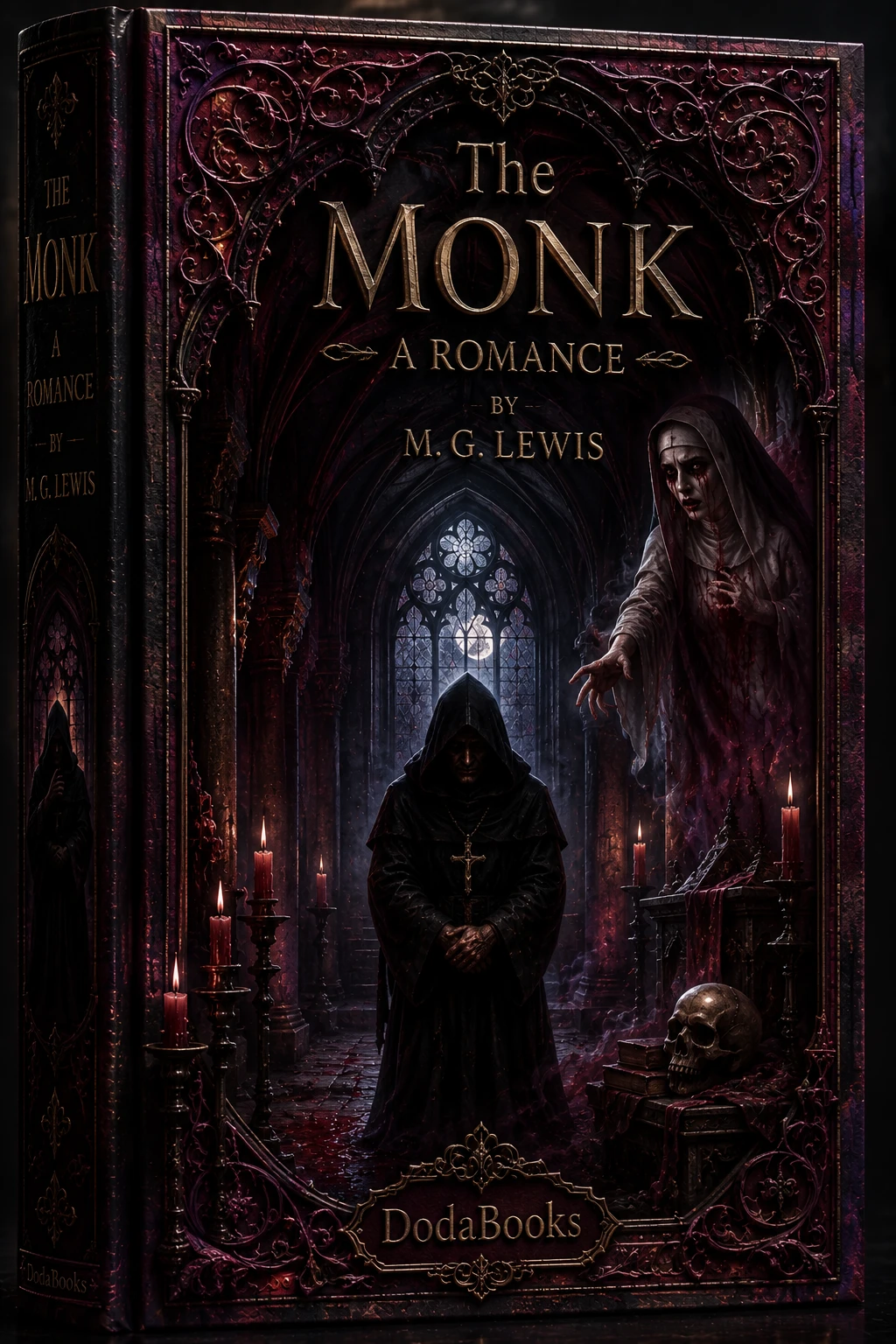
The Monk
A pious monk's descent into lust, murder, blackmail, and a pact with the devil — the most scandalous Gothic novel of the 18th century, written by a twenty-year-old.
| Author | M. G. Lewis (Matthew Gregory Lewis) |
| Published | 1796 |
| Genre | Gothic fiction, horror, romance |
| Chapters | 12 |
| Setting | 18th-century Madrid — the Capuchin monastery, the Cathedral, the dungeons of the Inquisition |
| Legacy | One of the most controversial novels of its age; a foundational work of Gothic horror |
😈 The Story
Ambrosio is the most revered monk in Madrid — celebrated for his piety, his eloquence, and his unassailable virtue. Orphaned as an infant and raised within the monastery, he has never known temptation — until the day a mysterious novice named Matilda arrives.
Matilda, it transpires, is a woman who has disguised herself as a monk to be near Ambrosio, whom she has loved from afar. She awakens desires Ambrosio has never felt, and his resistance crumbles. They become lovers, and Ambrosio begins a descent into sin that accelerates with terrifying speed.
From lust, Ambrosio moves to blackmail, then to murder. He rapes and kills the innocent Antonia, who is revealed to be his own sister. To escape punishment, he makes a pact with the devil — only to discover that his salvation was never as secure as he believed, and that damnation is not the abstract concept he once preached about.
The novel weaves a parallel plot involving Don Raymond and the Bleeding Nun — a classic Gothic subplot of haunted castles, family secrets, and supernatural terror — that connects to Ambrosio’s story in the final, devastating chapters.
🎭 Key Characters
Ambrosio
The monk of the title, Ambrosio begins as a paragon of virtue — admired, respected, seemingly incorruptible. His fall is all the more terrifying for its methodical progression. Each sin makes the next easier, and his capacity for self-deception grows with each transgression. He is one of literature’s great studies of hypocrisy and moral collapse.
Matilda
Matilda is a brilliant and ambiguous figure — a woman who loves Ambrosio enough to damn herself for him. She is intelligent, seductive, and ultimately revealed to be a servant of Satan. Whether she truly loves Ambrosio or merely tempts him as part of a diabolical plan is left deliberately unclear.
Antonia
The innocent young woman who becomes Ambrosio’s victim. She is pure, devout, and trusting — qualities that make her destruction all the more horrifying. Her fate is the novel’s most shocking element and the clearest sign that Lewis is writing something far darker than conventional Gothic fiction.
Don Raymond
A nobleman whose story — including his encounter with the legendary Bleeding Nun — forms a major subplot. His romance with Agnes, Antonia’s aunt, provides a counterpoint to Ambrosio’s destructive lust.
📖 Literary Significance
The Monk caused a scandal on publication. Readers were shocked by its explicit sexuality, its savage criticism of religious hypocrisy, and its unflinching portrayal of evil. The novel was condemned from pulpits, attacked in reviews, and eventually bowdlerized in a second edition. But it was also an immediate sensation, making its teenage author a literary celebrity.
The novel stands at the crossroads of the Gothic tradition. It takes the atmospheric terror of Ann Radcliffe and adds a psychological depth — and a willingness to depict evil — that Radcliffe never approached. Ambrosio’s fall is not caused by ghosts or supernatural forces (at least not at first) but by his own choices, rationalized step by step.
Lewis’s influence can be traced through Byron, the Shelleys, Poe, and Lovecraft. The novel’s unflinching depiction of corruption and damnation anticipates the darker currents of Romanticism, and its psychological depth looks forward to Dostoevsky. It remains, as the critic Mario Praz wrote, “the most Gothic of all Gothic novels.”
✨ What Makes the DodaBooks Edition Special
This is the original 1796 text, carefully prepared for modern readers without distractions or clutter.
Zero Distractions
No ads, no license pages, no project boilerplate — just the original novel, clean and uninterrupted.
Smart Typography
Curly quotes, em-dashes, proper ellipsis — typeset with care for a premium reading experience.
Chapter Navigation
Full table of contents with back-to-chapter links in every section — jump between all 12 chapters effortlessly.
Cleaned & Polished
All Gutenberg boilerplate stripped, consistent formatting throughout the text.
No DRM
You own your copy — read on any device, anytime, forever.
Instant Download
EPUB format included, delivered instantly after purchase.
🔥 The Descent, Step by Step
Lewis maps Ambrosio’s fall with terrifying precision. It begins as vanity and curiosity about the mysterious novice Matilda, escalates into a sexual obsession he refuses to name, and turns to sacrilege in a pilgrimage church. From there he wants Antonia, and he is willing to use blackmail, the machinery of the Inquisition, and finally murder to get her — killing her mother Elvira when she discovers the plot. Each step is rationalized, and each rationalization makes the next sin easier. That psychological accumulation is precisely what makes the horror land: this is not a monster at the start, only a man who declines to stop.
🏛️ The Scandal of 1796
The Monk appeared in March 1796, and the reviews were ferocious. Samuel Taylor Coleridge attacked its “libidinous minuteness”; pulpits condemned it from across England; and a bowdlerized second edition followed in 1798 with the most explicit passages cut. None of that stopped readers — the novel sold out within months and made its teenage author a celebrity forever known as “Monk” Lewis. The timing mattered too: published in the revolutionary 1790s, when churches and governments felt newly vulnerable, a story about a revered monk unmasked as a monster was read as a political and religious provocation on top of a moral one.
🔮 What The Monk Is Really About
Beneath the demon and the dungeons, The Monk is a novel about hypocrisy — the gap between a public saint and a private monster. Ambrosio’s reputation is his religion; once it is threatened, he will commit any crime to preserve it. Lewis also refuses the comfort of the explained supernatural: here the devil is real, damnation is real, and no rescue arrives. That willingness to let evil swallow the protagonist whole is why the book still unsettles readers. It puts the polite horrors of The Mysteries of Udolpho in sharp contrast — Lewis takes Radcliffe’s toolbox and burns the rulebook.
🧭 Tips for a First-Time Reader
Steady yourself: the violence is explicit even by modern standards. Read Ambrosio’s fall as a psychological case study rather than pure shock, and watch how Lewis alternates the monk’s horror with the Don Raymond subplot — the change of register is deliberate. If you are new to the Gothic, read Radcliffe first for the conventions, then The Monk for their demolition. And if the ending leaves you shaken, that is the intended effect: Dracula and Frankenstein both descend from Lewis’s blend of terror and transgression, and both reward the same patient, slightly unhinged reading mood.
❓ Frequently Asked Questions
Is The Monk really that scandalous?
Yes — even by modern standards, the novel contains disturbing scenes of sexual violence, religious hypocrisy, and explicit supernatural horror. It was condemned from pulpits across England and Lewis was forced to release a bowdlerized second edition. It remains one of the most transgressive novels of the 18th century.
How does it compare to other Gothic novels?
Where Ann Radcliffe’s Gothic novels explain away their supernatural events, Lewis fully embraces the supernatural and adds explicit sexuality and violence. The Monk is darker, more psychological, and more disturbing than novels like The Mysteries of Udolpho. It’s the Gothic tradition stripped of its manners and pretensions.
How long does it take to read?
At 467 pages, most readers finish in 10-14 hours. The novel is divided into 12 chapters, each propelling Ambrosio’s descent further.
Is it true that Lewis wrote this at nineteen?
Yes. Matthew Gregory Lewis was just nineteen when he wrote The Monk, serving as a diplomat in The Hague. He completed the novel in ten weeks. The book made him instantly famous — and notorious — and he was known as “Monk” Lewis for the rest of his life.
What is the Bleeding Nun subplot?
A classic Gothic ghost story within the novel, the tale of the Bleeding Nun involves a haunted castle, a family curse, and the spirit of a nun who was walled up alive for breaking her vows. This subplot connects to the main story through Don Raymond’s relationship with Agnes.
Is The Monk connected to The Mysteries of Udolpho?
Loosely — and openly. Lewis wrote in Ann Radcliffe’s shadow but deliberately refused her rules: where Radcliffe explains away the supernatural, Lewis embraces it. Readers of the 1790s argued about the two novels endlessly, and the rivalry made both bestsellers.
Which edition should I read?
Read the original 1796 text. Lewis’s own bowdlerized 1798 edition cut some of the novel’s most powerful passages, so the earlier text — presented here in full — is the version that scandalized Europe.
What should I read after The Monk?
For more Gothic horror, try Dracula and Frankenstein. For the novel’s harshest spiritual sibling, James Hogg’s Private Memoirs and Confessions of a Justified Sinner; for a lighter companion, The Mysteries of Udolpho.
📚 Related Articles
😈 Read the Original Gothic Masterpiece
The Monk is the most audacious Gothic novel ever written — a harrowing tale of virtue destroyed by desire. The DodaBooks edition preserves the complete 1796 text in a clean, distraction-free format:
- ✅ Complete 12-chapter novel — every word of the 1796 edition
- ✒️ Smart typography — curly quotes, em-dashes, proper ellipsis
- 📜 Full table of contents with chapter navigation
- 🔒 DRM-free — read on any device, anytime
- 📥 Instant download — EPUB format