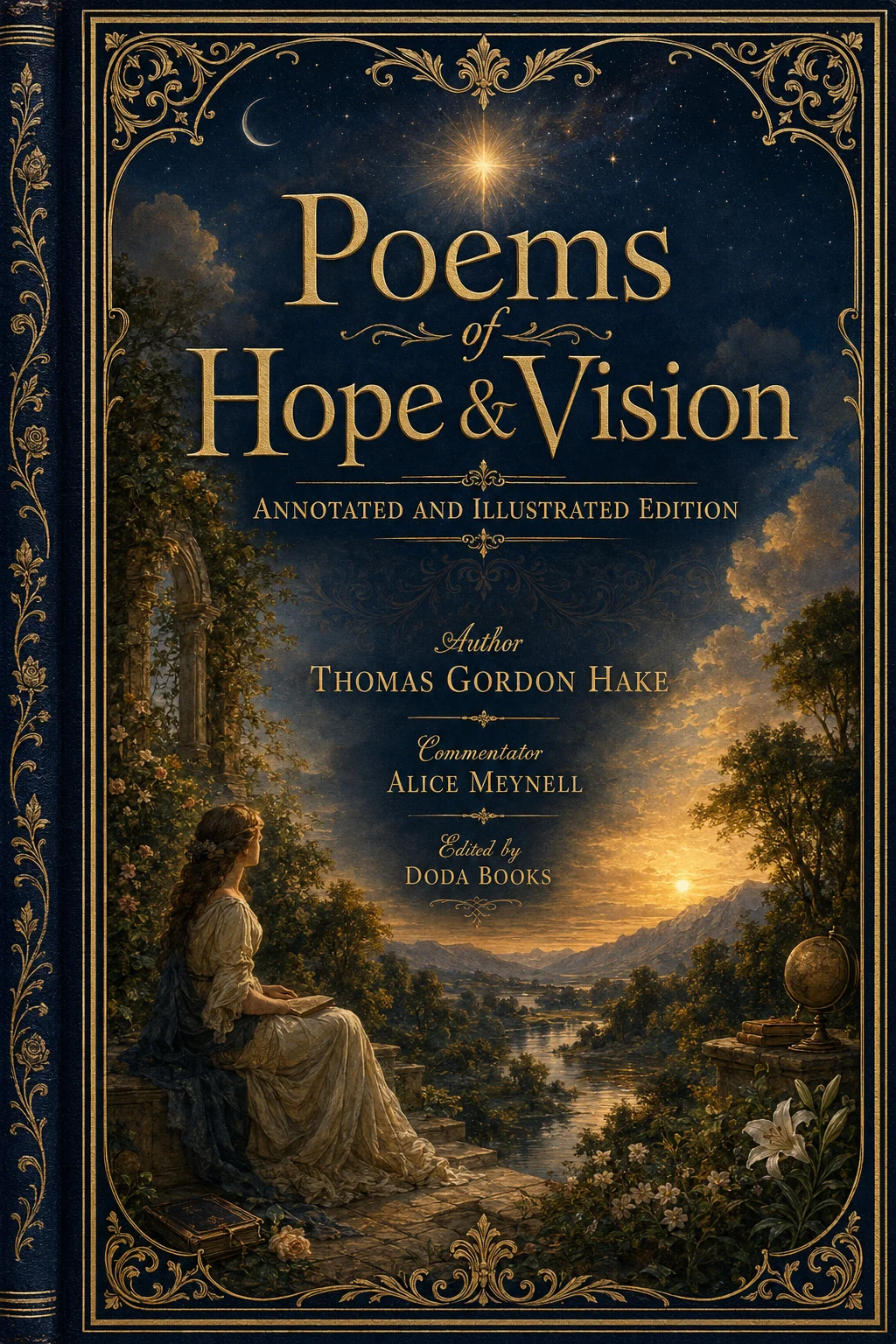
The annotated and illustrated edition of Thomas Gordon Hake’s poems brings 27 selected poems to life with per-poem full-page illustrations, colour-coded annotation cards, vocabulary definitions, historical context, literary analysis, and guided reading questions.
📚
The Poems of Thomas Gordon Hake: Annotated and Illustrated Edition
27 poems with per-poem illustrations, stanza-by-stanza annotations, vocabulary cards, historical context, and close reading analysis.
| Poet | Thomas Gordon Hake |
| Genre | Victorian poetry (annotated edition) |
| Poems | 27 fully annotated |
| Illustrations | Per-poem full-page artwork |
| Features | Vocabulary cards, historical context, analysis, guided reading |
| Best For | Students, teachers, poetry lovers |
🎯 What Makes This Edition Different
Every poem is enriched with a comprehensive set of annotation features designed to deepen your understanding without interrupting the reading experience.
Per-Poem Illustrations
Every poem features a full-page illustration drawn from the original edition, providing visual context for Hake's verse.
Before You Read
Contextual introductions that frame each poem's themes, historical background, and key questions to guide your reading.
Stanza-by-Stanza Annotations
Close readings of every section of each poem, with colour-coded cards for vocabulary, context, and analysis.
Vocabulary Cards
Definitions for archaic and difficult words, ensuring no line remains unclear.
Historical Context
Victorian-era background illuminating Hake's references, the Pre-Raphaelite circle, and the literary world of the 19th century.
A Closer Look
Deeper literary analysis of structure, imagery, and technique — plus "Did You Notice?" observations for attentive reading.
📖 What’s Inside
- 27 poems — with per-poem illustrations drawn from the original edition
- Before You Read — contextual introductions framing each poem's themes and questions
- Stanza-by-stanza annotations — close readings of every section with colour-coded cards
- Vocabulary cards — definitions for archaic and difficult words
- Historical context — Victorian-era background illuminating Hake's references
- A Closer Look — deeper literary analysis of structure, imagery, and technique
- Did You Notice? — key observations for attentive reading
- After the Last Line — reflective questions and connections
- Prefatory Note by Alice Meynell — the celebrated poet and essayist's original introduction
- Professional EPUB3 formatting — styled for clarity on all major e-readers
- No DRM — buy once, download instantly, keep forever
👨⚕️ The Poet and His Circle
Thomas Gordon Hake (1809–1895) was a physician-poet who moved in the inner circle of the Pre-Raphaelite Brotherhood. His close friendship with Dante Gabriel Rossetti — who painted his portrait and wrote a celebrated review of his poetry — places him at the heart of Victorian literary culture.
The annotated edition’s historical context cards explore Hake’s relationships with Rossetti, Swinburne, and Alice Meynell, providing a window into the ferment of Victorian poetry.
🏛️ The Patient Poet: Hake and His Time
Thomas Gordon Hake came to poetry by an unusual road. He trained as a physician in Edinburgh and Glasgow, practised medicine for years, and only turned seriously to verse in middle age. His literary career effectively began in 1839 with a strange, ambitious prose work called Vates, or the Philosophy of Madness — the kind of publication that sinks without trace, except that it was read by a young Dante Gabriel Rossetti, who never forgot it. Rossetti would not actually meet Hake until 1869, but by then he had carried that early enthusiasm for three decades, and it finally ripened into one of the great literary friendships of the Victorian age.
It is worth pausing on what that friendship meant. Rossetti was notoriously reluctant to review poetry — he almost never did it — yet he made an exception for Hake, publishing reviews that helped place the physician-poet squarely inside the Pre-Raphaelite circle. Hake returned the favour in the darkest way possible: in 1872, in the depths of Rossetti’s personal crisis, it was Hake who took charge of his friend’s care, brought him into his own household, and stayed with him through the recovery. The bond between the two men was at once literary and deeply personal, and the edition’s context cards map that relationship for modern readers.
Hake’s own verse sits naturally beside Rossetti’s influence without ever imitating it. It is contemplative, difficult, and deliberately unfashionable — poetry “for the few,” as one early estimate put it — full of an inward, almost visionary strangeness. A physician’s exactness meets a mystic’s wonder on nearly every page. That combination baffled many contemporaries and fascinates ours, which is exactly why an annotated edition is the right way to meet him: once the tools are in place, the difficulty becomes part of the pleasure.
📚 Meet Victorian poetry's best-kept secret. Twenty-seven poems, fully annotated and illustrated.
Get the Annotated Edition →🏫 Perfect for Students and Poetry Lovers
The annotation system is designed for readers at every level. New readers of Victorian poetry can rely on the vocabulary cards and historical context. Experienced readers will find the stanza-by-stanza analysis and “After the Last Line” reflection questions offer fresh perspectives on Hake’s work.
🎓 How to Read an Annotated Poem
The edition is designed so you never have to choose between moving forward and understanding. Here is a reading method that uses every feature without turning the poems into homework.
First, read the “Before You Read” introduction and let it set the scene — you should not need more than a minute. Then read the poem through once, completely, without stopping. This first pass is about sound and mood: let the rhythm carry you and notice which images catch you. On the second pass, work through the stanza-by-stanza annotations, using the vocabulary cards whenever a word is unclear and the context cards whenever a reference seems historical or biblical. Hake’s diction is the main barrier for modern readers, and the edition removes it methodically.
Keep a notebook or a notes app handy for the “A Closer Look” observations and the “Did You Notice?” moments — this is where reading turns into study. Finally, before you leave a poem, mull over the “After the Last Line” questions. You do not need to write answers; merely forming one in your head is enough to consolidate what you have understood. Readers who follow this loop report that the most difficult poem in the collection opens up by the third read-through, and that each subsequent poem is noticeably easier than the one before.
If you are preparing for an essay or a class, try a different sequence: read the historical context cards for the collection first, then choose three poems that genuinely interest you and read those fully annotated, then compare them. Twenty-seven poems is a short enough span that close-reading a handful is a feasible, satisfying project — and the patterns you notice across poems give you real material for analysis.
✨ Why a Nearly Forgotten Poet Is Worth Your Afternoon
Hake was never a bestseller. His poems reached a small, intensely appreciative circle, and after his death in 1895 they drifted toward obscurity — the common fate of the “poet’s poet.” But obscurity is not the same as mediocrity. Rossetti’s willingness to review him against his own habits is one clue to his quality; the quiet persistence of the readers who discover him is another. Hake represents a Victorian counter-current: verse written not to please the marketplace but to pursue a private vision, with all the strangeness and integrity that implies.
That is what this annotated and illustrated edition exists to recover. By bringing 27 of his poems together with era artwork, vocabulary support, historical context, and close analysis, it treats Hake as seriously as his circle did — and gives modern readers the same courtesy. If you enjoy poetry that rewards effort, this is a discovery waiting to happen.
The experience also highlights what good poetry guidance can do. With a poet as famous as Robert Burns, the challenge is knowing where to begin among hundreds of pieces, which our overview of Burns’s themes and style handles by surveying the whole body of work. With Hake, the challenge is the reverse: the poems are unfamiliar and the diction is hard, so the annotation itself must carry the reader. The Lady of the Lake shows the narrative-poem side of the same century. Between the three, you get a strong sense of how much good guidance can unlock verse that would otherwise remain closed.
❓ Frequently Asked Questions
Are all 27 poems annotated?
Yes. Every poem in the collection includes the full set of annotation features: Before You Read, stanza-by-stanza annotations, vocabulary cards, historical context, A Closer Look, and After the Last Line.
How is this different from the plain edition?
The plain edition offers the clean text with professional formatting. The annotated edition adds per-poem illustrations, colour-coded annotation cards, vocabulary definitions, historical context, literary analysis, and guided reading questions for every poem.
Is this edition suitable for academic study?
Absolutely. The stanza-by-stanza analysis and historical context cards provide depth suitable for university-level study, while the vocabulary cards make the poems accessible to newcomers.
Is the Rossetti portrait included?
Yes. Dante Gabriel Rossetti’s 1872 portrait of Hake is included, along with Alice Meynell’s original prefatory note.
Do I need to know Hake or Victorian poetry before starting?
No. The “Before You Read” introductions, historical context cards, and vocabulary definitions are designed for a first-time reader. You can begin with zero background and build your understanding poem by poem.
How long does it take to work through the collection?
Read straight through, the 27 poems take roughly an evening. Read properly — with annotations, context cards, and reflection questions — the collection sustains several focused study sessions, and the poems repay revisiting across weeks or a term.
Is this Hake's complete works?
No. The edition collects 27 selected poems, curated from the span of Hake’s career, rather than his complete output. The selection is designed for readers new to his verse — every included poem carries the full set of annotation features.
📚 Related Articles
📚 Experience the Annotated Edition
Everything you need to discover and appreciate the poetry of Thomas Gordon Hake:
- ✅ 27 poems with per-poem illustrations
- 📝 Stanza-by-stanza annotations for every poem
- 📖 Vocabulary cards and historical context
- 💡 Close reading analysis and reflection questions
- 🎨 Prefatory note by Alice Meynell and Rossetti portrait
- 📥 Instant download — EPUB + PDF + AZW3 formats