Robert Louis Stevenson’s The Strange Case of Dr. Jekyll and Mr. Hyde is a chilling novella of duality and the battle between good and evil within every human soul. Published in 1886, it gave the English language one of its most enduring phrases and established a template for psychological horror that endures to this day.
🧪
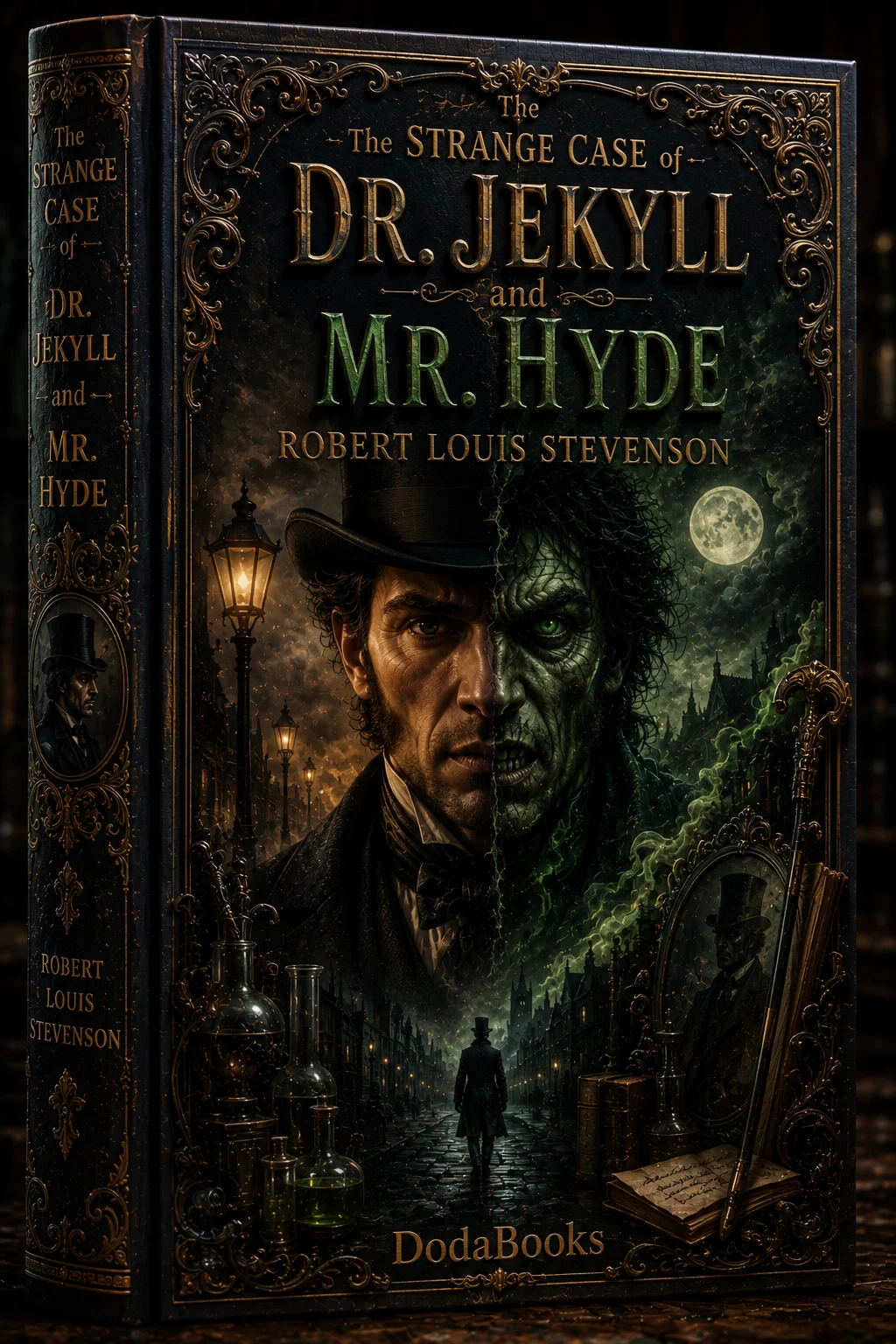
The Strange Case of Dr. Jekyll and Mr. Hyde
A chilling 1886 novella of duality and the battle between good and evil within every human soul — the definitive literary exploration of the divided self.
| Author | Robert Louis Stevenson |
| Published | 1886 |
| Genre | Gothic novella, psychological horror, mystery |
| Chapters | 10 |
| Setting | Victorian London — foggy streets, laboratories, respectable townhouses, and dark alleyways |
| Legacy | The definitive literary exploration of the duality of human nature; “Jekyll and Hyde” entered the English language as a phrase |
🧪 The Story
Mr. Gabriel Utterson, a London lawyer, begins investigating the strange relationship between his old friend Dr. Henry Jekyll and the repellent Edward Hyde. Hyde is Jekyll’s heir, yet Jekyll pays his bills without question and no one can explain the arrangement. When Hyde commits acts of increasing brutality, Utterson’s unease becomes an obsession.
The investigation reveals that Jekyll has been conducting experiments to separate his good nature from his evil impulses. The potion works — but the resulting alter ego, Hyde, is not merely a release of dark impulses. It is a living, growing force that eventually escapes Jekyll’s control entirely.
Stevenson constructs his tale with the precision of a mystery. The truth is revealed gradually, through letters, testimonies, and the horrified observations of those who know Jekyll. The final chapter delivers a revelation that recontextualizes everything that has come before.
🎭 Key Characters
Dr. Henry Jekyll
A respected physician and chemist, Jekyll is outwardly everything Victorian society admires — respectable, generous, and morally upright. But beneath the surface, he harbors desires he considers incompatible with his reputation. His experiment is born not of scientific curiosity but of a desperate need to indulge his darker nature without losing his social standing.
Mr. Edward Hyde
Hyde is Jekyll’s “evil” self, given physical form by the potion. He is small, deformed, and radiates menace. But Hyde is not simply a villain — he is a part of Jekyll, and his increasing power reflects the truth that suppressed desires grow stronger the longer they are denied.
Mr. Gabriel John Utterson
The novel’s moral center, Utterson is a lawyer who embodies Victorian respectability and quiet integrity. His investigation provides the reader’s point of view, and his horror at what he discovers mirrors the reader’s own.
Dr. Hastie Lanyon
Jekyll’s former friend and fellow physician, Lanyon represents the rational, scientific worldview. His confrontation with the truth destroys him — a powerful symbol of what happens when the rational mind encounters something it cannot explain.
📖 Literary Significance
Dr. Jekyll and Mr. Hyde is the definitive literary exploration of the divided self. Stevenson distills a complex philosophical idea — that good and evil coexist within every person — into a taut, gripping narrative that reads like a thriller.
The novella’s power lies in its restraint. Hyde’s evil is never fully described; it is felt rather than seen, experienced through the reactions of those who encounter him. This ambiguity makes the story universal — every reader can project their own understanding of “the Hyde within” onto the text.
The phrase “Jekyll and Hyde” has become part of the English language, used to describe anyone who exhibits a dramatic duality of character. The novella’s influence extends across literature, psychology, and popular culture, and its exploration of repression and desire anticipates Freudian psychoanalysis by more than a decade.
✨ What Makes the DodaBooks Edition Special
This is the original 1886 text, carefully prepared for modern readers without distractions or clutter.
Zero Distractions
No ads, no license pages, no project boilerplate — just the original novella, clean and uninterrupted.
Smart Typography
Curly quotes, em-dashes, proper ellipsis — typeset with care for a premium reading experience.
Chapter Navigation
Full table of contents with back-to-chapter links in every section — jump between all 10 chapters effortlessly.
Cleaned & Polished
All Gutenberg boilerplate stripped, consistent formatting throughout the text.
No DRM
You own your copy — read on any device, anytime, forever.
Instant Download
EPUB + PDF + AZW3 formats included, delivered instantly after purchase.
🏛️ Historical Context: Victorian Hypocrisy
The Strange Case of Dr. Jekyll and Mr. Hyde is inseparable from the Victorian society that produced it. Published in 1886, the novella appeared in a culture obsessed with respectability — a public world of churchgoing, propriety, and unassailable reputation, and a private world of impulses that could not be acknowledged. Stevenson, who had moved in bohemian circles and knew the gulf between social face and private life firsthand, turned this tension into the story’s engine.
The story arrived, too, at a moment of scientific ferment. Darwin’s theories had shaken confidence in humanity’s special place, and the boundaries of the self were being redrawn by new ideas about consciousness and instinct. Stevenson’s genius was to compress an era’s fears — about hypocrisy, science, and the hidden depths of the soul — into a taut, ten-chapter thriller.
🔮 The Big Idea: The Divided Self
At its heart the novella is a meditation on duality — the belief that every person contains both good and evil, and that civilisation is a thin skin stretched over a volatile interior. Jekyll does not create an entirely new monster; he gives physical form to the side of himself he refuses to own. Hyde is not a stranger but Jekyll’s own repressed nature, freed from restraint and growing stronger the longer it is indulged.
Stevenson’s modernity lies in how he refuses a simple good-versus-evil reading. Hyde is not pure evil in a cartoonish sense so much as Jekyll’s desire without conscience — the appetite once it has shed shame. This is why the story has never dated: it is less about supernatural transformation than about the psychological truth that we all suppress parts of ourselves. For another Victorian classic of hidden depths and moral decay, our guide to The Picture of Dorian Gray makes a fascinating companion study.
🧭 How to Read It
Because the novella is short and its structure deliberately mysterious, it rewards paying close attention to who is speaking and what they know. The story unfolds through multiple documents and witnesses — Utterson’s investigation, Lanyon’s account, and finally Jekyll’s confession — and Stevenson withholds information masterfully. Notice that we meet Hyde’s crimes from a distance, described by horrified witnesses, before we ever understand their cause.
A useful approach is to read straight through for the suspense first, then reread the opening chapters with knowledge of the ending. On a second pass, small details — the discrepancy in Hyde’s appearance, Jekyll’s evasions, the omissions in Lanyon’s letter — snap into place. If you enjoy atmospheric Victorian horror, our guide to Frankenstein and the collection Twenty-Five Ghost Stories offer rich neighbouring territory.
📖 Why It Still Matters
More than a century on, “Jekyll and Hyde” remains shorthand for anyone who seems to contain two different personalities, and the novella’s afterlife in film, psychology, and everyday speech is unrivalled. Its insights about repression predate Freud, and its warning about indulging our darker impulses without accountability feels more pressing than ever.
What keeps the book genuinely unsettling is its refusal to moralise. Stevenson never tells us Hyde is evil and Jekyll good; he shows us that they are the same person, and that trying to separate them only makes the suppressed half stronger. That ambiguity asks us to look honestly at the parts of ourselves we prefer not to see.
❓ Frequently Asked Questions
Is Hyde Jekyll's split personality?
Not exactly. Hyde is not a separate personality in the modern psychiatric sense — he is Jekyll’s repressed evil nature given physical form by a potion. Stevenson understood the concept of duality long before Freud formalized it, and the novella’s power comes from the idea that Hyde is not a foreign entity but an integral part of Jekyll himself.
What does the story mean?
The story explores the duality of human nature — the idea that good and evil coexist within every person. It also critiques Victorian hypocrisy: the pressure to maintain respectability can lead people to suppress their true selves, with dangerous consequences. The more Jekyll tries to separate his good and evil natures, the more power Hyde gains.
How long does it take to read?
At 87 pages in the DodaBooks edition, most readers finish it in 2-3 hours. It’s a novella that rewards careful attention — Stevenson’s prose is economical, and every detail carries weight.
Is it based on true events?
While the story is fictional, Stevenson was inspired by real cases of sudden personality change and the scientific debates of his time about the nature of evil. The concept of a potion that separates good from evil draws on both chemistry and moral philosophy.
Why is it considered a classic?
It gave the English language one of its most enduring phrases and established the template for psychological horror. Its exploration of repression, duality, and the hidden darkness within respectable society remains startlingly relevant, and its taut, economical prose makes it one of the most perfectly constructed novellas in the language.
Was Stevenson really inspired by a nightmare?
Yes. Stevenson said the story came to him in a dream, and he famously wrote a first draft in just three days before his wife famously criticised it, leading him to burn it and rewrite. The final version was composed with remarkable speed in late 1885 and published in January 1886, becoming an immediate and enduring success.
Why is Hyde described as small and deformed?
Stevenson uses Hyde’s repulsive, undersized physical form to externalise his moral corruption — the idea that evil shrinks and deforms what it inhabits. Characters consistently struggle to describe exactly why Hyde disgusts them, which was a deliberate choice: Stevenson wanted evil to feel real but fundamentally indescribable.
Does the novella have a happy or tragic ending?
The ending is tragic, though it contains a form of redemption. Realising that Hyde is permanently taking over and that he cannot stop the transformations, Jekyll chooses to take his own life rather than allow his dark half to prevail. It is a bleak, powerful conclusion that leaves no easy moral resolution.
📚 Related Articles
🧪 Read the Original Classic
The Strange Case of Dr. Jekyll and Mr. Hyde is the definitive exploration of the divided self. The DodaBooks edition preserves the complete original text in a clean, distraction-free format:
- ✅ Complete 10-chapter novella — every word of the 1886 edition
- ✒️ Smart typography — curly quotes, em-dashes, proper ellipsis
- 📜 Full table of contents with chapter navigation
- 🔒 DRM-free — read on any device, anytime
- 📥 Instant download — EPUB + PDF + AZW3 formats