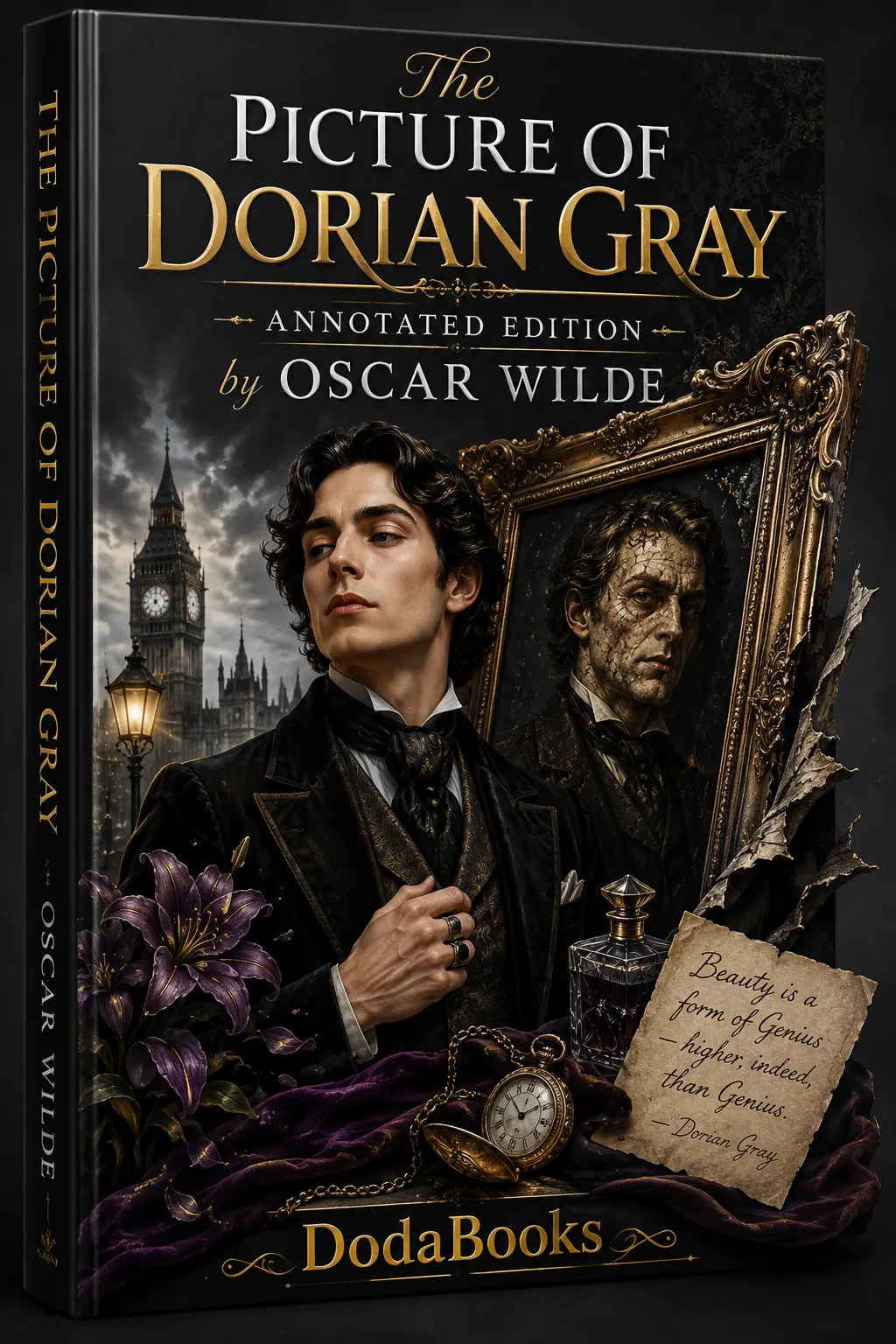
Oscar Wilde’s The Picture of Dorian Gray is the 1890 novel that scandalized London and outlasted its scandal — a gothic fable of beauty, hedonism, and the portrait that ages while its subject stays forever young. This guide covers the plot, the philosophy, and how the DodaBooks Annotated Edition unlocks its layers.
🖼️
The Picture of Dorian Gray
"If it were I who was to be always young, and the picture that was to grow old! For that — for that — I would give everything!" Dorian gets his wish. The portrait absorbs the rot. And the face in the frame becomes a confession.
| Author | Oscar Wilde |
| Published | 1890 (magazine) / 1891 (revised novel) |
| Genre | Gothic novel, philosophical fiction |
| Setting | London high society and the underworld beyond it |
| Best For | Literary fiction readers, Gothic fans, students |
| Reading Time | 6–8 hours |
🖼️ The Story
Basil Hallward, a painter, has made a masterpiece — a portrait of his friend Dorian Gray, a young man of extraordinary beauty. That same day, the cynical wit Lord Henry Wotton plants a poison in Dorian’s ear: beauty and youth are the only things worth having, and both will be stolen from him.
Dorian wishes it were the picture that aged. The picture deforms his life accordingly: he stays twenty-one forever, and the canvas quietly rots — a fleck of cruelty, a line of deceit, then a livid face looking back from the frame. Dorian descends into the beautiful, secret corruption his era made possible — the opium dens, the abandoned loves, the ruined names — while the portrait keeps the ledger.
“You will have to pay for your sins, Dorian. There is nothing in the world so inexorable as the payment of one’s own sins.”
💎 The Aesthetic Sermon
Dorian Gray is famous for its contradictions, and those contradictions are the point. Wilde has Lord Henry deliver the most persuasive speeches in favor of pure, beautiful hedonism in English — then shows what such a doctrine does to a human being. The book both begs to be read as a thrilling fantasy of eternal youth and refuses to let pleasure escape its consequences.
It’s also, devastatingly, a book about the artist: Basil loves the real Dorian, Henry loves the idea of him, and Dorian loves only the image. Every character performs for the portrait of something they want to be — which is exactly Wilde’s anatomy of the era’s obsession with surface, and his own confession hurled back at the critics who had mocked him.
🎭 The Characters Who Make It Work
Wilde’s novel lives or dies on three men and one unforgettable actress, and he makes each of them a facet of the idea at the story’s heart. Dorian Gray is the beautiful young man who becomes the experiment: he is not evil by nature but by choice, gradually trading the open innocence of his early days for the studied cruelty of a man who believes nothing can touch him. Basil Hallward, the painter, is the artist-friend who sees something sacred in Dorian and begs him not to let Lord Henry poison his soul — his earnest devotion makes him the novel’s moral conscience, and his warning goes unheeded. Lord Henry Wotton is the brilliant threat: an aristocrat who treats people as ideas and delivers the epigrammatic seductions — wit, paradox, and cynical charm — that make bad advice sound like wisdom. He never acts himself; he only talks, and his talk is the most dangerous thing in the book.
The fourth figure, Sybil Vane, is the young actress Dorian falls in love with, and she is where cruelty first shows its teeth. The daughter of a scheming mother with no true talent of her own, Sybil is an actress who lives on the stage — until love for Dorian awakens her real self and her performances fail. The moment she is no longer a beautiful fantasy, Dorian casts her off with a coldness that pushes her toward suicide. Her brother, James, senses the ruin and vows revenge on the man who wronged her, adding a thread of pursuit that shadows the later chapters. Sybil’s fate is the first great proof that Dorian’s beauty now shelters something monstrous, and she haunts the rest of the book.
🏛️ Historical & Cultural Context: The 1890s and Art for Art’s Sake
The Picture of Dorian Gray is inseparable from the aesthetic movement of the late Victorian age — the culture of “art for art’s sake” that Wilde championed and, in his novel, also interrogated. The movement was inspired in part by the critic Walter Pater, whose writings urged a life lived for intense experience, and by the French aestheticism of writers like Théophile Gautier. Its creed insisted that art need not teach a moral lesson, that beauty was its own justification, and that the pursuit of exquisite sensation was a legitimate way to live. Dorian Gray becomes the grotesque embodiment of that creed taken to its logical end: a life devoted purely to pleasure and appearance, with the consequences outsourced to a canvas.
The novel’s scandalous reception is part of its legend and its meaning. First published in Lippincott’s Monthly Magazine in 1890, the story drew immediate attacks from Victorian reviewers who called it immoral, unhealthy, and dangerously obsessed with beauty. Wilde’s response was defiant: in 1891 he expanded the novel to six new chapters, softened some of the most explicit material, and added a famous preface that reframed the whole work as art, not doctrine. Yet the scandal never really faded — and within a few years Wilde’s own life would be engulfed by the very forces of judgment the novel predicted. Reading the book with that history in view, several sibling gothic and decadent classics offer illuminating parallels, most directly Stevenson’s Dr. Jekyll and Mr. Hyde, which explores the same idea of a public self and a hidden one, and Dracula, which turns the doppelgänger and the corruption of identity into outright horror.
🔥 The Themes Beneath the Surface
Beneath the glittering wit, Dorian Gray is a serious novel of ideas, and five themes hold it together. First is beauty and morality — the question of whether a beautiful exterior can contain a corrupt soul, and whether the world’s admiration is earned or simply seduced. Second is influence: the novel is a study in how a person can be reshaped by another’s words, as Lord Henry remakes Dorian almost without touching him. Third is art versus life, the tension between the perfect, static image and the messy, aging reality — Basil’s devotion to the image, Dorian’s love of his own reflection, and Sybil’s collapse when fantasy and reality collide. Fourth is the portrait as conscience and doppelgänger: the painting is the only honest thing in the book, an externalisation of everything Dorian refuses to feel, silently recording every sin while its subject looks untouched. And finally there is decadence — the seductive, rotting glamour of late-century London, its opium dens and secret pleasures, rendered beautiful and horrifying at once.
Wilde deliberately refuses to resolve the tension between fascination and judgment. He makes Lord Henry’s philosophy spellbinding even as he shows its cost, and he makes Dorian repulsive even as he keeps our eyes on his beauty. That refusal to preach — insisting instead that art shows rather than teaches — is the novel’s deepest argument, and it is why the book still feels modern more than a century later. If you enjoy fiction that holds a mirror up to vanity and hidden corruption, the mysterious terrors of The Monk and the atmosphere-drenched Mysteries of Udolpho take the gothic machinery in darker, stranger directions, while our guide to the gothic Frankenstein explores the same Faustian terror of a creator undone by his own creation.
🔍 The Annotated Edition
Annotation Cards
Visible, color-coded notes beside the text — read them as you turn.
Aestheticism Explained
Art for art's sake, Pater, and the philosophy the novel argues both ways.
1890s London
High society, the theatre, the crowd, and the secrets beneath culture.
Character Lenses
Dorian, Henry, Basil, and Sibyl — desire, influence, and vanity.
The Censors' Cuts
What the 1890 editors removed, and how the 1891 revision changed the book.
Reading Lenses
Chapter guides, a Themes essay, and a full Annotation Index.
📘 Annotated Insight — The Portrait That Does the Thinking
The novel’s most underrated device is that the portrait is a character — the only honest one. Every time Dorian lies to himself, the canvas tells the truth; the reader is never permitted to forget the bill. The annotations trace how Wilde makes the frame into a conscience, a confessor, and finally an executioner.
🕰️ The Scandal and Its Afterlife
When the story first appeared in Lippincott’s Monthly Magazine in 1890, Victorian reviewers called it poisonous, unhealthy, unclean. Wilde absorbed the abuse, added six chapters, and published the novel — which he called the first “tsteineth” and the best he had written. Within five years he was in prison for the very “love that dare not speak its name” the book’s critics had smelled from the opening chapter. That biography gives the final paragraph of Dorian Gray a force that has never faded.
One of the most-quoted books in English, best read with the layers in view — and the annotations put them there.
❓ Frequently Asked Questions
Is it very difficult to read?
Wilde’s prose is dazzling but never opaque; he’s a wit, not a puzzle-box. The annotations smooth the classical allusions and explain the period references, so the wit lands clean.
Do I need to know about aestheticism first?
No — but you’ll enjoy the book far more with the context. “Art for art’s sake” is the novel’s operative creed, argued from both sides, and the notes give you the debate as you read.
Is Dorian Gray a horror novel or a romance?
It’s gothic — a fable with a supernatural premise and a very real terror. The horror is psychological and moral rather than gory, and the closing chapters are genuinely chilling.
What's the difference between the 1890 and 1891 versions?
The magazine version was shorter and rawer (its homoerotic charge was unmistakable). The revised of 1891 added chapters, softened motives, and prefixed a preface that has become as famous as the novel. The annotated edition handles both your questions about what was changed.
How long does it take to read?
Around 250 pages — 6 to 8 hours. It’s short enough for a weekend, long enough to become a loyal companion.
Who is Sybil Vane and why does she matter?
Sybil Vane is the young, untalented actress Dorian falls in love with. Her love for him awakens her real self and ruins her performances, and when she is no longer a beautiful fantasy Dorian casts her off with crushing coldness. Her suicide is the novel’s first proof that his beauty now hides something monstrous, and her brother’s vow of revenge shadows the later chapters.
What happens at the end of the novel?
Dorian, tormented by the portrait’s record of his sins and pursued by the memory of those he has ruined, finally attacks the canvas with a knife. He destroys the painting — and in the act destroys himself. When the servants arrive, they find the beautiful young man gone and the portrait restored to its original glory, with a withered, aged figure lying dead before it, the knife in his heart.
Is the portrait a symbol or a literal supernatural object?
It works as both. Wilde never explains the mechanism — the painting simply begins to age and corrupt in Dorian’s place. Read literally, it is a supernatural device; read symbolically, it is the externalised conscience and doppelgänger, the only honest record of everything Dorian refuses to feel. The novel gains most of its power from keeping both readings alive at once.
Why is the 1891 preface so famous?
The preface Wilde added in 1891 reads like a manifesto of the aesthetic movement, full of bold claims about the relationship between art and morality. Its most-quoted line — “There is no such thing as a moral or an immoral book. Books are well written, or badly written. That is all.” — is a defiant answer to the critics who had attacked the first version, and it frames the entire novel as art that shows rather than teaches.
📚 Related Articles
🖼️ Read Wilde’s Masterpiece With Every Layer in View
The picture ages; the reading shouldn’t. This edition brings it all:
- ✅ Complete text — the lasting 1891 novel, with the cuts explained
- 🗂️ Passage-specific annotation cards — visible, color-coded
- 💡 Aestheticism and the era’s philosophy decoded
- 🗡️ The censorship story and the scandal that made it immortal
- 🔒 DRM-free — read on any device
- 📥 Instant download — EPUB format