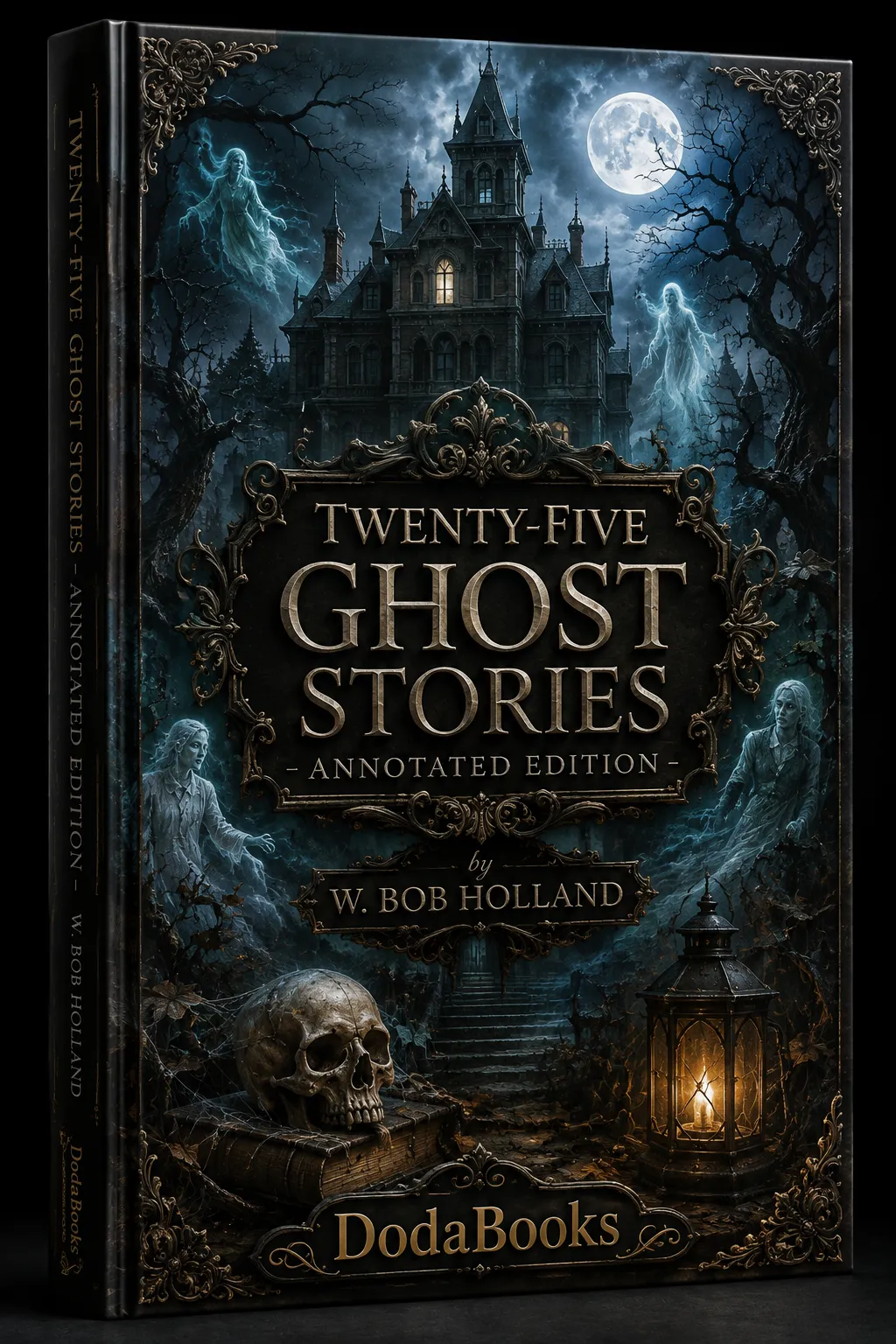
Twenty-Five Ghost Stories is W. Bob Holland’s celebrated anthology of the supernatural — a single volume gathering the creamiest of the Victorian and Edwardian ghost story, when the form was perfected between candle drippings and gaslight. This guide explains the collection’s appeal, the golden age it preserves, and how the DodaBooks Annotated Edition deepens every haunt.
👻
Twenty-Five Ghost Stories
Twenty-five tales from the golden age of the ghost story — haunted houses, phantom trains, spectral brides, and the horror that waits politely behind a drawing-room door. The definitive anthology, fully annotated.
| Compiler | W. Bob Holland |
| Era | Victorian & Edwardian British fiction |
| Genre | Ghost story, supernatural anthology |
| Stories | 25 complete tales |
| Best For | Horror fans, short-story readers, cozy-spooky nights |
| Reading Time | 6–8 hours |
👻 What This Anthology Is
Twenty-Five Ghost Stories is exactly what its title promises: a single, portable volume gathering twenty-five complete tales from the great age of British supernatural fiction. Compiled by W. Bob Holland, the anthology is designed for the reader who loves a good haunting but does not want to spend years hunting through out-of-print magazines and flea-market collections to find the best examples. Everything worth knowing about the golden age is gathered here between two covers.
Because it is a Victorian and Edwardian anthology, its range is wide. Some stories are familiar classics, others are neglected gems rescued from the ephemeral magazines where they first appeared. What unites them is a shared sensibility: this is horror built on atmosphere and dread rather than blood, on the whisper in the drawing room rather than the scream in the basement. If you are new to classic ghost stories, this volume is the ideal on-ramp — a curated tour of a form as influential as it is underrated.
🕯️ The Victorian Ghost Story in Context
The Victorian and Edwardian eras, roughly the 1850s through the 1910s, were the golden age of the British ghost story — and understanding why goes a long way toward appreciating everything in this anthology.
The Victorians lived in an age of sincere and widespread belief in the afterlife. Mourning was elaborate, public, and structured, with strict customs governing how long widows were expected to wear black and how the dead were remembered. Alongside that faith ran a fascination with spiritualism — séances, mediums, table-rapping, and the claimed ability to contact the departed — that swept through drawing rooms on both sides of the Atlantic. Ghost stories fed directly off both currents. They were not just entertainment; they were a way of thinking through grief, of imagining what lay beyond the veil, and of testing the boundary between the living and the dead.
At the same time, the Victorian ghost story had a very specific social habitat: the family magazine and the fireside reading aloud. Editors like Dickens ran ghost stories in their weeklies, and the “Christmas ghost story” became a beloved tradition — the supernatural tale told around the hearth when families gathered. When this anthology’s stories speak of country houses with too many doors and railway carriages in the dusk, they are drawing on the shared texture of that era: steam travel, fog, gaslight, and the long winter evenings perfect for a good scare told by lamplight.
🔮 Supernatural and Psychological
One of the most rewarding ways to read this collection is to notice the two broad registers it moves between.
The supernatural register takes its ghosts at face value. A drowned bride appears in the upstairs window; a phantom passenger boards the train; a portrait changes on the wall. These stories commit to the reality of the haunting and frighten us with a world that obeys its own uncanny rules. The pleasure is in the quiet impossibility of it all — the ordinary world invaded by the extraordinary.
The psychological register is subtler. Here the “ghost” may be guilt, grief, or a broken mind — the haunting happening inside the characters as much as around them. As our guide notes, a great Victorian haunting is almost never only about what it appears to be about: beneath the spectral surface sits a broken promise, an unpaid debt, or a sorrow the living cannot let go. This is why the ghost stories of this era age so well. They ask us to consider whether the scariest presence might be memory itself, and whether the phantom is a visitor from beyond — or from within.
Reading the twenty-five tales beside each other makes this machinery visible. Set the plainly supernatural next to the purely psychological and you begin to see the craft: how atmosphere is built, how dread accumulates, how the reveal is timed. If you enjoy this kind of layered, atmospheric unease, you will likely also appreciate the cosmic dread of The House on the Borderland or the slow-burn unease of The King in Yellow, both of which push the tradition into stranger territory.
💐 Mourning, Christmas, and the Ghost’s Reassurance
The Victorian ghost was not always terrifying in the modern sense. In many of these stories, the ghost is less a monster than a mourner — someone (or something) tethered to the world by unfinished business. The anthology’s tales are sprinkled with shocks of grief as much as frights, and that melancholy is part of their power. A ghost story that moves you to sorrow as well as fear is reaching for something more complex than a simple jump-scare, and it is this emotional depth that separates the best of the era from mere horror pulp.
The Christmas connection matters here too. In the Victorian era the ghost story was a seasonal art — the tale told on Christmas Eve, when the year was dying and the veil between worlds felt thin. That tradition, made famous by Dickens and kept alive in the century’s magazines, gives these stories a warmth alongside their dread. They are designed to be read aloud by lamplight to a gathered company, which is part of why they remain so readable today: they were written to be shared.
🛏️ Why Read a Century-Old Horror
The Victorian ghost story has a very specific weather: candlelight, fog, a railway carriage at dusk, a country house with too many doors. Between the 1850s and the 1910s, British writers perfected a formula — a supernatural event glided into an otherwise perfectly realistic world, told to the reader the way listeners once told it to a fire. Holland’s anthology gathers the best of that eighty-year window into a single volume.
What makes a great ghost story is rarely the monster — it’s the atmosphere, the premise’s quiet impossibility, and the precise, believable voice of the person telling it. The genius of the Victorian form is that everything is ordinary until the last page turns. This anthology preserves that art at its height, story after story, in the one place it is safe.
🕰️ What’s Inside
Expect the full romantic-ghostly compendium: the haunted house that is more tenant than the tenant; the phantom passenger who boards the 4:15; the wife seen once too often waving from the upstairs window; the inexplicable knock; the portrait that changes. Some tales chill through pure dread, others through a shock of grief — the Victorian ghost, happily, was allowed some variety of sorrow as well as fright.
The anthology was assembled for exactly the reader who loves the genre but not the effort of hunting through a hundred magazines and flea-market collections. Now, in the DodaBooks edition, it becomes a guided tour of the form.
🔍 The Annotated Edition, Tale by Tale
An anthology of twenty-five stories is the perfect use of an annotation system — because every story’s mood, technique, and period deserve their own notes, and a single preface cannot do any of them justice.
Story-Specific Cards
Visible, color-coded annotations tailored to each of the twenty-five tales.
Victorian Context
Spiritualism, séances, mourning customs, and the texture of the era.
The Craft of the Chill
Technique notes on atmosphere, pacing, and the perfect reveal.
Form History
How the ghost story evolved across the period — and where each finds its shape.
Folklore & Fear
Why certain images — roads, mirrors, weddings, windows — so reliably terrify.
Reading Lenses
Chapter guides, a Themes essay, and a full Annotation Index.
📘 Annotated Insight — The Ghost Story’s Secret Engine
A great Victorian haunting is almost never about what it appears to be about. Under the spectral surface sits grief, guilt, a broken promise, an unpaid family debt — and the ghost is the conscience arriving late. The annotations trace this machinery in each tale, showing how the best of these writers made every phantom pay for something human.
🛏️ Why Read a Century-Old Horror
Because the genre has never returned to this exact note. Modern horror is loud, direct, and anatomically explicit; the Victorian ghost story is quiet, oblique, and psychological. Reading twenty-five examples in a row is like unmuting an entire tradition — you feel the collective intelligence of the form, the shared vocabulary, the evolution of the scare — and the cumulative effect is far stronger than any single gore set-piece.
One anthology, a century of fear, and annotations that keep the lamps lit as you read.
🧭 How to Read the Anthology
Because this is a collection rather than a novel, you are free to read it however you like — and the anthology rewards a flexible approach. Some readers enjoy devouring all twenty-five stories in order, letting the accumulated effect of the form wash over them. Others prefer to dip in one story at a time, a tale on each long winter evening, which respects the Victorian tradition these stories were written for. Both approaches work; the important thing is to let the stories build on one another.
If you want to get the most out of the craft, read a few stories twice. On the first pass, surrender to the mood and let the dread accumulate. On the second, watch the machinery at work — how the writer establishes a believable, ordinary world before the first supernatural wrinkle, how atmosphere is built through setting and weather, how the reveal is timed and placed. This is where the annotated edition earns its keep: its story-specific notes reveal the technique in each tale so you can see, rather than just feel, how the best of these writers operate.
A final tip for new readers: resist the temptation to skim the endings. The Victorian ghost story lives in the setup — the slow accumulation of unease — and its payoffs depend on your willingness to sit in the tension. Give each story the full journey, and the final page will land with far more force. If you find yourself craving even more of this atmosphere afterward, the collection’s companion articles on The House on the Borderland and The Call of Cthulhu extend the tradition into stranger, more modern territory.
❓ Frequently Asked Questions
Are these stories very scary or more atmospheric?
Almost entirely atmospheric. The Victorian ghost story aims for creeping dread, uncanny unease, and the occasional well-earned jolt — not gore. Perfect for a stormy evening or a reading club.
Are all twenty-five by the same author?
No — it’s an anthology. The collection draws on the broad golden-age tradition, and part of the pleasure is meeting the varied voices: elegant, plain, witty, morbid. The annotations identify each author and their place in the tradition.
How long is the book?
Twenty-five complete short stories, sized to be one sitting or a week of nights — roughly 6–8 hours of reading at an easy pace.
Is this a good way to start reading classic horror?
The best possible way. Short forms, rich atmosphere, no commitment — and a single volume gives you both breadth and depth if the genre turns out to be yours.
Are there jump-scares?
These stories predate the jump-scare by a century. What you get instead is the slower, haunting dread that invited movie directors from Hitchcock to Aster to copy the cadence.
Do I need to read all twenty-five stories in order?
No. Each tale stands on its own, so you can dip in and out. Some readers enjoy working through the volume in sequence, letting the moods build; others read one story a night, which honours the Victorian fireside tradition the tales were written for.
Are these stories suitable for someone who normally avoids horror?
Very likely yes. This is the restrained end of the genre — atmospheric, psychological, and melancholy rather than explicit or gory. If you are curious about classic horror but nervous about it, this anthology is the gentlest possible on-ramp.
📚 Related Articles
👻 One Volume, a Century of Hauntings
Read the golden-age anthology with the era and the craft fully explained:
- ✅ All twenty-five stories — complete, uncut
- 🗂️ Story-specific annotation cards — visible, color-coded
- 🕯️ Craft notes on atmosphere, pacing, and reveal
- 🎩 Victorian spiritualism and mourning culture — context alive
- 🔒 DRM-free — read on any device
- 📥 Instant download — EPUB format