Mary Shelley’s Frankenstein is the novel that launched science fiction — a Gothic masterpiece of ambition, creation, and the monster who became more famous than his creator. Written when Shelley was just eighteen years old, it remains one of the most influential works in the Western canon.
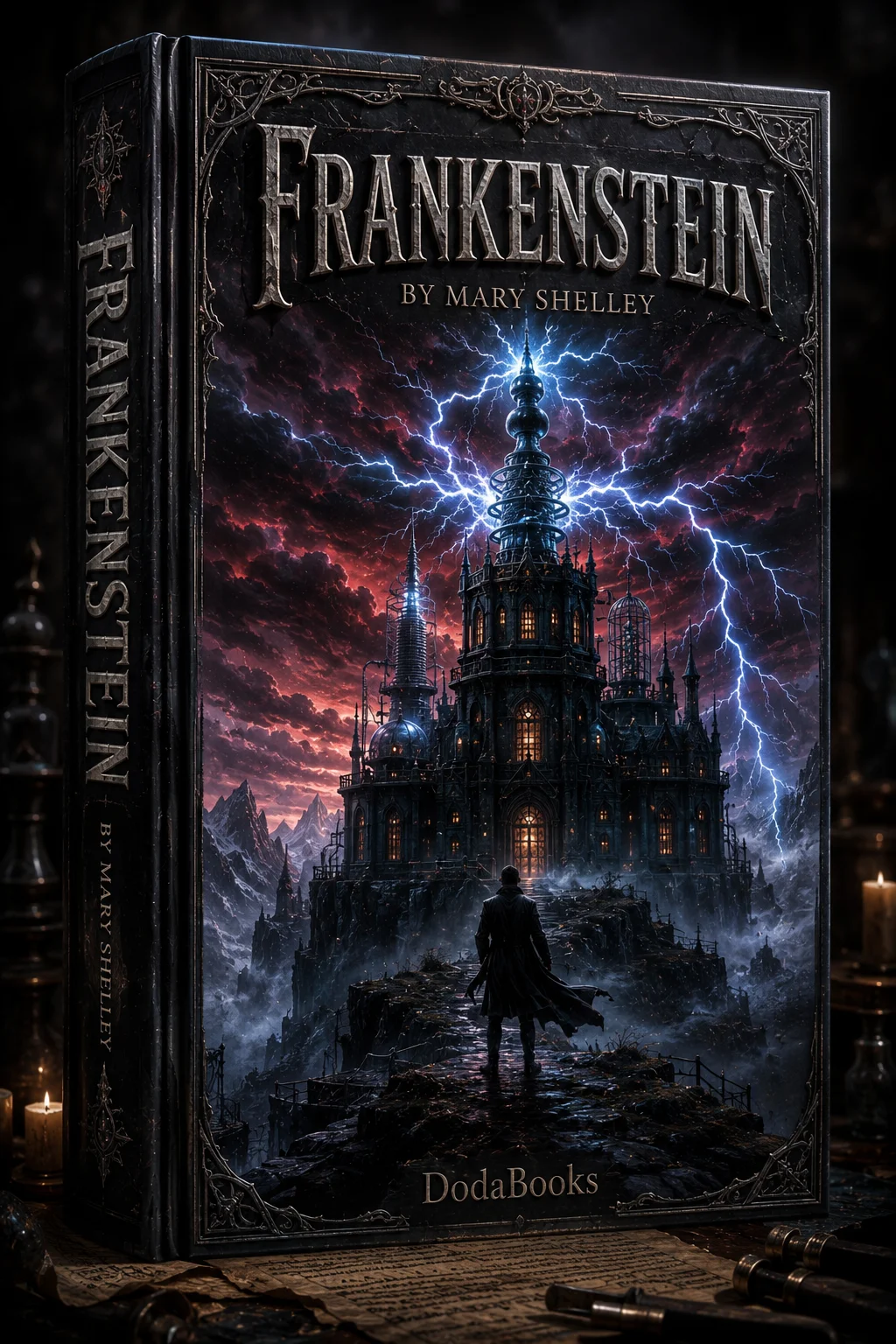
⚡
Frankenstein
The 1818 Gothic masterpiece of ambition, creation, and the monster who became more famous than his creator — the novel that launched science fiction.
| Author | Mary Shelley |
| Published | 1818 (revised 1831) |
| Genre | Gothic fiction, science fiction, horror |
| Chapters | 26 (24 chapters + letters) |
| Setting | Late 18th-century Europe — Geneva, Ingolstadt, the Arctic, the Swiss Alps, the Orkney Islands |
| Legacy | The first true science fiction novel; a foundational work of horror and a profound meditation on creation, responsibility, and monstrosity |
⚡ The Story
Victor Frankenstein, a young scientist consumed by ambition, discovers the secret of animating dead tissue. In his laboratory, he assembles a creature from body parts and brings it to life — then immediately recoils in horror at what he has made. Abandoned by its creator, the Creature must navigate a world that fears and despises it.
The Creature learns language, reads literature, and develops a profound capacity for feeling. But every attempt at human connection is met with violence and rejection. As despair turns to rage, the Creature demands that Victor create a companion — and when Victor refuses, a devastating cycle of revenge begins.
The story unfolds through nested narratives: Captain Robert Walton’s Arctic expedition frames Victor’s tale, which in turn contains the Creature’s own eloquent account. This structure gives the novel its extraordinary emotional depth, forcing the reader to sympathize with both creator and creation.
🎭 Key Characters
Victor Frankenstein
Victor is brilliant, driven, and catastrophically irresponsible. His ambition to unlock nature’s deepest secrets is admirable in the abstract, but his failure to consider the consequences — or to care for the being he creates — makes him a tragic figure. He embodies the danger of knowledge without wisdom.
The Creature
Far from the inarticulate brute of popular imagination, Shelley’s Creature is eloquent, intelligent, and deeply sensitive. Its plea for a companion is the novel’s emotional heart, and its articulate account of suffering makes it one of literature’s most complex and sympathetic monsters.
Robert Walton
The Arctic explorer whose letters to his sister frame the entire novel. Walton mirrors Victor — both are ambitious men pushing into dangerous territory — but where Victor fails, Walton listens and learns, choosing to turn back rather than destroy himself and his crew.
Elizabeth Lavenza
Victor’s adopted sister and eventual wife, Elizabeth represents the domestic world that Victor neglects in pursuit of his experiments. Her fate is the novel’s most devastating consequence of Victor’s obsession.
📖 Literary Significance
Frankenstein is widely regarded as the first true science fiction novel. Where earlier Gothic works relied on the supernatural, Shelley grounded her horror in science — galvanism, chemistry, and the material world. The creature is not animated by magic but by a (fictional) scientific process, making the novel’s questions about creation and responsibility startlingly modern.
The book is also a profound Romantic text, exploring themes of isolation, nature, and the dangers of unchecked ambition. Shelley drew on the scientific debates of her time, the poetry of Milton and Coleridge, and her own experiences of loss and motherhood.
Its cultural impact is immeasurable. The story has been adapted hundreds of times in film, theater, and television, and the image of the square-headed monster has become universal. But the novel itself — with its moral complexity, its sympathetic Creature, and its devastating critique of irresponsible creation — remains far more powerful than any adaptation.
🏛️ A Ghost Story Written on a Rainy Night
The origin of Frankenstein is almost as famous as the novel itself. In the summer of 1816, eighteen-year-old Mary Godwin — soon to marry the poet Percy Bysshe Shelley — was staying at the Villa Diodati on Lake Geneva with Shelley, Lord Byron, and Byron’s physician John Polidori. Volcanic ash from the eruption of Mount Tambora had darkened skies across Europe and brought cold, relentless rain, keeping the party indoors. One evening, after reading a collection of German ghost stories, Byron proposed a challenge: each of them would write a ghost story of their own.
While the others struggled, Mary — who had absorbed the era’s debates about galvanism and the nature of life — had a waking nightmare. She saw, in her own words, a “pale student of unhallowed arts” kneeling beside the thing he had animated. That vision became the seed of the novel. It is a genuinely Romantic creation myth, and it explains why the book feels so personal: Mary Shelley had recently given birth and lost a child, and the terror of creating something whose fate you cannot control runs through every page.
⚡ The 1818 and 1831 Editions
Readers should know that Frankenstein exists in two distinct versions. Shelley published the novel anonymously in 1818, when she was just eighteen. In 1831, she revised it heavily — smoothing the prose and softening some of the philosophical edges the first edition left deliberately raw. Most editions offer the 1831 text, but scholars increasingly prefer the 1818 original, which is closer to the young author’s daring first vision.
The DodaBooks edition presents the original 1818 text — the version many critics consider the more powerful and consistent of the two. It is leaner, stranger, and more uncompromising. Knowing the difference enriches your reading, because the two texts show a brilliant young novelist revising her own masterpiece — a rare chance to watch a work of art evolve.
📖 Why It Still Matters
Frankenstein has aged astonishingly well because its central questions have only grown more urgent. Are we responsible for what we create? What happens when science outruns ethics? Who is truly monstrous — the one who makes the creature, or the one who abandons it? In an age of artificial intelligence and genetic engineering, the novel reads less like a Gothic curio and more like a prophecy. This is why critics call it the first true work of science fiction: it asks not what we can do but what we should.
The book also matters as a work of profound sympathy. By telling the Creature’s story in its own eloquent voice, Shelley forces us to confront the difference between being monstrous and being made monstrous. The Creature is not born evil — it becomes so through rejection and neglect. That argument, startlingly modern, is what separates the novel from every simplified adaptation. For a deeper dive into the Gothic tradition that shaped this story, our guide to The Mysteries of Udolpho traces what Shelley inherited, while Dracula shows where the Gothic would travel next.
🎓 How to Read It
The nested narrative rewards patience. Captain Walton’s Arctic letters open and close the novel, Victor’s tale fills the middle, and within it the Creature tells its own story. Hold each voice in your head — every narrator is unreliable in their own way, and Shelley wants you to weigh their claims. Victor blames fate; the Creature blames Victor; Walton must decide who to believe. On a first read, let the voices carry you and resist taking sides too early. The novel is short enough to finish in a weekend, and its emotional intensity makes it hard to set down.
✨ What Makes the DodaBooks Edition Special
This is the original 1818 text, carefully prepared for modern readers without distractions or clutter.
Zero Distractions
No ads, no license pages, no project boilerplate — just the original novel, clean and uninterrupted.
Smart Typography
Curly quotes, em-dashes, proper ellipsis — typeset with care for a premium reading experience.
Chapter Navigation
Full table of contents with back-to-chapter links in every section — jump between all 26 chapters effortlessly.
Cleaned & Polished
All Gutenberg boilerplate stripped, consistent formatting throughout the text.
No DRM
You own your copy — read on any device, anytime, forever.
Instant Download
EPUB + PDF + AZW3 formats included, delivered instantly after purchase.
❓ Frequently Asked Questions
Is the monster's name Frankenstein?
No. In Shelley’s novel, Victor Frankenstein is the creator. The Creature is never given a name — it is referred to as “the Creature,” “the monster,” or “the fiend.” The popular misconception that the monster is called Frankenstein is one of the most widespread errors in literary history.
What does the subtitle "The Modern Prometheus" mean?
In Greek mythology, Prometheus stole fire from the gods and gave it to humanity. Victor Frankenstein similarly “steals” the secret of creation — and suffers terribly for it. The subtitle frames the novel as a cautionary tale about the price of overreaching ambition.
How long does it take to read?
At 140 pages in the DodaBooks edition, most readers finish it in 3-5 hours. The nested narrative structure keeps the pacing tight, and the novel’s emotional intensity makes it hard to put down.
Was the novel based on a dream?
Mary Shelley conceived the story during the famous summer of 1816 at the Villa Diodati, when a challenge to write a ghost story led her to have a waking nightmare about a “pale student of unhallowed arts.” The novel grew from that vision, informed by scientific debates about galvanism and the nature of life.
Is it horror or science fiction?
Both. Frankenstein is the bridge between the Gothic horror tradition and modern science fiction. Its horror derives not from the supernatural but from scientific ambition gone wrong — making it as much a cautionary tale about technology as a ghost story.
Who is the real monster — Victor or the Creature?
That is the novel’s central question, and Shelley deliberately leaves it open. Victor abandons and refuses to take responsibility for his creation, while the Creature, though guilty of terrible acts, is driven to them by rejection and isolation. The book asks you to hold both accounts in tension rather than pick a single culprit.
Why does the Creature want a female companion?
The Creature’s request is the emotional heart of the novel. It argues that it has been denied every human connection, and a companion is its only hope of escaping total isolation. When Victor, terrified of breeding a race of monsters, destroys the unfinished companion, the Creature’s rage turns irrevocably toward revenge — making Victor’s decision the turning point of the tragedy.
Which edition should I read, 1818 or 1831?
For most readers, the 1818 edition is the better choice. It is the novel as the eighteen-year-old Mary Shelley first wrote it — leaner, stranger, and more thematically consistent. The DodaBooks edition presents the 1818 text. The 1831 revision, though historically interesting, softens some of the original’s sharper edges.
📚 Related Articles
For early scientific adventure into the unknown realms of the subterranean world, explore Jules Verne’s classic in A Journey into the Interior of the Earth Guide.
⚡ Read the Original Gothic Masterpiece
Frankenstein is the novel that launched science fiction. The DodaBooks edition preserves the complete original text in a clean, distraction-free format:
- ✅ Complete 26-chapter novel — every word of the 1818 edition
- ✒️ Smart typography — curly quotes, em-dashes, proper ellipsis
- 📜 Full table of contents with chapter navigation
- 🔒 DRM-free — read on any device, anytime
- 📥 Instant download — EPUB + PDF + AZW3 formats