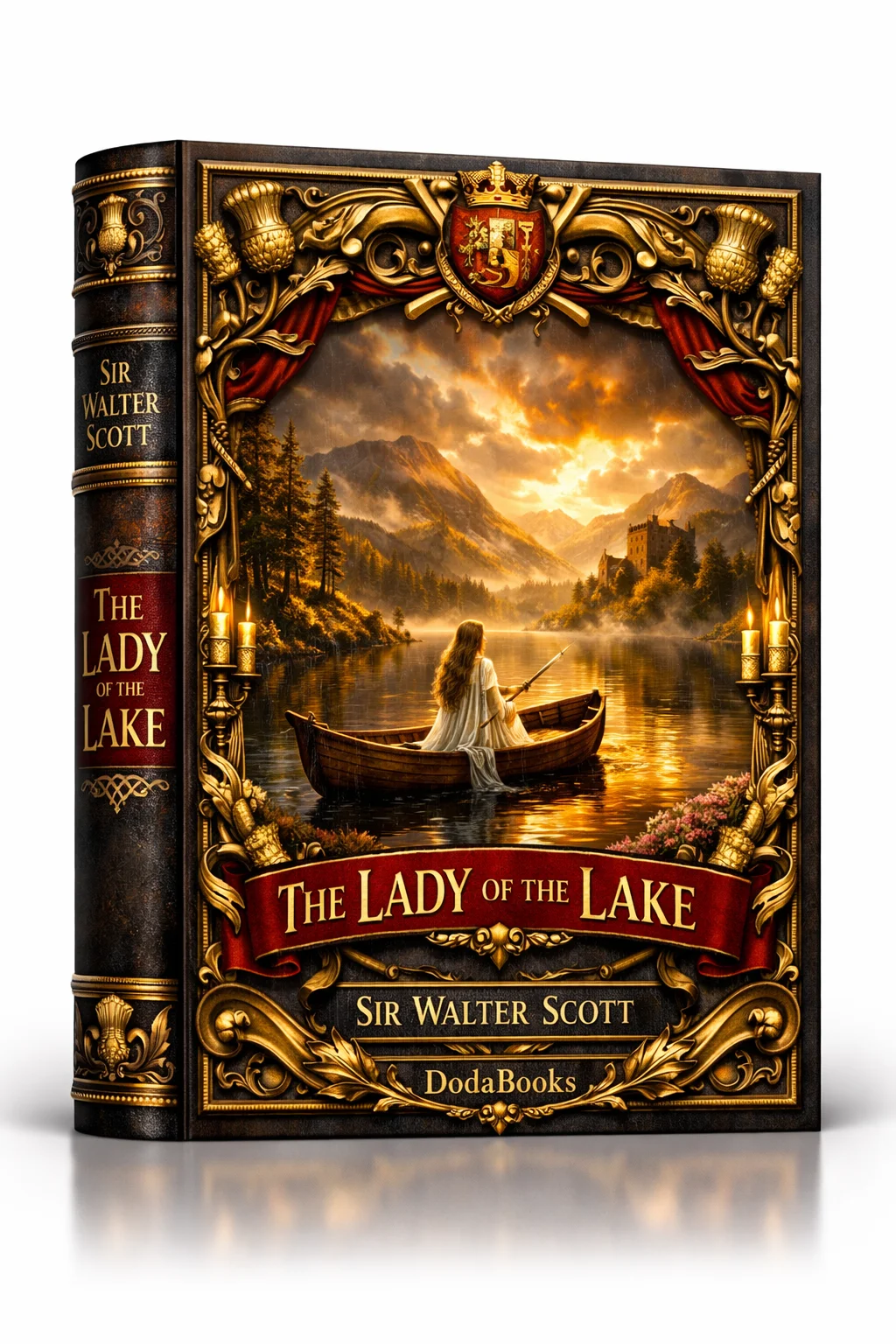
Sir Walter Scott’s The Lady of the Lake (1810) is a sweeping narrative poem set in the Trossachs region of the Scottish Highlands. The poem follows the fortunes of Ellen Douglas, the Lady of the Lake, as she navigates the intersecting paths of the outlawed Clan Alpine, a mysterious knight known as Fitz-James, and the fugitive heir Malcolm Graeme.
🏴
The Lady of the Lake
A narrative poem of love, honor, and clan warfare set against the dramatic backdrop of Loch Katrine and the Scottish Highlands.
| Author | Sir Walter Scott |
| Published | 1810 |
| Genre | Narrative poem |
| Cantos | 6 |
| Setting | Loch Katrine, Trossachs, Scotland |
| Legacy | Inspired the Highland tourism boom |
📜 The Story
The poem opens with a dramatic stag hunt. A magnificent stag leads King James V of Scotland (travelling incognito as the knight Fitz-James) deep into the Highlands, where he becomes separated from his hunting party. Lost and weary, he encounters Ellen Douglas, the beautiful “Lady of the Lake,” who offers him shelter on an island in Loch Katrine.
Ellen is the daughter of the outlawed Lord James of Douglas, who has been exiled by the king. Living in hiding with her father and the loyal minstrel Allan-Bane, Ellen is caught between three suitors: the mysterious Fitz-James, the exiled heir Malcolm Graeme (whom she loves), and the fierce Highland chief Roderick Dhu, leader of Clan Alpine.
As the poem unfolds through six cantos, Scott weaves together romance, clan warfare, Highland history, and breathtaking descriptions of the Scottish landscape. The poem builds toward a dramatic confrontation that reveals Fitz-James’s true identity as the King of Scots — and the fate of Ellen, Malcolm, and the Highland clans hangs in the balance.
🗺️ The Story, Canto by Canto
Canto I, “The Chase,” opens with the famous stag hunt: the deer leads the knight deep into the Trossachs, and night finds him alone at the shore of Loch Katrine. He is Fitz-James — King James V in disguise — and he is rowed to the island at the lake’s core, where Ellen Douglas shelters him and sings:
“Soldier, rest! thy warfare o’er, / Sleep the sleep that knows not breaking.”
Canto II, “The Island,” stretches the stay: Ellen’s father Lord Douglas keeps his name hidden, her true love Malcolm Graeme visits under cover of night, and word comes that Roderick Dhu, fierce chief of Clan Alpine, is raising his men against the crown. When Fitz-James departs, he presses a ring into Ellen’s hand — a token that will serve her, he promises, in royal hands.
Canto III, “The Gathering,” is the poem’s great set-piece: the Fiery Cross, a charred and blood-tipped branch, passes by night from township to township, summoning the warriors of the clan. Cantos IV–VI close the tragedy: a duel with Roderick at a mountain pass, the wounded chief carried to Stirling to die, and the king’s revelation of himself to Ellen and her father. The resolution is mercy — James pardons Douglas and returns Ellen to Malcolm — the man beneath the disguise, not the crown, the point all along.
🎭 Key Characters
Ellen Douglas
The Lady of the Lake herself — beautiful, loyal, and courageous. Ellen lives in hiding with her outlawed father but maintains her dignity and grace. Her love for Malcolm Graeme is tested by the attentions of the powerful Fitz-James and the fierce Roderick Dhu.
Fitz-James (King James V)
The King of Scots travelling incognito. Fitz-James is chivalrous and honourable, and his genuine admiration for Ellen creates the poem’s central romantic tension. When his true identity is revealed, he must choose between his duty as king and his feelings.
Roderick Dhu
The fierce chief of Clan Alpine, outlawed and fighting to protect his people. Roderick is a complex figure — a warrior and a leader, but also Ellen’s unwanted suitor. His death in combat is one of the poem’s most powerful scenes.
Malcolm Graeme
The young heir whom Ellen truly loves. Malcolm is honourable but powerless — exiled from his lands, he represents the dispossessed Highland gentry caught between the crown and the clan system.
🔥 Honor, Freedom, and the Weight of a Name
The poem’s engine is honour, and Scott tests it in every key. Roderick Dhu’s honour belongs to his clan — loyalty to a cause he knows he cannot win, and a warrior code that treats even an enemy fairly. Fitz-James’s honour is the crown’s, stretched by his disguise; his final choice, to answer Ellen’s ring with mercy rather than punishment, is the moral climax the whole poem has built toward. Ellen’s honour is quieter: she keeps her own counsel, refuses what she does not love, and chooses poverty with Malcolm over power beside a king.
The clansmen are free men who will fight and die rather than bend, and Scott mourns them even as his plot argues their world must pass. And everyone is partly someone else — king in disguise, outlaw as father, heir courting in secret — until honour is the only truth that remains.
📖 Literary Significance
The Lady of the Lake was a phenomenon when it was published in 1810. It sold over 20,000 copies in its first year and made the Trossachs region of Scotland a tourist destination — the Scottish Highlands had never been so vividly described for a popular audience.
Scott’s use of the landscape as both setting and character was revolutionary. His descriptions of Loch Katrine, Ben Venue, and the surrounding mountains created a romantic image of the Highlands that persists to this day. The poem also preserved aspects of Highland culture and history that were disappearing in the wake of the Jacobite risings and the Highland Clearances.
The poem’s influence extended beyond literature. It inspired paintings, music (including Schubert’s Lady of the Lake songs), and countless imitations. Sir Walter Scott went on to become the most famous author of his age, and The Lady of the Lake remains one of the finest narrative poems in English.
🏛️ Historical & Cultural Context: A Highlands Worth Saving
Scott set the poem in the sixteenth-century Scotland of James V (reigned 1513–42) — a monarch remembered as the “poor man’s king,” who walked among his people in disguise. He wrote it with his own time in mind. By 1810 the real Highland world had changed irrecoverably: the Jacobite risings had ended at Culloden in 1746, the wearing of tartan had been banned by law, and the Clearances were emptying the glens. Scott’s clansmen were already ghosts, and it is that fading that gives the poem its ache.
The landscape is the other lead actor. Loch Katrine, Ellen’s Isle, and Ben Venue are real places, and The Lady of the Lake turned them into a destination within a generation — steamships began carrying sightseers across the very loch where Ellen rowed Fitz-James. The romance Scott built around the Trossachs became the blueprint for how the whole world would picture Scotland.
✨ What Makes the DodaBooks Edition Special
This is the original 1810 text, carefully prepared for modern readers without distractions or clutter.
Zero Distractions
No ads, no license pages, no project boilerplate — just the original poem, clean and uninterrupted.
Proper Verse Formatting
Each canto formatted with care — line indentation, stanza breaks, and poetic structure faithfully preserved.
Canto Navigation
Full table of contents with navigation for all 7 sections (6 cantos plus introduction).
Author Biography
Context on Sir Walter Scott's life and the poem's creation included.
No DRM
You own your copy — read on any device, anytime, forever.
Instant Download
EPUB format delivered instantly after purchase.
💭 Why It Still Matters
The Lady of the Lake fixed the image of the Highlands for the modern imagination — misty lochs, gallant clans, doomed chiefs — and that image still shapes how Scotland presents itself. The poem inspired paintings, operas, and music of its own: its “Hail to the Chief” passed into a march heard wherever heads of state gather, and its geography still draws visitors by the thousand. For the modern reader it is also a reminder of how thrilling narrative verse could be, in an age when poetry routinely outsold novels.
🧭 How to Read a Verse Romance
Read a canto in a sitting rather than a stanza at a time — Scott builds momentum across whole scenes, and the duel in Canto V means little without the gathering of Canto III behind it. Read the songs and speeches aloud: they carry the rhythms of the ballad, and they land better on the ear than the eye. The cast is small and the geography signposted, so a few archaic words should not slow you — the annotated edition supplies the quiet context. If the taste for romance in verse appeals, the poetry-and-prose Arcadia — see our guide to The Countess of Pembroke’s Arcadia — and the quests of Chrétien de Troyes in the Four Arthurian Romances guide make natural next courses.
❓ Frequently Asked Questions
Is The Lady of the Lake based on a true story?
The characters are fictional, but the poem is set in real locations in the Scottish Highlands and references real historical figures, including King James V of Scotland.
How long is the poem?
Six cantos totalling approximately 117 pages, making it a substantial but manageable read — about 3-4 hours for most readers.
Do I need to know Scottish history to understand it?
No. Scott provides all the context needed within the poem. The story is self-contained and accessible to any reader.
Why was this poem so popular in its time?
It captured the Romantic imagination with its vivid descriptions of the Scottish landscape, its dramatic story of love and clan warfare, and its celebration of Highland culture. It essentially created the modern image of the Scottish Highlands.
Where does the Fiery Cross come from?
It is an old Highland war-signal: a charred wooden cross, often blood-tipped, passed from township to township to summon the clan to arms. In the poem, Roderick Dhu raises it in Canto III to call Clan Alpine against the crown.
Why does the poem contain so many songs and ballads?
Scott was steeped in the ballad tradition, so he populated the poem with poems-within-the-poem — laments, love songs, and war songs. The best known are the “Soldier, rest!” lullaby and the “Hail to the Chief” address; Ellen’s songs reveal her heart, and the clan’s songs reveal its spirit.
Is The Lady of the Lake connected to the American "Hail to the Chief"?
Indirectly, yes. Scott’s line “Hail to the Chief who in triumph advances” caught on with American readers and musicians, and across the nineteenth century it developed into the march now heard at US presidential appearances.
📚 Related Articles
🏴 Read the Highland Epic
The Lady of the Lake is one of the greatest narrative poems in English. The DodaBooks edition preserves the complete original text in a clean, distraction-free format:
- ✅ Complete 6-canto poem — every word of the 1810 edition
- ✒️ Proper verse formatting — stanza breaks, indentation, poetic structure preserved
- 📜 Full table of contents with canto navigation
- 📝 Author biography included
- 🔒 DRM-free — read on any device, anytime
- 📥 Instant download — EPUB format