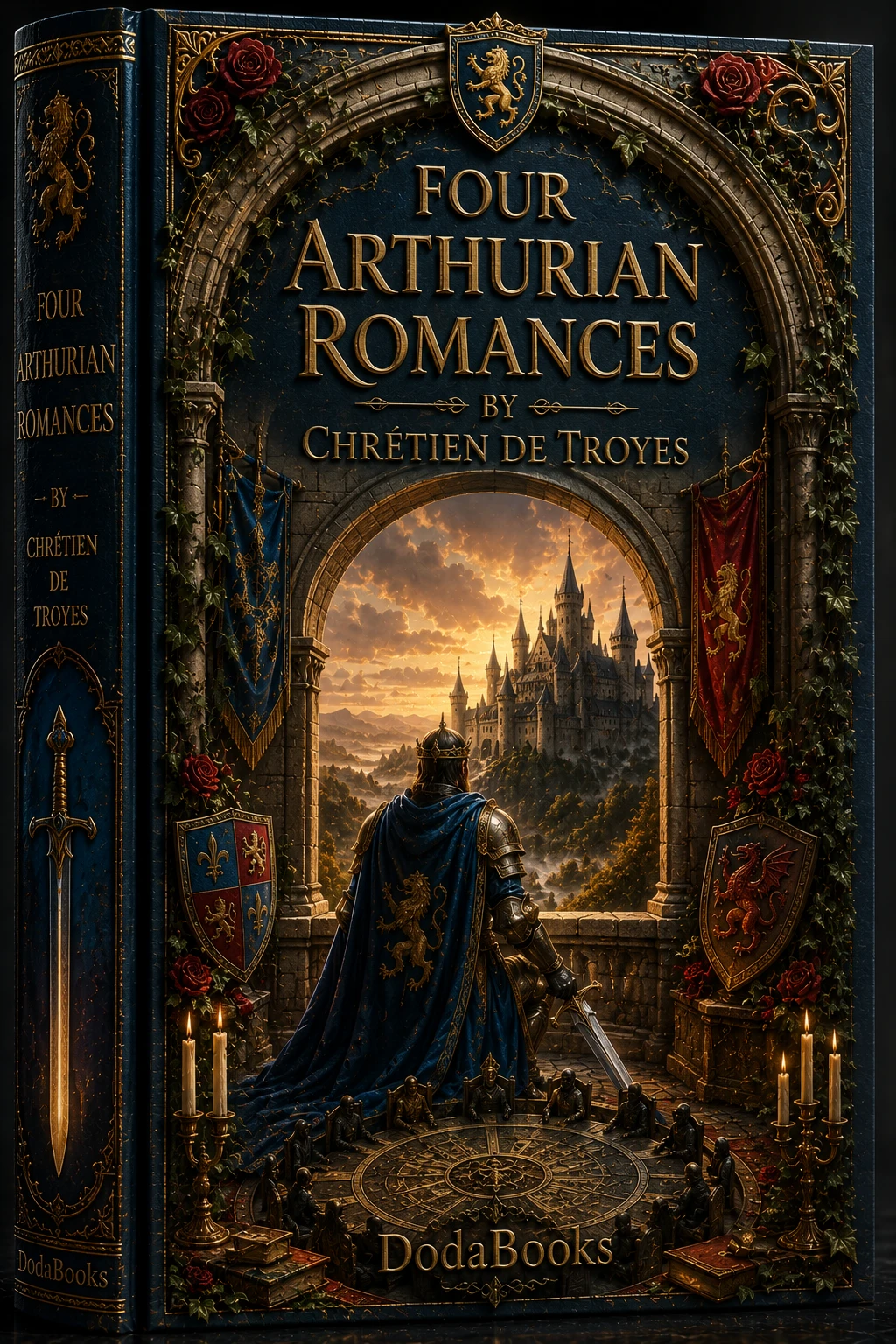
Chrétien de Troyes’s Four Arthurian Romances brings together the four complete works of the twelfth-century poet who invented the Arthurian romance as we know it. These tales of chivalry, courtly love, and knightly adventure — Erec and Enide, Cligés, Yvain, and Lancelot — established the ideals of Camelot that inspired Malory, Tennyson, and all who followed.
🏰
Four Arthurian Romances
Four timeless romances of chivalry, courtly love, and knightly adventure — from the poet who invented the Arthurian romance and shaped Camelot for all time.
| Author | Chrétien de Troyes |
| Composed | c. 1170–1190 |
| Genre | Chivalric romance, medieval poetry (in prose translation) |
| Romances | 4 — Erec and Enide, Cligés, Yvain, Lancelot |
| Setting | King Arthur’s Britain — Camelot, the forest of Brocéliande, and the dreamlike world of chivalric adventure |
| Legacy | The foundation of all Arthurian literature; established the Round Table, courtly love, and the quest tradition |
🏰 The Romances
Erec and Enide — The Oldest Arthurian Romance
Erec, a knight of the Round Table, faces a crisis when his devotion to his beautiful wife Enide causes others to question his knightly valor. To prove himself, he sets out on a journey of adventure with Enide forced to accompany him in silence — forbidden to speak a warning even when danger approaches. The story becomes a profound meditation on love, trust, and the balance between marriage and honor.
Cligés — A Tale of Two Courts
Cligés, son of the Greek emperor Alexander and his wife Soredamors, is raised at Arthur’s court but must return to Constantinople to claim his inheritance. There he falls in love with Fenice, who is betrothed to his uncle. Their escape — involving a fake death, a hidden tower, and a loyal servant — creates one of medieval literature’s most ingenious love stories.
Yvain — The Knight with the Lion
Yvain wins the love of the Lady Laudine by slaying her husband in combat, then marrying her. But when his quest for glory causes him to overstay his leave, she rejects him utterly. Yvain goes mad with grief, is cured by a noblewoman, and begins a quest for redemption aided by a loyal lion he rescues from a serpent. The lion becomes his constant companion — and one of the most beloved animal characters in medieval literature.
Lancelot — The Knight of the Cart
The first known telling of Lancelot and Guinevere’s tragic love. When the Queen is abducted by the evil Meleagant, Lancelot pursues her — but his path requires him to ride in a cart of shame, a humiliation that will mark him forever. His willingness to sacrifice his honor for love established the ideal of courtly love that defined medieval romance.
👑 Literary Significance
Chrétien de Troyes is the single most important figure in the development of the Arthurian legend. Before him, Arthur was a shadowy figure in Welsh and Latin chronicles. Chrétien invented the Camelot we know — the Round Table, the code of chivalry, the ideal of courtly love, and the tradition of knightly quests.
His influence is staggering. Malory’s Le Morte d’Arthur, Tennyson’s Idylls of the King, T. H. White’s The Once and Future King, and every film adaptation from Excalibur to Monty Python all descend from Chrétien’s inventions. He created Lancelot’s love for Guinevere, gave Yvain his lion, and established the narrative patterns that have shaped storytelling for eight centuries.
The romances are also remarkable for their psychological depth. Chrétien is interested not just in adventures but in the inner lives of his characters — their doubts, their conflicts between love and honor, their capacity for growth and change. This makes his work feel surprisingly modern despite its medieval setting.
✨ What Makes the DodaBooks Edition Special
This edition presents William Wistar Comfort’s acclaimed translation of Chrétien’s four romances, freshly typeset for modern readers.
Zero Distractions
No ads, no license pages, no project boilerplate — just the complete romances, clean and uninterrupted.
Smart Typography
Curly quotes, em-dashes, proper ellipsis — typeset with care for a premium reading experience.
Chapter Navigation
Full table of contents with navigation to each romance and its internal sections.
Cleaned & Polished
All Gutenberg boilerplate stripped, consistent formatting throughout the text.
No DRM
You own your copy — read on any device, anytime, forever.
Instant Download
EPUB format included, delivered instantly after purchase.
🏛️ Historical Context: The Courts That Shaped Camelot
Chrétien wrote for aristocrats, not monasteries. In the 1170s and 1180s he worked at the courts of Champagne and Flanders — the fashionable capitals of tournament, heraldry, and the newly codified doctrine of courtly love. Marie of Champagne personally commissioned the Lancelot, and patrons like her set not just the funding but the subject matter of the poems. Before Chrétien, Arthur was a war leader of Celtic chronicle; after him he presided over a court where manners mattered as much as might.
That context is not decoration — it explains the rules the stories obey. A knight’s reputation could be won or lost in a single adventure, marriage was often a political alliance rather than a love match, and “courtesy” was treated as the mark of a civilised man. To trace how the legend grew from Celtic roots into Malory and the Victorians, start with our complete guide to King Arthur, then see the chivalric style reinvented in The Lady of the Lake, Scott’s Highland romance.
🧭 How to Read the Four Romances
Forget everything you expect from a modern novel. These are verse romances in prose translation, built around tests of character rather than mystery plots. Erec and Enide asks whether a knight can love too well. Cligés stages a love triangle inside a court crawling with spies. Yvain is a redemption story — a hero who falls, loses everything, and claws back to worth. Lancelot is a descent into the radical sacrifice that courtly love demands.
Read for the situations and the debates as much as for the action. Chrétien is the first great psychological storyteller of European fiction: he interrupts his own adventures to comment on his characters’ choices, to wink at his audience, and to undercut his own heroes. Each romance runs on the same frame — a promise, a crisis, a quest, a reconciliation — and once you see the frame, individual episodes become twice as rewarding.
⚔️ The Chivalric Code in Action
Chivalry in Chrétien is not a rulebook; it is a running argument. Every romance pits two duties against each other — a knight’s public honour versus his private loyalty to his lady. Erec is mocked for doting on Enide. Yvain is destroyed when he chooses glory over the wedding promise he made. Lancelot willingly rides a cart of shame through the streets to rescue Guinevere.
The code can look alien, but its questions are not: How much of yourself do you owe the person you love? What are you willing to sacrifice for reputation? When does pride curdle into self-destruction? Read the four romances together and you watch one dilemma handled from four angles — a single long conversation about love and honour.
🎨 Why Chrétien Still Matters
Every Arthurian adaptation you have ever watched carries Chrétien’s fingerprints. He gave Lancelot his doomed love for Guinevere, gave Yvain his lion, and fixed the shape of the quest narrative that still dominates fantasy fiction. The Round Table, the courtesy code, the idealised court — all of it runs back to the poet of Troyes.
Reading the source is the fastest route to understanding everything that came after, and it is also, on its own terms, great entertainment — full of magical springs, disguised knights, monsters, and love triangles. If you enjoy the collection’s darker edge, the turn toward gothic horror in The Monk shows how differently the medieval inheritance could be reworked by the Romantics.
❓ Frequently Asked Questions
Do I need to know Arthurian legend to enjoy these?
No. Chrétien’s stories work perfectly as standalone adventures. The characters and settings are introduced within each romance, and the themes of love, honor, and adventure are universal. However, familiarity with the basic outlines of Arthurian legend adds richness.
Is this the original poetry or a translation?
This is William Wistar Comfort’s prose translation of Chrétien’s Old French octosyllabic rhyming couplets. The translation is faithful to the original while being readable for modern audiences. An extensive introduction provides historical and literary context.
Which romance should I read first?
Each stands alone. Yvain is the most accessible and beloved — its redemption arc and the lion make it a favorite for first-time readers. Erec and Enide is the oldest and sets the pattern. Lancelot is essential for understanding the tragic love story that became central to the legend.
How long does it take to read?
At 637 pages, most readers finish in 10-14 hours. Each romance is roughly novel-length and can be read independently, making it easy to read at your own pace.
How does this connect to Le Morte d'Arthur?
Malory’s Le Morte d’Arthur (1485) drew heavily on Chrétien’s romances, especially the Lancelot material. Chrétien invented the chivalric framework and character relationships that Malory later compiled into the definitive English Arthurian cycle. Think of Chrétien as the architect and Malory as the builder.
Were these the first King Arthur stories?
Not quite. Arthur appears in earlier chronicles — most famously Geoffrey of Monmouth’s History of the Kings of Britain (c. 1136) — but Chrétien was the first to turn those king-list entries into full-blown chivalric romance. He is the inventor of the Arthurian romance as a genre, and the source of most of what modern readers recognise as Camelot.
Why does Lancelot feel unfinished?
Lancelot: The Knight of the Cart was left incomplete by Chrétien and finished by another poet, Godefroi de Leigni, who names himself in the closing lines of the romance. Scholars generally accept that Chrétien set the work aside, presumably for his patron Marie of Champagne, and a continuator completed it — a common arrangement for commissioned medieval romance.
Who should read this collection?
Students of medieval literature, fantasy fans who want to see where the genre’s DNA comes from, and anyone who has enjoyed Malory, Tennyson, or modern Arthurian films. Because each romance is independent, it also works as a sampler: start with Yvain and you will quickly know whether this world agrees with you.
📚 Related Articles
🏰 Read the Original Arthurian Romances
Four Arthurian Romances collects the complete works of the poet who invented the Arthurian romance — tales that shaped Camelot, chivalry, and courtly love for all time. The DodaBooks edition presents the complete text in a clean, distraction-free format:
- ✅ All four complete romances — Erec, Cligés, Yvain, and Lancelot
- ✒️ Smart typography — curly quotes, em-dashes, proper ellipsis
- 📜 Full table of contents with romance navigation
- 🔒 DRM-free — read on any device, anytime
- 📥 Instant download — EPUB format