Jean-Jacques Rousseau’s Eloisa: Or, a Series of Original Letters was the best-selling novel of the 18th century. Written in letters, it tells the story of the forbidden love between Saint-Preux, a middle-rank tutor, and his aristocratic student Eloisa — a passionate correspondence that explores social rank, premarital love, women’s autonomy, and the meaning of virtue.
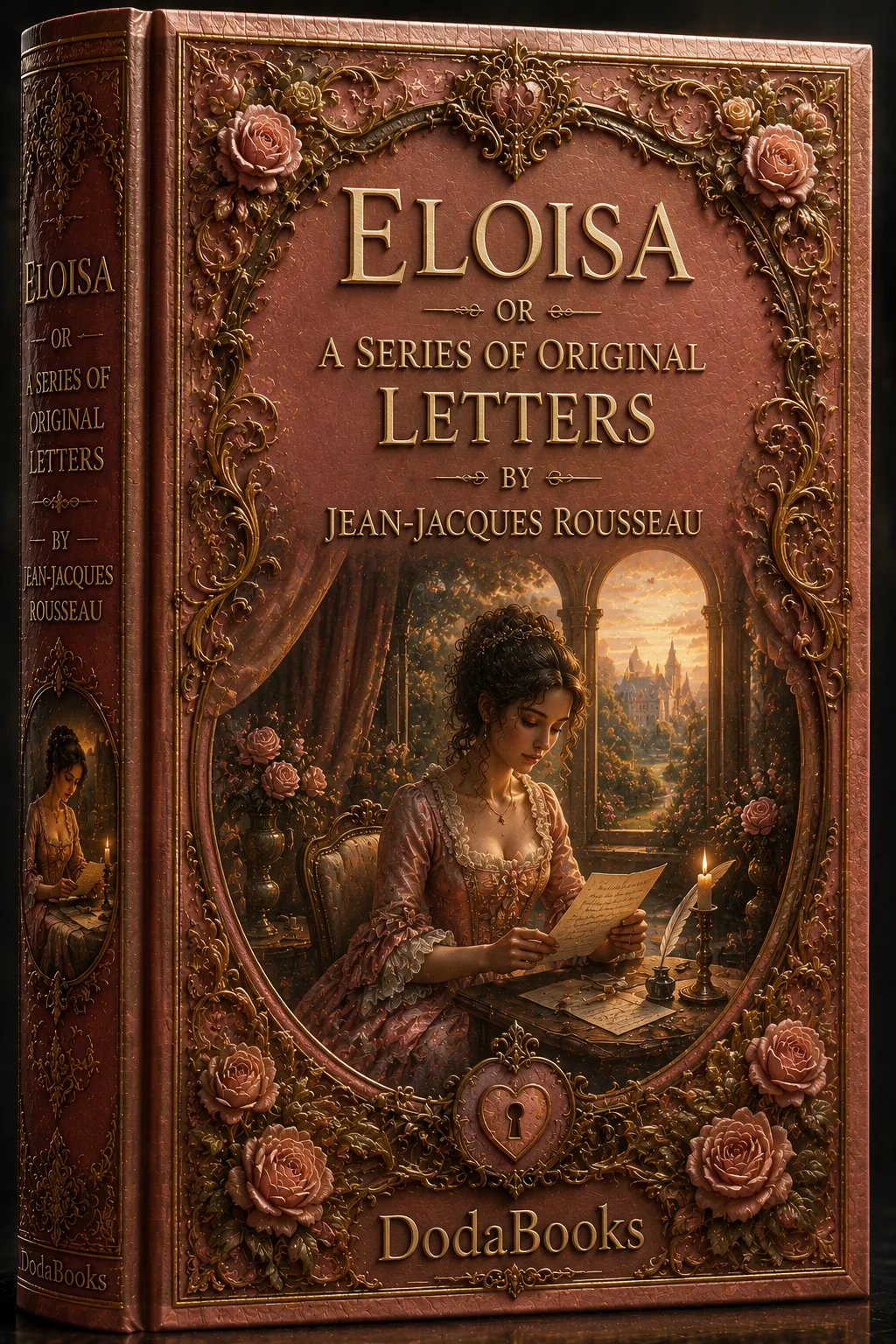
💌
Eloisa
A forbidden love between a tutor and his aristocratic student unfolds through passionate letters — the best-selling novel of the 18th century and a landmark of Romantic literature.
| Author | Jean-Jacques Rousseau |
| Original Title | Julie, ou La Nouvelle Héloïse |
| Published | 1761 |
| Genre | Epistolary novel, romance, philosophical fiction |
| Letters | 85 |
| Setting | 18th-century Switzerland — the Alpine village of Clarens, the city of Paris |
| Legacy | The best-selling novel of the 1700s; profoundly influenced the Romantic movement |
💌 The Story
Saint-Preux, a gifted but low-born tutor, falls hopelessly in love with his student Eloisa, the daughter of the Baron d’Étange. Their love is passionate, intellectual, and impossible — the gulf of social rank makes marriage unthinkable.
Their letters trace the arc of a forbidden romance. In the early letters, Saint-Preux declares his love with an intensity that scandalized 18th-century readers. Eloisa resists, then yields, and their correspondence becomes a dialogue about the nature of love, the claims of virtue, and the injustice of social conventions that deny happiness to those who love truly.
The affair is discovered. Saint-Preux is dismissed and sent away. Eloisa, bowing to her father’s will, marries the older, rational Monsieur de Wolmar — a man she respects but does not love. The second half of the novel follows the lovers years later: Saint-Preux returns from his travels, and the three of them — Eloisa, her husband, and her former lover — attempt to build a new kind of domestic life at Wolmar’s country estate, Clarens.
The novel’s conclusion, in which Eloisa’s final letter reveals a truth she has hidden for years, delivers one of the most devastating endings in 18th-century literature.
🎭 Key Characters
Eloisa (Julie)
Eloisa is intelligent, passionate, and deeply conflicted. She loves Saint-Preux with her whole heart but believes she must choose virtue over passion. In the novel’s second half, she reinvents herself as a devoted wife and mother — yet the question of whether she has truly found happiness, or merely accepted her fate, haunts every page.
Saint-Preux
The tutor whose love for Eloisa defines his life. He is idealistic, eloquent, and utterly devoted. His letters are among the most passionate love letters in literature. His journey — from desperate lover to world-weary traveler to reluctant guest in Eloisa’s married household — mirrors the novel’s central tension between desire and duty.
Monsieur de Wolmar
Eloisa’s husband, a rationalist who believes that the human heart can be managed through reason and transparency. He invites Saint-Preux to live with them at Clarens, confident that openness and willpower can subdue any lingering passion. His philosophy is tested by everything the novel reveals about the human heart.
📖 Literary Significance
Julie, ou La Nouvelle Héloïse was a cultural phenomenon. Upon its publication in 1761, it became the best-selling novel of the century, inspiring a cult of sensibility across Europe. Readers wrote letters to Rousseau as if his characters were real people. They visited the novel’s settings in Switzerland. They wept over the lovers’ fate.
The novel’s influence on Romanticism was immense. Its celebration of authentic feeling over social convention, its vivid descriptions of Alpine nature, and its revolutionary ideas about education and domestic life shaped the intellectual landscape of the coming century. Goethe, Stendhal, and Tolstoy all acknowledged its impact.
Rousseau used the novel to explore the same ideas he developed in his philosophical works — the corruption of civilization, the value of authentic feeling, the possibility of virtue in a fallen world — but in a form that reached readers who would never pick up a philosophical treatise. Eloisa is not just a love story; it is a novel of ideas, and its ideas changed the world.
✨ What Makes the DodaBooks Edition Special
This is the complete 1761 English translation by William Kenrick, carefully prepared for modern readers without distractions or clutter.
Zero Distractions
No ads, no license pages, no project boilerplate — just the original text, clean and uninterrupted.
Smart Typography
Curly quotes, em-dashes, proper ellipsis — typeset with care for a premium reading experience.
Letter Navigation
Full table of contents with navigation to each of the 85 letters — easily jump between them.
Cleaned & Polished
All Gutenberg boilerplate stripped, consistent formatting throughout the text.
No DRM
You own your copy — read on any device, anytime, forever.
Instant Download
EPUB format included, delivered instantly after purchase.
🏛️ The World of 1761
Rousseau published Eloisa in 1761 at the height of his fame — the man who had already scandalized Europe with the Discourse on Inequality and who would later write The Social Contract. France and Geneva were still rigidly hierarchical: marriage across classes was nearly impossible, and women’s minds were rarely taken seriously. That is exactly why the book detonated. Readers recognized the lovers’ dilemma as their own and treated Eloisa’s letters as real ones — some even wrote to Rousseau asking whether Julie was still alive. No novel had ever blurred fiction and life so completely.
🔥 Themes That Still Burn
Eloisa is dense with ideas that still feel current. Virtue versus passion — is it nobler to obey your conscience or your heart? Class and love — the novel asks whether merit can cross an aristocratic divide. Women’s autonomy — Eloisa’s choices, and her rebellions, anticipate debates that are still running. And behind everything lies Rousseau’s love of nature, whose Alpine scenes became a blueprint for Romantic landscape writing. A generation later, Jane Austen’s Sense and Sensibility explored the same territory with sharpened irony, while the scandalous Gothic end of the eighteenth century is covered in our guide to The Monk and The Mysteries of Udolpho — novels the age of sensibility helped to make possible.
📖 Why a 1761 Novel Still Matters
Eloisa was the best-selling novel of the 1700s, and its fingerprints are all over modern fiction. It made the epistolary form the defining format of its age, pioneered the psychology of forbidden love, and gave the Romantic movement its vocabulary of feeling, nature, and revolt. Goethe, Stendhal, and Tolstoy all read it, and Rousseau’s scenes of Alpine retreat echo through later novels of passion and restraint. Reading it today is not a museum visit — you are reading the ancestor of nearly every romance novel published since, with the added pleasure of watching an eighteenth-century mind argue with itself about happiness.
🧭 Tips for Reading an 85-Letter Novel
Read a handful of letters per sitting rather than the whole book; each letter is a self-contained unit of emotion and argument. Watch for the shift in tone after Saint-Preux is banished — the novel moves from heat to philosophy as Rousseau turns to education, marriage, and household economy. If you want the ideas without the plot, linger on the Clarens letters, which carry the most explicit philosophy. And if you finish hungry for more eighteenth-century romance, our guide to Manon Lescaut pairs naturally with Eloisa as an even darker study of love and ruin.
❓ Frequently Asked Questions
Is this the same as Rousseau's Julie?
Yes — the original French title is Julie, ou La Nouvelle Héloïse. The English translator William Kenrick retitled it Eloisa: Or, a Series of Original Letters to connect it to the medieval story of Héloïse and Abélard, which Rousseau’s novel consciously echoes.
Is this a philosophical work or a novel?
Both. It is a novel of ideas — a love story that explores Rousseau’s philosophy of authentic feeling, social equality, and the corruption of civilization. The characters debate the same questions Rousseau addressed in his philosophical works, but through the intimate medium of personal letters.
How long does it take to read?
At 368 pages, most readers finish in 8-12 hours. The letter format makes it ideal for reading in short sessions — each letter is a complete unit of emotion and argument.
Why was it so popular in its time?
No novel had ever portrayed romantic love with such intensity and psychological realism. Readers felt they were reading real letters, not fiction. The novel’s celebration of authentic feeling over social convention resonated with a generation ready to question authority and tradition.
Do I need to know Rousseau's philosophy to enjoy it?
No — the novel stands on its own as a love story. The philosophical ideas enrich the reading but are woven naturally into the characters’ concerns. If you find yourself interested in the ideas, Rousseau’s Discourse on Inequality and The Social Contract are the natural next steps.
Is Eloisa based on a true story?
The characters are fictional, but the novel deliberately echoes the medieval lovers Héloïse and Abélard — which is why the translator retitled it Eloisa. Rousseau also wove in episodes from his own life, which is one reason the letters feel so vividly personal.
Does this edition contain all 85 letters?
Yes. The DodaBooks edition preserves the complete 1761 English translation by William Kenrick, including all 85 letters, with a full table of contents so you can jump between them.
Is the language difficult for a modern reader?
The Kenrick translation is period English — occasional archaic words and long sentences — but it is far more direct than the French original and very readable. Treat any odd phrasing as part of the eighteenth-century texture rather than a barrier.
📚 Related Articles
💌 Read the 18th Century’s Most Passionate Novel
Eloisa was the best-selling novel of the 1700s — a passionate epistolary romance that changed literature forever. The DodaBooks edition preserves the complete 1761 translation in a clean, distraction-free format:
- ✅ Complete 85-letter novel — every word of the 1761 edition
- ✒️ Smart typography — curly quotes, em-dashes, proper ellipsis
- 📜 Full table of contents with letter navigation
- 🔒 DRM-free — read on any device, anytime
- 📥 Instant download — EPUB format