The best Robert Burns poems for beginners — start with these five accessible poems that are short, emotionally direct, and use less Scots vocabulary than his longer works.
Best Robert Burns Poems for Beginners
The best Robert Burns poems for beginners — five accessible poems that are short, emotionally direct, and use less Scots vocabulary than his longer works. Each one rewards reading with minimal effort.
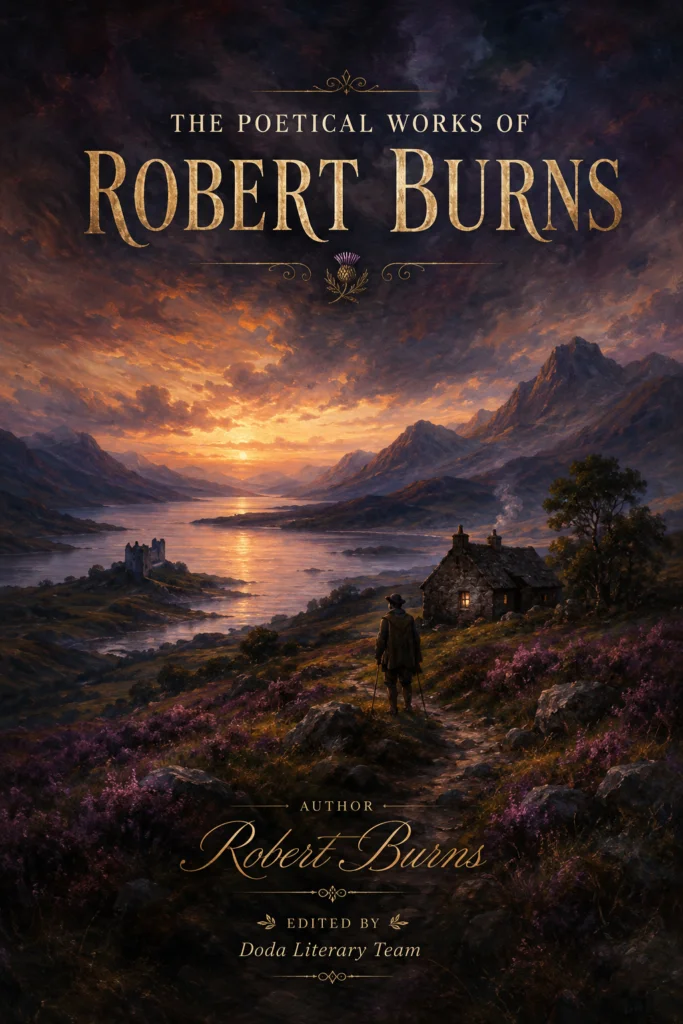
| Difficulty Level | Easy to Moderate |
| Starting Poem | “A Red, Red Rose” (4 stanzas) |
| Total Poems Recommended | 5 |
| Scots Vocabulary | Minimal in beginner picks |
| Reading Time per Poem | 2–10 minutes |
| Best Next Step | Annotated full collection |
🚀 Why Start Here?
Most people meet Robert Burns before they ever know his name — usually at New Year’s, when the whole world sings “Auld Lang Syne” at midnight. That is the perfect starting point for understanding him: Burns is a poet you already half-know, and the real barrier is not his ideas but his vocabulary. The five poems in this guide were chosen to remove as much of that barrier as possible while still introducing the genuine Burns — the farmer-poet who wrote about love, fate, and the way people treat one another.
Here is the honest secret: every Burns poem rewards you on a first read, even when you miss half the words. The feeling arrives through the rhythm and the music long before the dictionary does. These five simply get you to that reward fastest. Two are universal love poems, two are reflections on tiny creatures, and one is a rollicking ghost story — together they give you the full range of his voice: the romantic, the philosophical, and the mischievous.
If you want the bigger picture before you start, the complete guide to Robert Burns for beginners covers his life and career, and the summary of his themes and style shows you what to look for as you read.
1 🌹 “A Red, Red Rose”
Length: 4 stanzas (16 lines)
This is the safest starting point. Burns compares his love to a rose and promises it will last beyond time itself. The language is mostly modern English with only a few Scots words (luve for love, gang for go). It is a love poem that anyone can understand on first reading.
Key line: “And I will luve thee still, my dear, Till a’ the seas gang dry.”
2 🐭 “To a Mouse”
Length: 8 stanzas (40 lines)
This poem made the phrase “the best-laid schemes o’ mice an’ men” famous. Burns accidentally destroys a mouse’s nest with his plough and reflects on how both animals and humans suffer from unpredictable fate. You will need help with words like sleekit (sleek) and bide (stay), but the meaning is clear once you have them.
3 💔 “Ae Fond Kiss”
Length: 4 stanzas (32 lines)
A heartbreaking farewell poem. Burns wrote it for a woman he loved but could not be with. The repetition and rhythm make it easy to follow even where the vocabulary is unfamiliar. The emotion carries you through.
Key line: “Never met or never parted — We had ne’er been broken-hearted.”
📚 Want all 539 poems explained line by line?
👉 Get the Annotated Edition4 🍺 “Tam o’ Shanter”
Length: 22 stanzas (224 lines — but do not skip it)
This is Burns’s only narrative poem and his most entertaining. A farmer gets drunk, sees witches, and barely escapes. It is longer than the others but tells a story, which makes it easier to follow. The language is dense, so a line-by-line guide helps enormously.
5 🦟 “To a Louse”
Length: 8 stanzas (48 lines)
Burns sees a louse crawling on a fancy lady’s hat in church. He imagines what the louse would see if it could judge humans the way humans judge each other. It is funny, sharp, and one of his most accessible social commentaries.
Key line: “O wad some Pow’r the giftie gie us To see oursels as ithers see us!”
🏛️ A Little Context: Who Was the Farmer-Poet?
Robert Burns was born in 1759 in Alloway, Ayrshire, and spent most of his short life — he died at 37 — working farms that barely kept his family fed. He wrote between the chores, published his first collection in 1786, and became a celebrity in Scotland almost overnight. He lived at an extraordinary moment: the tail end of the Scottish Enlightenment, with the French Revolution and its talk of liberty and equality gathering force as his fame grew.
That background matters for these five poems even where it is not obvious. The ploughman of “To a Mouse” and “To a Louse” is Burns’s own self-image — the man of the soil who nevertheless sees further than the gentry. The egalitarian fire behind “A Man’s a Man for A’ That” burns quietly beneath even a love poem like “A Red, Red Rose,” which treats its beloved as an equal partner in a promise rather than an ornament. Scotland’s national poet was also the man who argued that a ploughman’s feelings were as worthy of verse as a lord’s, and these five poems are the gentlest door into that argument.
🧭 A Simple Method: Read Aloud, Then Look Up
The biggest mistake beginners make with Burns is reading silently, the way you would skim an article. Burns wrote songs — most of his poems were built around tunes — and they only reveal themselves when you hear them. Read each poem aloud once, without worrying about the words you do not know; the rhythm carries you. Then go back and look up the Scots vocabulary.
A three-step loop that works for all five poems:
- Read aloud once. Forget understanding; chase the music.
- Read again with a glossary. Find each unfamiliar word, then re-read the line with its meaning.
- Read aloud a final time. You will be surprised how much clicks into place once the words are supplied.
Do not force a poem in one sitting. “Tam o’ Shanter” runs 224 lines with a dense opening, and treating it as a weekend project — a stanza or two at a time — is far more enjoyable than bulldozing through it. When a passage still refuses to open, the stanza-by-stanza walkthrough of To a Mouse and the simple-English versions of Burns’s poems explain the trickiest lines in plain language.
✨ Why These Five Still Matter
These poems have never really left the language. “To a Mouse” gave John Steinbeck the title of Of Mice and Men, and its “best-laid schemes” warning is still shorthand for any plan that collapses. “Ae Fond Kiss” has been sung at farewells for more than two centuries. “Tam o’ Shanter” remains a landmark of comic storytelling that nobody has quite matched. And “To a Louse” gave the world one of its most quoted moral maxims: if only we could see ourselves the way other people see us.
Read together, these five are a complete introduction to everything Burns still offers — music, feeling, humour, and a steady, unsentimental eye on human nature. That is also why the format you read them in matters. Poetry needs marginal help the way a recipe needs clear notes, and a good first edition of Burns — original text kept intact, glossary beside it — doubles the value of twenty minutes of reading.
🎯 What the Annotated Edition Unlocks
539 Poems Annotated
Every poem from "A Red, Red Rose" to the obscurest epigram — with line-by-line explanations.
Scots Glossary
500+ Scots words defined and indexed. Find any word's meaning in seconds.
Teacher's Insights
Stanza-level commentary explaining what Burns is doing with language and structure.
Poem Summaries
Overview, historical context, key themes, and literary devices for every poem.
Historical Context
Explanations of the people, places, and events Burns referenced.
Beautiful Formatting
Colour-coded card design in EPUB 3, works on all major e-readers.
❓ Frequently Asked Questions
Which Burns poem should I read first?
Start with “A Red, Red Rose.” It is the shortest, uses the least Scots vocabulary, and has a universal theme that requires no historical knowledge to understand.
How long does it take to read these 5 poems?
About 20–30 minutes total, including looking up unfamiliar words. Without annotations, expect longer for “Tam o’ Shanter” (which runs 224 lines).
What if I find "Tam o' Shanter" too long?
Skip it and come back later. Read the other four first — they give you a solid sense of Burns’s range. “Tam o’ Shanter” is worth the effort, but you do not need it to start.
Do I need to know Scottish history to understand these poems?
Not for these five. “A Red, Red Rose” and “Ae Fond Kiss” are universal love poems. “To a Mouse” and “To a Louse” are about human nature. Only “Tam o’ Shanter” benefits from knowing a little about Scottish folklore.
What should I read after these 5 poems?
Move on to “A Man’s a Man for A’ That” (equality), “Address to a Haggis” (Scottish identity), and “Scots Wha Hae” (patriotism). Then try the full annotated collection for all 539 poems.
Where can I get line-by-line help for these poems?
The Poems and Songs of Robert Burns: Annotated Edition includes all five poems (and all 534 others) with full annotations, Scots translations, and Teacher’s Insights for every stanza.
What if I still struggle with the Scots vocabulary?
You do not need to master every dialect word. These poems run on a handful of recurring Scots terms (luve, gang, wee, blithe, a’). Look those up once and the whole poem opens up. The annotated edition’s 500+ word Scots glossary is indexed alphabetically, so you can find any of them in seconds while you read.
Are these poems meant to be read aloud or sung?
Both. “A Red, Red Rose” and “Ae Fond Kiss” were written as songs, and their regular metre makes them natural to sing or read aloud. “Tam o’ Shanter” is the opposite — comic storytelling meant to be performed by a voice. Whatever the poem, reading it aloud is the single fastest way to feel Burns’s rhythm working on you.