Everything you need to start reading Robert Burns — his best poems explained in plain English, a Scots glossary, historical context, and the best editions for beginners.
Robert Burns Complete Guide: Everything You Need
Everything you need to start reading Robert Burns — his best poems explained in plain English, Scots glossary, historical context, and the best editions for beginners.
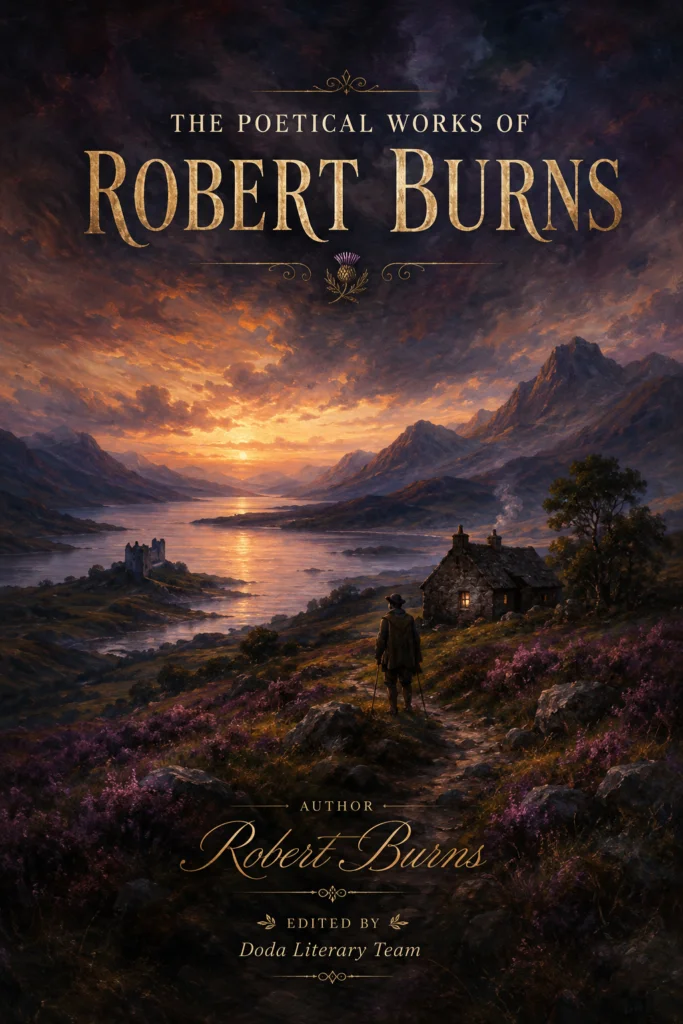
| Poet | Robert Burns (1759–1796) |
| Born | 25 January 1759, Alloway, Scotland |
| Died | 21 July 1796, Dumfries, Scotland |
| Language | Scots, English, Scots-English |
| Famous Works | “Tam o’ Shanter,” “Auld Lang Syne,” “A Red, Red Rose,” “To a Mouse” |
| Total Poems | 539 poems and songs |
| Celebration | Burns Night (25 January) |
📖 Who Was Robert Burns?
Burns was a farmer-poet who wrote in both Scots and English. He published his first collection, Poems, Chiefly in the Scottish Dialect, in 1786. The book was an immediate success, and Burns became a celebrity in Edinburgh society. He wrote about love, nature, politics, religion, and everyday life — ranging from tender love songs to biting political satire. He also collected and preserved hundreds of traditional Scottish folk songs.
🏡 The Life Behind the Poems
Burns was born on 25 January 1759 in a clay cottage in Alloway, Ayrshire, the oldest of seven children of a tenant farmer who worked himself into an early grave. The family rented farm after farm, and from boyhood Burns did the heaviest labour on them all — years of poverty that marked his health and fed his lifelong sympathy for the crofter and the creature underfoot. His father scraped together money for schooling, and Burns read far beyond his station: the Bible, Shakespeare, English poetry, and the songs and ballads of his own country, taken in by ear as much as by eye.
The farm never thrived and his private life was stormy. By the spring of 1786, facing scandal and emigration to Jamaica, he wrote in one astonishing summer the poems of that July’s Kilmarnock edition — Poems, Chiefly in the Scottish Dialect — which sold out almost immediately. He spent the winter of 1786–87 lionised in Edinburgh, tried farming again at Ellisland, failed, and in 1789 took the excise post he kept in Dumfries until his death in 1796, aged just 37. All the while he collected and rewrote Scottish folk songs for James Johnson’s Scots Musical Museum and George Thomson’s song collections, setting “Auld Lang Syne,” “A Red, Red Rose,” and “Scots Wha Hae” to old airs.
🏛️ Historical & Cultural Context: Two Scotlands in One Life
Burns wrote at the hinge of two realities. Lowland Ayrshire in his youth was still an old world — tenant farms, kirk sessions, fairs, superstition — yet the Enlightenment had reached Edinburgh, and the new age was remaking the country around him. Burns stood with one foot in each — a ploughman who read Adam Smith. The Jacobite cause had died at Culloden in 1746, and by the early 1790s his sympathy with the French Revolution was a genuine danger to his excise career; “A Man’s a Man for A’ That” was written in that risky air. The poems open up fast once the Scots is translated — which is why newcomers wonder why Burns’s language feels so foreign and why a glossary of the words he uses most unlocks a whole world.
🔥 Why Is Burns Hard to Read?
Burns wrote primarily in the Scots language, which shares vocabulary with English but has its own grammar, spelling, and idioms. Even poems that appear to be in English often contain Scots words or Scottish grammatical constructions.
For example, the opening of “To a Mouse”:
Original: “Wee, sleekit, cowran, tim’rous beastie”
Translation: “Small, sleek, cowering, timid little animal”
Without a glossary, modern readers lose the meaning and the music of the language.
❤️ Love, Nature, Equality, and Satire — the Big Ideas
Strip away the dialect and Burns becomes one of the most direct poets in the language. His love poetry runs the full register, from the radiant simplicity of “A Red, Red Rose” —
“O my Luve is like a red, red rose / That’s newly sprung in June”
— to the desolate farewell of “Ae Fond Kiss,” written from a real and broken romance. No poet of his age wrote so plainly about longing and loss.
His rural poems are never mere scenery. “To a Mouse,” written when a ploughshare carved through a field-mouse’s nest, turns the accident into a meditation on fear and the frailty of plans — and gave John Steinbeck the title of Of Mice and Men. Beneath the songs runs a fierce moral core: “Holy Willie’s Prayer” is a devastating monologue about religious hypocrisy, while “A Man’s a Man for A’ That” answers poverty with dignity and rank with merit. Satirist, sentimentalist, radical, and patriot — the full range is the man.
🎯 Best Poems for Beginners
Start with these 5 poems, which are shorter and have clearer themes:
- “A Red, Red Rose” — A love poem with simple, beautiful imagery. Most accessible for beginners.
- “To a Mouse” — A reflection on plans going wrong. The inspiration for Steinbeck’s Of Mice and Men.
- “Ae Fond Kiss” — A poignant farewell poem. One of Burns’s most emotional works.
- “Tam o’ Shanter” — A narrative poem about a farmer’s supernatural adventure. Longer but rewarding.
- “Address to a Haggis” — A humorous poem about Scotland’s national dish. Often performed at Burns Night.
📚 Want every poem explained line by line?
👉 Get the Annotated Edition🛒 Which Edition Should You Buy?
For serious readers, the Poems and Songs of Robert Burns: Annotated Edition is the best choice — all 600+ poems with line-by-line annotations, Scots translations, and historical context. It removes every barrier between you and Burns’s genius.
🎓 What the Annotated Edition Unlocks
539 Fully Annotated Poems
Every single poem and song from the canonical collection — from "A Red, Red Rose" to the obscurest epigram — with line-by-line explanations.
Scots Glossary
500+ Scots words defined (twa, bonie, braw, een, ken) with a cumulative index at the end of the book for quick reference.
Teacher's Insights
Commentary for every stanza explaining what Burns is doing — the literary devices, the tone shifts, and the emotional core.
Poem Summaries
Overview, historical context, key themes, and literary devices for every poem — perfect for revision or lesson planning.
Historical Context Notes
Explanations of the 18th-century Scottish references — people, places, scandals, and traditions that Burns assumed his readers knew.
EPUB 3 Format
Works on Kindle, Apple Books, Google Play Books, Kobo, and Foliate. Beautifully formatted with card-based design for easy navigation.
💭 Why Burns Still Matters
No other British poet keeps so many public lives. Every 25 January, Burns Night suppers from Aberdeen to Auckland raise a glass to the Immortal Memory with haggis and whisky; every Hogmanay, “Auld Lang Syne” carries his words round the world. He tops polls of the greatest Scot and gives his name to festivals and distilleries. Partly it is the politics — he believed, loudly and early, in the dignity of the poor. Partly the music — he rebuilt a nation’s songbook. And partly the openness: Burns never distils to a single mood, so every reader finds their own. Our review of the annotated edition gives an honest verdict on the full 539-poem collection.
🧭 How to Read Burns for Pleasure
Read Burns the way he meant to be heard: out loud. The Scots unlocks far faster when you hear the rhythm, and rhymes designed for song and recitation flatten in silent reading. Start with the love songs and short occasional poems, keep a glossary rather than a dictionary beside you — the words that defeat you (“sleekit,” “braw,” “gang,” “ken”) are the commonest ones — and try “Tam o’ Shanter” when you want him at full stretch. Our complete guide to starting Burns walks you through the order, and the annotated edition translates every line so the music never waits for the dictionary.
❓ Frequently Asked Questions
Who was Robert Burns?
Robert Burns (1759–1796) is Scotland’s national poet. He was a farmer-poet who wrote in both Scots and English, publishing his first collection in 1786. His poems cover love, nature, politics, and everyday life, and he also preserved hundreds of traditional Scottish folk songs.
Why is Burns hard to read?
Three reasons: the Scots vocabulary (words like sleekit, ken, braw, gang), the 18th-century Scottish references, and the dense imagery in longer narrative poems. An annotated edition solves all three barriers at once.
What are the best poems to start with?
Start with “A Red, Red Rose” (easiest), then “To a Mouse,” “Ae Fond Kiss,” “To a Louse,” and finally “Tam o’ Shanter” when you’re ready for a longer narrative poem.
What is Burns Night?
Burns Night is celebrated on 25 January, the poet’s birthday. It involves a traditional dinner with haggis, whisky, readings of Burns’s poetry (especially “Address to a Haggis”), and singing “Auld Lang Syne.”
How many poems did Burns write?
Burns wrote 539 poems and songs in his short life (he died at 37). This includes everything from famous works like “Tam o’ Shanter” to short epigrams and folk song collections.
What is the best edition of Burns for beginners?
The Poems and Songs of Robert Burns: Annotated Edition is the best choice for beginners. It includes line-by-line annotations, a Scots glossary, historical context, and teacher’s insights for all 539 poems.
Can I read Burns for free?
The original poems are in the public domain and available on Project Gutenberg. However, these plain text editions have no translations or context. An annotated edition includes hundreds of hours of editorial work to make Burns accessible.
Why is Burns called Scotland's national poet?
Because he wrote the songs and poems that still define Scottish identity — “Auld Lang Syne,” “Scots Wha Hae,” “A Man’s a Man for A’ That” — in the people’s own voice, mixing Scots and English. His birthday, 25 January, has been marked as Burns Night since 1801.
What is the difference between the Scots and the English in Burns's poems?
Scots is a language in its own right, not corrupted English, with its own vocabulary (“bonnie,” “ken,” “braw”), grammar, and sound. Burns wrote in both, and often switched between them on purpose — using Scots for warmth and home, English for formality and irony.
📚 Related Articles
For a grand Continental pilgrimage of romantic disillusionment, explore Lord Byron’s epic in our Childe Harold’s Pilgrimage Guide. To trace the full sweep of English poetic and prose masters from the medieval dawn through Victorian heights, explore Henry A. Beers’s From Chaucer to Tennyson Guide. To discover the heroic stoicism and private literary world of Scotland’s other literary titan, explore The Journal of Sir Walter Scott Guide. For passionate fin-de-siècle lyric poetry celebrating love and tragic devotion across the British Raj, explore our India’s Love Lyrics Guide.
🎯 Start Reading Burns Today
The Poems and Songs of Robert Burns: Annotated Edition gives you everything you need to enjoy Scotland’s greatest poet:
- ✅ All 539 poems — every word from the canonical collection
- ✅ Line-by-line annotations — Scots words translated on every page
- ✅ Teacher’s Insights — commentary for every stanza
- ✅ Cumulative Scots glossary — 500+ words indexed
- ✅ Beautiful EPUB 3 format — works on all major e-readers