The fully annotated edition of A Dog of Flanders transforms Ouida’s beloved classic into an enriched reading experience. Every chapter features colour-coded annotation cards with vocabulary definitions, historical context, literary analysis, and guided reading questions — making it perfect for students, teachers, and book clubs.
📖
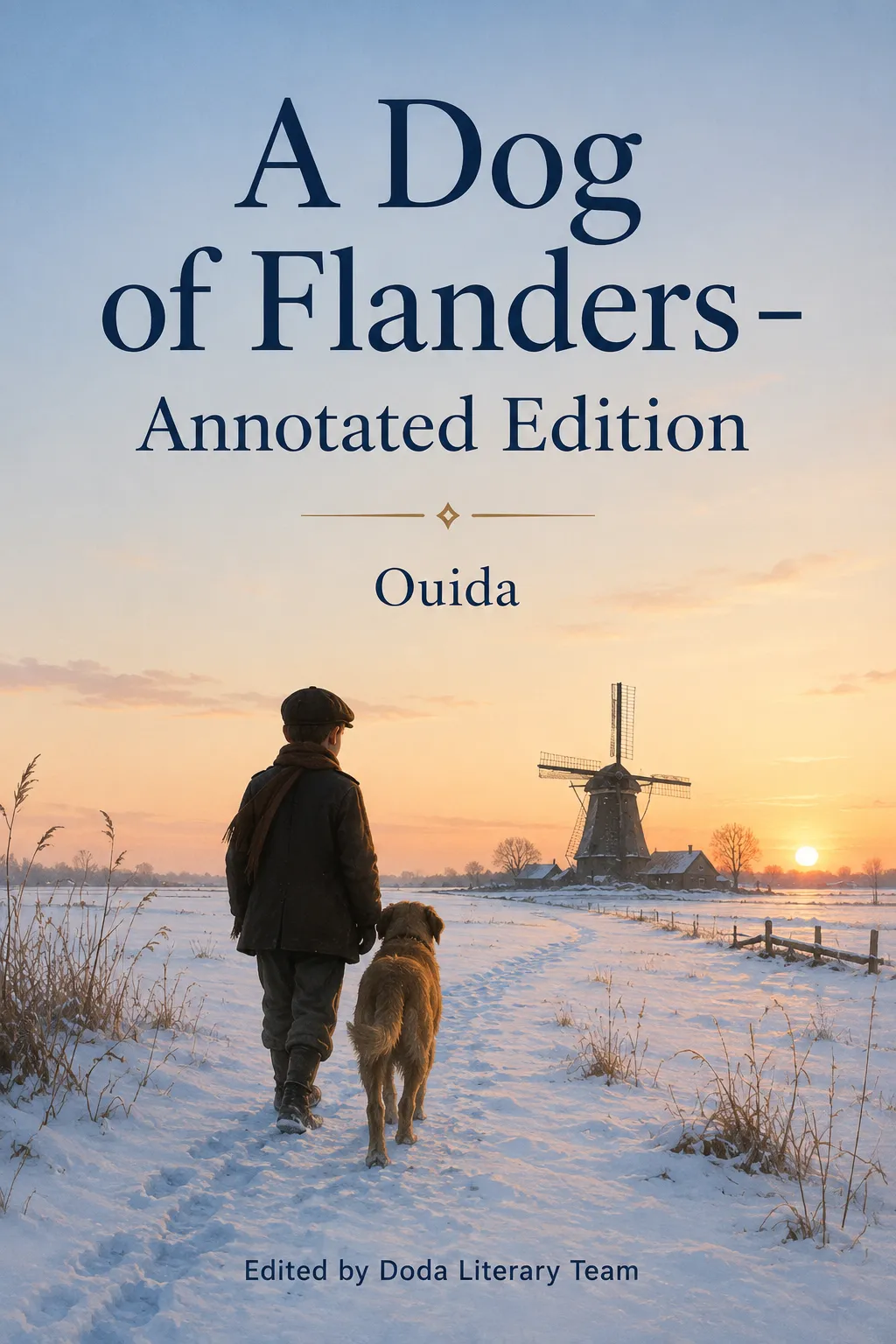
A Dog of Flanders: Fully Annotated Edition
The complete original story enriched with colour-coded annotation cards, vocabulary definitions, historical context, literary analysis, and discussion questions for every chapter.
| Author | Ouida (Marie Louise de la Ramée) |
| Published | 1872 (original) |
| Chapters | 4 (fully annotated) |
| Annotation Cards | Vocabulary, historical context, analysis, simplify, companion |
| Bonus Features | Character guide, glossary, discussion questions, quiz |
| Best For | Students, teachers, book clubs, deep readers |
🎯 What Makes This Edition Different
This isn’t just a clean text — it’s a complete guided reading experience. Every chapter of the 4-chapter novella is enriched with colour-coded annotation cards that sit alongside the original text, providing instant access to deeper understanding without breaking the flow of reading.
Vocabulary Cards
30+ archaic and difficult terms defined in context — no more reaching for a dictionary.
Historical Context Cards
Victorian-era background, Flemish setting, and the tradition of animal stories explained.
Analysis Cards
Deeper exploration of themes: poverty, art, loyalty, loss, and the bond between humans and animals.
Simplify Cards
Complex passages explained in clear, modern English for readers who find the original prose challenging.
Companion Cards
In-depth explorations of Ouida's life, the Rubens connection, the novel's reception, and its adaptation history.
Discussion Questions
Thought-provoking prompts for book clubs and classrooms, plus a 10-question comprehension quiz.
📖 What’s Inside
- Complete 4-chapter novella — the full original text faithfully preserved
- Colour-coded annotation cards — vocabulary, historical context, literary analysis, simplified passages, and companion explorations
- Post-chapter understanding — after every chapter, a recap section with reflection prompts and key takeaways
- Complete character guide — Nello, Patrasche, Jehan Nana, Baas Cogez, and all others profiled
- Glossary of 50+ terms — Flemish words, archaic English, and artistic terminology defined
- 12 discussion questions with thoughtful prompts for book clubs and classrooms
- 10-question quiz — test your comprehension with a detailed answer key
- Professional EPUB3 formatting — styled for clarity on all major e-readers
- No DRM — buy once, download instantly, keep forever
🐕 The Story: Nello, Patrasche, and a Boy’s Impossible Dream
If you’ve never read A Dog of Flanders, it may surprise you to learn how short and how devastating it is. (For a quick orientation, our plain guide to A Dog of Flanders walks through the plot and its legacy.) Written in 1872, it follows a poor orphan boy named Nello and his loyal draft dog Patrasche through the Flemish countryside. Nello lives with his grandfather, an old wheelwright, in a humble cottage near Hoboken, just outside Antwerp. Patrasche, rescued after being cruelly worked nearly to death, becomes the boy’s closest friend — carrying Nello’s milk to market and, as the boy grows, pulling his grandfather’s cart and providing the family’s only livelihood.
The story is anchored in a single, aching ambition. In the great Cathedral of Antwerp hangs a dazzling painting, Rubens’s The Descent from the Cross, and Nello — who has no formal schooling but a natural gift for drawing — longs to see it and to win the village’s annual drawing contest, whose prize is a place in the art academy. A kindly old painter recognizes Nello’s talent and gives him a few rudimentary lessons, but the boy is too poor to waste the day on drawings, and the contest means nothing to someone who must work to eat.
Tragedy crowds in from every side. His grandfather falls ill and dies, leaving Nello alone with Patrasche. Baas Cogez, a wealthy miller, suspects Nello of setting fire to his barn and turns the village against him; Nello is shunned and driven to the edge of starvation. In the devastating final chapter, caught in the snow on Christmas Eve, Nello finally enters the Cathedral and stands before the Rubens altarpieces he has dreamed of all his life — and there, in the presence of the beauty he could never reach, he and Patrasche die together of cold and exhaustion.
🎨 Themes: Poverty, Loyalty, Art, and Innocence
What makes the story endure is not its plot but what it keeps insisting on. Poverty and dignity are woven throughout: Nello is poor, but he is never diminished by it in his own eyes, and the novel asks us to see his worth even when the village refuses to. Loyalty and friendship are embodied in Patrasche, whose devotion to Nello is total — the dog asks nothing, gives everything, and becomes the truest companion in literature. Art versus rejection drives the tragedy: Nello’s one great gift is the very thing he cannot afford to cultivate, and his love of beauty stands in painful contrast to a world that has no room for it. Beneath it all runs innocence — a good boy destroyed by misunderstanding, poverty, and a community that never stops to look closely enough. Those are the exact threads the analysis cards in the annotated edition pick up and untangle.
🏛️ Historical & Cultural Context
To feel the story’s power fully, it helps to understand the world Ouida was writing in and about. The novella is set in 19th-century Flanders, and the real Antwerp — its soaring cathedral, its busy markets, its working dogs pulling milk-carts — grounds the fairy-tale simplicity in everyday reality. Ouida, an Englishwoman writing for an English audience, offered readers a glimpse of a foreign, rural Catholic world that felt both distant and romantic, and she gave it an animal-welfare message that echoed rising British concerns of the 1870s. The annotated edition’s historical-context companion cards lay all of this out — the Victorian mindset, the Flemish setting, and the animal-story tradition — before the tragedy lands.
❤️ Why This Story Still Matters
Nearly a century and a half on, A Dog of Flanders has been adapted into films, animated series, and cartoons around the world — and it is still the story that moves grown adults to tears. It matters because it refuses to soften its ending: it insists that goodness and love are real even when they are not rewarded, and that beauty is worth pursuing even when it cannot be reached. If you love stories in which loyalty and love shine through hardship, you’ll find a kindred spirit in Little Women, and readers interested in an earlier voice of longing and devotion will enjoy Eloisa alongside it.
📚 How the Annotated Edition Helps a Modern Reader
The gap between a Victorian reader and a modern one is real. Words like wheelwright and milestone need glossing, the rhythms of Ouida’s prose can feel stately to a new reader, and the cultural background is easy to miss. The annotated edition closes all of those gaps: it keeps the full original text, then adds the colour-coded cards exactly when you need them — a vocabulary card beside an unfamiliar word, a historical card beside the cathedral scene, a simplify card beside a knotty paragraph. A first-time reader can follow every emotional beat without tripping over the language, which is precisely what lets the tragedy land as Ouida intended.
👩 Who Was Ouida?
Ouida (1839–1908), born Marie Louise de la Ramée, was one of the most prolific and popular Victorian novelists. She wrote over 40 novels, often featuring romantic and melodramatic plots set in high society. A Dog of Flanders was unusual for her — a simple children’s story set among peasants — yet it became her most enduring work.
The annotated edition includes a companion card exploring Ouida’s fascinating life: her fierce independence, her love of animals, her financial struggles, and her eventual decline into poverty and obscurity despite her immense popularity.
🎨 The Rubens Connection
One of the most valuable features of the annotated edition is its exploration of the Rubens references that run through the story. Nello’s dream of seeing Rubens’s The Descent from the Cross in the Antwerp Cathedral is not just a plot device — it connects to the novel’s deepest themes about art, beauty, and transcendence.
The companion card on Rubens and Flemish painting provides context that enriches every scene set in the Cathedral, making the devastating final chapter even more powerful.
🏫 Perfect for Classrooms and Book Clubs
The annotated edition was designed with educators and discussion groups in mind. The colour-coded annotation system allows readers to engage with the text at their own level — younger readers can focus on vocabulary cards, while advanced readers can dive into the analysis and companion cards.
The 12 discussion questions cover:
- Character motivation and development
- Theme analysis (poverty, art, loyalty, loss)
- Historical and social context
- Literary devices and narrative technique
- Personal reflection and modern relevance
The 10-question quiz with answer key makes it easy for teachers to assess comprehension.
❓ Frequently Asked Questions
Is this the complete original story?
Yes. The full original text of Ouida’s 1872 novella is included. The annotations are added alongside the text, not as replacements.
How are the annotations organized?
Each annotation type has its own colour-coded card. Vocabulary cards might be blue, historical context gold, and analysis purple. This colour-coding makes it easy to find the kind of help you need at a glance.
Is this edition suitable for young readers?
Absolutely. The vocabulary and simplify cards make the original 1872 text accessible to modern readers aged 10 and up. The discussion questions and quiz are suitable for middle school and high school classrooms.
How is this different from the plain edition?
The plain edition offers the clean text with professional formatting. The annotated edition adds colour-coded annotation cards, a character guide, glossary, discussion questions, and a comprehension quiz — everything needed for deep understanding.
Is the ending as sad as people say?
Yes — and it is entirely true to Ouida’s intentions. Nello and Patrasche die together in the Cathedral on Christmas Eve. Rather than spoil it further, the annotated edition helps you arrive at that ending prepared: the analysis and historical cards build the context, and the discussion questions give you a constructive way to process the tragedy with a class or book group.
Do I need to know anything about Rubens before reading?
No. The annotated edition includes a companion card on Rubens and Flemish painting, so you understand who Peter Paul Rubens was, why The Descent from the Cross matters, and why it means so much to Nello — all before the cathedral scenes unfold.
📚 Related Articles
📚 Experience the Fully Annotated Edition
Everything you need to understand and appreciate Ouida’s classic:
- ✅ Complete 4-chapter text preserved in full
- 📝 Colour-coded annotation cards for every chapter
- 🌍 Historical context — Victorian era, Flemish setting, Rubens
- 💬 12 discussion questions and a 10-question quiz
- 📖 Glossary of 50+ terms and character guide
- 📥 Instant download — EPUB + PDF + AZW3 formats