Ouida’s A Dog of Flanders (1872) is among the most enduring animal stories ever written. Set in the Flemish village of Hoboken, it tells the story of Nello, a gentle orphan boy who dreams of becoming a painter, and his devoted dog Patrasche. Together they face poverty, cruelty, and heartbreak with unwavering loyalty and courage.
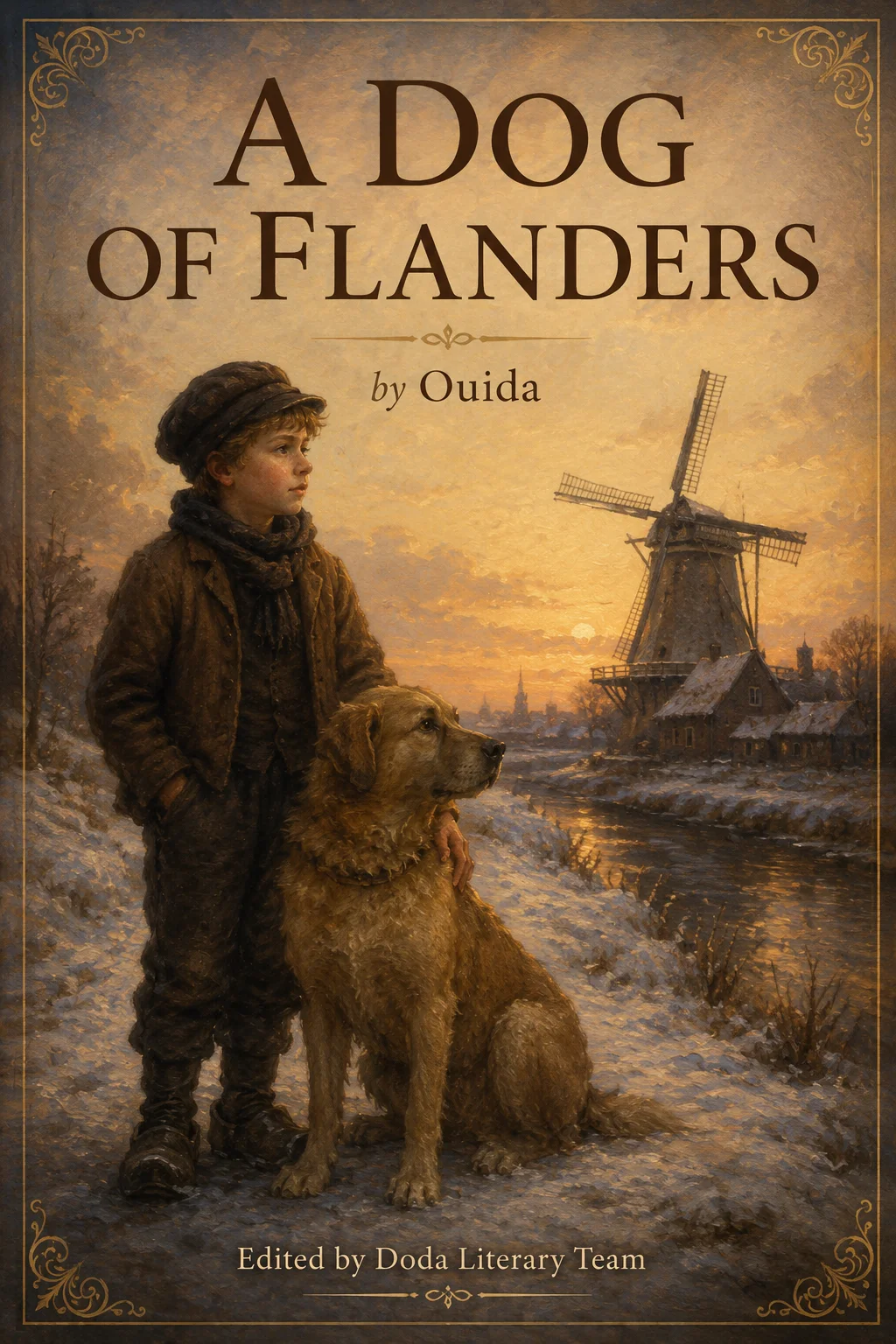
🐕
A Dog of Flanders
The beloved Victorian story of a boy, a dog, and a dream of art — set against the stark beauty of the Flemish countryside.
| Author | Ouida (Marie Louise de la Ramée) |
| Published | 1872 |
| Genre | Children’s fiction, animal story |
| Chapters | 4 |
| Setting | Hoboken, Flanders (Belgium) |
| Legacy | Adapted into numerous films and TV series |
🐕 The Story
Nello is an orphan boy living with his elderly grandfather, Jehan Nana, in a small cottage on the outskirts of Hoboken, a village near Antwerp. They are desperately poor — Jehan Nana sells milk from a cart pulled by their dog Patrasche, whom Nello rescued from abuse and near-death.
Patrasche repays Nello’s kindness with fierce devotion. Together, the boy and dog make their daily rounds through the village, delivering milk. Nello dreams of becoming a painter like his hero, the great Flemish artist Rubens. He draws constantly, using charcoal on scraps of paper, imagining the masterpieces he might one day create.
Nello’s talent catches the attention of the village artist, but poverty and bad fortune conspire against him. When his grandfather falls ill and dies, Nello is left alone with only Patrasche. A misunderstanding leads the villagers to blame him for a fire, and he is shunned. With no money and nowhere to turn, Nello and Patrasche wander the winter streets.
The story builds toward its famous, devastating conclusion — Nello and Patrasche take shelter in the Antwerp Cathedral before Rubens’s great painting The Descent from the Cross, the masterpiece Nello always dreamed of seeing. The ending, while heartbreaking, is also a testament to the power of loyalty and love.
🎨 Key Themes
Loyalty and Devotion
The bond between Nello and Patrasche is the emotional core of the story. Patrasche, once beaten and abandoned, finds in Nello a master who treats him with kindness. In return, Patrasche gives everything — pulling the milk cart through freezing winters, protecting Nello from harm, and ultimately refusing to leave his side even in death.
Art and the Dream of Beauty
Nello’s passion for painting is his escape from poverty. The Flemish masters, especially Rubens, represent a world of beauty and meaning beyond the harsh realities of his life. The novel uses art as a symbol of aspiration — the idea that even the poorest soul can be uplifted by beauty.
Poverty and Social Cruelty
Ouida does not romanticize poverty. The villagers are not kind; they are suspicious, quick to judge, and ultimately cruel. The story is a sharp critique of how society treats the poor and vulnerable.
📖 Literary Significance
A Dog of Flanders was immensely popular in its time and remained a staple of children’s literature for generations. It has been adapted into numerous films (most famously the 1975 animated version and the 1999 live-action film), television series, and even a Japanese anime.
The story’s appeal lies in its emotional honesty. Ouida does not spare her readers — the ending is genuinely heartbreaking. But she also celebrates loyalty, love, and the pursuit of beauty in the face of despair. The book has been translated into dozens of languages and continues to be read worldwide.
✨ What Makes the DodaBooks Edition Special
This is the original 1872 text, carefully prepared for modern readers without distractions or clutter.
Zero Distractions
No ads, no license pages, no project boilerplate — just the original story, clean and uninterrupted.
Smart Typography
Curly quotes, em-dashes, proper ellipsis — typeset with care for a premium reading experience.
Full Chapter Navigation
Complete table of contents with back-to-chapter links for easy navigation.
Foreword & Author Bio
Historical and literary context for the story, plus a biography of Ouida.
No DRM
You own your copy — read on any device, anytime, forever.
Instant Download
EPUB + PDF + AZW3 formats included, delivered instantly after purchase.
🏛️ Historical & Cultural Context
To understand the power of this little story, it helps to remember when it was written. Ouida — the pen name of the English novelist Marie Louise de la Ramée — published A Dog of Flanders in 1872, at the height of the Victorian fascination with animals, sentiment, and the lives of the poor. Animal stories were enormously popular in the nineteenth century, and writers from many countries were turning to dogs and horses as narrators or protagonists. Ouida herself had a deep, lifelong love of dogs, and that tenderness bleeds through every line about Patrasche.
The setting is real and carefully chosen. Hoboken, the village where Nello and Jehan Nana live, sits just outside Antwerp in Flemish Belgium, and Antwerp was the home of Peter Paul Rubens, the towering painter of the Flemish Baroque. The story’s deep roots in a specific place give it a documentary quality: the milk carts, the winter cold, the cobbled streets, and above all the great cathedral where The Descent from the Cross hangs are grounded in a landscape Ouida clearly knew and loved. It was this specificity that helped the story travel beyond England and become a beloved tale in Japan, where Patrasche and Nello became symbols of loyalty nearly as famous there as they are in Europe.
🎨 A Closer Look: Art, Rejection, and Innocence
If A Dog of Flanders were merely a sad tale about a boy and his dog, it would not have survived for a century and a half. Its durability comes from what it says about art and about human nature. Nello is not just poor; he is a born artist whose talent is never given a fair chance. He draws on scraps of paper with charcoal, longing to be a painter like his idol Rubens, and he pins his hopes on the annual drawing competition in Antwerp — the contest in which the winner would be admitted to the Academy. When the judges reject his entry, the blow is not merely professional but spiritual: it tells him that his one gift, the thing that made his poverty bearable, is worthless in the world’s eyes.
That rejection forces the reader to confront the story’s bleakest theme: talent and goodness are no protection against cruelty and misfortune. Nello is the most innocent character in the book, yet he is punished again and again — by poverty, by the death of his grandfather, by the unfair suspicion of his neighbors over a barn fire. Ouida refuses to cushion any of this. Her point is not that the world is always cruel, but that virtue too often goes unrewarded, and that it is the creatures who love without expecting anything in return — the boy and his dog — who carry the true dignity. Harnessing that idea to a child protagonist is exactly what makes the story so devastating to read.
💛 Why It Still Matters
A Dog of Flanders matters today for the same reason it mattered to readers in 1872: it is one of the purest literary tributes to loyalty ever written. The bond between Nello and Patrasche is almost wordless — Patrasche cannot speak, and his devotion is shown entirely through action, from pulling the milk cart through the freezing Flemish winter to refusing to leave Nello’s side when all hope is gone. In an age of screens and noise, that silent, absolute loyalty still lands with unusual force, which is why the story has been adapted into films, television series, and one of the most beloved Japanese anime adaptations of the twentieth century.
The book also continues to speak to readers through its uncompromising honesty. It does not pretend that good children are always saved, or that love conquers every obstacle. Instead, it argues something harder and more moving: that love is worth having even when it cannot change the ending. That is a mature lesson, and it is why so many adults who first met Nello as children return to the story and find it even more affecting than they remembered. If you are reading it for the first time, or want to study the themes more closely alongside a guided reading, our fully annotated edition guide walks through every chapter with analysis and discussion questions — the perfect companion to the story itself.
📖 How to Read This Story
At just four chapters and roughly eighty pages, A Dog of Flanders is designed to be read in a single sitting, and that is the best way to experience it. Give yourself an hour or two, find a quiet uninterrupted stretch, and let the story build its effect without pausing at chapter breaks. The pacing is deliberate: the early chapters establish the quiet rhythm of Nello and Patrasche’s life together — the milk round, the drawings, the small kindnesses — so that the later disasters hit with full weight. Resist the urge to hurry toward the ending; the novel’s power depends on you caring about the world before it falls apart.
If you are reading it with younger children, you may want to prepare them for the tone and read the final chapters together, since the emotional payoff is the whole point and deserves to be shared. Older readers will find their own rewards in paying attention to Ouida’s style: the way she weaves art and beauty through even the grimmest passages, and the quiet, almost painterly descriptions of the Flemish landscape. On a second reading, notice how often images of light, color, and the cathedral recur — they are the threads that tie the boy’s longing for Rubens to the story’s final scene. For those drawn to family sagas and tales of loyalty in hardship, our guide to Little Women and our exploration of Eloisa’s story offer similarly warm and emotionally rich reads.
❓ Frequently Asked Questions
Is A Dog of Flanders a true story?
No, it is a work of fiction. However, it is set in real locations (Hoboken and Antwerp, Belgium) and references real artists (Rubens) and real artworks.
Is it suitable for children?
Yes, but parents should be aware that the ending is very sad. It is most appropriate for ages 8 and up, and many adults find it deeply moving as well.
How long does it take to read?
At about 80 pages across 4 chapters, most readers finish it in 1-2 hours.
Why is this book so famous?
It is one of the most enduring animal stories in children’s literature, known for its emotional power and its celebration of loyalty between a boy and his dog.
Who is the old artist who encourages Nello?
Nello is befriended by a gentle, aging painter living near Hoboken who recognises the boy’s gift and encourages his drawing. His kindness briefly offers Nello a glimpse of a future as a painter — which makes the cruelty of his later rejection feel all the sharper.
What happens in the drawing competition?
Nello enters the annual Antwerp drawing competition, hoping to win a place at the Academy. Despite his genuine talent, the judges reject him — a devastating moment that strips away the one ambition that had made his poverty bearable, and sets the stage for the story’s tragic final chapter.
Why do Nello and Patrasche end up in the cathedral?
Driven out by poverty and unjust suspicion, Nello and Patrasche seek shelter in the Antwerp Cathedral on a freezing Christmas night. There Nello finally stands before Rubens’s great painting The Descent from the Cross, the masterpiece he had longed his whole short life to see — and finds his release beside it, with Patrasche refusing to leave him.
Why is the ending so sad, and is it worth it?
The ending is deliberately devastating — that is the source of the story’s fame. Yet readers return to it because the tragedy is in service of a profound celebration of loyalty: Patrasche chooses to stay with Nello even in death. It is a heartbreaking but strangely uplifting conclusion that has kept the book beloved for over a century.
📚 Related Articles
🐕 Read the Original Classic
A Dog of Flanders is one of the most beloved animal stories ever written. The DodaBooks edition preserves the complete original text in a clean, distraction-free format:
- ✅ Complete 4-chapter novella — every word of the 1872 edition
- ✒️ Smart typography — curly quotes, em-dashes, proper ellipsis
- 📜 Full table of contents with chapter navigation
- 📝 Foreword with historical context and author biography
- 🔒 DRM-free — read on any device, anytime
- 📥 Instant download — EPUB + PDF + AZW3 formats