A Honeymoon in Space follows British aristocrat Lord Redgrave, who kidnaps the woman he loves aboard his anti-gravity spaceship the Astronef — beginning a grand tour of the Solar System where each planet reveals astonishing civilizations and unsettling truths about humanity’s place in the cosmos.
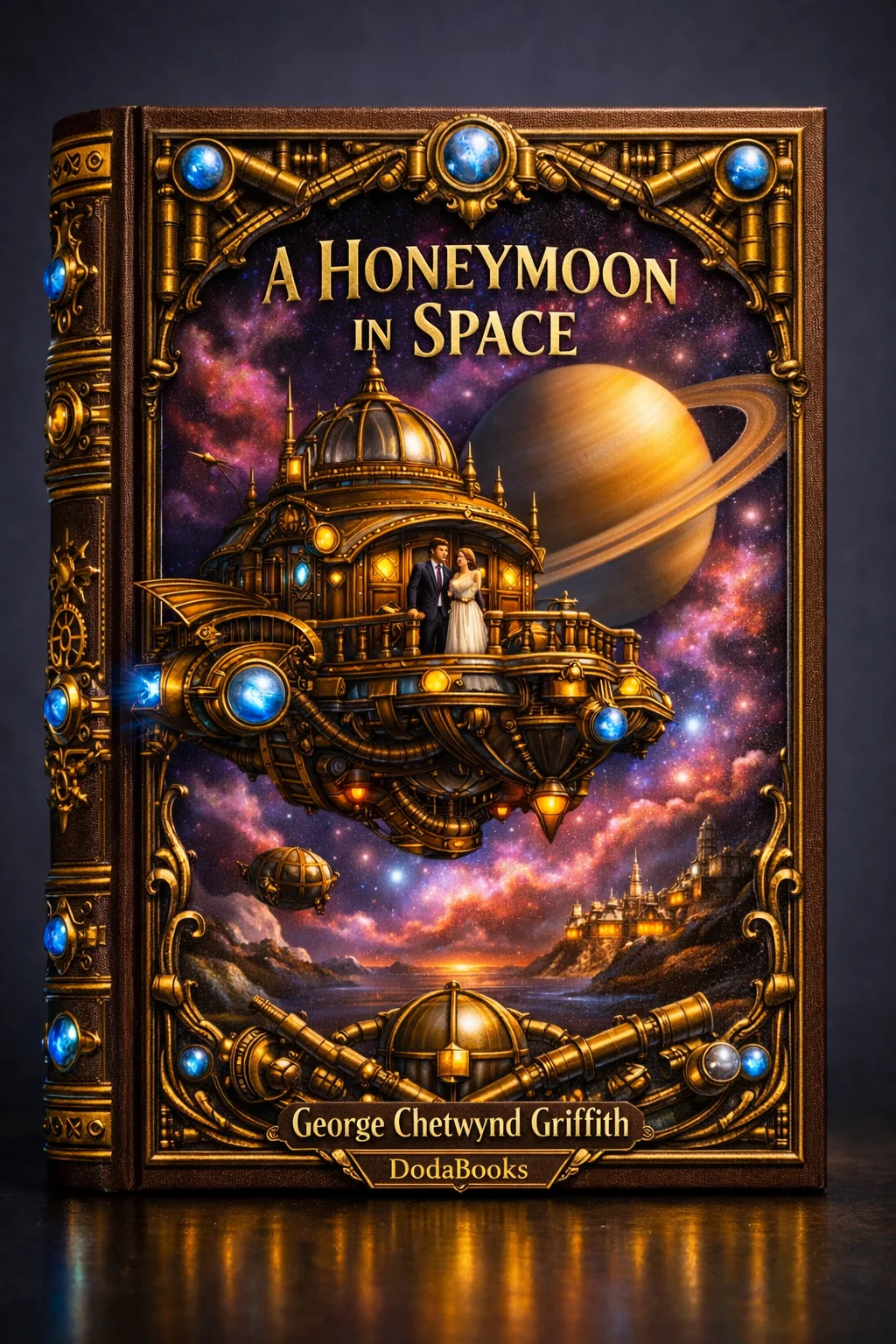
🚀
A Honeymoon in Space
A visionary Victorian space opera — when a brilliant inventor kidnaps the woman he loves and takes her on an interplanetary honeymoon across the Solar System in an anti-gravity spaceship.
| Author | George Chetwynd Griffith |
| Published | 1901 |
| Genre | Science fiction, space opera, romance |
| Chapters | 22 |
| Setting | The Solar System — the Moon, Mars, Venus, Jupiter, Saturn, and beyond |
| Legacy | One of the earliest space operas; remarkably prescient about space travel |
🚀 The Story
Lord Redgrave, a brilliant and enigmatic inventor, has perfected the ultimate vehicle — the Astronef, an anti-gravity spaceship capable of crossing the void between worlds. When he abducts the beautiful Miss Zaidie Rettick from Earth and marries her among the stars, their extraordinary honeymoon begins.
From the desolate ruins of the Moon to the intellectual giants of Mars, the sinless angels of Venus, and the bizarre creatures of Jupiter and Saturn, each stop on their cosmic journey reveals civilizations at every stage of evolution. But as they venture deeper into the solar system, they discover that the universe holds both wonders and dangers beyond imagination.
What follows is a breathtaking tour of the cosmos as the Victorians dreamed it — a universe filled with life, mystery, and moral complexity, where love and courage are tested against the vastness of space.
📖 Literary Significance
A Honeymoon in Space (1901) is one of the earliest examples of space opera — a genre that would later be defined by E. E. Smith, Edmond Hamilton, and the pulp magazines of the 1920s and 30s. Griffith published it just three years after H. G. Wells’s The War of the Worlds and one year before The First Men in the Moon, placing him at the very dawn of scientific romance.
What makes Griffith remarkable is his prescience. He imagined anti-gravity propulsion, space walks, interplanetary navigation, and the exploration of other worlds — all decades before such things became the stuff of serious scientific speculation. His Astronef anticipates the spaceships of later science fiction in remarkable detail.
The novel also reflects the Victorian fascination with evolution and progress. Each planet Redgrave and Zaidie visit represents a different stage of social and spiritual development — from the warlike Martians to the angelic Venusians — creating a cosmic hierarchy that mirrors Victorian ideas about civilization and morality.
✨ What Makes the DodaBooks Edition Special
This edition brings Griffith’s pioneering space opera back to life in a clean, distraction-free format.
Zero Distractions
No ads, no license pages — just the complete text, clean and uninterrupted.
Smart Typography
Curly quotes, em-dashes, proper ellipsis — typeset with care for a premium reading experience.
Chapter Navigation
Full table of contents with navigation to each of the 22 chapters — easily jump between them.
Cleaned & Polished
All Gutenberg boilerplate stripped, consistent formatting throughout the text.
No DRM
You own your copy — read on any device, anytime, forever.
Instant Download
EPUB format included, delivered instantly after purchase.
🚀 A Grand Tour of the Solar System
The engine of the book is the Astronef, the invented anti-gravity vessel that lets Lord Redgrave do what no one had done before: travel freely from world to world as though crossing a sea. That one technical conceit — a ship that cancels gravity and so can drift out of Earth’s atmosphere and glide between planets — unlocks everything that follows, and it is easy to forget how audacious it felt in 1901. Today we take interplanetary travel for granted; for Griffith’s original readers it was pure prophecy.
Each destination on the honeymoon tour is built around a single, vivid idea. The Moon appears as a desolate ruin-strewn world, the silent graveyard of a former civilization. Mars is home to intellectual giants, a people advanced far beyond humanity. Venus is peopled by beings who read as almost sinless and angelic — a nobility humanity aspires to but has not reached. Jupiter and Saturn, in turn, are populated by bizarre and monstrous creatures that suggest the foreignness of life under utterly different conditions. The pattern is deliberate: as Redgrave and Zaidie sail outward, each planet represents a different stage of evolution and a different answer to the question of what a civilization can become. Readers who enjoy this optimistic, wonder-filled vision of the cosmos may want to compare it with Burroughs’s rival Martian romance in our guide to Thuvia, Maid of Mars.
🏛️ The Edwardian Moment of Scientific Romance
A Honeymoon in Space appeared in 1901, a pivotal year that opened a new century and a new imaginative mood. Queen Victoria had died in January 1901, bringing the long Victorian era to a close; the Edwardian period that followed was one of fascination with technology, progress, and the possibilities of a world being remade by machines. It was the ideal atmosphere for what contemporaries called “scientific romance” — fiction that used emerging science, or plausible-sounding inventions, as the springboard for adventure.
Griffith worked in this vein alongside better-remembered names. H. G. Wells had published The War of the Worlds in 1898 and would publish The First Men in the Moon in 1901, and Jules Verne’s voyages extraordinaires had long made the genre respectable. What distinguishes Griffith is the sheer confidence and optimism of his vision. Where Wells often used space as a mirror for human folly, Griffith leaned into wonder — a cosmos teeming with life, peopled with civilizations both curious and grand, and fundamentally open to exploration. That celebratory energy is exactly why his novel reads as such an early, pure example of the space opera, and why it belongs on the shelf beside the genre’s pioneers. For another taste of the era’s escapist adventure, The Blue Lagoon offers a very different kind of romantic journey; see our guide to The Blue Lagoon for a comparison.
✨ Why a Century-Old Space Opera Still Matters
Two things make A Honeymoon in Space worth your time. The first is historical: it is one of the earliest space operas ever written, published at the dawn of the genre, and reading it is like watching a form discover itself. You can see the template — a capable hero, a romantic lead, a wondrous voyage, a universe full of marvels — being assembled almost in real time, long before the pulp magazines of the 1920s and 30s codified it. It is genuinely remarkable how much of later science fiction Griffith anticipated, from anti-gravity propulsion to space walks to interplanetary navigation.
The second reason is pleasure. The novel has a lightness and charm that its pessimistic successors often lack. Its premise is literally outlandish — a bridegroom who kidnaps, then wins, his bride among the stars — and it leans into that delight rather than apologising for it. As a window into how the early twentieth century dreamed about the future, it is both illuminating and hugely enjoyable. You meet its romantic sensibility again, writ large and stranger, in the swamp-and-princess worlds of Burroughs’s Martian adventure Thuvia, Maid of Mars, which shares its interplanetary romance and its sense of wonder.
🎓 How to Read It
The right approach is to read it as the escapist adventure of its moment, not as hard science fiction. Do not measure Griffith’s planets against later astronomy — the fun is in watching him imagine each world as a single evocative idea, from angelic Venus to monstrous Jupiter. Read briskly and let the tour carry you; the 22 chapters are short and designed to move. If you meet a passage of dense Victorian description, glide over it and keep going — the story is quick to reward you.
Because the book is short and light, it also makes a fine companion to the other classics of the era. If you enjoy the Victorian romance-and-adventure mode, The Count of Monte Cristo gives you the same larger-than-life energy on the ground, while G. K. Chesterton’s bizarre masterpiece The Man Who Was Thursday offers a stranger, more nightmarish take on the same adventurous decade.
❓ Frequently Asked Questions
Is this a romance novel or science fiction?
Both. The romance between Lord Redgrave and Zaidie Rettick is the engine of the plot, but the novel is primarily a work of visionary science fiction. Griffith uses their interplanetary honeymoon as a device to explore the solar system, much as Jules Verne used scientific expeditions to explore the Earth.
How accurate is the science?
It is remarkably prescient for 1901. Griffith imagines anti-gravity propulsion, space suits, and interplanetary travel decades before any of these were seriously considered. The astronomy is based on the best knowledge of the time, though the descriptions of civilizations on each planet are of course entirely fictional.
How does it compare to H. G. Wells's space stories?
Griffith’s vision is more optimistic and romantic than Wells’s. Where Wells imagined hostile Martians (The War of the Worlds, 1898) and grotesque lunar beings (The First Men in the Moon, 1901), Griffith portrays a universe filled with diverse civilizations, some more advanced than humanity. Both writers were pioneers of the scientific romance.
How long does it take to read?
At 223 pages across 22 short chapters, most readers finish in 4-6 hours. It is a wonderfully brisk read — the perfect introduction to early science fiction.
Is this connected to the Martian romances of Edgar Rice Burroughs?
No, it is not connected narratively — it predates Burroughs’s Barsoom series and belongs to the optimistic scientific-romance tradition rather than Burroughs’s swashbuckling pulp style. But readers who love the interplanetary romance of A Honeymoon in Space will find kindred wonder in our guide to Thuvia, Maid of Mars.
What is the romance in the title?
Lord Redgrave literally takes his new wife on their honeymoon into space. The marriage happens among the stars early in the book, and the rest of the novel is their voyage of discovery across the Solar System — a love story of its own and a tour of the cosmos in one.
Why is it called a space opera?
Space opera traditionally means adventurous, melodramatic science fiction on a grand scale — exactly what Griffith pioneered here. The term great adventure-and-romance in space captures his blend of a daring hero, a romantic lead, and a universe full of marvels.
📚 Related Articles
🚀 Read the Victorian Space Opera
A Honeymoon in Space is one of the earliest and most imaginative space operas ever written — a visionary tour of the solar system wrapped in a romantic adventure. The DodaBooks edition presents Griffith’s classic in a clean, distraction-free format:
- ✅ Complete 22-chapter text — every word of the classic novel
- ✒️ Smart typography — curly quotes, em-dashes, proper ellipsis
- 📜 Full table of contents with chapter navigation
- 🔒 DRM-free — read on any device, anytime
- 📥 Instant download — EPUB format