Teaching Pride and Prejudice to high school students comes with four predictable problems: the language feels foreign, the social rules are invisible, students check out, and the assessment workload is heavy. Here is why each problem exists and how a complete unit plan solves it.
Why Teaching Pride and Prejudice Is Hard (And How This Unit Fixes It)
The four biggest challenges teachers face when teaching Pride and Prejudice — archaic language, invisible social rules, student engagement, and assessment — and how a complete unit solves them.
| Challenge 1 | Archaic language barrier |
| Challenge 2 | Invisible social rules |
| Challenge 3 | Student engagement |
| Challenge 4 | Assessment workload |
| Solution | Complete novel study unit |
| Prep Time Saved | 15-20 hours |
🗣️ Problem 1: The Language Is a Barrier
Jane Austen wrote between 1796 and 1813. Her vocabulary, sentence structure, and grammar differ significantly from what modern teenagers read. Words like “condescension” (which meant polite behaviour toward inferiors) and “address” (meaning manners) regularly trip students up. Sentences routinely run 60-80 words with multiple embedded clauses.
How a unit fixes it: A complete novel study unit provides vocabulary lists with definitions specific to Austen’s usage. Close reading passages with annotation guides help students practise unpacking long sentences. Chapter summaries let struggling readers preview content before they read.
🎭 Problem 2: The Social Rules Are Invisible
Austen’s original readers already knew the social code — who could visit whom, why a woman could not propose, what “entailment” meant. Modern students miss these cues, which means they miss the drama. Without understanding entailment, Mr. Collins’s power over the Bennet family makes no sense. Without understanding reputation, Lydia’s elopement feels like a minor scandal rather than a family crisis.
How a unit fixes it: A pre-reading section with Regency England context handouts explains class structure, entailment, women’s legal status, and social etiquette before students open the novel.
😴 Problem 3: Students Struggle to Stay Engaged
The novel moves slowly by modern standards. The first volume establishes character and social dynamics but has no dramatic action. Students who do not understand the stakes will tune out well before Darcy’s first proposal.
How a unit fixes it: Discussion questions for every section give you ready-made prompts to check understanding and spark conversation. Deeper dive prompts push advanced students to think critically. The anticipation guide gets students debating statements before reading, giving them a personal stake in the novel’s themes.
📊 Problem 4: Assessment Creates a Grading Mountain
A full-novel unit can generate dozens of hours of grading. Writing quiz questions, building a final exam, grading essays, and tracking participation all take time that teachers do not have.
How a unit fixes it: Eight section quizzes, 3 volume quizzes, 3 vocabulary quizzes, a final exam, a quote identification test, and a character matching test are all included with complete answer keys. The 10 essay prompts come with a detailed rubric.
Stop building from scratch. The Pride and Prejudice Novel Study Unit solves all four problems with a single 182-page PDF.
📚 Language Support
50+ vocabulary words, annotation guides, and chapter summaries in plain language.
📖 Context Resources
18-page pre-reading section with Regency context, character tree, and locations map.
❓ Engagement Tools
Discussion questions, Socratic seminar prompts, debates, mock trial, and film comparison.
📝 Complete Assessments
20+ quizzes and tests with complete answer keys, plus 10 essay prompts with rubric.
✍️ Teacher Toolkit
Pacing guides, differentiation strategies, lesson plan template, and observation forms.
🎯 Answer Keys
Model answers for every question — 4-6 sentences with textual evidence throughout.
🧩 What a Complete Unit Actually Contains
It helps to map exactly how a full novel study unit flows, because each problem above is solved by a different part of the plan. The pre-reading phase is the answer to the invisible social rules: an 18-page context section explaining the Regency class system, entailment, women’s legal standing, and the etiquette of visits and calls. Students open the novel already knowing what a “settlement” means, why the Bennets face ruin, and why a man proposing to the wrong sister is a catastrophe rather than a minor annoyance.
The during-reading phase tackles both the language and engagement problems at once. Vocabulary lists keyed to the specific chapters where words appear, annotation guides for the long sentences, and plain-language chapter summaries for previewing — these carry the readers who would otherwise quietly give up. Alongside them, the discussion questions and Socratic prompts keep the whole class moving at the same pace and give you, the teacher, an easy way to check comprehension without a formal assessment.
The post-reading phase is where the unit’s assessment bank pays off. Eight section quizzes, three volume quizzes, three vocabulary quizzes, a quote identification test, a character matching test, and a final exam — all with complete answer keys — mean your marking is done before you assign a single paper. The ten essay prompts with a detailed rubric cover argumentative, analytical, and character-based writing, so you can differentiate the final task by class or by student.
📅 A Workable Three-Week Pacing
One of the biggest hidden costs of teaching Austen is simply figuring out a realistic schedule. A good pacing guide should tell you to spend the opening days on context and the first volume’s long setup, to front-load the discussion questions you will actually use, and to reserve the final stretch for the proposal scenes, the elopement fallout, and the essay or exam. A three-week plan breaks down naturally: Week One for context and Volume I, Week Two for Volume II and the Hunsford proposal, Week Three for Volume III, the climax, and assessment. The unit’s pacing guide lays out day-by-day reading targets, so you are never guessing how much to assign before the weekend. For a closely related plan you can adapt side by side, our unit-plan guide walks through scheduling and differentiation in more detail.
🎭 Making the Novel an Event, Not a Reading Task
The single biggest lever on student engagement is turning Austen’s world into something students can do. The anticipation guide gets them taking a position on the novel’s key questions before they read a word — is it wiser to marry for security or love? — which gives them a personal stake in the debate. Once you are several chapters in, the character hot seat activity makes students embody Elizabeth or Mr. Darcy and answer questions from the class in character. The marriage market simulation is the standout: students are assigned rank, income, and property, and discover the constraints Elizabeth and Charlotte Lucas operate under by living them. Teachers consistently report these activities convert students who had written Austen off as “boring.” Our classroom activities collection has more ideas you can drop straight into a period.
📖 Pairing the Unit with an Annotated Edition
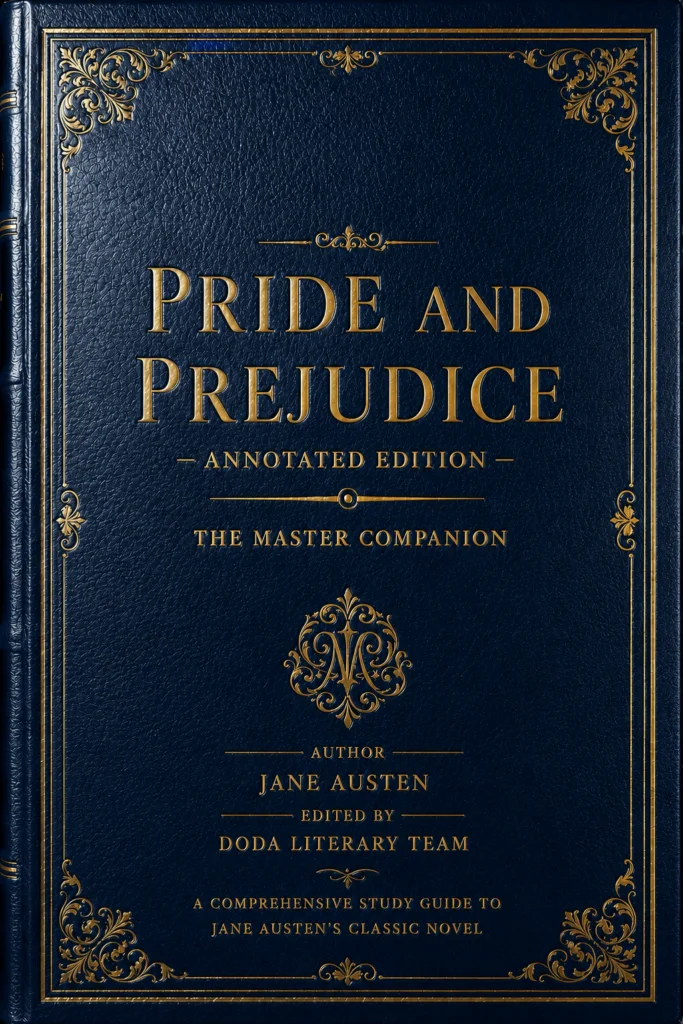
The unit works on its own, but it is at its strongest beside the annotated edition. The unit gives you the teaching architecture — the quizzes, prompts, rubrics, and pacing — while the annotated edition gives students the same passages explained at the chapter level, with Regency vocabulary and cultural notes placed right where they hit them. That pairing means the teacher and the text are pulling in the same direction: struggling readers can lean on the notes without feeling singled out, and advanced students can go beyond them into the deeper-dive questions. If you are still deciding which text to use with your class, our guide to the annotated edition compares it against plain reprints and student editions.
🎓 A Note on Differentiation
No class is uniform, and one virtue of a pre-built unit is that it arrives with the differentiation thinking already done. For struggling readers, plain-language summaries and the language-support vocabulary lists lower the floor. For advanced students, the deeper-dive prompts and the ten essay prompts with a rubric raise the ceiling — they can be asked to write comparatively or analytically while the rest of the class works on comprehension. Because the quizzes and tests are keyed to the whole text but the essay prompts are varied, you can comfortably teach one novel to a mixed-ability class without building three separate lessons. For more on this, our piece on differentiating Pride and Prejudice for struggling and gifted learners digs into strategy specifics.
❓ Frequently Asked Questions
Is a unit study worth it if I only teach the novel once?
If you teach Pride and Prejudice as a one-off, a complete unit still saves 10-15 hours of prep time — at $19.99, that's roughly $1.50 per hour saved.
How does the unit handle the language barrier specifically?
It provides vocabulary lists with Regency-specific definitions, close reading passages with annotation guides, and chapter summaries in plain language for previewing.
What engagement strategies work best for reluctant readers?
The anticipation guide, character hot seat, and marriage market simulation are particularly effective for hooking reluctant students.
How much grading time do the answer keys save?
Most teachers report saving 5-8 hours on grading alone, since model answers are provided for every question rather than just the multiple-choice sections.
Can I use this with an annotated edition?
Absolutely. The unit pairs perfectly with the annotated edition, which provides chapter-by-chapter explanations of the same passages.
How much class time does a full unit need?
A three-week plan is the sweet spot for most courses: a week on context and Volume I, a week on Volume II, and a final week on the climax, close reading, and assessment. The unit's pacing guide breaks it into day-by-day targets so you can shorten or extend it without rebuilding anything.
Does the unit cover the language barrier for ELL students too?
Yes. The vocabulary lists, plain-language chapter summaries, and annotation guides are designed to support readers who need more scaffolding, including ESL and ELL students. The differentiation notes suggest specific strategies for those classrooms.
Are the quizzes and essay prompts editable for my school's standards?
The unit is designed to be adapted — the assessments map onto common standards, and a guide to aligning them to your own outcomes is included, so you can adjust grading weight or prompts without starting over.
📚 Related Articles
Stop Struggling — Get the Complete Unit
- Solves all four teaching challenges
- Saves 15-20 hours of prep time
- Complete answer keys included
- Ready to print and use today