Teaching Pride and Prejudice to high school students? This 8-week unit plan gives you chapter lessons, discussion questions, and assessments for grades 9-12 ELA.
How to Teach Pride and Prejudice: Complete Unit Plan
A ready-to-use 8-week Pride and Prejudice teaching plan with daily lessons, discussion questions, assessments, and differentiation strategies for grades 9-12 ELA.
| Novel | Pride and Prejudice by Jane Austen |
| Suggested Duration | 8 weeks |
| Grade Level | 9-12 ELA |
| Total Chapters | 61 |
| Unit Pages | 182 |
| Assessment Types | Quizzes, essays, exams, Socratic seminar |
📅 Week 1: Pre-Reading & Context
Before students read a single word of Austen, they need to understand the world she wrote about.
Day 1 — Anticipation Activity: Start with a discussion about first impressions. Ask students: “Has anyone ever judged you based on a first impression? Were they right or wrong?” This connects the novel’s central theme to their own experience.
Day 2 — Historical Context: Cover the basics of Regency England — the class system, entailment (why the Bennet daughters can’t inherit), and what “proper” behaviour meant for women.
Day 3 — Meet the Characters: Introduce the Bennet family tree and the key players. The Darcy vs. Wickham dynamic is especially important to flag early.
Day 4 — Vocabulary Preview: Pre-teach 10-15 challenging words from Volume 1. Words like “condescension” (which meant polite, not patronising) and “address” (meaning manners or behaviour) will trip students up if they use modern definitions.
📖 Weeks 2-3: Volume 1 (Chapters 1-23)
Read 3-4 chapters per day. Focus on the famous opening line, Mr. Bingley’s arrival, Elizabeth’s first impression of Darcy at the Meryton assembly, and Jane’s illness at Netherfield.
Key discussion questions:
- Why does Mrs. Bennet care so much about her daughters marrying rich men?
- Is Darcy proud, shy, or both? What evidence supports each interpretation?
- Why does Charlotte Lucas marry Mr. Collins? Was it a practical choice or a betrayal of friendship?
💍 Week 4: Volume 2, Chapters 1-10
The action shifts to Hunsford and Rosings. This week covers Darcy’s proposal — the emotional climax of the novel. Spend extra time on the proposal scene. Have students read it aloud and discuss why Darcy’s proposal is so insulting even though he’s saying he loves her.
✉️ Week 5: Volume 2, Chapters 11-19 + Volume 3, Chapters 1-5
Darcy’s letter changes everything. Elizabeth reads Darcy’s letter — a turning point in her character arc. Elizabeth and the Gardiners visit Pemberley. Lydia runs away with Wickham.
Writing assignment: Have students write a journal entry from Elizabeth’s perspective after reading Darcy’s letter.
💔 Week 6: Volume 3, Chapters 6-16
The resolution. Darcy’s role in finding Lydia and Wickham. Bingley and Jane get engaged. Lady Catherine’s confrontation with Elizabeth. Darcy proposes again — and is accepted.
📝 Week 7: Volume 3, Chapters 17-19 + Review
The final chapters and wrap-up. Each sister’s fate. The relationship between Darcy and Elizabeth at the end. Mr. Bennet’s regrets. Use character matching, quote identification, and timeline sorting to prepare for the final assessment.
🎯 Week 8: Final Assessment
Day 1: In-class essay — choose from prompts about pride, prejudice, marriage, or class.
Day 2: Multiple-choice exam covering plot, character, theme, and vocabulary.
Day 3: Return essays with feedback. Discuss what students learned.
Ready to teach without the prep? The Pride and Prejudice Novel Study Unit includes 182 pages of printable resources — chapter summaries, quizzes, essay prompts, answer keys, and a full teacher toolkit.
📚 Pre-Reading Materials
18 pages of anticipation guide, author timeline, Regency context, character tree, locations map, and 50+ vocabulary words.
📖 Chapter Summaries
All 61 chapters summarised in plain language for previewing or struggling readers.
❓ Discussion Questions
6 comprehension + 3 analysis questions per section with complete model answers.
📝 Quizzes & Tests
8 section quizzes, 3 volume quizzes, final exam, quote ID test, and character matching — all with answer keys.
✍️ Essay Resources
10 essay prompts with 4-criteria rubric, plus 2 sample essays with teacher commentary.
🎭 Speaking Activities
Socratic seminar, debates, mock trial kit, and film adaptation comparison guide.
📅 Why an 8-Week Arc Works
Teaching a full novel like Pride and Prejudice in high school lives or dies by pacing, and the 8-week arc above is designed to do one thing most units get wrong: it builds momentum toward the emotional climax rather than burning out early. The first two weeks are deliberately about context and first impressions — because Austen’s world is genuinely foreign to modern teenagers, and the novel’s entire comedy depends on readers understanding what is at stake for the Bennet daughters.
The middle weeks are structured in three distinct phases: the setup (Volume 1, where first impressions form), the crisis (Darcy’s proposal and his letter, which shatter Elizabeth’s certainties), and the resolution (Lydia’s scandal, Pemberley, and the second proposal). Each phase asks a different kind of question, so students are never doing the same thing for eight weeks straight. If you are new to the book entirely, you might want our guide to what makes teaching P&P hard before you build your calendar — and if you are pressed for time, this same argument for planning in advance is what saves you hours of lesson planning.
🎓 The Shape of a Strong Lesson
Regardless of where you are in the unit, every lesson benefits from the same three-movement shape. Open with a hook that raises the stakes — a provocative question, a short passage to react to, or a character dilemma to weigh in on. Then move into the reading and close work, where students annotate a short selected passage rather than passively skimming. Finally, close with a discussion or application that pulls the day’s discovery into a broader pattern — how this scene advances Elizabeth’s arc, or how a modern situation echoes a Regency one.
Keeping that rhythm consistent has a surprisingly strong effect on engagement. Students stop waiting to be told the answer and start expecting to do the interpreting themselves. The slow chapters — the parsonage at Rosings, the country-house visiting — become far more bearable when students are hunting for evidence of character rather than just advancing a plot they already know. For a full bank of ready-made activities that fit this kind of lesson, our collection of Pride and Prejudice classroom activities is a good starting point.
📝 Assessment That Teaches
The most common mistake in teaching any classic is to treat assessment purely as a final exam. The unit plan above spaces assessment throughout precisely because Austen’s novel rewards re-reading and revision. Section quizzes keep students honest about the details; the writing assignments — like the journal entry from Elizabeth’s perspective after Darcy’s letter — build empathy and close reading at the same time; and the final essay asks students to synthesize a whole-novel argument.
The key is to make every assessment do teaching work, not just grading work. A quick quote-identification quiz at the start of a class, for example, is a five-minute retrieval exercise that firms up memory and gives you a fast read on who is keeping up. If you want to see the full suite of quiz, essay, and test options — and how to weigh them — our guide to assessing P&P with quizzes, essays, and tests lays out the options and the trade-offs between them.
💬 Discussion That Gets Everyone Talking
Discussion is where Pride and Prejudice comes alive, because almost every scene is a debate about motives and judgments. The questions that work best are the ones with no tidy answer: Was Charlotte’s marriage to Mr. Collins sensible or self-betraying? Is Darcy proud, shy, or both? Does Elizabeth really change, or does Darcy simply become what she wants? Questions like these divide a room and make students defend their reading with evidence.
To avoid the same three students dominating every conversation, use think-pair-share and small-group jigsaws before whole-class discussion, so quieter students have rehearsed their ideas. And let students disagree in a structured, courteous way — Austen’s whole method is to make the reader revise a first impression, and a good discussion re-enacts that. If you want a ready-made set of prompts with model answers, our free discussion questions for the classroom were built for exactly this part of the unit.
🧩 Differentiation Without Extra Prep
A grade 9-12 classroom is a wide range of readers, and differentiation built into the planning saves you from scrambling later. The unit handles this in layered ways: chapter summaries for struggling readers and for previewing, close-reading passages everyone can annotate, and higher-order essay prompts for students ready to push further. Because the resources include answer keys and model answers, you can differentiate by scaffolding — giving some students more structure, others more independence — without creating a second set of materials from scratch.
The simplest lever is reading role: assign the same chapter to everyone, but let students take on different jobs — summarizer, questioner, evidence-finder, connector. It keeps a mixed-ability class reading the same text while letting each student work at a level that stretches them. If you are teaching this for the first time and want to see how another early-career teacher structured the whole arc, our first-year teacher’s unit plan is a useful companion to this one.
❓ Frequently Asked Questions
How long should each reading session be?
Aim for 20-25 minutes of in-class reading or assign as homework. Break longer chapters across two sessions.
What if students don't do the reading?
Use chapter summaries as a read-aloud at the start of class. Students who read can contribute text evidence; those who didn't at least know the plot.
How do I keep students engaged through slower chapters?
Use close reading passages — pick one paragraph per chapter and have students annotate it together. The novel study unit includes pre-selected passages.
Can I adapt this for a shorter timeline?
Yes. The unit includes 4-week, 6-week, and 8-week pacing guides. Use the 4-week guide for accelerated classes.
Do I need to create answer keys myself?
No. The complete unit includes answer keys for every question — comprehension, analysis, quizzes, and exams.
What grades is this unit designed for?
Grades 9-12. The unit includes differentiation strategies for struggling readers, ELL students, and advanced learners.
Does this align with Common Core standards?
Yes. The unit covers 30+ CCSS ELA standards across reading, writing, speaking and listening, and language domains.
Should I use an annotated edition in the classroom?
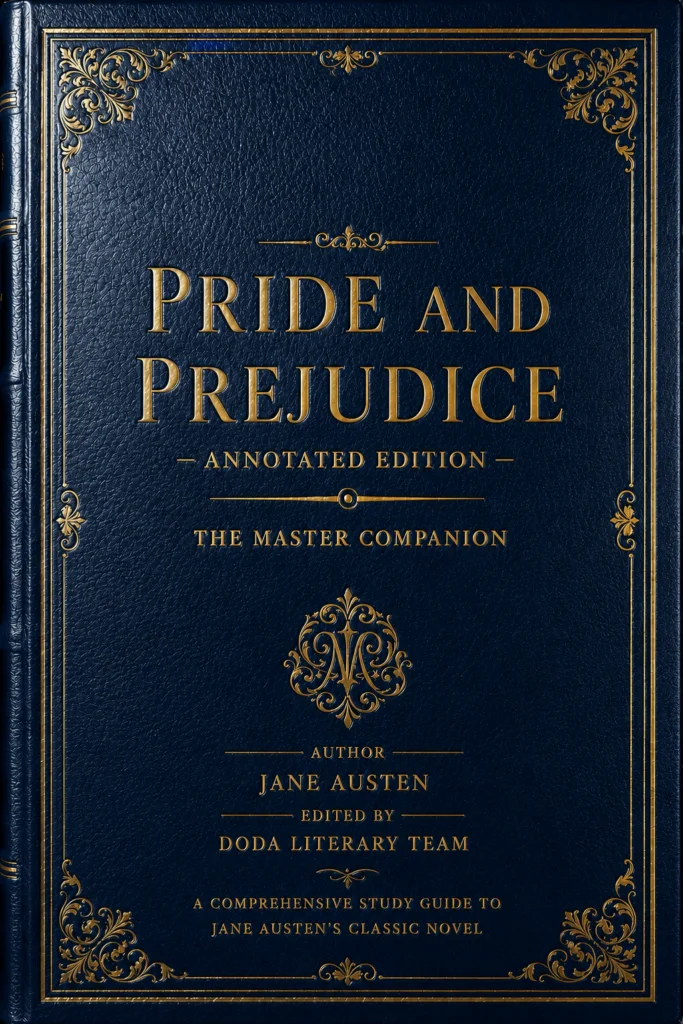
It helps enormously. The annotation edition of Pride and Prejudice keeps vocabulary and historical references inline, so students spend less time decoding and more time discussing. This is especially useful for the volume of social nuance in Austen's prose.
How do I handle the famous first line?
Spend a full lesson on it. "It is a truth universally acknowledged, that a single man in possession of a good fortune, must be in want of a wife" is ironic, satirical, and sets up the whole novel. Have students unpack what it claims versus what the novel actually shows.
What if my semester is shorter than 8 weeks?
Use the 4-week guide and prioritise the scenes that matter most: the Meryton assembly, Darcy's proposal, the letter, Pemberley, and the final proposal. The pre-reading context can be condensed into one strong lesson.
📚 Related Articles
Get the Complete Pride and Prejudice Novel Study Unit
- 182 pages of printable classroom materials
- Complete answer keys for every question
- 8-week, 6-week, and 4-week pacing guides
- Teacher toolkit with trackers and rubrics