The top 10 Robert Burns poems explained simply — each one summarised in plain English with its key theme and a famous line. These are the poems most readers encounter first.
Top 10 Robert Burns Poems Explained
The top 10 Robert Burns poems explained simply — each one summarised in plain English with its key theme and famous line. These are the poems most readers encounter first, representing Burns's full range.
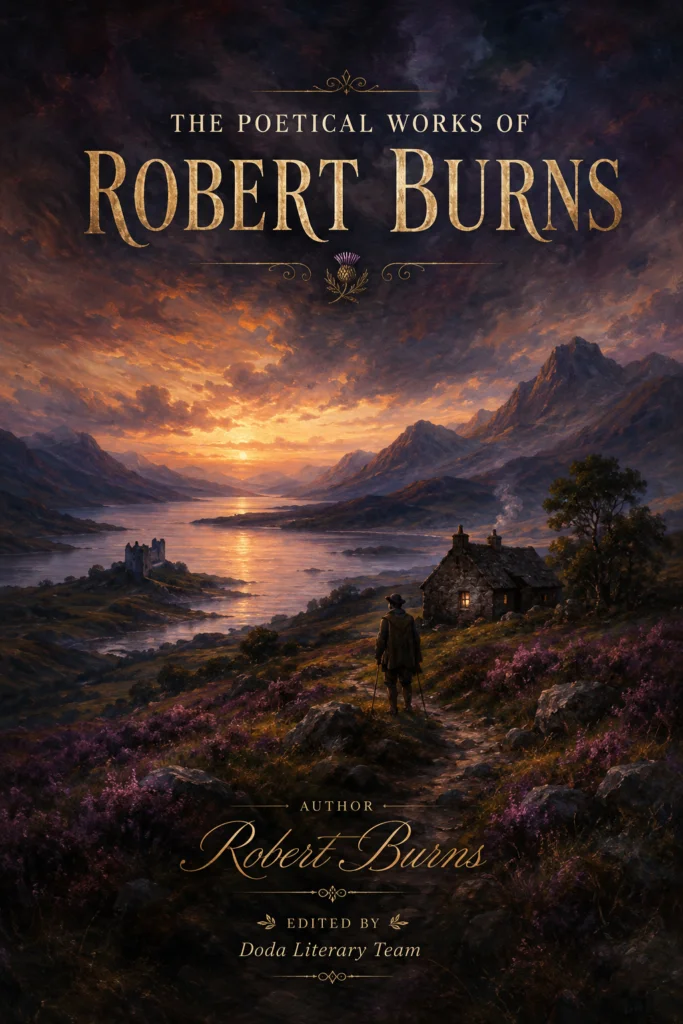
| Poems Covered | 10 most famous works |
| Range | Love, satire, patriotism, humour |
| Difficulty | Easy to Moderate |
| Total Reading Time | ~45 minutes |
| Best Known | “A Red, Red Rose” |
| Most Celebrated | “Auld Lang Syne” |
🎯 Why These Ten Poems
Any list of Burns’s “top ten” is a judgement call, and another reader would happily argue for a different selection. So it helps to be honest about how this one was chosen. The ten poems below were picked to do two jobs at once: they are the works you are most likely to meet in anthologies, on Burns Night, and in casual conversation, and they span the full range of what Burns could do with language. There is a love poem, a satire, a narrative of the supernatural, a meditation on fate, a patriotic ballad, and a comic address to a pauper’s dinner. Read the whole set and you will have a fair picture of the man: tender, rowdy, devout, sceptical, fierce about justice, and endlessly playful with words.
A word on difficulty. If you are new to Burns, do not judge all of these by “To a Mouse” or “Tam o’ Shanter,” which lean heavily on Scots. For a gentler on-ramp, our guide to the best Robert Burns poems for beginners walks through shorter, clearer pieces first.
1 🌹 A Red, Red Rose
Theme: Eternal love
Famous line: “O my Luve is like a red, red rose”
Burns compares his love to a rose and promises it will outlast the earth itself. Short, beautiful, and unforgettable. The poem builds by stacking similes — the rose, the melody — before stretching its promise across all of space and time. It is one of the few Burns poems a beginner can read without a glossary, which is why so many people fall in love with him here.
2 🐭 To a Mouse
Theme: Fate and misfortune
Famous line: “The best-laid schemes o’ mice an’ men gang aft agley”
Burns destroys a mouse’s nest with his plough and reflects on how all creatures — human and animal — suffer from unpredictable fate. The famous line about plans going awry gave John Steinbeck the title Of Mice and Men and has passed into everyday speech. What makes the poem more than a sentimental shrug is its hard concession: the mouse has only the present to fear, while human beings carry memory and foresight, which Burns calls “backward-bending pains and sorrows.” We have it worse, and he knows it. Our plain-English walkthrough of To a Mouse untangles the trickiest stanzas line by line.
3 🍺 Tam o’ Shanter
Theme: Consequences of excess
Famous line: “Wi’ tippenny, we fear nae evil”
A drunken farmer stumbles into a witches’ coven and barely escapes. Burns’s only full-length narrative poem, written in one furious sitting in 1790, and arguably his greatest single work. It drags you along on Tam’s horrified flight from Alloway Kirk with the witch Nannie close behind. The comedy and the terror are inseparable, which is the whole trick.
📚 Explore all 539 poems with full annotations
👉 Get the Annotated Edition4 💔 Ae Fond Kiss
Theme: Lost love and parting
Famous line: “Never met or never parted — We had ne’er been broken-hearted”
A gut-wrenching farewell to Agnes McLehose, the woman he loved but could not keep.
5 ⚖️ A Man’s a Man for A’ That
Theme: Human equality
Famous line: “The honest man, though e’er sae poor, is king o’ men for a’ that”
Burns’s radical statement that character matters more than wealth or birth. Published near the end of his life and in the aftermath of revolution, the poem has been adopted as an unofficial anthem of equality — it was even sung at the opening of the Scottish Parliament.
6 🦟 To a Louse
Theme: Self-awareness and humility
Famous line: “O wad some Pow’r the giftie gie us To see oursels as ithers see us”
A louse crawling on a fine lady’s hat becomes a lesson about vanity and perspective.
7 🏴 Address to a Haggis
Theme: Scottish identity
Famous line: “Great chieftain o’ the pudding-race!”
A hilarious and proud tribute to Scotland’s national dish. Burns at his most Scottish.
8 🙏 Holy Willie’s Prayer
Theme: Religious hypocrisy
Famous line: “I bless and praise Thy matchless might” (spoken by a deeply corrupt man)
A savage satire of a church elder who thinks he is saved while everyone else burns.
9 👴 John Anderson My Jo
Theme: Aging and enduring love
Famous line: “John Anderson my jo, John, we clamb the hill thegither”
An elderly woman looks back on a lifetime of love with her husband. Gentle and moving.
10 ⚔️ Scots Wha Hae
Theme: Scottish freedom
Famous line: “Scots, wha hae wi’ Wallace bled”
A war poem that imagines Robert the Bruce’s address before the Battle of Bannockburn in 1314. Burns wrote it in the 1790s, when Scotland’s identity was being swallowed by the British Union, so the martial rallying cry is really a coded cry for independence and pride.
🏛️ Historical & Cultural Context
These ten poems grew out of a specific time and place, and the more you know about that world, the more they open up. Burns was born in 1759 in Alloway, Ayrshire, into a farming family, and he spent most of his life working the land even as he composed some of the finest poetry in the language. That double life — ploughman and poet — is everywhere in his work: he writes about mice, field-workers, haggis, and village scandals with the authority of someone who lived among them, not an aristocrat observing from a distance.
The 18th century was a turbulent moment for Scotland. The Jacobite risings had failed and the Union with England (1707) had folded Scotland into a larger British state. Writing in Scots was therefore a political as well as an artistic choice: English was the language of power and “improvement,” while Scots was the language of ordinary people and their folk traditions. When Burns chose Scots, he was insisting that rural Scotland mattered and that its voice deserved a place in poetry. He also spent much of his energy collecting old Scottish songs and airs — “Auld Lang Syne” and “A Red, Red Rose” both draw on older folk material Burns reworked into its enduring form.
📖 Why It Still Matters
Two centuries on, Burns remains startlingly current. “A Man’s a Man for A’ That” speaks directly to questions of equality and class that are still unresolved. “To a Mouse” captures the modern anxiety that no matter how carefully we plan, life refuses to cooperate. “To a Louse” is a sharp lesson in self-awareness that fits neatly into the age of social media. And “Auld Lang Syne,” the world’s most sung song, still makes strangers hold hands and promise remembrance every New Year.
Part of the pleasure is simply the sound. Read Burns aloud and the rhythm and rhyme do the work — the Scots words, once you know a dozen of them, become a music rather than a barrier. For a deeper view of what drives him, our exploration of the themes in Burns’s poetry pulls together the love, nature, justice, and defiant Scottishness that run through everything he wrote, while the complete poems in simple English help close the vocabulary gap line by line.
🎯 What the Annotated Edition Unlocks
539 Poems Annotated
All 10 poems here plus 529 more — every one with line-by-line explanations.
Scots Glossary
500+ Scots words defined and indexed for quick lookup.
Teacher's Insights
Stanza-level commentary for every poem explaining literary techniques.
Poem Summaries
Overview, context, themes, and devices for each of the 539 poems.
Historical Notes
Explanations of every 18th-century Scottish reference.
Beautiful Formatting
Colour-coded card design, works on all major e-readers.
❓ Frequently Asked Questions
Which is Burns's most famous poem?
“Auld Lang Syne” is the most famous globally because it is sung worldwide at New Year. But “A Red, Red Rose” and “To a Mouse” are close competitors for recognition.
What is Burns's best poem?
Critics often name “Tam o’ Shanter” as his greatest achievement — it combines narrative drive, humour, supernatural elements, and virtuosic Scots language. But “To a Mouse” is arguably his most perfect short poem.
Are all of these poems available in an annotated edition?
Yes — all 10 appear in the Poems and Songs of Robert Burns: Annotated Edition, which contains all 539 poems with full annotations.
Which of these is easiest to read?
“A Red, Red Rose” (short, modern English, simple theme) and “John Anderson My Jo” (gentle, repetitive, easy vocabulary).
Which one should I read on Burns Night?
“Address to a Haggis” is the traditional Burns Night reading, often performed dramatically with a knife before the haggis is carved. “Auld Lang Syne” is sung at the end.
Are there any funny poems on this list?
Yes — “Tam o’ Shanter” has comic elements, “Address to a Haggis” is genuinely hilarious, and “To a Louse” is sharp social comedy. Burns had a great sense of humour.
Which poem should I memorise or quote at a Burns Supper?
“Address to a Haggis” is the traditional recitation, meant to be delivered with the ceremonial carving of the pudding. For a short, show-stopping love quote, “A Red, Red Rose” is hard to beat — “O my Luve is like a red, red rose” opens every door.
Do these poems appear in chronological order?
No. The list is arranged for maximum variety, alternating tone and theme rather than following Burns’s career. Chronologically, “Scots Wha Hae” and “A Man’s a Man for A’ That” belong to his last, most politically charged years in the 1790s, while “To a Mouse” and “To a Louse” come from his first great burst of fame in the mid-1780s.
Is "Auld Lang Syne" considered one of his best lyrics even though it is not on the numbered list?
It is — and it sneaks into this list by association. “Auld Lang Syne” is best known as a song, and it belongs with “A Red, Red Rose” as one of the folk songs Burns rescued and shaped into its world-famous form. It appears in full in the annotated collection alongside the ten poems above.