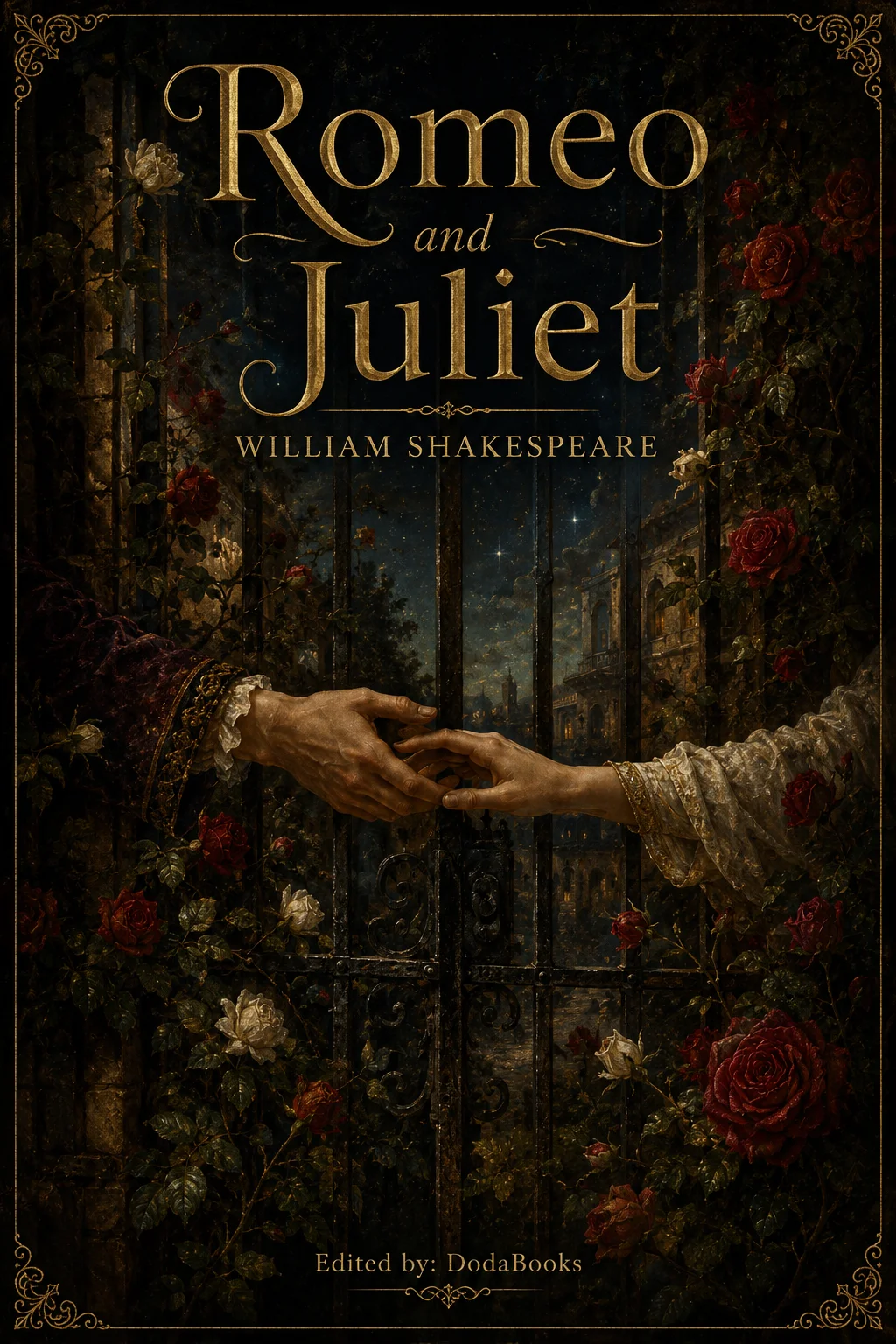
William Shakespeare’s Romeo and Juliet is among the most enduring love stories ever written. Composed around 1594–1596, during the height of the English Renaissance, the play dramatizes the passionate and ultimately tragic romance of two young lovers caught between their feuding families in Verona.
🎭
Romeo and Juliet
Two star-cross'd lovers. Two feuding houses. One of the greatest tragedies ever written — Shakespeare's timeless story of love and loss in Verona.
| Playwright | William Shakespeare |
| Composed | Around 1594–1596 |
| First Published | 1597 |
| Genre | Tragedy |
| Acts | 5 acts, 24 scenes |
| Setting | Verona and Mantua, Italy |
| Source | Arthur Brooke’s narrative poem (1562) |
🎭 The Story
The play opens in Verona, where a long-standing feud between the Montague and Capulet families erupts into street violence. Prince Escalus threatens death to anyone who disturbs the peace again.
Romeo Montague, lovesick for Rosaline, attends a masquerade feast hosted by the Capulets. There he sees Juliet Capulet and falls instantly in love. They discover each other’s identities only after parting — the son of Montague has fallen for the daughter of Capulet.
That night, Romeo climbs the Capulet orchard wall and overhears Juliet confessing her love from her balcony. They exchange vows of love and decide to marry in secret. With the help of Friar Laurence, they are wed the next day.
But tragedy strikes when Tybalt, Juliet’s hot-headed cousin, kills Romeo’s friend Mercutio. In revenge, Romeo kills Tybalt and is banished from Verona by the Prince. Juliet’s parents, knowing nothing of the marriage, arrange for her to wed Count Paris.
Friar Laurence devises a desperate plan: Juliet will drink a potion that makes her appear dead for 42 hours. Romeo will be summoned from Mantua to retrieve her from the family tomb. But the message never reaches Romeo. Hearing only that Juliet is dead, he buys poison and returns to Verona, where he finds Paris at Juliet’s tomb, kills him, drinks the poison, and dies beside his wife. Juliet awakens, finds Romeo dead, and stabs herself with his dagger.
🎭 The Story, Scene by Scene
To appreciate the tragedy fully, it helps to trace how Shakespeare builds it — because every step of the plot is a choice that the lovers make in desperate haste.
The Prologue and the Feud. The Chorus opens the play with a promise of what is coming: two households, both alike in dignity, hold “an ancient grudge” that breaks out in “new mutiny.” We are told from the start that these lovers are “star-cross’d” and that their death will bury their parents’ strife. This is no spoiler — it is a framing device that makes us watch how, not whether, tragedy arrives. The first scene dramatizes the feud in street violence, a brawl between servants of the Montagues and Capulets that draws in the princes and families. Prince Escalus decrees that anyone disturbing the peace again will pay with his life — a threat that will hang over everything that follows.
The Meeting. Romeo, lovesick for a woman named Rosaline, is persuaded to crash the Capulet masquerade feast. There he sees Juliet and is transformed on the spot. Their first exchange is the famous sonnet, shared line by line, in which they speak of pilgrims and holy shrines — a love that is immediately spiritual and immediate. Only after they part do they learn the staggering fact: the son of Montague has fallen for the daughter of Capulet.
The Balcony. Later that night, Romeo climbs the Capulet orchard wall and overhears Juliet confessing her love, unaware he is there. When he reveals himself, there follows the most celebrated love scene in English — “But soft, what light through yonder window breaks?” The pair pledge themselves to one another and, the very next day, are secretly married by Friar Laurence, who hopes the union may mend the feud. In a matter of days the lovers have gone from first sight to wedlock — the haste that will undo them.
Mercutio and Tybalt. Between the marriage and its catastrophe stands a single afternoon. Juliet’s volatile cousin Tybalt, enraged at Romeo’s presence at the feast, challenges him. Romeo, now secretly Tybalt’s kinsman and newly wed, refuses to fight. But his hot-tempered friend Mercutio takes up the quarrel in his place and is fatally wounded by Tybalt. Dying, Mercutio curses both houses — “a plague o’ both your houses!” — and blames Romeo’s pacifism for his death. Enraged, Romeo kills Tybalt in revenge. The Prince, caught between the demands of justice and the law he set, spares Romeo execution but banishes him from Verona forever.
The Exile and the Ruse. Banishment is, in Shakespeare’s hands, a fate worse than death for Romeo, who must now part from Juliet after a single night of marriage. Meanwhile Juliet’s parents, knowing nothing of the marriage, arrange for her to wed Count Paris. Friar Laurence devises a desperate plan: Juliet will drink a potion that makes her appear dead for forty-two hours; Romeo will be summoned from his exile in Mantua to wake her in the family tomb. But the crucial message never reaches Romeo.
The Tomb. On hearing only that Juliet is dead, Romeo buys poison and races back to Verona. At the Capulet tomb he encounters and kills Paris, then drinks the poison and dies beside what he believes is the corpse of his wife. Juliet awakens to find him dead and takes his dagger. Only in the aftermath do their grieving families reconcile over the bodies of their children. It is a funeral that becomes the price of peace — the bitter, terrible logic the Chorus promised in the very first lines.
🎯 Key Themes
Love and Passion
The love between Romeo and Juliet is immediate, overwhelming, and absolute. Shakespeare presents it as both beautiful and dangerous — a force that transcends social boundaries but also leads to destruction. Their love exists in tension with the hatred around them.
Fate and Free Will
From the Prologue’s description of “star-cross’d lovers,” fate hangs over the play. Characters repeatedly sense they are caught in forces beyond their control. Yet their choices — to marry in secret, to fight, to deceive — drive the tragedy forward.
Family and Feud
The Montague-Capulet feud is the engine of the tragedy. It creates the obstacles the lovers must overcome, and it ultimately destroys both families. Shakespeare’s ending — the families reconciled over their children’s bodies — is both a condemnation of senseless hatred and a bitter commentary on what it takes to end it.
⚡ Haste and Youth
Beneath the love story and the feud runs a quieter theme: the cost of haste. The entire tragedy unfolds in a matter of days. From first sight to secret marriage to death, the lovers rush from one decision to the next, and the adults move with a matching carelessness — Juliet’s father advancing her wedding to Paris on a whim, Friar Laurence trusting a fragile plan against impossible odds. Shakespeare does not present young love as foolish; he presents it as powerful precisely because it is unguarded. But he also shows that the world around them refuses to slow down, and the collision of overwhelming passion and a world that cannot wait is what produces the catastrophe.
💔 Love vs. The World Around It
Set against a background of violence, the love of Romeo and Juliet is a fragile and radical act. It crosses a boundary the entire community treats as sacred, and it exists entirely in secret. Shakespeare repeatedly gives his lovers language that insists their love is real and valuable even as everything around them moves toward ruin. This is what makes the play so affecting: it takes the single most powerful human feeling and shows it trapped inside a web of family, law, and feud that it cannot survive. The love is not the problem — the world that cannot accommodate it is.
🕯️ Why It Still Resonates
Four centuries on, Romeo and Juliet remains the archetype of doomed young love — the play behind West Side Story, countless films, operas, and ballets. Its power endures because it gives voice to the extremity of adolescent emotion with complete seriousness, refusing to patronise the intensity of first love even as it shows how dangerous that intensity can be. The lovers’ willingness to defy the entire world for each other still speaks to something universal, while the play’s warning against tribalism and inherited hatred feels as urgent as ever. We do not cheer their deaths; we mourn the waste — and that mourning is the play’s great achievement.
The play is also endlessly studied because its language is inexhaustible. It contains some of the most quoted lines in English poetry, and its shifts between comedy and tragedy — Mercutio’s bawdy wit, the Nurse’s chatter, and then the sudden, unstoppable descent — demonstrate Shakespeare’s range at its most dazzling.
📖 How to Read It
Because it is a play, Romeo and Juliet rewards being read (or better, spoken) aloud. Reading the dialogue in your head can make the verse feel distant; reading it aloud — even alone — reveals its music and its emotion. Pay particular attention to the sonnets: the play opens with one, the lovers share one on stage, and the speeches are packed with them. Each one is a small, complete poem.
Note also how Shakespeare plays with time. The play compresses days into a whirlwind, and the Chorus reminds us of the speed. Watch for the countdown of the potion’s forty-two hours and the tragic irony that the lovers are always just too slow or just too fast. A second read throws the architecture into relief — the fatal coincidences, the misdelivered message, the timing that is always tragically wrong. If you find the Elizabethan verse at all challenging, the annotated edition of Romeo and Juliet offers scene-by-scene notes that make every line clear.
📖 Literary Significance
Romeo and Juliet is one of Shakespeare’s most popular plays and has been continuously performed since its premiere. It established the template for tragic romance in Western literature — the idea that true love is worth dying for.
The play’s language is some of Shakespeare’s finest. The balcony scene (Act II, Scene 2) contains some of the most famous lines in English poetry. The play shifts effortlessly between comedy (Mercutio’s bawdy jokes, the Nurse’s chatter) and tragedy (the deaths of Mercutio, Tybalt, and finally the lovers).
Its influence extends far beyond the stage. The story has been adapted into operas, ballets, films (including the Oscar-winning 1968 Zeffirelli version and Baz Luhrmann’s 1996 modern adaptation), musicals (West Side Story), and countless other works.
✨ What Makes the DodaBooks Edition Special
This is the original play text, carefully prepared for modern readers without distractions or clutter.
Zero Distractions
No ads, no license pages — just the complete play text with clean professional formatting.
Professional Drama Markup
Table-based speaker-label dialog, stage directions in italics, proper act/scene structure.
Full Navigation
Complete table of contents with act/scene navigation and Dramatis Personae.
Foreword & Author Bio
Historical and literary context plus a biography of Shakespeare.
No DRM
You own your copy — read on any device, anytime, forever.
Instant Download
EPUB + PDF + AZW3 formats included, delivered instantly after purchase.
❓ Frequently Asked Questions
Is Romeo and Juliet based on a true story?
The story is a work of fiction, though Shakespeare adapted it from Arthur Brooke’s narrative poem The Tragical History of Romeus and Juliet (1562), which itself drew on Italian sources.
How old are Romeo and Juliet?
Juliet is 13 years old. Romeo’s age is not specified but is generally understood to be around 16-17.
How long does it take to read the play?
Most readers complete it in 2-3 hours. The play is about 160 pages with 5 acts and 24 scenes.
Is Shakespeare's English hard to understand?
Some passages require attention, but the language is not as difficult as many assume. Reading aloud helps. The DodaBooks edition preserves Shakespeare’s original early modern English with proper formatting that makes it easy to follow.
Why did Juliet's parents arrange her marriage to Paris?
Wealthy families in Shakespeare’s time treated marriage as a matter of family alliance and financial security rather than individual choice. Believing Juliet is in mourning for Tybalt and unaware she is already secretly married, her father pushes her toward a match with the well-connected Count Paris.
Is Romeo and Juliet a love story or a warning about love?
It is both, and that is precisely its power. It celebrates the intensity of youthful love while grieving the waste it causes in a hostile world. Shakespeare takes the passion completely seriously and simultaneously shows how haste and hatred destroy it — which is why the play has been read both ways for centuries.
What is a "star-cross'd" lover?
The phrase, coined in the Prologue (“a pair of star-cross’d lovers”), means lovers whose fate is written against them by the stars — doomed from the start. It introduces the theme of fate that hangs over the entire play, even as the characters’ own choices keep driving the tragedy forward.
📚 Related Articles
🎭 Read the Timeless Tragedy
Romeo and Juliet is the most famous love story ever written. The DodaBooks edition preserves the complete play in a clean, distraction-free format:
- ✅ Complete 5-act play — all 24 scenes
- ✒️ Professional drama markup — speaker labels, stage directions, act/scene navigation
- 📜 Full table of contents with Dramatis Personae
- 📝 Foreword with historical context and author biography
- 🔒 DRM-free — read on any device, anytime
- 📥 Instant download — EPUB + PDF + AZW3 formats