Charles Dickens’s Oliver Twist, first published serially from 1837 to 1839, is one of the most iconic novels in English literature. This second volume continues the story of the orphan Oliver as he is drawn deeper into London’s criminal underworld.
📖
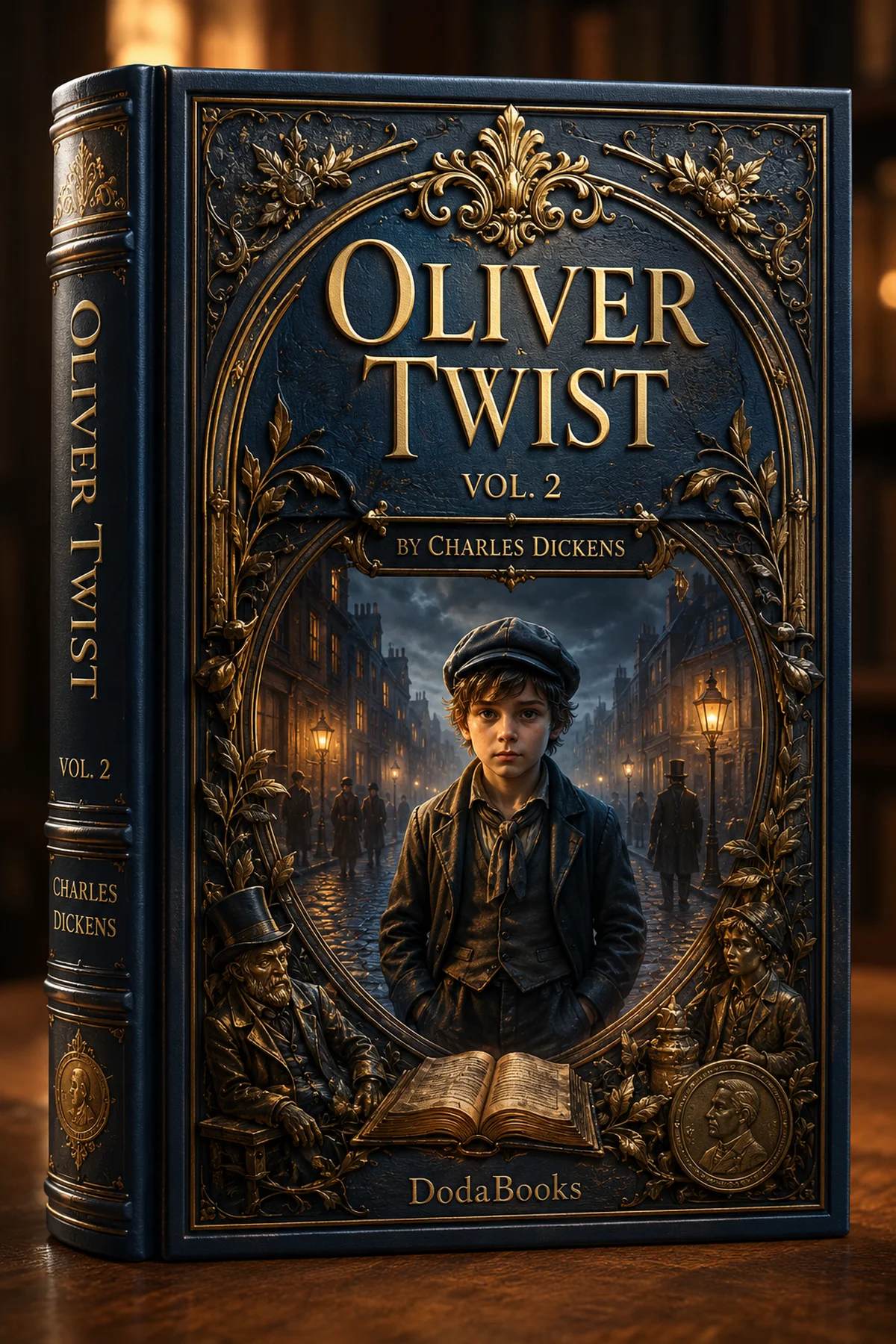
Oliver Twist, Vol. 2
The second volume of Charles Dickens's classic novel of innocence and survival. Oliver has escaped the workhouse only to fall into the hands of Fagin's gang of child thieves in London's criminal underworld.
| Author | Charles Dickens |
| Published | 1837–1839 (serialized) |
| Genre | Social novel, bildungsroman |
| Volume | 2 of 3 (chapters 18–34) |
| Pages | 169 |
| Setting | London — from the criminal dens of the East End to the quiet homes of the gentry |
📖 The Story
After being taken in by the kind Mr. Brownlow, Oliver enjoys a brief respite from hardship. But the sinister forces of Fagin and the brutal Bill Sikes have not forgotten him. When Oliver is recaptured and forced to participate in a burglary, his life hangs in the balance. Meanwhile, the mysterious Monks conspires in the shadows to destroy evidence of Oliver’s true identity — and the fortune that rightfully belongs to him.
This volume contains some of the most memorable episodes in the novel: Oliver’s introduction to the art of picking pockets, the court scene that nearly condemns him, his time with the kind Maylie family, and Nancy’s fateful encounters that seal her tragic destiny. Dickens weaves a gripping tale of social injustice, criminality, and the redemptive power of kindness.
📖 Literary Significance
Oliver Twist was Dickens’s second novel and the first in English literature to feature a child as its central protagonist. It was also a landmark in social criticism — Dickens’s portrayal of the workhouse system, child labour, and the criminal underworld shocked middle-class readers and helped fuel the movement for social reform.
The novel’s characters have become indelible: the Artful Dodger, Fagin, Bill Sikes, Nancy, and the innocent Oliver himself are among the most famous in all of literature. This second volume contains some of Dickens’s most powerful writing: the burglary scene, Nancy’s agonizing moral crisis, and the revelation of Oliver’s true parentage.
📖 Read the story at the pace Dickens intended. The clean DodaBooks edition keeps every cliffhanger of the serialized original intact.
Get the Book at DodaBooks →✨ What Makes the DodaBooks Edition Special
This edition presents Dickens’s classic in a clean, distraction-free format.
Zero Distractions
No ads, no license pages — just the complete text, clean and uninterrupted.
Smart Typography
Curly quotes, em-dashes, proper ellipsis — typeset with care for a premium reading experience.
Chapter Navigation
Full table of contents with navigation to each of the 17 chapters — easily jump between them.
Cleaned & Polished
All Gutenberg boilerplate stripped, consistent formatting throughout the text.
No DRM
You own your copy — read on any device, anytime, forever.
Instant Download
EPUB format included, delivered instantly after purchase.
🏛️ The Historical World Behind This Volume
Oliver Twist was written at a specific, explosive moment in English history. In 1834 — just three years before the novel began appearing — Parliament had passed the New Poor Law, which redesigned the country’s welfare system around the workhouse. Families were separated on entry, the able-bodied poor were pressed inside, and the austere regime of gruel rations, rigid discipline, and pauper uniforms was deliberately meant to be harsh enough to discourage applicants. Dickens attacked that system with a fury that was public and personal at once: his own boyhood had included a stint pasting labels in a blacking warehouse after his father was imprisoned for debt.
This volume’s chapters were published serially in a monthly magazine from 1837 to 1839, and that serial form shaped the story’s structure. Dickens wrote and revised as his readers reacted, pacing every instalment to end on a note that would hold a paying audience for another thirty days. The cliffhangers, the sudden shifts between Oliver’s peril and the comic interlude of Mr. Bumble’s courtship of Mrs. Corney, and the slow tightening of the noose around the criminal world were not accidents — they were professional showmanship of a very high order. Reading this volume straight through, you can still feel the monthly rhythm ticking beneath the prose.
The London of the novel was equally real. Dickens knew the courts and alleys of the city’s poorest districts — Saffron Hill, Field Lane, and the rookeries near Holborn that the fictional Fagin’s den recalls — because he had walked them as a young reporter and written about them for newspapers. Oliver’s journey from workhouse to metropolis follows a route many real children travelled, which is part of why the novel is best read as reportage disguised as an orphan’s rescue fantasy.
For readers who love nineteenth-century literature, this volume sits squarely inside the era’s great fascination with the city and its secrets. Fans of these streets will find kindred territory in Jane Eyre, Charlotte Brontë’s orphan-to-happiness story published only a decade later, and in the suspense tradition of The Mysteries of Udolpho, which shaped the gothic tension that Victorian novelists — Dickens emphatically included — borrowed so freely.
🧭 How to Get the Most Out of Volume 2
Because Oliver Twist was published in monthly parts, it rewards how you read it. Try treating each chapter, or pair of chapters, as a self-contained instalment. Read briskly, ride the cliffhangers, and resist racing ahead — Dickens built genuine suspense, and the book works best when you allow each chapter to do its job before peeking at the next. At roughly 3–5 hours for this volume, you could comfortably finish it across a week of lunch breaks and evenings.
Keep an eye on Dickens’s method of alternation. He constantly cuts between settings: a chapter inside the criminal world, then a chapter in the comparative quiet of the Maylies’ home, then a comic scene at the workhouse. This is not restlessness — it is a deliberate engine of suspense, letting the reader see dangers that Oliver himself cannot. Notice too how Dickens presses the same small gestures and the same ironic catchphrases into service as running jokes that accumulate rather than merely repeat. These details are where his comedy lives, and they are easy to miss on a first hurried pass.
The edition helps in ways that quietly matter. Chapter-by-chapter navigation means you can move between the volume’s 17 chapters without fumbling, and clean, consistent typography keeps nothing between you and the text. If you are reading aloud — this novel is wonderful read aloud — the careful em-dashes and ellipsis keep Dickens’s rhythms easy to voice.
Finally, do not skip the quieter chapters. The moments with the Maylie family, with Rose, and with the benevolent Mr. Brownlow are where the novel’s moral centre lives, and they make the darker chapters bearable. Dickens is not simply shocking his readers; he is measuring the strength of kindness against the weight of the world — and that measurement is the whole point of the book.
✨ Why This Volume Still Matters
Most readers first meet Oliver Twist through its famous scenes — “Please, sir, I want some more” — or through one of its many film and stage adaptations. But the novel endures because it understands something uncomfortable: that poverty is not a character flaw, and that children are not miniature adults to be hardened early. In Volume 2 that argument is made with unusual force, because Oliver has been exposed to the criminal world and still refuses to become part of it.
Dickens wrote this volume while England still ran heavily on child labour, and his audience was mostly adults who had never thought twice about the child pickpockets working their own streets. The book refused to let them look away. More than a century and a half later, the same narrative engine — an innocent at the mercy of forces larger than himself — remains one of storytelling’s most reliable shapes. Dickens did not invent it, but he gave it so much speed and moral clarity that every later version traces back to this one. The DodaBooks edition returns you to that original, in a clean, uninterrupted format.
❓ Frequently Asked Questions
Can I read this volume without reading Volume 1?
This volume picks up where Volume 1 ends. While the story is summarized at the beginning, you will get the most out of it by starting with Volume 1.
How long does it take to read?
At 169 pages across 17 chapters, most readers finish in 3-5 hours. The fast-paced narrative and cliffhanger chapter endings make it a brisk read.
What chapters are included?
Chapters 18 through 34 of the complete novel, covering Oliver’s recapture, the burglary, his time with the Maylie family, and the deepening of the mystery surrounding his parentage.
Is this suitable for young readers?
Oliver Twist deals with dark themes — child exploitation, violence, murder — but Dickens handles them with restraint. It is suitable for mature teens and above.
Is Oliver Twist based on a true story?
Not on a single true story, but on very real material. Dickens drew on the actual workhouse system created by the 1834 New Poor Law, on the real criminal districts of London he had walked as a reporter, and on his own childhood experience of poverty and child labour. The child pickpockets and the cruel institutions felt recognizably real to contemporary readers — that was the point.
Why did Dickens write Oliver Twist?
Partly to entertain — it was his money-making serial, written for a large monthly audience — but chiefly to expose the cruelty of the workhouse system and to open middle-class readers’ eyes to the lives of London’s poor. Dickens later said he wanted the book to show what the New Poor Law and its institutions truly meant for the people trapped inside them.
What happens after this volume?
Volume 3 resolves everything the earlier chapters have been building. The mystery of Oliver’s parentage comes fully to light, Monks’s schemes are exposed, Nancy meets her tragic end at Bill Sikes’s hands, Fagin faces justice, and Oliver is finally adopted by Mr. Brownlow and comes into the inheritance that should always have been his.
📚 Related Articles
📖 Read the Victorian Classic
Oliver Twist, Vol. 2 continues one of the most famous stories in English literature — a gripping tale of innocence, survival, and the redemptive power of kindness. The DodaBooks edition presents Dickens’s classic in a clean, distraction-free format:
- ✅ Complete 17-chapter text — chapters 18 through 34 of the novel
- ✒️ Smart typography — curly quotes, em-dashes, proper ellipsis
- 📜 Full table of contents with chapter navigation
- 🔒 DRM-free — read on any device, anytime
- 📥 Instant download — EPUB format
For an earlier and even more biting satire of British society, politics, and institutions, explore Jonathan Swift’s masterpiece in our Gulliver’s Travels Guide.
For a fast-paced American pulp tale of prison escape engineering and underground justice, read our guide to Three Sevens Guide.