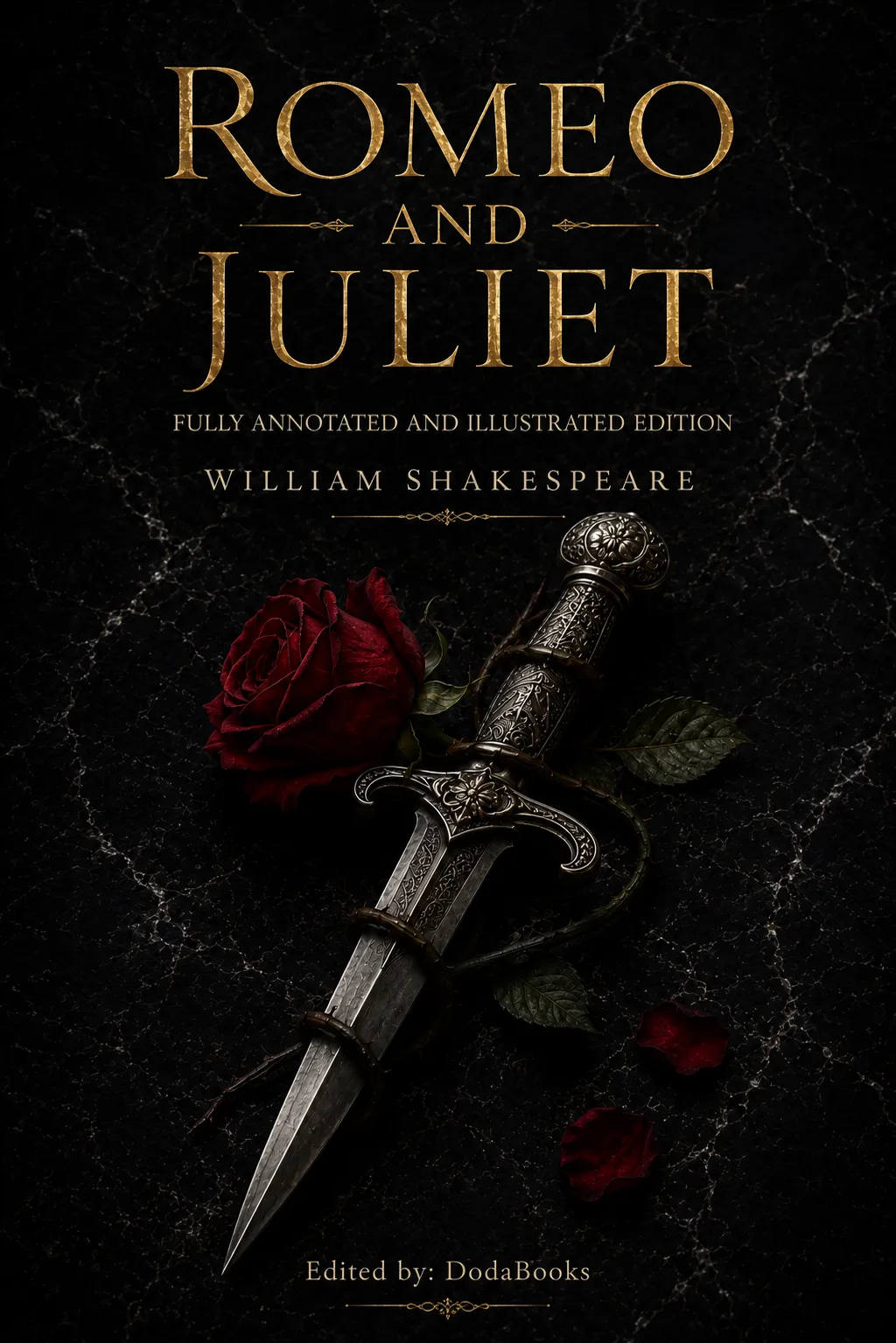
The fully annotated and illustrated edition of Romeo and Juliet enriches Shakespeare’s timeless tragedy with 10 full-page illustrations, scene-by-scene annotation cards, vocabulary definitions, historical context, literary analysis, and performance insights — making it the definitive edition for students, teachers, and lovers of Shakespeare.
📚
Romeo and Juliet: Fully Annotated and Illustrated Edition
The complete tragedy with 10 full-page illustrations, act-by-act overviews, scene-by-scene annotations, 242 vocabulary cards, and 25 performance notes.
| Playwright | William Shakespeare |
| Composed | Around 1594–1596 |
| Genre | Tragedy (annotated edition) |
| Acts | 5 acts, 24 scenes |
| Illustrations | 10 full-page original artworks |
| Vocabulary Cards | 242 archaic and difficult terms |
| Best For | Students, teachers, deep readers |
📖 The Story, Structure and Key Scenes
Romeo and Juliet is built like a fast-closing trap. Shakespeare compresses the entire tragedy into five acts and roughly four days of plot, and almost every scene tightens the noose another turn. The play opens with a street brawl between the servants of the Montagues and Capulets — a warning that the feud will cost more than pride — and ends in a tomb where the two families are finally forced to reckon with what their hatred has destroyed.
The famous set-pieces arrange themselves around the central whirlwind romance. At the masquerade feast, Romeo and Juliet meet and fall in love in a single night, quite unaware of each other’s surname until it is too late. The balcony scene is the play’s emotional heart: two teenagers, separated by a wall and a family war, promise themselves to each other in the dark. Friar Laurence secretly marries them the next day, convinced the match might heal the feud. The duel with Tybalt kills Mercutio and then Tybalt himself, and Romeo is banished to Mantua — the first decisive swing of the trap.
The second half turns the screw. Juliet, facing an enforced marriage to Paris, takes Friar Laurence’s potion to fake her own death. The message explaining the plot to Romeo goes astray, and Romeo arrives at the tomb believing her dead. Their deaths finally end the feud, but only after both households have lost what mattered most. If you would rather hear the whole arc in one place, the complete guide to Romeo and Juliet walks through every act scene by scene.
🎯 What Makes This Edition Different
This isn’t just a clean text — it’s a complete guided reading experience. Every scene is enriched with colour-coded annotation cards and exclusive original artwork that bring Shakespeare’s Verona to life.
10 Full-Page Illustrations
Exclusive original artwork at key scenes: the Verona street brawl, the masquerade feast, the balcony scene, the secret wedding, the duel and death of Mercutio, the dawn parting, Juliet and the potion, Romeo's despair, and the final tragedy in the tomb.
Scene-by-Scene Annotations
Every scene enriched with colour-coded cards: vocabulary definitions, historical context, literary analysis, close reading prompts, and discussion questions.
Act Overviews
Before each act, a comprehensive overview card sets the stage with context, themes, and key questions to guide your reading.
Performance Notes
25 production-focused insights covering staging choices, directorial interpretations, casting decisions, and the play's theatrical legacy.
Vocabulary Cards
242 archaic and difficult terms defined in context — no more reaching for a dictionary mid-scene.
Companion Cards
11 in-depth explorations of themes, characters, sources, and literary techniques that deepen your understanding.
📖 What’s Inside
- Complete 5-act play — all 24 scenes with the original early modern English text preserved faithfully
- 10 full-page original illustrations — exclusive artwork at key dramatic moments
- Act overviews — comprehensive context, themes, and key questions before each act
- Scene-by-scene colour-coded annotations — vocabulary, historical context, literary analysis, close reading prompts, discussion questions
- 25 performance notes — staging choices, directorial interpretations, casting decisions
- 242 vocabulary cards — archaic and difficult terms defined in context
- 11 companion cards — in-depth explorations of themes, characters, and sources
- Dramatis Personae — complete character list with speaker-label table formatting
- Stage directions — clearly marked in italics
- Foreword — historical and literary context
- Professional EPUB3 formatting — styled for clarity on all major e-readers
- No DRM — buy once, download instantly, keep forever
🏛️ Themes: Love Against Fate, and the Price of Haste
Beneath the famous romance runs a debate about whether the lovers are doomed by fate or by their own impatience. Shakespeare gives the prologue the word “star-cross’d,” inviting us to blame the heavens — yet almost every disaster in the play is set in motion by a human choice made too quickly. Romeo marries within a day of meeting Juliet. Friar Laurence wagers everything on a potion that must arrive perfectly on time. The message that should have caught Romeo in Mantua is delayed by a single plague quarantine. The playwright keeps both explanations alive, which is precisely why the play still speaks to readers who no longer believe in astrology.
Haste is the play’s engine and its flaw. Nearly every major character moves too fast: Juliet accepts a stranger’s proposal at first sight, the lovers marry in secret, Friar Laurence hopes against all evidence, and the feud flares back to life the instant the marriages could have healed it. Shakespeare shows that quick passion and the quick violence of the feud are two faces of the same impulsiveness — the city is governed by haste, and the lovers are its victims as much as its inventors.
Alongside those run the recurring themes of the feud and its cost in young lives, duty versus desire (Juliet torn between obedience to her father and her love for Romeo), and the role of authority — the Prince, the friar, and the gulled parents, all of whom fail to protect the young people they are meant to guide. For a closer look at how these work across the play, the complete guide to Romeo and Juliet explores the themes in depth.
🏫 Why the Annotated Edition Helps a Modern Reader
Shakespeare wrote Romeo and Juliet in early modern English in the 1590s — the vocabulary, syntax, classical references, and cultural assumptions of Verona in that period are all centuries away from a modern student. Even good readers stumble on a line like “But soft, what light through yonder window breaks?” in the first stumble and miss the play’s wit, wordplay, and dramatic irony in every subsequent scene.
The annotated edition closes that gap scene by scene. The 242 vocabulary cards define archaic terms in context so no one reaches for a dictionary mid-scene. The historical context notes explain the period’s expectations about courtship, marriage, and family honour that drive characters’ choices. The 25 performance notes reveal how directors have staged the famous moments across the centuries, and the 11 companion cards dive into the themes, sources, and techniques that reward a closer reading.
Of course, the same features make it a natural classroom edition: students can move at their own level, focusing on vocabulary while more advanced readers work through the companion cards and performance notes, and the act overviews give teachers ready-made starting points for discussion.
🎨 The Illustrations
The 10 original illustrations are placed at key dramatic moments throughout the play:
- The Verona street brawl — the violence that frames the tragedy
- The masquerade feast — where Romeo first sees Juliet
- The balcony scene — the most famous love scene in literature
- The secret wedding — Friar Laurence marries the lovers
- The duel and death of Mercutio — the turning point of the play
- The dawn parting — Romeo must leave for Mantua
- Juliet and the potion — Friar Laurence’s desperate plan
- Romeo’s despair in Mantua — the misdelivered message
- The final tragedy in the tomb — the lovers’ deaths
Each illustration is designed to help visual learners connect with the text and to provide a fresh interpretation of Shakespeare’s most famous scenes.
🏫 Perfect for Students and Teachers
The annotated edition was designed with the classroom in mind. The colour-coded annotation system allows readers to engage with the text at their own level — students can focus on vocabulary cards while advanced readers dive into the companion cards and performance notes.
The scene-by-scene structure makes it easy to assign and discuss individual scenes. The act overviews provide excellent starting points for lecture or discussion. The performance notes offer unique insights into how the play has been staged across the centuries.
❓ Frequently Asked Questions
Is the complete play included?
Yes. The full original text of all 5 acts and 24 scenes is included. The annotations are added alongside the text, not as replacements.
How are the annotations organized?
Each annotation type has its own colour-coded card system. Vocabulary cards, historical context, literary analysis, close reading prompts, and discussion questions are all visually distinct for easy navigation.
How is this different from the plain edition?
The plain edition offers the clean play text with professional formatting. This annotated edition adds 10 original illustrations, scene-by-scene annotation cards, act overviews, 242 vocabulary definitions, 25 performance notes, and 11 companion cards.
Is this suitable for classroom use?
Absolutely. The act overviews, annotation cards, and performance notes are designed for high school and university-level study. The vocabulary cards make Shakespeare’s early modern English accessible to all students.
How hard is Romeo and Juliet to read for a first-time student?
The story is simple and gripping, but the early modern English can slow you down — especially the wordplay, which is where much of the meaning lives. Start by getting the plot from the act overviews, then read the scenes with the vocabulary cards at hand. The annotations let you see the jokes and dramatic irony you would otherwise miss.
What are the most famous scenes included in the illustrations?
The 10 full-page artworks cover the street brawl, the masquerade feast, the balcony scene, the secret wedding, the duel and death of Mercutio, the dawn parting, Juliet and the potion, Romeo’s despair in Mantua, and the final tragedy in the tomb — each one helping visual learners connect with a key dramatic moment.
Does the annotated edition include notes on staging and performance?
Yes. There are 25 performance notes covering staging choices, directorial interpretations, and casting decisions across the play’s theatrical history — a dimension of Shakespeare that a plain text simply cannot show.
📚 Related Articles
📚 Experience the Fully Annotated Edition
Everything you need to understand and appreciate Shakespeare’s timeless tragedy:
- ✅ Complete 5-act play preserved in full
- 🎨 10 original full-page illustrations
- 📝 Scene-by-scene annotation cards for every scene
- 🎭 25 performance notes and 11 companion cards
- 📖 242 vocabulary cards — no dictionary needed
- 📥 Instant download — EPUB + PDF + AZW3 formats