A complete Pride and Prejudice study guide covering every section of the novel — chapter groupings, key events, character development, and exam-ready analysis for students and teachers.
Pride and Prejudice Study Guide: Everything You Need
Complete chapter-by-chapter analysis, key quotes, character development tracking, and exam-ready topics for students studying Jane Austen's masterpiece.
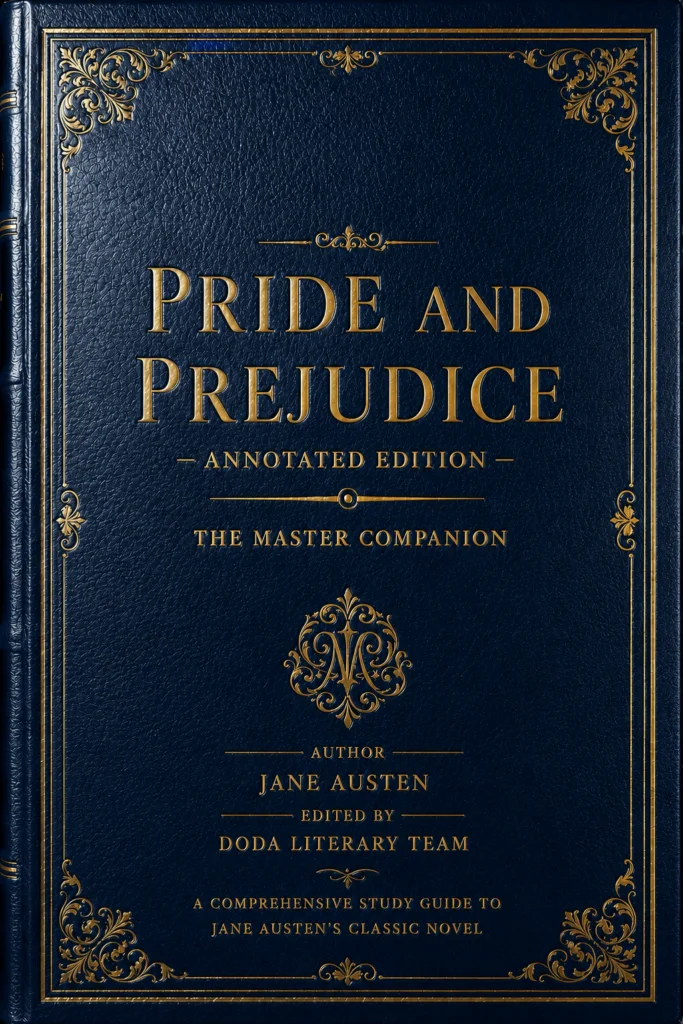
| Chapters covered | 61 across 3 volumes |
| Sections | 7 study sections |
| Key scenes | 5 essential turning points |
| Exam topics | Pride, prejudice, marriage, class, self-knowledge |
| Best for | Exam revision, essay prep, classroom teaching |
| Reading time | 10–14 hours for the novel |
🎯 Part 1: First Impressions (Chapters 1–3)
What happens: Bingley arrives at Netherfield. The Bennets attend the ball where Darcy snubs Elizabeth.
| Element | Detail |
|---|---|
| Key event | Darcy refuses to dance with Elizabeth |
| Character intro | All major characters introduced |
| Tone established | Ironic, social satire |
| First impression | Darcy = villain, Elizabeth = victim |
Key quote: “She is tolerable, but not handsome enough to tempt me.”
Analysis: The entire novel’s central conflict is launched by one rude comment. Elizabeth’s judgment of Darcy is frozen at this moment — and she spends the rest of the story learning to thaw it.
💞 Part 2: Jane and Bingley (Chapters 4–6)
What happens: Jane and Bingley grow closer. Elizabeth walks to Netherfield to nurse Jane. Darcy begins to notice Elizabeth.
Analysis: This section establishes the Jane-Bingley relationship as a contrast to Elizabeth-Darcy. Jane and Bingley are open and easy. Elizabeth and Darcy are guarded and complicated. The reader is supposed to notice the difference.
💍 Part 3: Collins and Charlotte (Chapters 13–22)
What happens: Mr. Collins proposes to Elizabeth. She refuses. Charlotte Lucas (her best friend) immediately accepts Collins’s offer.
Analysis: This is the novel’s harshest social commentary. Charlotte is intelligent, sensible, and 27 years old — almost past marriageable age. She marries Collins not because she loves him but because she needs financial security. Elizabeth is horrified. Austen lets both women be right: Charlotte made a practical choice, and Elizabeth would have been miserable doing the same.
🎭 Part 4: Wickham and Pemberley (Chapters 15–18)
What happens: Wickham tells Elizabeth his story about Darcy. Elizabeth believes him. Darcy’s first proposal.
Analysis: Elizabeth makes her biggest error here — she trusts a charming stranger over the evidence of Darcy’s behaviour. The proposal scene is the novel’s climax. Darcy’s rudeness matches Elizabeth’s anger, and the result is a complete rupture.
📚 Master every chapter with in-depth analysis
👉 Get the Annotated Edition✉️ Part 5: Darcy’s Letter (Chapters 35–36)
What happens: The morning after the proposal, Darcy gives Elizabeth a letter explaining his actions with Wickham and Bingley.
Analysis: Elizabeth goes through five emotional stages while reading:
- Denial — Darcy must be lying
- Doubt — but the details match what she knows
- Shame — she has been completely wrong
- Self-awareness — “Till this moment, I never knew myself”
- Growth — she accepts she was biased and proud
This is the most important section for Elizabeth’s character arc. Without this letter, there is no second proposal.
🏃 Part 6: Lydia’s Elopement (Chapters 39–50)
What happens: Lydia runs away with Wickham. Darcy secretly arranges their marriage.
Analysis: Lydia functions as a warning of what Elizabeth could have become. Lydia is Elizabeth without the self-awareness — impulsive, proud, careless. Darcy’s intervention here proves he has genuinely reformed: he acts selflessly and anonymously.
💎 Part 7: Resolution (Chapters 51–61)
What happens: Darcy proposes again. Elizabeth accepts. Jane and Bingley marry.
Analysis: The double wedding is Austen’s way of showing different kinds of successful marriages: Jane-Bingley (easy compatibility) and Elizabeth-Darcy (hard-won growth). Both work, but Elizabeth and Darcy are the only couple who truly understand each other.
📝 Exam Topics to Prepare
| Topic | Key Chapters | What to Say |
|---|---|---|
| Pride | Opening, Proposal, Letter | Both characters must overcome it |
| Prejudice | Wickham’s story, Darcy’s letter | Elizabeth’s bias against Darcy |
| Marriage | Charlotte’s choice, ending | Different models of marriage |
| Social class | Netherfield ball, Lady Catherine | Austen critiques class snobbery |
| Self-knowledge | Letter scene | Growth requires self-awareness |
⚡ Quick Revision: Five Key Scenes
- The Meryton ball (Ch. 3) — first impressions established
- Collins’s proposal (Ch. 19) — Elizabeth’s independence shown
- Darcy’s first proposal (Ch. 34) — pride vs. pride
- Darcy’s letter (Ch. 35) — the turning point
- Lady Catherine’s visit (Ch. 56) — Elizabeth’s final stand
🧩 What the Annotated Edition Unlocks
242 Literary Annotations
Historical context, critical analysis, and literary allusions for every chapter — understand why Austen chose certain words and what Regency-era social rules mean for the plot.
139 Modern Simplifications
Complex passages rewritten in clear modern English. When Austen's sentences get dense, you will find a plain-English breakdown right there on the page.
Chapter Summaries
Every chapter begins with a concise 150–250 word recap of key events — perfect for quick orientation before you read or for revision after.
76 Discussion Questions
With original answers. Perfect for teachers planning classroom activities, book clubs preparing for meetings, or students writing essays.
Character Relationship Maps
Detailed profiles of every major character with relationship diagrams showing how Elizabeth, Darcy, Bingley, Jane, Wickham, and the rest connect.
Bonus Resources
Story timeline, chapter length bar chart, 10-question quiz with answers, comprehensive glossary of 143 archaic terms, and further reading recommendations.
📖 The Story in One Overview
Jane Austen wrote Pride and Prejudice as an ironic study of how quickly people judge each other — and how badly they misjudge. Elizabeth Bennet, the second of five daughters, is brilliant, witty, and dangerously confident in her own judgment; Mr. Darcy is rich, handsome, and socially powerful, yet so proud that he comes across as cold and arrogant. Before they have exchanged two sentences, Elizabeth has decided Darcy is intolerable and Darcy has decided Elizabeth is beneath his notice. The entire novel is the slow, painful, and often very funny demolition of those first impressions. Both characters must earn their happiness: Darcy learns that worth is not the same as rank, and Elizabeth learns that being clever is not the same as being right. Love in Pride and Prejudice is not a lightning strike — it is the reward for self-knowledge.
🏛️ Historical Context: England in 1813
Pride and Prejudice appeared in early 1813, in the middle of the Napoleonic Wars, and Austen deliberately keeps battles off the page: her characters fret about balls, inheritances, and whether the militia is quartered nearby. That focus is the point. For a woman of the gentry, life turned on money, respectability, and marriage. Two facts explain most of the plot’s anxiety. The Bennet estate is entailed to a male heir, so the five daughters face ruin the moment their father dies — the reason Mrs. Bennet’s matchmaking feels so desperate. And the militia genuinely garrisoned English towns during the war, giving real Wickhams a stage for charm. Add Regency etiquette on top, and you have the machinery behind every conversation in the book.
🎓 Why Austen Still Matters
Two centuries on, Pride and Prejudice still gets taught, adapted, and quoted because we still make snap judgments and defend them, still confuse wealth with worth, still decide love under financial pressure. Austen’s precision lets a reader in 2026 recognise herself in a drawing room of 1813. The annotated edition makes that connection visible on every page — 242 literary annotations for context and 139 modern simplifications for dense sentences — turning a beloved novel into the strongest possible revision set.
✍️ Reading Tips for a Stronger First Read
Do the novel in two passes. On the first read, follow the plot and mark every moment you change your mind about a character — Austen wants you to feel prejudice before you analyse it. On the second, track the five places where first impressions are corrected: the Meryton ball, Wickham’s story, Darcy’s letter, Pemberley, and the final engagement. They are the skeleton of almost every essay you will write. Need a quick re-anchor? Our chapter-by-chapter summaries get you up to speed in minutes, and the character guide untangles every relationship in plain English.
❓ Frequently Asked Questions
How should I use this study guide with the novel?
Read each section of the guide before the corresponding chapters. The guide provides context and key events to watch for, making your reading more focused. After reading, return to the guide for analysis and discussion questions.
What are the most important chapters for exams?
Chapters 3, 19, 34, 35, 56, and 58 are the most frequently examined. Chapter 34 (first proposal) and Chapter 35 (Darcy’s letter) are essential for understanding the central conflict and resolution.
How do I write an essay on Pride and Prejudice?
Focus on one theme (pride, prejudice, marriage, or class) and trace its development through specific chapters. Use the key quotes from this guide as evidence. Always connect character actions to Austen’s broader social commentary.
What is the best edition for exam preparation?
The annotated edition is ideal for exam prep because it explains every significant passage, provides chapter summaries for quick revision, and includes 76 discussion questions with sample answers that model good essay arguments.
How can I remember characters and their relationships?
Use the character relationship maps from the annotated edition. Focus on the key connections: Elizabeth-Darcy, Jane-Bingley, Lydia-Wickham, and the Collins-Charlotte-Lucas triangle. Most exam questions revolve around these relationships.
What is Elizabeth's character arc in simple terms?
Elizabeth begins trusting her judgment completely, realises she was wrong about Darcy and Wickham, experiences shame and self-awareness, and learns to balance her intelligence with humility. She grows from defending her first impressions to questioning them.
How are the 61 chapters organised for revision?
The novel splits naturally into three volumes: Volume I covers the first 23 chapters, Volume II runs chapters 24–42, and Volume III finishes with chapters 43–61. The seven study sections in this guide map onto those volumes, so you can revise in manageable chunks rather than facing sixty-one chapters at once.
How do I prepare for an essay in a hurry?
Start from the five key scenes, choose one theme, and anchor every claim to a specific chapter and quote. The exam topics table in this guide gives you the argument for each major theme, and the annotated edition’s discussion questions model the paragraph-level thinking examiners reward.