Here is a free sample of Pride and Prejudice in simple English — side by side with the original text. If the original feels too difficult, the simplified version keeps the story while making the language accessible.
Pride and Prejudice Simple English Guide
Free side-by-side comparison of original and simple English versions — perfect for ESL learners, younger readers, and anyone who finds Austen's 19th-century prose challenging.
| Original vocabulary | 19th-century, highly formal |
| Simple English level | Grade 5–6 reading level |
| Sentence length (original) | 30–80 words |
| Sentence length (simple) | 10–20 words |
| Austen’s voice preserved | Original: Yes / Simple: No |
| Plot preserved | Both versions: Yes |
🔤 Opening Lines: Original vs Simple
Original (Jane Austen):
“It is a truth universally acknowledged, that a single man in possession of a good fortune, must be in want of a wife.”
Simple English:
“Everyone agrees that a rich single man must be looking for a wife.”
The meaning is identical. But the simple version uses modern word order, shorter words, and a structure that is immediately clear. You do not lose the irony — you just get it faster.
📖 More Comparison Examples
Original:
“Mr. Bingley was good-looking and gentlemanlike; he had a pleasant countenance, and easy, unaffected manners.”
Simple English:
“Mr. Bingley was handsome and well-mannered. He had a friendly face and easy, natural behaviour.”
Original (Darcy’s first proposal):
“In vain I have struggled. It will not do. My feelings will not be repressed. You must allow me to tell you how ardently I admire and love you.”
Simple English:
“I have tried to fight my feelings, but I cannot. I must tell you that I love you deeply.”
The simple version removes 19th-century phrasing while keeping the emotional content intact.
📚 Read the full novel without the language barrier
👉 Get the Annotated Edition⚖️ What You Gain and Lose
| Aspect | Original | Simple English |
|---|---|---|
| Austen’s voice | Preserved | Lost |
| Easy comprehension | Hard for beginners | Clear instantly |
| Wit and irony | Full effect | Mostly preserved |
| Vocabulary | 19th-century | Modern |
| Sentence length | 30–80 words | 10–20 words |
📚 How to Read More
If the original is too challenging but you want the full story, you have three options:
- Simplified edition — the complete novel rewritten for accessibility
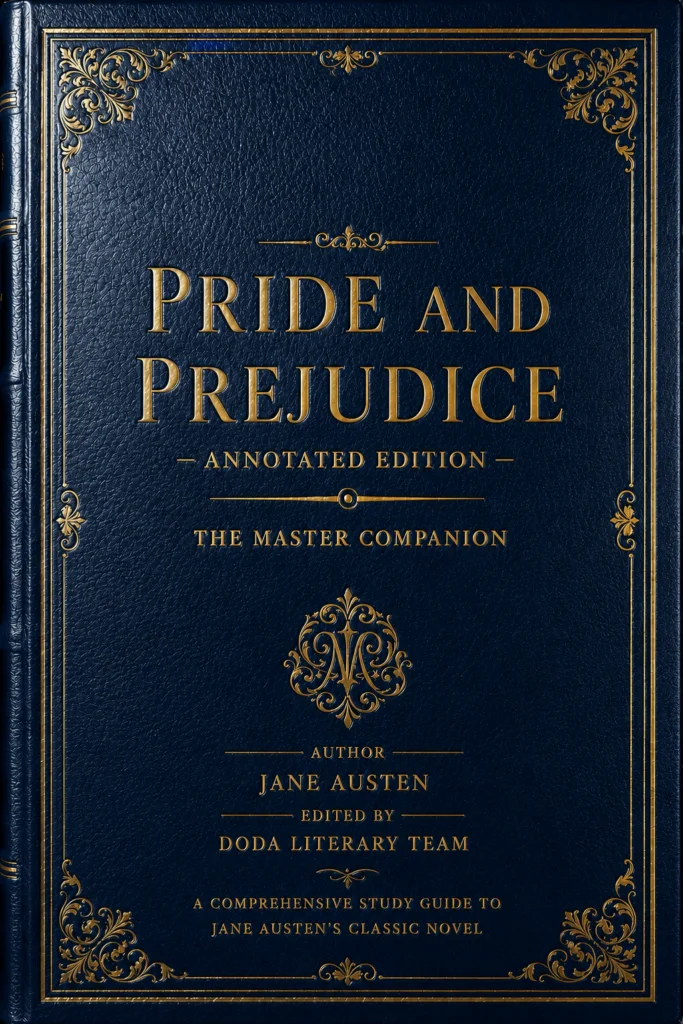
- Annotated edition — original text with explanations alongside
- Bundle — both, plus a study guide
The simplified edition preserves every scene, character, and plot point. What changes is the language — and only enough to make it readable.
🧩 What the Annotated Edition Unlocks
242 Literary Annotations
Historical context, critical analysis, and literary allusions for every chapter — understand why Austen chose certain words and what Regency-era social rules mean for the plot.
139 Modern Simplifications
Complex passages rewritten in clear modern English. When Austen's sentences get dense, you will find a plain-English breakdown right there on the page.
Chapter Summaries
Every chapter begins with a concise 150–250 word recap of key events — perfect for quick orientation before you read or for revision after.
76 Discussion Questions
With original answers. Perfect for teachers planning classroom activities, book clubs preparing for meetings, or students writing essays.
Character Relationship Maps
Detailed profiles of every major character with relationship diagrams showing how Elizabeth, Darcy, Bingley, Jane, Wickham, and the rest connect.
Bonus Resources
Story timeline, chapter length bar chart, 10-question quiz with answers, comprehensive glossary of 143 archaic terms, and further reading recommendations.
🟢 What Exactly Is a Simple English Edition?
A simple English edition is a retelling of a classic novel in which the plot, characters, and every major scene stay exactly the same, but the language is rewritten for easier comprehension. It is not an abridgement, and it is not a summary. The full story is there — every chapter, every character, every turning point — but the sentences are shortened, the archaic vocabulary replaced with modern words, and the 19th-century grammar smoothed into forms that are immediately clear.
The comparison above shows this in action. Austen’s famous opening line — “It is a truth universally acknowledged, that a single man in possession of a good fortune, must be in want of a wife” — becomes “Everyone agrees that a rich single man must be looking for a wife.” The irony survives, but the reader no longer has to untangle the construction to reach it. This is the core promise of a simplified edition: it removes the language barrier while leaving the story intact, so that comprehension never comes at the cost of losing the plot.
🏛️ Why Austen’s English Is Hard in the First Place
To understand what a simplified edition does, it helps to see precisely why the original is difficult for many readers. Austen wrote almost exactly two centuries ago, in a style that reflects the formal expectations of the Regency era. Her sentences are long — frequently running to thirty, fifty, or even eighty words — and they use a Latinate, highly structured grammar that asks the reader to hold many clauses in mind before the meaning resolves. Words such as “countenance,” “acquaintance,” “propriety,” and “candid” have shifted in meaning or fallen out of everyday use.
Add to that the fact that much of the novel’s comedy depends on social codes that modern readers were never taught. A single glance, a withheld invitation, an unspoken expectation about rank and fortune — these carry huge weight in Austen’s world but are easy to miss for a reader unfamiliar with Regency manners. The simplified edition addresses the first barrier (language) directly, while readers who also want help with the social context can pair it with an ESL-focused guide to the simplified text or the fuller study guide to Pride and Prejudice.
👥 Who Is a Simplified Edition For?
A simplified edition serves several very different readers, and it is worth knowing which one you are so you choose the right resource. English language learners are the most obvious audience — the shorter sentences and modern vocabulary let an intermediate reader enjoy the full story without a dictionary on every page. Younger readers, and adults returning to reading for pleasure after a long gap, benefit equally from the smooth, fast-moving prose.
A simplified edition is also a wonderful bridge for readers who are not yet ready for the original but fully intend to get there. Reading the plot first — in clear language — means that when you do tackle Austen’s prose, you are no longer trying to follow the events and decode the style at the same time. You already know what happens; now you can savour how she says it. If that eventual goal appeals to you, you may want to compare how the simplified and annotated approaches differ in our original vs simplified overview.
✨ How to Use the Free Sample Well
The free sample above is designed to be a decision tool as much as a learning tool. Read the original and simplified passages side by side, and ask yourself where you fall on the spectrum. If the simple versions feel almost too easy, you may be ready to try the annotated edition, which keeps Austen’s exact words but explains every difficult passage alongside it. If the simple versions feel like a relief — if you found yourself simply enjoying the story for the first time — then the full simplified edition is the right next step. Our guide to the best version for beginners walks you through all the choices side by side so you can pick the one that matches your reading level and your goals.
❓ Frequently Asked Questions
What reading level is the simple English version?
It is written at approximately a grade 5–6 reading level, using common vocabulary and shorter sentences while preserving the full plot and all major scenes.
Does the simplified version cut any scenes?
No. Every scene, character, and plot point from the original is preserved. Only the language is simplified.
Do I lose Austen's humour in the simple version?
The wit and irony are mostly preserved, though some of the more subtle wordplay and layered meanings are inevitably lost. The plot-driven humour survives well.
Which edition should an ESL reader choose?
Start with the simplified English version for a smooth first read. If you want to challenge yourself later, the annotated edition keeps the original text but explains every difficult passage.
Can I get the simple English version for free?
The free sample above gives you a taste. The complete simplified edition is a paid product because it is an original adaptation with significant editorial work.
How long does the simple English version take to read?
At average reading speed, the simplified version takes about 6–7 hours — significantly faster than the original’s 10–14 hours.
Will a simplified edition ever feel like the real book?
For reading pleasure, absolutely, because the story is complete. What is necessarily lost is Austen’s distinctive voice and the artful density of her sentences. If those matter to you, read the simplified version first for the plot, then graduate to the annotated edition to experience her actual prose with support.
Is the simple English version good for building reading stamina?
Yes. Because every scene is preserved, you build the habit of reading long-form narratives without the frustration of decoding, which is often the biggest obstacle for new or returning readers. The confidence you gain carries over when you move on to harder texts.