Welcome to the complete guide to Jane Austen’s Pride and Prejudice. Whether you’re reading it for the first time, teaching it in a classroom, or revisiting it as an adult, this guide gives you everything you need — chapter summaries, character breakdowns, theme analysis, free resources, and recommendations for which annotated edition to buy.
Pride and Prejudice: The Complete Guide for Modern Readers
Everything you need to read, understand, and enjoy Jane Austen's masterpiece — with chapter summaries, character analysis, themes, and study resources.
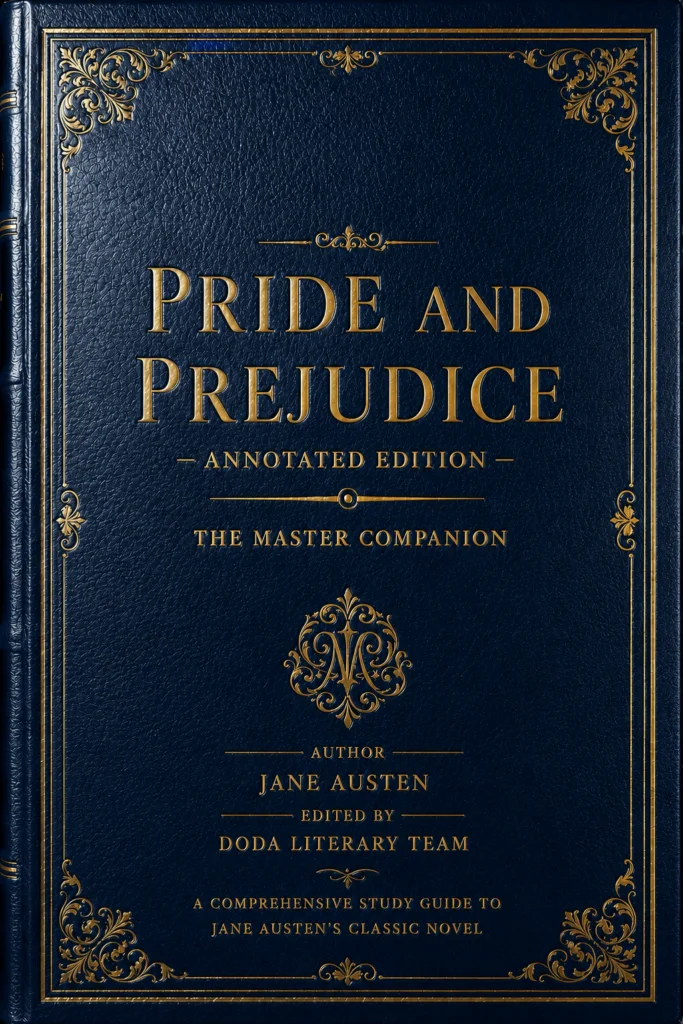
| Author | Jane Austen (1775–1817) |
| Published | 1813 |
| Original Title | First Impressions |
| Chapters | 61 |
| Setting | Hertfordshire, England, ~1811–1812 |
| Genre | Novel of manners, romance, satire |
| Reading Time | 10–14 hours |
| Summary Time | 3 minutes |
📖 About the Novel
Pride and Prejudice was published in 1813 by Jane Austen. It follows Elizabeth Bennet, the second of five daughters, as she navigates love, class, and family expectations in Regency England. The novel is famous for its witty social commentary, memorable characters, and one of the most iconic romantic storylines in English literature.
Why Read Pride and Prejudice?
- Universal themes: Pride, prejudice, love, class, family — the issues Austen explored are still relevant today
- Sharp wit: Austen’s irony and social satire are as funny now as they were in 1813
- Memorable characters: Elizabeth Bennet is one of literature’s most beloved heroines
- Cultural influence: The novel has inspired countless adaptations, from BBC miniseries to Hollywood films
🔥 Major Themes
Pride
Darcy’s pride comes from his social position; Elizabeth’s pride comes from her confidence in her own judgment. Both must overcome their pride to see each other clearly.
Prejudice
Elizabeth prejudges Darcy based on his rude first impression. Darcy prejudges Elizabeth’s family based on their social awkwardness. The novel shows how first impressions can be dangerously wrong.
Class and Society
Regency England had rigid class structures. The novel explores whether character matters more than class, and whether love can cross social boundaries.
Marriage
Every marriage in the novel represents a different economic and emotional arrangement — from Charlotte’s pragmatic choice to Elizabeth’s romantic ideal.
📚 Want every chapter explained line by line?
👉 Get the Annotated Edition👥 Main Characters
The Bennet Family
| Character | Age | Key Trait |
|---|---|---|
| Elizabeth Bennet | 20 | Clever, witty, trusts her judgment too much |
| Jane Bennet | 22 | Beautiful, kind, sees the best in everyone |
| Mr Bennet | 50s | Sarcastic, intelligent, checks out of family life |
| Mrs Bennet | 40s | Obsessed with marrying off daughters |
| Lydia Bennet | 15 | Reckless, boy-crazy, badly parented |
| Mary Bennet | ~18 | Pedantic, uses books to feel superior |
| Kitty Bennet | ~17 | Follows Lydia, lacks independence |
The Love Interests & Key Characters
| Character | Income | Key Trait |
|---|---|---|
| Mr Darcy | £10,000/yr | Proud, loyal, socially awkward |
| Mr Bingley | £5,000/yr | Friendly, easily influenced, kind |
| Mr Wickham | None | Charming, manipulative, dishonest |
| Mr Collins | Inherits Longbourn | Pompous, sycophantic |
| Charlotte Lucas | None (27, unmarried) | Practical, marries Collins for security |
| Lady Catherine de Bourgh | Immense | Arrogant, controlling |
🎓 What the Annotated Edition Unlocks
242 Literary Annotations
Historical context, critical analysis, and literary allusions for every chapter — understand why Austen chose certain words and what Regency-era social rules mean for the plot.
139 Modern Simplifications
Complex passages rewritten in clear modern English. When Austen's sentences get dense, you'll find a plain-English breakdown right there on the page.
Chapter Summaries
Every chapter begins with a concise 150–250 word recap of key events — perfect for quick orientation before you read or for revision after.
76 Discussion Questions
With original answers. Perfect for teachers planning classroom activities, book clubs preparing for meetings, or students writing essays.
Character Relationship Maps
Detailed profiles of every major character with relationship diagrams showing how Elizabeth, Darcy, Bingley, Jane, Wickham, and the rest connect.
Bonus Resources
Story timeline, chapter length bar chart, 10-question quiz with answers, comprehensive glossary of 143 archaic terms, and further reading recommendations.
🏛️ Historical Context
Pride and Prejudice was written during the Regency era (1811–1820), a period of war with France, rapid social change, and rigid class hierarchies. Austen’s novel captures a world where:
- Entailment laws meant estates could only pass to male heirs — forcing women to marry for financial security
- Reputation was everything — a single scandal could ruin a family’s social standing permanently
- Marriage was an economic transaction — love was a luxury most couldn’t afford
- Class mobility was limited — birth determined your opportunities more than merit
Understanding this context transforms the novel from a simple romance into a sharp critique of social injustice.
📖 Pride and Prejudice in Brief
The novel’s 61 chapters unfold across three volumes. In the first, Elizabeth Bennet meets the proud Mr Darcy at a country ball and, offended by his coldness, lets his rival Mr Wickham’s lies shape her view of him. The second volume contains the emotional heart of the book: Darcy’s disastrous first proposal, which reveals both his love and his condescension, and the devastating letter in which he defends himself against Elizabeth’s accusations. The final volume brings the course of true love — and the course of a family scandal — to its resolution, as the elopement of the youngest Bennet sister, Lydia, tests every relationship in the novel.
This is a love story, but it is also a story about learning to see clearly. Elizabeth must discover that her judgment is fallible; Darcy must discover that pride is a poor defence against genuine feeling. For a fast recap of the whole plot, our 15-minute chapter summary distils the essentials, and our summary of the ending examines how the final chapters resolve each thread.
🔥 Why It Matters Today
Pride and Prejudice has never gone out of fashion because its subject is the permanent comedy and difficulty of human relationship. The central mistake — trusting a charming first impression over careful judgment — is as common in life and on social media as it was in Regency society. Austen’s insight that people are not always what they appear, and that love requires both self-knowledge and mutual respect, gives the novel an enduring relevance beyond its period setting.
It also matters as social history. The novel captures a world in which women’s only real security lay in marriage, where a family’s reputation could be ruined by a single scandal, and where class shaped every interaction. Reading it today, with the annotated edition’s context, you see both how far society has come and how much of human nature has not changed. For a deeper look at the book’s central ideas, our guides to Pride and Prejudice themes and the characters explained break each one down in detail.
🎓 Reading Tips
Pride and Prejudice is famously rewarding but demands patience with Austen’s long, ironic sentences. Read the opening chapters slowly — they establish the tone, the family dynamics, and the social landscape you will need for the whole book. Don’t worry if you miss subtext on a first read; Austen rewards rereading, and the annotated edition’s 242 notes help you catch the jokes and references a modern reader would otherwise miss.
If prose is a struggle, try listening before reading — free audiobook recordings let you absorb the rhythm and the irony by ear, which often makes Austen far more enjoyable. Decide on a steady pace, read in the volumes’ natural breaks, and when you finish, our which edition should you read guide helps you choose the format that fits you best, whether annotated, simplified, or a quick 15-minute read.
❓ Frequently Asked Questions
How long does it take to read Pride and Prejudice?
The original novel is about 120,000 words. Average readers take 10–14 hours. The annotated edition takes longer because you’ll pause to read the explanations — expect 15–20 hours for a thorough read-through.
What is the best edition for a first-time reader?
For first-time readers, start with the annotated edition. The line-by-line explanations remove the language barrier while keeping Austen’s original text intact. If the original still feels too difficult, try the simplified English version first.
Why is Pride and Prejudice so hard to read?
Three reasons: the 200-year-old vocabulary, the extremely long sentences (some over 80 words), and the unfamiliar Regency social rules. An annotated edition solves all three by explaining unfamiliar terms, breaking down complex passages, and providing context for the social dynamics.
Is Pride and Prejudice worth reading today?
Absolutely. The themes of pride, prejudice, family pressure, and the tension between personal desire and social expectation are as relevant in 2026 as they were in 1813. Plus, it’s genuinely funny — Austen’s wit translates across centuries.
How many chapters does Pride and Prejudice have?
The novel has 61 chapters, typically divided into three volumes. Volume 1 (chapters 1–23) covers the Netherfield ball and Elizabeth’s first encounters with Darcy. Volume 2 (chapters 24–42) includes Elizabeth’s visit to Hunsford and Darcy’s first proposal. Volume 3 (chapters 43–61) covers the Lydia scandal, Darcy’s reformation, and the resolution.
What is the main message of Pride and Prejudice?
The novel argues that first impressions are often wrong, that true love requires mutual respect and self-awareness, and that character matters more than class. Both Elizabeth and Darcy must overcome their pride and prejudice before they can find happiness together.
Can I read Pride and Prejudice for free?
The original text is in the public domain and available for free online. You can also find free audiobook recordings on LibriVox. However, annotated editions with explanatory notes are paid products because they include original scholarly content.
📚 Related Articles
For another passionate Regency and Victorian romantic drama of social obstacle, discover Benjamin Disraeli’s Henrietta Temple Guide.
Ready to experience Pride and Prejudice like never before?
Get the Annotated Edition
242 annotations, 139 simplifications, 76 discussion questions, and complete character analysis — all in one beautifully formatted EPUB.
👉 Get the Annotated Edition{ .cta-button }
For a sweeping, emotional Victorian romance of pastoral English beauty and enduring devotion, read our guide to Charles Garvice’s Only a Girl’s Love Guide.