How long does it take to read Pride and Prejudice? The answer depends on your reading speed, which edition you choose, and whether you are reading for pleasure or study. Here are realistic estimates for every scenario.
How Long Does It Take to Read Pride and Prejudice?
Realistic reading time estimates for every edition and reading speed — from the original text to annotated and simplified versions. Plan your reading schedule with confidence.
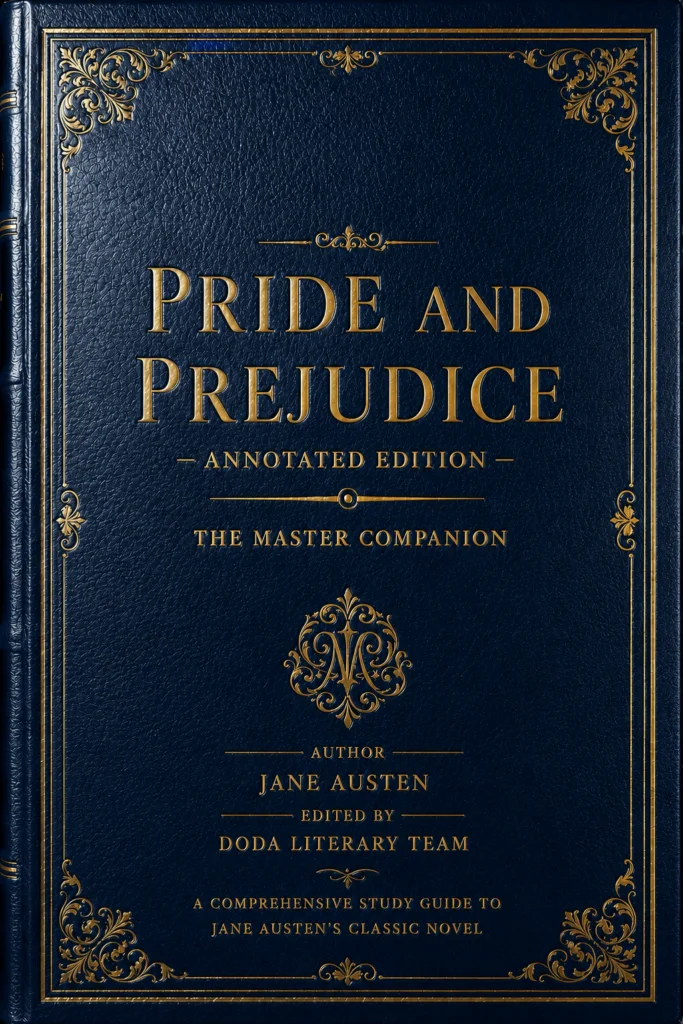
| Word count | ~120,000 words |
| Chapters | 61 |
| Average chapter length | ~2,000 words |
| Fast reading speed | 300 wpm |
| Average reading speed | 200 wpm |
| Slow reading speed | 150 wpm |
📖 The Honest Answer
The single honest answer to “how long does it take to read Pride and Prejudice?” is that it depends far more on you than on the book. The novel is a fixed object — about 120,000 words across 61 chapters — but the time it takes you to get through those words varies wildly with your reading speed, your familiarity with early-nineteenth-century English, and how much you pause to look things up.
Typical reading speeds for adults cluster between 150 and 300 words per minute. A comfortable reading pace for fiction is usually around 200 words per minute, which puts the plain text of Pride and Prejudice at about ten hours. But that figure assumes you read continuously without stopping. In practice nobody does. You set the book down, you reread a sentence that puzzled you, you check your phone — and all of that quietly adds to the clock. That is why a ten-hour book can easily feel like a two-week project.
There is also a real difference between reading and studying. If you are reading purely for enjoyment, your pace will be quicker and your to-the-minute total smaller. If you are a student preparing for class or an exam, you are not just reading — you are highlighting, making notes, and rereading key passages like the proposal scene. That can easily add half again to the time. If you want a guide to planning that study time efficiently, our guide to revising Pride and Prejudice for exams walks through a realistic study schedule chapter by chapter.
🎧 Audio vs. Print vs. Annotated
The format you choose changes the answer too. A well-narrated audiobook of Pride and Prejudice typically runs between eleven and thirteen hours — longer than the pure-text reading time for a fast reader, because a narrator can only speak so quickly. Audiobooks are a great way to “read” on a commute, but listening is nearly always slower than silent reading, so if speed is your priority, print wins.
The annotated edition sits somewhere between on the calendar. You are still reading the full original text, so your base time is the same as the plain-original column in the table above. What changes is that you will pause more — each annotation is an invitation to look something up, and that is exactly the point. Most readers find the total takes about 30 to 40 percent longer, but the payoff is that they understand far more on the first pass and rarely need to reread chapters later. For many people that means the annotated edition is actually the fastest route to genuine comprehension. If you are weighing editions before you start, our comparison of the original vs. modern editions lays out the trade-offs.
🏛️ Historical Context: Why the Book Is the Length It Is
Pride and Prejudice is a Regency-era novel of manners, published in three volumes in 1813 when novels were typically sold and borrowed by the volume. Its 61 chapters and roughly 120,000 words were deliberately paced for volume-by-volume reading — a middling length for its day, shorter than the Victorian triple-deckers that would follow. Austen’s chapters are short, and her scenes are built around set pieces — visits, dinners, letters, dances — that make natural stopping points.
That structure is why the novel survives so well in the “one chapter a day” format. Each chapter is a self-contained unit, so you can read for ten or fifteen minutes and always end at a satisfying break. Austen designed them to be digestible in a single modest sitting, which lets a modern reader reproduce the original reading experience — a little at a time, never feeling rushed.
🌟 Why It Still Matters
The length is part of what makes the book great. Pride and Prejudice earns its 120,000 words by building Elizabeth Bennet and Fitzwilliam Darcy’s relationship slowly and believably — the famous “misunderstanding” plot only works because Austen spends dozens of chapters letting prejudice accumulate and pride harden before the great reversal. A shorter book could not do this; a faster read would cheapen it.
That is the argument for giving the novel real time on your calendar, whether you spread it over two months a chapter at a time or power through a weekend. If the length is what is holding you back, our 15-minute summary of the whole novel previews the shape of the story before you commit to the full read.
💡 Reading Tips for Any Schedule
However long you decide to take, a few habits make the reading time more productive. First, read the first handful of chapters without stopping to look anything up — Austen establishes her register and cast quickly, and pushing through the first sitting breaks the intimidation factor. Second, use the chapter recap if you get lost; it takes a minute and dramatically improves orientation. Third, if you are short on time, pair a compact paperback with the audiobook and alternate — many readers find the combination keeps them moving faster than either format alone.
📊 Raw Numbers
| Reading Speed | Original Text | With Annotations | Simplified |
|---|---|---|---|
| Fast (300 wpm) | 6.5 hours | 8–9 hours | 4–5 hours |
| Average (200 wpm) | 10 hours | 12–14 hours | 6–7 hours |
| Slow (150 wpm) | 13 hours | 16–18 hours | 8–9 hours |
| Student (with notes) | 15–20 hours | 18–25 hours | 10–12 hours |
📋 What the Estimates Include
Original text — just the novel, no interruptions.
With annotations — the same novel plus reading chapter summaries, checking annotations, and following companion cards. The extra time varies by edition and how much you engage with the supplementary material.
Simplified version — rewritten at a lower reading level. Shorter sentences, simpler vocabulary, faster reading overall. You lose Austen’s voice but gain speed.
📅 Realistic Breakdown
Most readers do not finish a novel in one sitting. Here is how the schedule might look:
- Casual reader (one chapter daily): 2 months
- Committed reader (one hour daily): 10–14 days
- Weekend reader (3–4 hours): 2–3 weekends
- Exam crammer (full day): 8–10 hours
📚 Make every reading minute count
👉 Get the Annotated Edition⏱️ Does Annotations Double the Time?
Not as much as you might think. Chapter summaries take 1–2 minutes each. Annotations add 30–60 seconds per page. For a reader at average speed, the total time increase is about 30–40%.
The trade-off is comprehension. Readers who use annotations report significantly higher understanding on a first reading — which means they do not need to re-read chapters later.
⚡ The Shortcut: 15-Minute Version
If you truly do not have time for the full novel, there is a condensed version that covers every chapter in about 15 minutes each — around 15 hours total. It is not a replacement for the novel, but it is useful for revision or overview.
🧩 What the Annotated Edition Unlocks
242 Literary Annotations
Historical context, critical analysis, and literary allusions for every chapter — understand why Austen chose certain words and what Regency-era social rules mean for the plot.
139 Modern Simplifications
Complex passages rewritten in clear modern English. When Austen's sentences get dense, you will find a plain-English breakdown right there on the page.
Chapter Summaries
Every chapter begins with a concise 150–250 word recap of key events — perfect for quick orientation before you read or for revision after.
76 Discussion Questions
With original answers. Perfect for teachers planning classroom activities, book clubs preparing for meetings, or students writing essays.
Character Relationship Maps
Detailed profiles of every major character with relationship diagrams showing how Elizabeth, Darcy, Bingley, Jane, Wickham, and the rest connect.
Bonus Resources
Story timeline, chapter length bar chart, 10-question quiz with answers, comprehensive glossary of 143 archaic terms, and further reading recommendations.
❓ Frequently Asked Questions
How many words is Pride and Prejudice?
The novel contains approximately 120,000 words across 61 chapters. Average chapter length is about 2,000 words.
How long if I read one chapter per day?
At one chapter per day, the novel takes 61 days — about two months. Each chapter takes roughly 10–15 minutes to read at average speed.
Does reading with annotations take significantly longer?
It adds about 30–40% more time. However, this is often offset because annotated readers understand more on first pass and do not need to re-read sections.
How long is the audiobook?
Most audiobook versions run between 11 and 13 hours, depending on the narrator’s pace. Free versions on LibriVox tend toward the longer end.
Can I read Pride and Prejudice in a weekend?
A very committed weekend reader (8–10 hours total) can finish the original text. For a relaxed weekend read, plan for 2–3 weekends.
Which edition is fastest to read?
The simplified English version is the fastest at 4–7 hours. However, you trade Austen’s original prose for speed.
How long for students studying the novel?
Students who take notes, write responses, and re-read key passages should budget 15–25 hours for a thorough study of the annotated edition.
How long is each chapter of Pride and Prejudice?
Chapter lengths vary, but the average is around 2,000 words, which takes roughly 10–15 minutes to read at an average pace. Some chapters are noticeably shorter, which makes the book easy to pick up and put down.
Is the annotated edition worth the extra reading time?
For most readers, yes. The extra 30–40% of time is spent on context and explanation that make the first (and often only) reading far more complete — so you rarely need to reread sections to understand them.
Can I read the first chapter to get a feel for it before committing?
Absolutely. The famous opening chapter is short and perfectly captures Austen’s ironic voice. Read just that chapter first — it only takes about five minutes and will tell you immediately whether the original prose, an annotated edition, or a simplified version suits you.