Need a Pride and Prejudice summary that cuts through the old English and gets straight to the story? Here is the entire novel broken down in plain language covering all 61 chapters.
📖
Pride and Prejudice Summary in 15 Minutes: All 61 Chapters
The complete Pride and Prejudice plot explained in plain English — who meets whom, what goes wrong, how it all works out — in about fifteen minutes.
| Novel | Pride and Prejudice by Jane Austen |
| Published | 1813 |
| Chapters | 61 |
| Main Characters | Elizabeth Bennet, Mr. Darcy, Jane Bennet, Mr. Bingley |
| Central Theme | Pride, prejudice, class, marriage |
| Reading Time | ~10-12 hours (full novel) |
| Summary Time | 15 minutes |
👥 The Setup: Who Everyone Is
Before the story begins, you need to know the key players:
The Bennet Family. Mr. Bennet is a sarcastic, detached gentleman. Mrs. Bennet is obsessed with marrying off her five daughters. Jane is the eldest — kind, beautiful, and optimistic. Elizabeth is the second — clever, witty, and our heroine. Lydia is wild and impulsive. Mary is bookish. Kitty follows Lydia’s lead.
The New Arrivals. Mr. Bingley is a rich, friendly young man who rents Netherfield Park. Mr. Darcy is Bingley’s friend — even richer, but proud and socially awkward. Mr. Wickham is a charming soldier with a hidden agenda. Mr. Collins is a pompous cousin who will inherit the Bennet estate.
📍 Part 1: The News (Chapters 1-3)
A wealthy young man named Mr. Bingley moves into Netherfield, a nearby estate. Mrs. Bennet, who has five unmarried daughters, sees this as a golden opportunity. She practically pushes her daughters toward him.
At a ball, Bingley dances with Jane and clearly likes her. His friend Mr. Darcy, however, refuses to dance with anyone and famously says Elizabeth is “not handsome enough to tempt me.” Elizabeth overhears this and forms an instant dislike of him.
💕 Part 2: Love and Misunderstandings (Chapters 4-23)
Jane and Bingley grow close. Elizabeth and Darcy grow annoyed with each other. A handsome soldier named Mr. Wickham arrives and tells Elizabeth that Darcy cheated him out of his inheritance. Elizabeth believes him without question — it confirms everything she already thinks about Darcy.
Meanwhile, Mr. Collins proposes to Elizabeth. She refuses. He marries her friend Charlotte instead.
Darcy, despite himself, falls in love with Elizabeth. He proposes to her — but does it in the most insulting way possible, pointing out how far beneath him she is. Elizabeth rejects him furiously, listing every reason she despises him: his arrogance, his interference with Jane and Bingley, his treatment of Wickham.
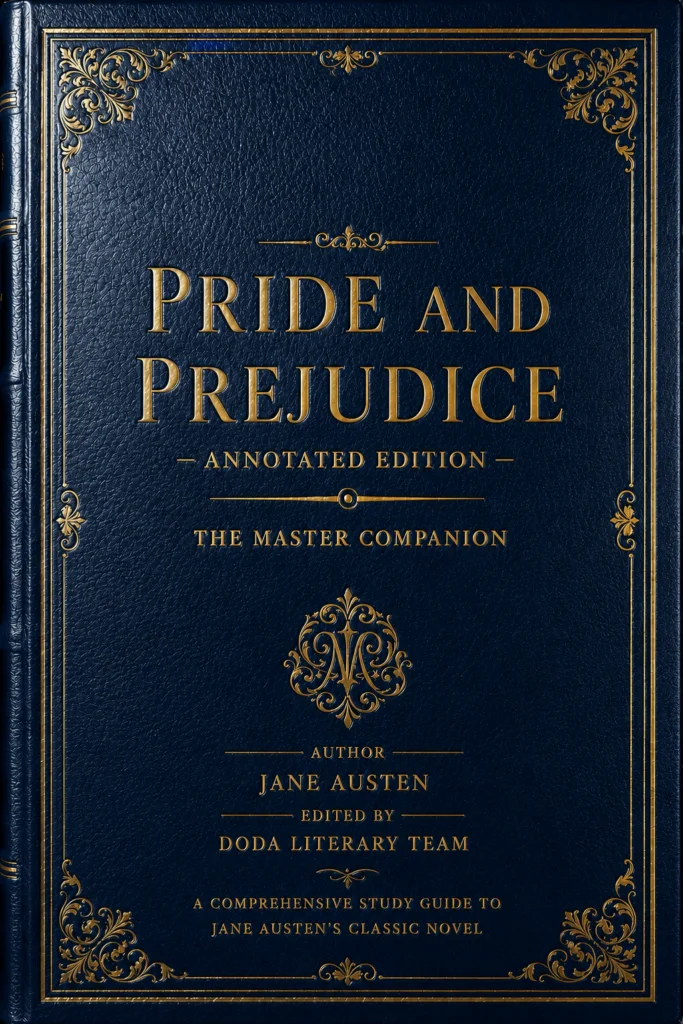
📖 Get the full annotated edition for deeper analysis of every chapter
👉 Get the Annotated Edition💌 Part 3: The Letter (Chapters 24-35)
The next day, Darcy gives Elizabeth a letter explaining everything. Wickham? He is a liar who tried to elope with Darcy’s young sister for her money. Jane and Bingley? Darcy admits he persuaded Bingley to leave, but honestly believed Jane did not love him back.
Elizabeth reads the letter and slowly realizes she has been wrong about everything. This is the turning point of the novel — and of her character.
“Till this moment, I never knew myself.” — Elizabeth Bennet
🌱 Part 4: Growth (Chapters 36-50)
Elizabeth visits Pemberley, Darcy’s estate, while he is away. She is told he is a good master and landlord — the opposite of what she expected. Darcy returns unexpectedly and is polite and warm. He helps rescue Lydia when she runs off with Wickham, paying Wickham to marry her and save the family’s reputation.
Elizabeth realizes her feelings have changed. But now she has no reason to think Darcy still cares.
💍 Part 5: Resolution (Chapters 51-61)
Bingley returns and proposes to Jane. Darcy proposes to Elizabeth again — this time humbly, without arrogance. She accepts. The novel ends with both couples married, and Elizabeth and Darcy understanding each other at last.
🎯 Why the Story Works
The plot of Pride and Prejudice is deceptively simple: girl meets proud man, hates him, then realizes she was wrong and falls in love. What makes it brilliant is that both main characters change. Elizabeth learns that her first impressions are not always right. Darcy learns that being good matters more than appearing good.
Every scene serves this double character arc. Nothing is wasted.
📚 What the Annotated Edition Unlocks
Chapter Annotations
242 annotations explaining context, language, and themes across all 61 chapters
Modern Simplifications
139 dense passages rewritten in clear English alongside Austen's original
Character Breakdowns
Detailed profiles with relationship maps for Elizabeth, Darcy, and the entire cast
Discussion Questions
76 questions with answers for essays, book clubs, and classroom activities
Glossary of Terms
143 archaic terms defined — from Regency social rules to obsolete vocabulary
Visual References
Character diagram, story timeline, and chapter length bar chart
🏛️ Historical Context: Why Marriage Was Everything
To understand why the whole plot turns on who marries whom, you have to appreciate how different Regency England was. In Austen’s world, a woman could not inherit her family’s estate, could not easily earn her own living, and was expected to marry well or face genuine hardship. The Bennet family’s situation makes this brutally clear: because the estate is entailed to a male heir, Mr. Collins will inherit Longbourn the moment Mr. Bennet dies, and the five daughters would be left with almost nothing.
This is why Mrs. Bennet’s frantic matchmaking is more than comic relief. She is terrified, and rightly so, that her daughters will end up destitute. Every scene involving an eligible bachelor — Bingley’s arrival, the Netherfield ball, the visit to Pemberley — carries this quiet economic anxiety beneath the romance. When you read with that context in mind, scenes that can seem merely fussy become genuinely tense. If you want a deeper look at the social machinery that drives the plot, our guide to the novel’s themes walks through class, pride, and reputation in detail.
🔥 Why the Novel Still Matters Today
Part of why Pride and Prejudice has never gone out of print is that its core conflict is timeless. Elizabeth’s mistake is not stupidity — she is intelligent, observant, and witty — but the way she lets a single bad first impression harden into a fixed belief. Darcy’s mistake is the inverse: his pride convinces him that his own judgment is unassailable. Both are undone not by a villain but by their own assumptions, and both must confess they were wrong before they can be happy.
That is a deeply modern idea. The novel is genuinely a study of self-knowledge and the difficulty of revising our opinions of other people. Elizabeth’s famous line — “Till this moment, I never knew myself” — lands so hard because it names the real journey of the book. It is also why the story remains a favorite for book clubs, classrooms, and readers of every generation. For more on the double character arc, our exploration of Elizabeth and Darcy’s relationship and our ending explained unpack how the final chapters pay off everything the earlier ones set up.
💡 How to Get the Most from This Summary
The fastest way to read the novel well is to use a summary like this one as a map, not a substitute. Skim the plot summary for each batch of chapters, then read the chapters themselves and notice how Austen builds scenes you already understand. You will catch details — the irony, the sly jokes, the social subtext — that are easy to miss on an unprepared first pass.
Pairing this summary with the annotated edition is the simplest route. The annotations explain the vocabulary and social rules, the modern simplifications reformat the densest passages, and the character diagrams keep relationships straight. If you are deciding between editions, our comparison of the annotated and original versions can help you choose, and the guide to pacing your reading gives realistic time estimates.
❓ Frequently Asked Questions
How long does it take to read Pride and Prejudice?
The full novel is approximately 120,000 words. Most readers finish in 10-12 hours of reading time, or 3-4 weeks at a comfortable pace of a few chapters per day.
What is the main message of Pride and Prejudice?
The novel explores how pride and prejudice distort judgment. Elizabeth's prejudice toward Darcy and Darcy's pride toward Elizabeth's family both prevent them from seeing each other clearly. Only when each recognizes their own fault can they find happiness.
Do Elizabeth and Darcy end up together?
Yes. After many misunderstandings, Darcy proposes again — this time humbly — and Elizabeth accepts. The novel ends with their marriage and a mature understanding between them.
Why does Elizabeth refuse Darcy's first proposal?
Elizabeth refuses because Darcy proposes arrogantly, pointing out her inferior social status and family embarrassments. She is also influenced by Wickham's lies about Darcy. After reading Darcy's letter, she realizes she was wrong about both Darcy and Wickham.
What is the significance of Pemberley in the novel?
Pemberley, Darcy's estate, symbolizes his true character. Elizabeth visits it expecting to see evidence of Darcy's arrogance, but instead finds a beautiful, well-managed estate where Darcy is respected by his staff. It marks the beginning of her change of heart.
How does Lydia's elopement affect the plot?
Lydia running off with Wickham threatens to ruin the Bennet family's reputation. Darcy secretly intervenes, pays Wickham to marry Lydia, and saves the family from disgrace — though Elizabeth does not learn of his role until later, further changing her opinion of him.
What is the entail and why does it matter?
Under English inheritance law, the Bennet estate is entailed to a male heir, so it passes to Mr. Collins when Mr. Bennet dies. Because the Bennets have no sons, their five daughters will inherit almost nothing. This is why Mrs. Bennet is so desperate to secure advantageous marriages — the family's financial future depends on it.
Does Elizabeth change more than Darcy over the course of the novel?
Both characters change, but Elizabeth's arc is the more visible one. She starts confident in her judgment and gradually learns that her first impressions were wrong. Darcy, meanwhile, learns humility and how to express his feelings. The symmetry of their growth — one shedding prejudice, the other shedding pride — is what makes the ending feel earned.
📚 Related Articles
🎯 Go Deeper with the Annotated Edition
The annotated edition of Pride and Prejudice gives you everything you need to truly understand Austen’s masterpiece:
- ✅ Complete, unabridged text — every word of the 1813 original
- ✅ 242 chapter-by-chapter annotations — historical context and literary analysis
- ✅ 139 modern simplifications — dense passages explained in plain English
- ✅ Character profiles and relationship maps — never lose track of who is who
- ✅ 76 discussion questions with answers — perfect for essays and book clubs
- ✅ Glossary of 143 archaic terms — every unfamiliar word defined