This side-by-side Pride and Prejudice original vs modern English comparison shows exactly what changes when a 200-year-old novel is translated into contemporary language — and what you gain or lose with each version.
Original vs Modern English
Three chapters compared side by side — the opening, the ball, and the proposal — with vocabulary and structure analysis.
| Edition | Vocabulary Level | Sentence Length | Tone Preserved | Readability |
|---|---|---|---|---|
| Original | 12th grade+ | 30–80 words | 100% | Hard |
| Annotated | 12th grade+ | Original | 100% with notes | Medium |
| Simplified | 5th–6th grade | 10–20 words | 80% | Easy |
| Modern retelling | 7th–8th grade | 15–25 words | 70% | Medium |
📖 What “Original vs. Modern” Really Means
When people ask about reading Pride and Prejudice “original vs. modern,” they usually mean one of two things: whether Austen’s 1813 text is readable today without help, or which of the simplified or modernized retellings to choose. The answer matters because it changes not just how fast you read, but what you actually experience.
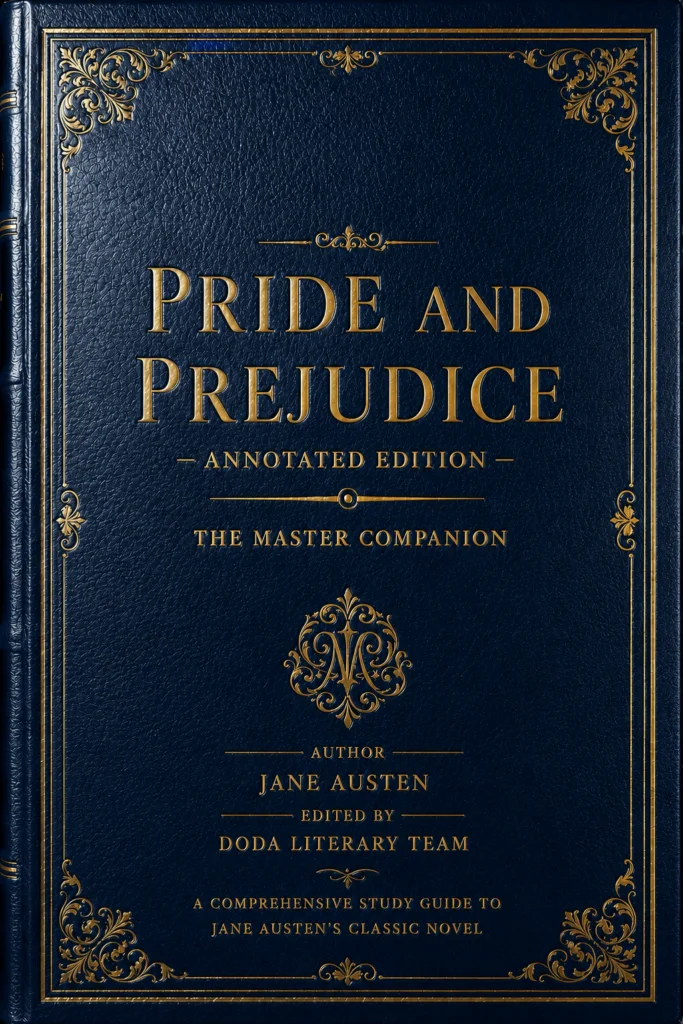
The original text is Austen’s own words, exactly as readers first met them. Its vocabulary, sentence rhythms, and assumed social knowledge are from the early nineteenth century, which is why even fluent modern readers stumble. A simplified version rewrites that prose in shorter sentences and plainer vocabulary, trading Austen’s voice for accessibility. An annotated edition keeps the original text untouched but adds explanations alongside it — giving you both the authentic prose and the keys to understand it.
🏛️ Historical Context: Why the Language Read Differently Then
To understand what “modernizing” Pride and Prejudice involves, it helps to know how different Austen’s readers were from us. The novel appeared in 1813, when the reading public was smaller and far more uniform. Austen’s audience shared a dense web of social knowledge that a modern reader has to learn: the strict rules of who could dance with whom, the legal realities of entailment and marriage settlements, and the elaborate codes of calling, visiting, and introduction that governed every encounter.
Much of what a simplified edition modernizes is precisely this — not just swapping archaic words, but unpacking assumptions about Regency society that Austen never had to explain. A sentence that relies on the reader understanding why Darcy’s fortune makes him a target of matchmaking mothers will puzzle a modern reader. That is why any honest “original vs. modern” comparison has to talk about social context as much as vocabulary — and it is a large part of what the annotated edition restores.
⚖️ A Point-by-Point Comparison
To make the differences concrete, here is what changes and what survives:
Vocabulary. The original uses a period vocabulary — “ardently,” “felicity,” “cognizance,” “repine” — precise and beautiful but not always instantly clear. Simplified versions replace these with everyday synonyms. You lose the flavour but remove almost every barrier.
Sentence structure. Austen’s hallmark is the long, balanced, ironic sentence that runs forty or fifty words and delivers its punchline at the end. Modernized versions break these into short declarative sentences. The meaning is clearer, but the wit’s timing is flattened — which is why Austen’s irony is what most often gets lost.
Tone. The original is narrated from a cool, ironic distance; Austen judges her characters without raising her voice. A modern retelling tends to be warmer and more direct. Many people read the modern version and wonder why Austen is so famous — the answer is that her brilliance lives almost entirely in the subtle voice that modernization smooths away.
Readability vs. reward. The simplified version reads at a 5th–6th grade level and takes half the time, a genuine on-ramp for new readers and second-language learners. But the novel’s comedy and social satire are carried by the original language. That is the central trade-off of the original vs. simple choice.
🎯 The Middle Ground: Annotated vs. Modernized
A modernized retelling is a translation: faithful to plot and character, but written in a new voice by a new writer. An annotated edition is not a translation — it leaves Austen’s voice intact and teaches you the language and context you need. Readers who value Austen’s voice and will slow down tend to prefer the annotated path; readers who want the story quickly and comfortably first tend to prefer simplified.
The annotated path lets you grow into the original text — you can read it once with the notes, then a second time without them and find you no longer need them. That is why many teachers pair a simplified or summarized read with the annotated original, as our beginner-friendly guide recommends.
📚 Why the Voice Matters
If you are tempted to skip straight to a modernized version, it is fair to ask what you are giving up. Austen’s is one of the most imitated voices in English literature, and Pride and Prejudice is where it peaks: the deadpan first line about a “truth universally acknowledged,” the quiet mockery of Mrs. Bennet, the economy of Darcy’s “I love you against my will.” None of that survives verbatim in a translation, because it is not in the plot — it is in the exact words. For a deeper look at the story those words carry, our chapter-by-chapter summary can keep you oriented as you read the original prose.
Read Austen's exact words — with help where you need it.
Get the Annotated EditionChapter 1: Opening
Original (1813): “It is a truth universally acknowledged, that a single man in possession of a good fortune, must be in want of a wife. However little known the feelings or views of such a man may be on his first entering a neighbourhood, this truth is so well fixed in the minds of the surrounding families, that he is considered as the rightful property of some one or other of their daughters.”
Modern English: “Everyone agrees that a rich single man must be looking for a wife. When a wealthy young man moves into a new area, the local families immediately assume he belongs to one of their daughters — whether he knows it or not.”
What changed: “Truth universally acknowledged” becomes “Everyone agrees.” A 42-word sentence becomes three shorter sentences. The modern version loses Austen’s ironic tone but gains immediate clarity.
Chapter 3: The Ball
Original: “Mr. Darcy danced only once with Mrs. Hurst and once with Miss Bingley, declined being introduced to any other lady, and spent the rest of the evening in walking about the room, speaking occasionally to one of his own party. His character was decided. He was the proudest, most disagreeable man in the world, and every body hoped that he would never come there again.”
Modern English: “Darcy danced twice — only with people he already knew. He refused to meet any new lady and spent the whole night walking around the room, talking just to his own group. His reputation was settled. He was the proudest, most unpleasant man alive, and everyone hoped he would never return.”
What changed: Specific names Mrs. Hurst and Miss Bingley are dropped. “Declined being introduced” becomes “Refused to meet.” “Disagreeable” becomes “Unpleasant.”
See every chapter compared. The annotated edition preserves the original text alongside modern explanations.
Get the Annotated EditionChapter 34: The Proposal
Original: “In vain I have struggled. It will not do. My feelings will not be repressed. You must allow me to tell you how ardently I admire and love you. I have fought against my better judgment, my family’s expectations, your inferiority, and your family’s low social position — but I love you anyway.”
Modern English: “I’ve tried to fight my feelings, but I can’t. I must tell you that I love you deeply. I’ve fought against what I know is right, what my family expects, your lower social standing, and your embarrassing family — but none of it matters.”
What changed: “Ardently” becomes “Deeply.” “Your inferiority” becomes “Your lower social standing” — less harsh, clearer meaning. “My feelings will not be repressed” becomes the simpler “I can’t.”
Which Should You Read?
Read the original if you have good reading stamina, enjoy language, and want Austen’s exact voice. Read an annotated edition if you want the original text but need help understanding it — the best middle ground. Read a simplified version if you are new to classic literature, English is your second language, or you just want the story without the struggle.
Original Text
Full Austen prose, period vocabulary, complex sentences.
Annotated Edition
Original text plus line-by-line explanations and context.
Simplified Version
Same story at 5th–6th grade reading level.
Modern Retelling
Contemporary language, 70% of original tone preserved.
Bundle Approach
Read simplified first, then annotated for depth.
Audiobook Pairing
Hear the original while reading the annotated text.
📖 Reading Tips for Either Version
Whichever version you choose, a little strategy helps. If you are reading the original, give yourself permission to read slowly and to use a chapter recap before each scene — knowing the social stakes of a visit or ball makes Austen’s comedy land harder. If you are reading a simplified version, treat it as a springboard: understand the story first, then try the original of your favourite chapter to see what the beauty actually is. For the best of both, read one chapter’s simplified text, then the same chapter in the original with annotations.
🌟 Why Both Versions Still Matter
Pride and Prejudice is two reading experiences in one book. As a story of Elizabeth Bennet misjudging and eventually loving Fitzwilliam Darcy, it works in any language — which is why modern retellings keep succeeding. But as prose artistry, its genius lives in Austen’s exact words, available only in the original. That is the philosophy behind the annotated edition, which keeps the exact original text while making it legible — so you do not have to choose between Austen’s voice and your own comprehension.
Frequently Asked Questions
Is the original Pride and Prejudice hard to read?
For modern readers, yes. Austen's vocabulary, sentence structure, and assumed social knowledge create barriers that did not exist for her original audience.
What is the reading level of the original?
Approximately 12th grade or above, depending on the reader's familiarity with 19th-century literary English.
Does the simplified version lose anything important?
Yes — Austen's ironic voice and some subtlety. But it preserves the plot, characters, and major themes, making it an excellent entry point.
Can I read both versions together?
Yes, and many readers recommend it. Read a simplified chapter first to understand the plot, then the original to appreciate the language.
How does the annotated edition help?
It keeps the original text but places definitions, historical context, and literary analysis alongside every passage that needs explanation.
Which version do teachers recommend?
Most teachers prefer the original text with supplementary annotation. The annotated edition satisfies both requirements.
Do I need to understand every word of the original?
No. Many words, especially the period vocabulary and social terms, will become clear from context or a quick glossary lookup. The annotated edition defines roughly 143 archaic terms, so nothing has to stop you for long.
Is a modern retelling the same as a simplified version?
Not exactly. A modern retelling is a fresh interpretation that may change wording and occasionally details, while a simplified version keeps the plot and characters intact but lowers the reading level. Simplified versions preserve more of the original story; retellings prioritise contemporary voice.
Will I enjoy the original if I found a simplified version too plain?
Very likely. Readers who feel a simplified version loses something are usually responding to exactly the wit and irony that only the original prose carries. Moving to the annotated original is the natural next step.
📚 Related Articles
Read Both Versions Effortlessly
- Original text preserved with modern annotations
- Vocabulary and context explained on every page
- Simplified edition included in the bundle