Burns is the national poet of Scotland because he gave the country a voice at a time when Scottish identity was under pressure. His achievement is cultural as much as literary.
What Makes Robert Burns the National Poet of Scotland
Why Robert Burns became Scotland's national poet — his preservation of the Scots language, celebration of Scottish traditions, and how he gave ordinary people a lasting voice.
👉 Get the Annotated Edition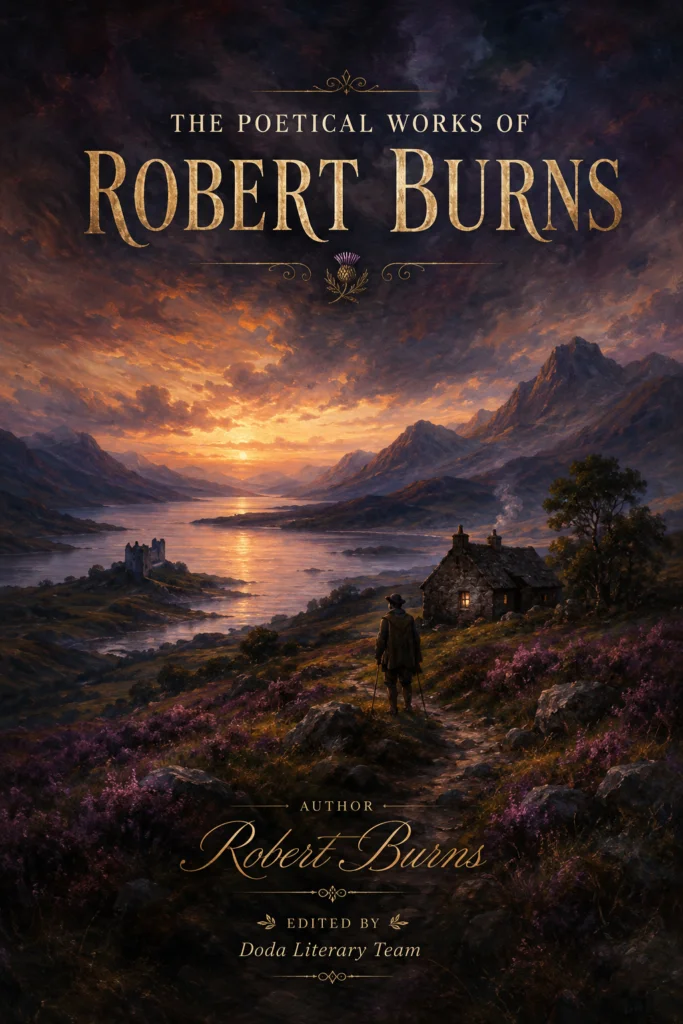
| Poet | Robert Burns (1759–1796) |
| Title | National Poet of Scotland |
| Key Works | Auld Lang Syne, Tam o’ Shanter, To a Mouse |
| Annual Celebration | Burns Night (January 25) |
| Legacy | Preserved Scots language, inspired generations |
🗣️ He Preserved the Scots Language
In the 18th century, the upper classes in Scotland were abandoning Scots in favour of standard English. Burns chose to write in Scots. This was not just a stylistic choice — it was a political and cultural statement. By proving that Scots could produce great poetry, he helped prevent the language from dying out.
🥘 He Celebrated Scottish Traditions
Burns wrote about haggis, whisky, Burns Suppers (before they were named after him), and Scottish history. Poems like “Address to a Haggis” and “Scots Wha Hae” turned everyday Scottish culture into material for great art. Before Burns, these subjects were considered too low or too local for poetry.
🎤 He Gave Scotland a Shared Voice
Burns wrote for everyone. He wrote love poems for lovers, satires for thinkers, songs for singers, and comic poems for people who just wanted to laugh. No matter who you are in Scotland, there is a Burns poem that speaks to you.
🎉 Burns Night Keeps the Legacy Alive
Every year on January 25, people around the world celebrate Burns Night. They eat haggis, drink whisky, recite poetry, and sing Burns’s songs. No other poet in the English-speaking world has an annual celebration on this scale. It keeps his work alive for new generations.
🌍 His Influence Goes Beyond Poetry
Burns influenced Robert Louis Stevenson, Hugh MacDiarmid, and the Scottish Renaissance. His line “the best-laid schemes o’ mice an’ men” gave John Steinbeck the title for Of Mice and Men. Bob Dylan cited Burns’s “A Red, Red Rose” as a major influence. His reach is extraordinary.
📚 Experience the complete works of Scotland's national poet
👉 Get the Annotated Edition🎓 What the Annotated Edition Unlocks
All 539 Poems
The complete canonical collection with line-by-line explanations for every poem and song Burns wrote.
Scots Language Guide
A 500+ word Scots glossary that makes Burns's language accessible — proof that Scots is a real language with consistent rules.
Historical Context
Understand the political and cultural pressures of 18th-century Scotland that shaped Burns's choice to write in Scots.
Cultural Commentary
Teacher's Insights that explain the Scottish traditions, references, and cultural significance in every poem.
Burns Night Ready
All the poems you need for Burns Supper — Address to a Haggis, Tam o' Shanter, Auld Lang Syne — with full annotations.
Portable Library
Works on Kindle, Apple Books, Kobo, and all major e-readers. Take Scotland's national poet wherever you go.
🏛️ Historical Context: Scotland in the 1750s
Burns was born in 1759 in Alloway, Ayrshire, the eldest son of a tenant farmer. He grew up in a Scotland shaped by the Jacobite risings of 1715 and 1745 and by the Treaty of Union of 1707, when the Scottish Parliament was dissolved into the Parliament of Great Britain. For ambitious Scots, advancement increasingly meant looking south: adopting English manners, English trade, and English speech. In the decades before Burns, the country’s educated elite had begun trimming the Scots language out of polite life, treating broad Scots pronunciation as a handicap rather than a heritage.
Burns walked straight into that divide. He was no armchair writer performing rusticity for fashion — he was a farmer’s son who knew, painfully, what a bad harvest meant. His father, William Burnes, went into debt to pay a tutor for his children, and the boy read deeply in English and Scottish literature even while he did a farmhand’s work. What emerged was a rare bilingualism: raised speaking Scots, schooled in English, Burns carried both registers in his head his whole life. That is why his poems can swing from proud Scots to polished English within a single stanza — the language itself dramatizes the cultural tug-of-war he lived.
Burns published his first book, the Kilmarnock edition, in 1786. It was an immediate sensation in Edinburgh, where the literati celebrated him as the “heaven-taught ploughman” — living proof of what the Scottish Enlightenment believed it had discovered: that natural genius could match the learning of the universities. Edinburgh at the time was the home of David Hume and Adam Smith, thinkers who placed feeling, sympathy, and moral intuition at the center of human life. Burns gave those intellectual fashions an emotional voice. His poems took sentiment — the era’s great keyword — and made it, as he put it, the soil from which real poetry grows.
🎵 The Man Who Saved the Songs
Beyond his own poems, Burns did a quieter piece of nation-building: he rescued Scotland’s folk music. In his final decade he poured himself into collecting old Scots airs and writing new words for them, contributing hundreds of songs to James Johnson’s Scots Musical Museum. Poems we now think of as age-old folk heritage often passed through Burns’s hands — he polished, rebuilt, and sometimes entirely rewrote fragments into the versions we sing today. “Auld Lang Syne” itself grew from older verses Burns collected and reshaped. By treating the folk tradition as worthy of his full art, he did for Scotland’s songs what the Brothers Grimm did a generation later for Germany’s fairy tales: he stopped a living oral tradition from fading into silence. That restoration work is a large part of why the Scots language and its music are still alive.
📖 How to Actually Read Burns
The single best piece of advice for a newcomer is to read Burns aloud. The poems were written to be heard and sung; their rhymes and rhythms only make full sense as sound, and Burns’s wit and his Scots dialect sound wonderful in a strong Scottish accent. Do not let the spelling scare you. Scots is not a corruption of English but a language with its own consistent rules, and most readers adapt within a few poems once they learn a handful of key words — ken, quine, mair, gang — that do almost all of the work. If you would rather see the mechanics explained before you dive in, our guide to why Burns’s poems are hard to understand unpacks the exact hurdles — spelling, grammar, and 18th-century allusions — that trip up first-time readers, and our step-by-step method for reading Burns turns those hurdles into a repeatable approach.
Once you have the words, read for the man behind them. Burns writes about love, drink, class, hypocrisy, and mortality with a warmth that feels startlingly modern. Read “To a Mouse” and watch his sympathy extend to a field creature he has accidentally destroyed; read “Holy Willie’s Prayer” and watch him skewer religious hypocrisy; read “A Red, Red Rose” or “Ae Fond Kiss” and feel how tenderly he treats love. It is this sense of a living, breathing, imperfect man behind the lines that makes the poetry feel like conversation rather than a museum specimen.
🌍 Why He Still Matters
Burns’s survival is not a literary fossil. Every January, on Burns Night, hundreds of thousands of people sit down to haggis, recite “Address to a Haggis,” and sing “Auld Lang Syne” — a song the whole world now reaches for to close weddings, funerals, and New Year’s Eve. At Hogmanay, at graduations, at the end of almost any shared occasion, his words are the ones people choose. No other writer in the English-speaking world commands this kind of living, annual, global celebration.
He also remains the standard against which Scottish identity measures itself. His egalitarian instinct — the insistence that a tenant farmer’s feelings matter as much as a duke’s — still speaks directly to a culture that prizes equality, sociability, and fairness. If you want to weigh whether that voice deserves its crown in the 21st century, our honest reassessment of Robert Burns today makes the case both for and against, and the guide for beginners covers his life and work if you are coming to him for the first time.
❓ Frequently Asked Questions
Why is Burns called Scotland's national poet?
Because he preserved the Scots language, celebrated Scottish traditions, and created a shared cultural voice that still unites Scots around the world — something no other Scottish writer has achieved.
When did Burns become the national poet?
Burns was celebrated during his lifetime, but his status as national poet grew throughout the 19th century as Scotland embraced his work as a symbol of national identity.
What is Burns Night?
An annual celebration of Burns’s life and work on January 25 (his birthday). Traditions include haggis, whisky, poetry recitation, and singing “Auld Lang Syne.”
Did Burns write in English or Scots?
Both. He wrote in a blend of Scots and 18th-century English. His most famous works are in Scots, which is what makes them distinctively Scottish.
How did Burns influence other writers?
His work inspired Robert Louis Stevenson, Hugh MacDiarmid, John Steinbeck (Of Mice and Men), Bob Dylan, and countless other poets and songwriters across the world.
Is Burns still celebrated in Scotland today?
More than ever. Burns Night is celebrated worldwide, his poems are taught in every Scottish school, and his face appears on Scottish banknotes.
What is "Auld Lang Syne" about?
Literally, “old long since,” or times gone by. The song looks back on old friendships and shared moments and raises a cup to them — which is why, sung at midnight on January 1, it has become the world’s anthem of remembrance and renewal. Burns adapted it from older Scots fragments and gave it the form we sing today.
Which Burns poem should a beginner start with?
“To a Mouse” is the classic starting point — it is short, moving, funny, and famously gave John Steinbeck the title of Of Mice and Men. “A Red, Red Rose” and “Address to a Haggis” are also approachable, especially read aloud. A glossary of the common Scots words will get you through the rest of the canon quickly.
📚 Related Articles
Celebrate Scotland’s national poet with the complete works
Poems and Songs of Robert Burns — The Annotated Edition
All 539 poems with line-by-line explanations, complete Scots glossary, and Teacher’s Insights for every stanza.
👉 Get the Annotated Edition{ .cta-button }