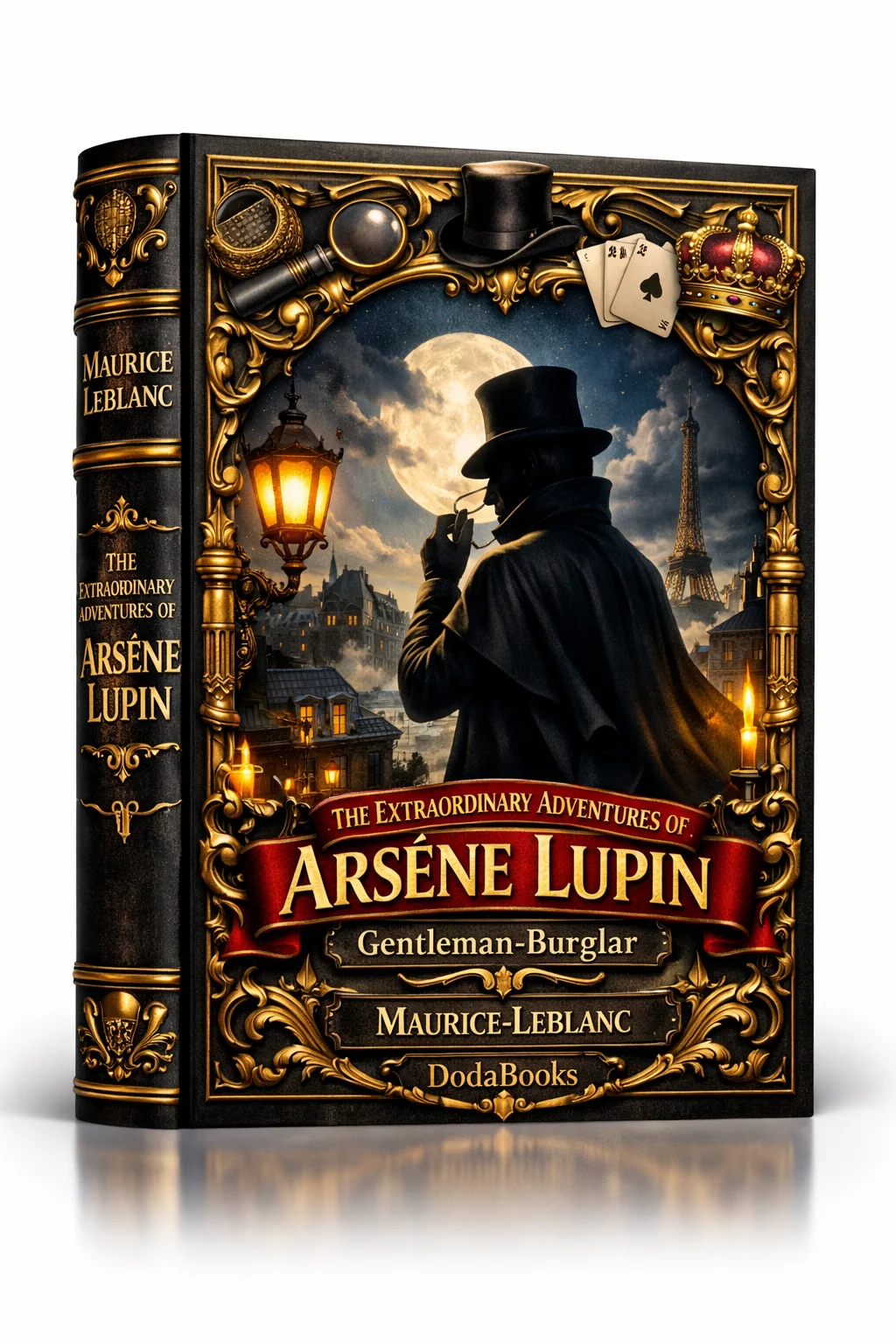
Maurice Leblanc’s The Extraordinary Adventures of Arsène Lupin, Gentleman-Burglar introduced the world to one of literature’s most captivating rogues — a gentleman-burglar whose wit, charm, and audacity rival even Sherlock Holmes himself. Published in 1907, this collection of nine stories established Lupin as France’s answer to the great detective, only with the law on the wrong side.
🔍
Arsène Lupin, Gentleman-Burglar
Nine tales of France's most charming gentleman-burglar — a master of disguise, a genius of deduction, and a thorn in the side of the Parisian police.
| Author | Maurice Leblanc |
| Published | 1907 |
| Genre | Adventure, mystery, crime fiction |
| Stories | 9 |
| Setting | Early 1900s France — Paris, prisons, châteaux, and luxury liners |
| Legacy | One of the most iconic characters in French literature; inspired the hit Netflix series |
📖 The Stories
The collection opens with “The Arrest of Arsène Lupin,” in which the gentleman-burglar is captured on a transatlantic liner — or is he? “Arsène Lupin in Prison” finds our hero conducting his affairs from behind bars, orchestrating crimes with the police as unwitting accomplices. “The Escape of Arsène Lupin” is a masterpiece of misdirection and one of the great prison break stories in literature.
“The Mysterious Traveller” sees Lupin match wits with a fellow passenger on a train. “The Queen’s Necklace” revisits the most famous jewel heist in French history — with a Lupin twist. “The Seven of Hearts” is a puzzle story worthy of Poe. “Madame Imbert’s Safe” and “The Black Pearl” showcase Lupin’s audacity and cleverness.
And finally, “Sherlock Holmes Arrives Too Late” brings the world’s two greatest detectives — one legal, one not — face to face. Holmes has come to Paris to solve a crime, but Lupin is always one step ahead. Their rivalry became legendary, though Leblanc was forced to rename Holmes “Herlock Sholmes” after Doyle’s lawyers objected.
🎭 Key Characters
Arsène Lupin
Lupin is a master of disguise, a genius of deduction, and a showman above all. He steals not just for profit but for the thrill of it — and he takes enormous pleasure in outwitting the police, the press, and anyone who underestimates him. Unlike a common criminal, he operates by a code: he targets the wealthy and corrupt, and he has a soft spot for women in distress. He is charming, theatrical, and impossible not to root for.
Sherlock Holmes / Herlock Sholmes
The great English detective makes a guest appearance in the final story, and the contrast between Holmes’s stern professionalism and Lupin’s playful audacity is perfect. Holmes is methodical, Lupin is improvisational; Holmes follows evidence, Lupin creates illusions. Their clash is one of the highlights of the collection.
The Prefect of Police
The long-suffering head of the Parisian police, who has made capturing Lupin his life’s mission and failed at every turn. He provides the comic relief of the collection, always a step behind and always baffled by Lupin’s latest exploit.
📖 Literary Significance
Arsène Lupin was a sensation from his first appearance. Leblanc created a character who was simultaneously a criminal and a hero — a daring concept for 1907. Lupin’s charm and wit made him irresistible to readers, and his adventures tapped into a French appetite for stories of clever rogues outsmarting authority.
The rivalry with Sherlock Holmes — both in fiction and in the legal battles between Leblanc and Doyle — added to the legend. Lupin’s ability to outwit even the great detective cemented his status as a unique figure in literature. Where Holmes represents order and justice, Lupin represents freedom and mischief.
The stories have never gone out of print and have been adapted into countless films, TV series, and comics. The Netflix series Lupin (2021–) introduced the character to a new generation, proving that the gentleman-burglar’s appeal is timeless.
✨ What Makes the DodaBooks Edition Special
This is the original 1907 text, carefully prepared for modern readers without distractions or clutter.
Zero Distractions
No ads, no license pages, no project boilerplate — just the original stories, clean and uninterrupted.
Smart Typography
Curly quotes, em-dashes, proper ellipsis — typeset with care for a premium reading experience.
Chapter Navigation
Full table of contents with back-to-story links in every section — jump between all 9 stories effortlessly.
Cleaned & Polished
All Gutenberg boilerplate stripped, consistent formatting throughout the text.
No DRM
You own your copy — read on any device, anytime, forever.
Instant Download
EPUB format included, delivered instantly after purchase.
🇫🇷 The Belle Époque: Why Lupin Belongs to His Era
Lupin is inseparable from the moment that created him — the tail end of the Belle Époque, when Paris glittered with luxury hotels, banquets, motor cars, and a press hungry for scandal. It was an age of enormous fortunes and a public that delighted in watching the rich get their comeuppance from someone cleverer than they were. A thief who robbed the wealthy and outsmarted the police was not a menace; he was a fantasy of class revenge dressed in evening gloves.
Leblanc was himself an established novelist when Pierre Lafitte, founder of the magazine Je Sais Tout, asked him for a rival to Sherlock Holmes. Rather than copy Conan Doyle, Leblanc inverted him: where Holmes restores order, Lupin dismantles it with style. Appearing first in 1905 and collected in this 1907 volume, the character struck a chord that France — and then the world — never let go.
🔮 Themes: Disguise, Class, and the Joy of the Performance
Strip away the locked rooms and the same three engines power every tale. First, disguise: Lupin is rarely ever simply himself. Second, class: his targets are always the rich and corrupt, and his heists double as satires on aristocratic vanity. Third, performance — Lupin steals for the newspapers as much as for the loot, and he wants the whole city to know it was him.
That moral economy is what keeps him a “gentleman” burglar. He never harms the poor, he flirts with the innocent, and he treats every inspector as a worthy opponent. Read for these threads and the collection reveals itself as one repeated fable about charm, wit, and brains over money.
🧭 How to Read the Nine Stories
This is a collection, not a novel, and it rewards dipping — but a little order helps. The first three stories form a loose arc around Lupin’s arrest and escape and are best read together; the middle tales are independent capers. The famous final story, “Sherlock Holmes Arrives Too Late,” lands hardest once you have watched Lupin work alone a few times.
If you are short on time, start with “The Escape of Arsène Lupin” — a prison break so neat it reads like a magic trick — then “The Queen’s Necklace.” Readers who enjoy the detective half will find the same wit in Chesterton’s guide to The Innocence of Father Brown, the lock-and-key ingenuity of The Problem of Cell 13, and the chase energy of The Thirty-Nine Steps.
🎭 Why the Gentleman-Burglar Endures
A century on, Lupin remains one of the most adapted characters in French literature — films, comics, and the Netflix series Lupin starring Omar Sy. Each generation rediscovers the same appeal: a hero who wins without violence, one clever step ahead of the authorities, who makes crime look like the most fun a person can have.
Part of the endurance is historical — Lupin belongs to the golden age of the gentleman thief, a type that also produced Raffles in England. Part of it is aesthetic: Leblanc writes with a lightness that keeps even the oldest stories fresh. If you have only met the Netflix version, the original shows you the source code of the myth.
❓ Frequently Asked Questions
Is Arsène Lupin a hero or a villain?
Both — that’s the point. Lupin is a thief who steals from the rich and corrupt, operates by a personal code of honor, and is unfailingly charming. He’s what you might call a lovable rogue, and readers have adored him for over a century for exactly that ambiguity.
Does Sherlock Holmes appear in this collection?
Yes — the final story, “Sherlock Holmes Arrives Too Late,” features the great detective. However, due to legal pressure from Arthur Conan Doyle, Leblanc was forced to rename him “Herlock Sholmes” in later editions. The DodaBooks edition preserves the original Holmes reference.
Do I need to read the stories in order?
Yes — the stories build on each other. Lupin is arrested in the first story and escapes in the third; characters and events recur. Reading in order gives the best experience.
How long does it take to read?
At 180 pages in the DodaBooks edition, most readers finish in 3-5 hours. The stories are short enough to read one at a time, making it perfect for commutes or short reading sessions.
Is this the inspiration for the Netflix series?
Yes — the 2021 Netflix series Lupin starring Omar Sy is directly based on Leblanc’s character. While the series is a modern adaptation with an original plot, it draws heavily on the spirit and style of the original stories.
Is Lupin a copy of Sherlock Holmes?
No — he is the mirror image. Leblanc was commissioned to create a rival to Holmes, and he deliberately built the opposite: Holmes is a detective who restores order, while Lupin is a criminal who disrupts it with charm. Where Holmes reasons from evidence, Lupin invents illusions. The two face off in the final story, and their rivalry became one of the great cross-channel brand battles in literature, fought partly in the courts when Doyle’s estate objected.
Why is he called a "gentleman-burglar"?
Two ideas are packed into the phrase. First, manners: Lupin moves through high society, dresses impeccably, and steals jewels and paintings rather than purses. Second, a code: he preys only on the rich and corrupt, spares the innocent, and treats theft as a performance rather than a crime. The title is half compliment, half oxymoron — and it is the joke at the centre of the whole character.
Is this book suitable for younger readers?
Broadly, yes. The heists are clever rather than violent, the tone is witty rather than grim, and there is no explicit content. Teenagers who enjoy puzzle stories and adventure will catch the thrills immediately, and the historical setting opens a door into Belle Époque France. The only dated element is the cameo by a certain English detective, whose original name was rewritten as “Herlock Sholmes” after Doyle’s objections.
📚 Related Articles
🔍 Read the Original Gentleman-Burglar Stories
The Extraordinary Adventures of Arsène Lupin is the collection that introduced one of literature’s most beloved rogues. The DodaBooks edition preserves all 9 original stories in a clean, distraction-free format:
- ✅ Complete 9-story collection — every word of the 1907 edition
- ✒️ Smart typography — curly quotes, em-dashes, proper ellipsis
- 📜 Full table of contents with story navigation
- 🔒 DRM-free — read on any device, anytime
- 📥 Instant download — EPUB format