John Buchan’s The Thirty-Nine Steps is the 1915 spy thriller that invented the man-on-the-run formula — and it still crackles with tension today. This guide covers the plot, the wartime history behind the novel, and why the DodaBooks Annotated Edition makes it the perfect way to experience the chase with every clue decoded.
🕵️
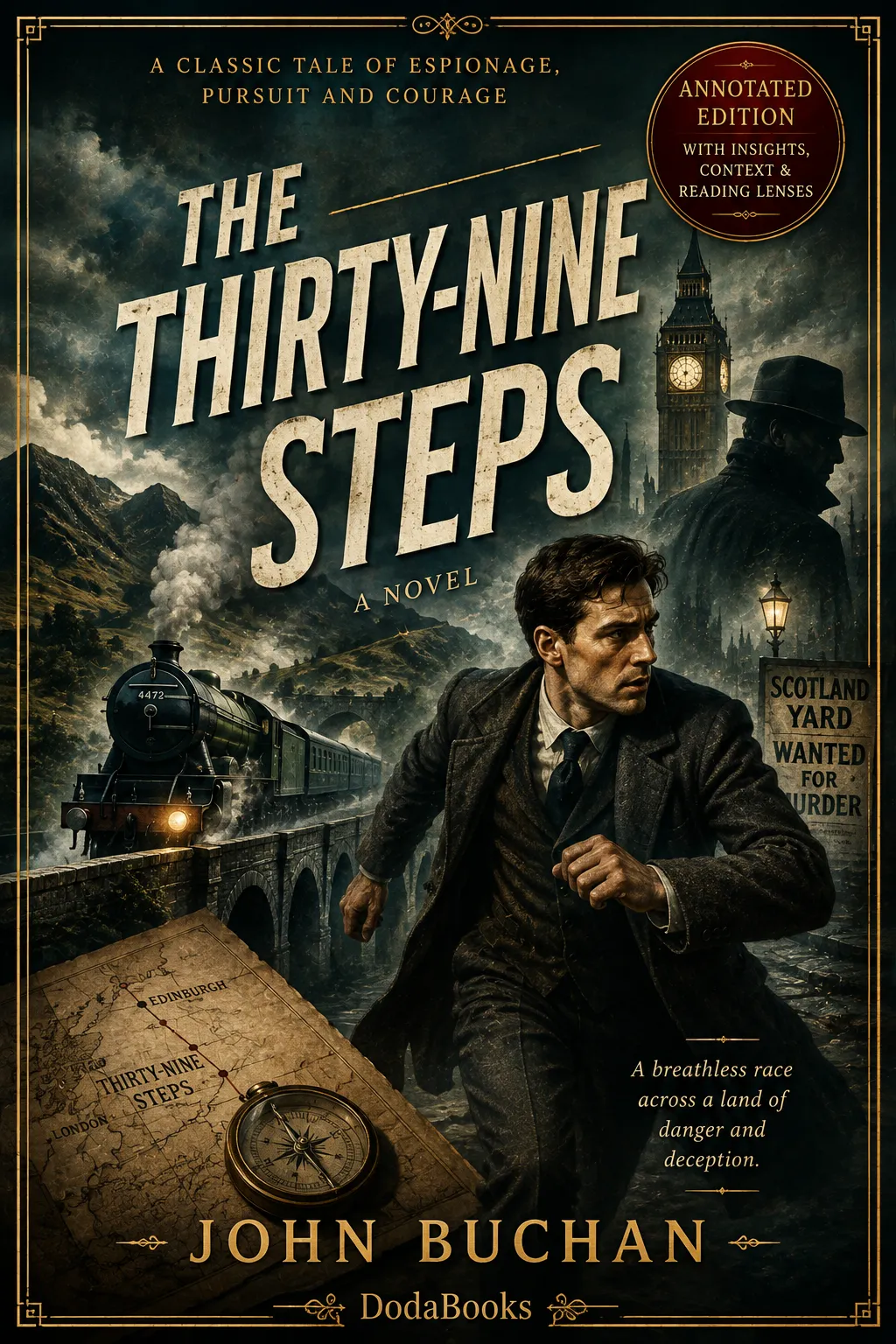
The Thirty-Nine Steps
A bored engineer stumbles onto a murder, a secret that could save Britain, and a nation-wide manhunt. The original man-on-the-run thriller — with 50 annotation cards decoding every clue, disguise, and false trail.
| Author | John Buchan |
| Published | 1915 |
| Genre | Spy thriller, adventure |
| Setting | London and the Scottish Borders |
| Annotation Cards | 50 passage-specific notes |
| Best For | Thriller fans, history lovers, first-time readers |
| Reading Time | 3–4 hours |
🕵️ The Story
Richard Hannay is a mining engineer back in London, bored out of his skull. When a mysterious American named Scudder claims to have evidence of a German spy ring planning to steal Britain’s naval secrets — and then turns up murdered in Hannay’s flat — Hannay does the only sensible thing: he runs.
With every policeman in the country looking for him, Hannay has to stay one step ahead of the net closing in. He’s chased across the Scottish Borders, hiding in moors, farmhouses, and country inns, all while trying to decode the nine clues Scudder left in a little black book. The trail leads to a quiet house on a cliff above Galloway — the “thirty-nine steps” of the title — where the fate of a nation will be decided by the thinnest of margins.
“I had my revenge on the people who had ruined my evening and my flat.”
The novel is a masterpiece of sustained suspense: every disguise, every train ride, every knock on the door resets the clock. Buchan never lets the reader relax long enough to notice the implausibilities — and for a book written in a matter of weeks in 1914, that pace is the point.
🌍 Why the First World War Made This Book
The Thirty-Nine Steps was written at white heat as war broke out across Europe, and you can feel it on every page. Buchan himself had watched the spy scare that gripped Britain in the summer of 1914. German spies, secret codes, hidden airfields, naval plans — these were the fears circulating in every newspaper and drawing room of the period.
The novel’s genius is to make a private murder feel like a national crisis. Hannay isn’t just running for his life; he’s running for Britain. That sense of ordinary people catching a glimpse of a huge hidden conflict is exactly what turned the book into an overnight bestseller and, within two decades, into the template for every cinematic man-on-the-run thriller from North by Northwest to The Bourne Identity.
🔍 How the Annotated Edition Changes the Read
Read at speed, The Thirty-Nine Steps is pure adrenaline. Read with the DodaBooks annotations, it becomes a richer, smarter novel — because Buchan’s trick is precisely that he moves too fast for you to notice how the machinery works.
You’ll never read a chase scene the same way again. The annotations pause the action just long enough to show you how geography, disguise, and misdirection conspire to keep Hannay alive.
50 Annotation Cards
Visible, color-coded notes beside key passages — no hidden footnotes, no clicking around.
WWI Context
The real wartime espionage scares, codes, and intelligence culture behind the plot.
Scottish Landscape
The actual geography of the chase — moors, railways, and the coast of Galloway.
Disguise & Identity
How appearance and social assumptions become Hannay's survival tools.
Suspense Mechanics
How Buchan weaponizes limited information to build dread on every page.
Reading Lenses
Chapter-end guides plus a full Themes guide and Annotation Index.
📘 Annotated Insight — The Art of the False Trail
When Hannay uses a pair of reading glasses and a change of clothes to walk past a roadblock, most thrillers treat this as a lucky break. Buchan is quietly showing you something smarter: the most effective disguises don’t change who you are, they change what people assume you are. A respectable man with a book is invisible in 1914 Britain — and the annotations flag exactly why that social assumption is the real weapon.
🗺️ The Legacy: From Buchan to Hitchcock
The Thirty-Nine Steps made Richard Hannay the grandfather of every fictional spy. T. E. Lawrence read it in the desert; John le Carré and Ian Fleming grew up on it; and Hitchcock adapted it into one of the most influential thrillers ever filmed (1935), creating the “wrong man” template Hollywood has used ever since.
The novel also matters as a time capsule. Written at the exact moment the world tipped into the Great War, it preserves a Britain on the edge — a country of polite surfaces, hidden loyalties, and catastrophes ticking quietly beneath respectability. That’s why the DodaBooks edition pairs the story with real wartime history: the more you know about 1914, the better the book works.
🔍 Decoding Scudder’s Nine Clues
Scudder’s little black book is the engine of the plot — a set of seemingly random notes that only make sense once Hannay learns how to read them. On one level they are genuine clues: a date, a street, a name that will eventually point him toward the man known as the “Black Stone.” On another level they are a lesson in how intelligence works.
“I had begun to get some glimmering of what it meant. I was not the detective; the ideas were all in Scudder’s book, and it was only a question of reading them aright.”
Buchan, who would later run Britain’s wartime information service, knew that espionage is rarely about heroic capture in an enemy headquarters. It is about fragments — a timetable here, a port name there — patiently fitted together by someone stubborn enough to keep going. Hannay’s panic and improvisation are the reader’s stand-in, but the book quietly rewards you for paying attention to the black book’s details right alongside him.
🎭 Disguise and Class on the Run
To survive, Hannay must learn to be invisible, and the tool he uses is the most British thing Buchan could have given him: class. A clean collar, a respectable suit, and a plausible story let a wanted man walk through police cordons and into the homes of strangers. When Hannay poses as a tramp, a political candidate, and a sly book collector, he is testing a simple thesis — people see the uniform, not the man.
The annotations in the DodaBooks Annotated Edition flag these moments because they are where the funniest and most revealing social comedy hides. The respectable façade that boxes in Edwardian Britain is the same one that lets Hannay escape through it, and Buchan uses the chase to poke gentle holes in the class system while relying on it completely.
🧭 Reading the Chase as a Map of Scotland
You can follow Hannay’s route on a modern map of the Borders, which is part of the book’s enduring appeal. The railway timetables, the moors, the farm kitchens, the lonely coastal cliffs near Galloway — these are real places, and Buchan knew every mile of them from his own tramping in the Borders. His love of the landscape turns a thriller into a kind of travel writing, and the chase becomes a you-are-there geography lesson.
For readers new to the region, that sense of place is half the pleasure. Buchan’s Scotland is not the romantic Highlands of the tourist postcards; it is a working country of shepherds, innkeepers, and small-town grudges, where a stranger is noted instantly and helped grudgingly. Keep an eye on the place names as you read — each one is a handhold in the suspense. And if the chase hooks you, our guide to Mr. Standfast follows Hannay into the closing months of the war, while our guide to A Study in Scarlet shows Conan Doyle building mystery from a similar mix of deduction and disguise.
❓ Frequently Asked Questions
Who was John Buchan, and why does his background matter?
Buchan was a Scottish novelist, historian, and later Governor-General of Canada who worked in British intelligence during the First World War. That background is everywhere in the book: the spycraft feels lived-in because it was written by a man who understood real wartime information operations and the spy scares that gripped the public.
How many Richard Hannay novels are there?
Five. The Thirty-Nine Steps (1915) is the first, followed by Greenmantle, Mr. Standfast, The Three Hostages, and The Island of Sheep. The DodaBooks edition of Mr. Standfast continues Hannay’s story through the final months of the Great War.
Is the "thirty-nine steps" a real place you can visit?
Not exactly. The novel’s cliff-top house is fictional, though it was inspired by the coastal scenery of Galloway in southwest Scotland. Literary pilgrims visit the region to walk Hannay’s route and imagine the climactic sequence against the real landscape.
Do I need to know anything about WWI to enjoy it?
No — the spy plot stands alone. But the historical annotations in this edition show you the real fears the novel is playing on: German agents, stolen naval plans, secret airfields. The context makes the book dramatically more interesting without ever getting in the way.
What does the title mean?
“The thirty-nine steps” turns out to be a set of steps leading from a cliff-top house down to the sea — the point where the novel’s crisis climaxes. Getting there is one of the great suspense sequences in thriller fiction.
Is The Thirty-Nine Steps connected to the other Richard Hannay novels?
Yes — it’s the first of five Hannay adventures. Buchan’s sequel Mr. Standfast (also available as a DodaBooks Annotated Edition) places Hannay behind enemy lines in the final months of WWI.
Is the book anything like the Hitchcock film?
Hitchcock kept the title and the chase but changed much of the plot. Both are classics in their own right — but the novel has a tighter, more desperate arc and an ending the film famously doesn’t show you.
How long does it take to read?
At roughly 100 pages, most readers finish in a single sitting or a couple of commutes — 3 to 4 hours. It’s the perfect length for a thriller.
📚 Related Articles
🕵️ Run the Chase with Every Clue Decoded
The Thirty-Nine Steps is where modern espionage fiction begins. The DodaBooks Annotated Edition keeps Buchan’s original text and adds a full reading layer:
- ✅ Complete 1915 text — every word of the classic
- 🗂️ 50 visible annotation cards — color-coded, passage-specific
- 🎖️ WWI espionage history and intelligence context
- 🗺️ Scottish geography explained — the real landscape of the chase
- 🔒 DRM-free — read on any device, anytime
- 📥 Instant download — EPUB format