The cetology chapters in Moby-Dick are often skipped, but they contain some of the novel’s deepest meanings. Learn why Melville included them and what they reveal.
This article is part of our annotated Moby-Dick guide, designed to help readers unlock the full depth of Melville’s masterpiece through comprehensive notes and analysis.
🐋
Moby-Dick Cetology Chapters Explained: Why the Whale Science Matters
The cetology chapters in Moby-Dick are often skipped, but they contain some of the novel's deepest meanings. Learn why M...
The Most Skipped Chapters
Every reader of Moby-Dick faces the same question: what do I do with the cetology chapters? These chapters — devoted to whale anatomy, classification, and behavior — interrupt the narrative at regular intervals. They seem to have nothing to do with the story of Ahab and the white whale. One minute Ishmael is standing at the helm watching the sea; the next, we are being lectured on the thickness of a sperm whale’s blubber or the number of bones in its spine.
Many first-time readers skip them entirely, and it’s easy to see why. Ahab is brooding below deck plotting his revenge, and the chase is building toward its terrible climax — and then Melville stops everything to classify whales like a naturalist in a museum. If you’re reading for the story, these chapters feel like speed bumps. You might even be tempted to jump from Chapter 31 straight to the dramatic confrontation in Chapter 36, skipping the interlude in between.
This is understandable, but it is also a real loss. The cetology chapters are not digressions pasted in to pad the page count. They are essential to the novel’s meaning — arguably the most original thing Melville did with the novel form. To understand why Moby-Dick is an encyclopedia as much as a story, the place to start is exactly where most readers look away. If you want context before you dive in, our guide to how Moby-Dick is both novel, epic, and encyclopedia explains how all these threads fit together.
What Are the Cetology Chapters?
📖 Want the complete annotated experience?
👉 Get the Annotated EditionThe term “cetology” means the study of whales. Melville devotes approximately 15-20 chapters to various aspects of cetology:
- Chapter 32: “Cetology” — an attempt to classify whale species
- Chapter 55: “Of the Monstrous Pictures of Whales” — a survey of inaccurate whale depictions
- Chapter 56: “Of the Less Erroneous Pictures of Whales and the True Pictures of Whaling Scenes”
- Chapter 57: “Of Whales in Paint; in Teeth; in Wood; in Sheet-Iron; in Stone; in Mountains; in Stars”
- Chapter 74: “The Sperm Whale’s Head — A Contrasted View”
- Chapter 75: “The Right Whale’s Head — A Contrasted View”
- Chapter 76: “The Battering-Ram”
- Chapter 85: “The Fountain”
- Chapter 86: “The Tail”
- Chapter 103: “Measurement of the Whale’s Skeleton”
- Chapter 104: “The Fossil Whale”
These chapters cover every aspect of the whale: its classification, its anatomy, its behavior, its representation in art, and its evolution. In his own famous sketch in Chapter 32, Melville even tries to lay out the whole whale kingdom like a library catalogue, dividing whales into folios, octavos, and duodecimos — book sizes rather than scientific orders, a joke that quietly signals how playful the whole enterprise will be.
Scattered through the novel, the cetology sections act as a kind of running scientific counterpoint to the whaling action. Where the narrative chapters are fast, dramatic, and driven by character, the cetology chapters are slow, digressive, and driven by curiosity. Together they create the strange double rhythm that makes Moby-Dick unlike any other novel of its time — an adventure story that keeps stopping to look closely at the world it moves through.
Why Melville Included Them
Melville included the cetology chapters for several reasons.
Authenticity. He wanted Moby-Dick to be the most complete book about whaling ever written. The cetology chapters establish his authority as a writer who knows what he is talking about.
Completeness. The novel is an attempt to contain all knowledge about its subject. The cetology chapters are the evidence of this ambition. They are the novel’s claim to be a total work of art.
Structure. The cetology chapters provide breathing room between the intense narrative chapters. They function like interludes in a literary tragedy — moments of reflection that heighten the drama of what follows.
Theme. Most importantly, the cetology chapters reinforce the novel’s central theme: the limits of human knowledge. The more Ishmael tries to classify and understand the whale, the more the whale escapes his categories. The cetology chapters demonstrate that the whale — and by extension the universe — cannot be fully known.
The Humor
The cetology chapters are also genuinely funny. Melville has a dry, ironic sense of humor that comes through in these sections. He compares his attempt to classify whales to the work of a “sub-sub-librarian” — a comically minor figure buried several levels below an ordinary librarian, toiling away in obscurity. He acknowledges that his classification is arbitrary and incomplete, cheerfully admitting that some of his “species” are probably invented or misunderstood.
This is not incidental comedy. It is Melville winking at the reader, acknowledging the absurdity of what he is attempting. A whole chapter classifying whales, he knows perfectly well, is a strange thing to put inside a sea adventure — and he leans into that strangeness rather than apologising for it. He even builds an elaborate mock-scholarly apparatus of extracts, prefaces, and etymologies onto the front of the book, sending up the learned conventions of his day.
This self-awareness is part of the chapters’ charm. Melville knows that what he is doing is absurd. He is trying to impose order on something that resists order. The comedy of the attempt is part of its meaning, and it is one reason the chapters reward a close second reading that most first-time readers never give them.
The Philosophy
The most important cetology chapter is Chapter 42: “The Whiteness of the Whale.” It is not strictly about whale anatomy — it is about the meaning of the color white. But it belongs with the cetology chapters because it represents the extension of scientific inquiry into philosophy. Having spent many chapters cataloguing the whale’s physical being, Melville in this chapter finally asks what the whale means.
“The Whiteness of the Whale” argues that white is terrifying not because it represents evil but because it represents nothing — blankness, absence, the void. The whale is terrifying not because it is wicked but because it is inscrutable. This chapter is the philosophical center of the novel. Ahab can fight a flesh-and-blood monster; what he cannot fight is the blank mystery the whale stands for. If you want to dig deeper into that symbol, our analysis of the meaning of whiteness in Moby-Dick and our reading of what the white whale symbolizes both take the chapter apart in detail.
🏛️ Historical & Cultural Context
To appreciate the cetology chapters, it helps to remember what Melville was writing against. In the 1840s and 1850s, natural history was becoming a popular enthusiasm in Britain and America. Books about whales existed, but they were often secondhand compilations written by people who had never been to sea, full of errors and tall tales passed from one author to the next. Melville, who had himself shipped aboard a whaler in 1841, was uniquely placed to correct them — and he enjoyed doing so with savage relish.
Two of the most entertaining cetology chapters, “Of the Monstrous Pictures of Whales” and “Of the Less Erroneous Pictures of Whales,” are devoted to skewering bad whale art. Melville walks through famous engravings and paintings, pointing out that the whales depicted are ridiculously misshapen, with heads where they should have fins and mouths that no real whale ever possessed. He is both a working sailor with firsthand knowledge and a satirist who delights in deflating armchair experts.
This context matters because it changes how the chapters feel. What looks like dry digression is actually a running argument about authority and knowledge — a theme that connects directly to the wider story. Ahab trusts his own private knowledge over everyone else’s; the cetology chapters suggest that Melville is far more humble, gathering evidence, admitting error, and letting the world speak back. For readers with the annotated edition, the historical notes on 19th-century whaling help bring this background to life.
Why It Still Matters
The cetology chapters matter to modern readers for a surprising reason: they anticipate how we now think about science, nature, and storytelling. Long before “nature writing” or “ecocriticism” existed, Melville was writing a book in which the natural world is not merely the backdrop for a human drama but a subject worthy of attention in its own right. The whale is not just a plot device; it is a living creature that Melville insists we look at closely and honestly.
There is also a deeply human lesson in the chapters. Again and again, Ishmael tries to sum up the whale in a rule, a measurement, a neat category — and again and again the whale slips out of it. That refusal to be contained is the book’s quiet argument about the limits of human understanding, the same humility before the vast and unknowable that Melville explores in the novel’s treatment of fate and religion and its many layers of allegory. The cetology chapters dramatise that idea in the most literal way possible — in trying, and failing, to measure a whale.
Reading the Cetology Chapters
For a first-time reader, I recommend reading at least a few paragraphs of each cetology chapter to understand the style, then moving on. You can skim the measurements and the finer points of anatomy while still catching the humor and the philosophical asides, which usually sit in the opening and closing paragraphs of each chapter. The historical and artistic chapters are more fun than the anatomical ones, so if you are short on time, start with “Of the Monstrous Pictures of Whales” and “The Fossil Whale.”
On a second reading — and Moby-Dick rewards second readings — give each cetology chapter the attention it deserves. Read them slowly, the way you would read a good essay, because that is essentially what they are: a series of linked essays on the whale that continually circle back to the big questions of the book. You will start to notice patterns — the way Melville measures the whale only to admit the measurement is inadequate, the way the comedy and the awe alternate — that transform the chapters from obstacles into the most distinctive part of the whole novel.
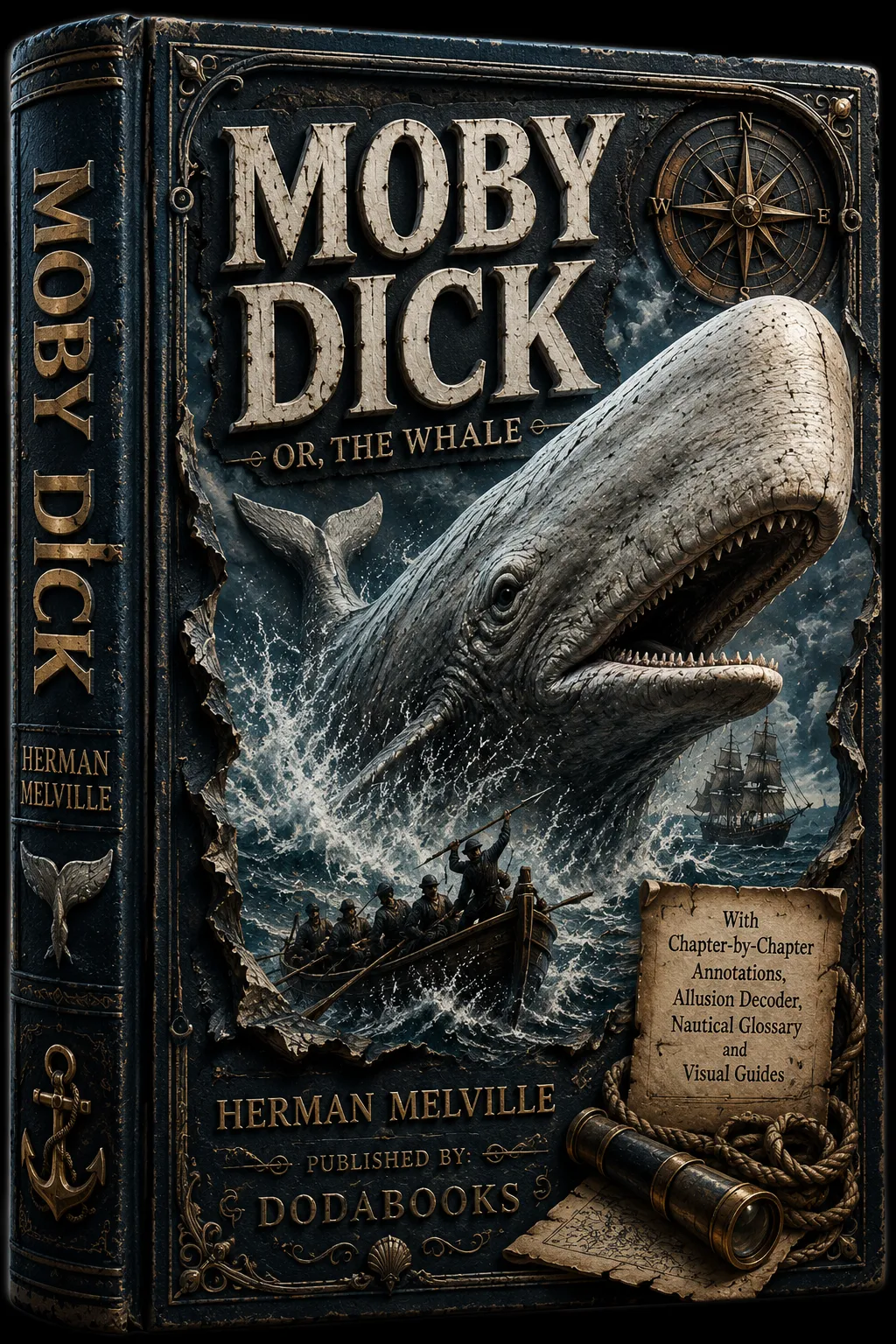
The annotated edition of Moby-Dick at DodaBooks includes explanatory notes for every cetology chapter, explaining the scientific references, the historical context, and the philosophical implications. For readers who want to understand these chapters without struggling through them, these notes are invaluable. Get the annotated edition →
❓ Frequently Asked Questions
How many cetology chapters are there in Moby-Dick?
There is no single fixed number, but roughly fifteen to twenty chapters across the novel are devoted to whale science, epitomised by Chapter 32 (“Cetology”). The exact list depends on how you define the term, but the chapter numbers 32, 55, 56, 57, 74, 75, 76, 85, 86, 103, and 104 give the clearest run.
Why does Melville interrupt the story with whale science?
He wanted Moby-Dick to be the most complete book about whaling ever written. The cetology chapters establish his authority as a firsthand witness, provide breathing room between the intense narrative chapters, and above all dramatise his central theme: the limits of human knowledge, since the whale always escapes every attempt to measure and classify it.
Is "The Whiteness of the Whale" a cetology chapter?
Chapter 42 is a philosophical meditation rather than a study of anatomy, but it is closely connected to the cetology chapters because it extends scientific inquiry toward the meaning of the white whale. It is widely considered one of the most important passages in the entire novel.
Can I skip the cetology chapters and still understand the story?
You can follow the plot without them, but you will miss much of what makes Moby-Dick great. A better approach is to skim each cetology chapter on a first read — catching the humor and the philosophical asides — and give them full attention on a second reading, when they become some of the most rewarding sections in the book.
Are the cetology chapters scientifically accurate?
Not by modern standards. Melville wrote from firsthand experience but also from the limited, sometimes erroneous natural history of his day, and he mixed fact with humor and deliberate playfulness. Part of their charm is watching him acknowledge how imperfect his own “science” is.
Experience Moby-Dick Like Never Before
Don’t struggle through Melville’s masterpiece alone. Our annotated edition of Moby-Dick includes:
- Complete, unabridged text of the novel
- Hundreds of explanatory footnotes clarifying obscure references
- Historical context on 19th-century whaling and Nantucket culture
- Literary analysis of key chapters and passages
- Victorian vocabulary definitions and nautical terminology
- Biblical and literary allusion guides
Get the annotated edition at DodaBooks →
📚 Related Articles
🎯 Stop Struggling. Start Understanding.
The annotated edition of Moby-Dick gives you everything you need to finally get Melville’s masterpiece:
- ✅ Complete, unabridged text — every word of the original 1851 edition
- ✅ Hundreds of explanatory footnotes — no more Googling every other page
- ✅ Historical context — the Essex disaster, Nantucket whaling, Melville’s life
- ✅ Literary analysis — chapter-by-chapter commentary on themes and symbols
- ✅ Victorian vocabulary — obsolete words and nautical terms defined inline
- ✅ Biblical & literary references — every allusion traced to its source