The real history of 19th-century whaling — the ships, the hunts, the processing, and the economics. Understand the world that Melville depicted in Moby-Dick.
This article is part of our annotated Moby-Dick guide, designed to help readers unlock the full depth of Melville’s masterpiece through comprehensive notes and analysis.
🐋
19th Century Whaling: The History Behind Moby-Dick
The real history of 19th-century whaling — the ships, the hunts, the processing, and the economics. Understand the world...
The World of Whaling
To understand Moby-Dick, you need to understand whaling. The novel is not just a story set on a whaling ship — it is a book about whaling, filled with the technical details of an industry that was central to 19th-century America.
In 1850, whaling was a massive global enterprise. The American whaling fleet numbered over 700 ships, crewed by more than 20,000 men. Whale oil was the primary lubricant for industrial machinery and the main fuel for lamps. Sperm whale oil was especially prized — it burned brighter and cleaner than any alternative, with less smoke and odor.
The city of Nantucket, Massachusetts, was the epicenter of this industry. At its peak in the 1840s, Nantucket was one of the wealthiest communities in America, its fortune built entirely on whale oil. To follow the true story that inspired Melville’s white whale, our account of the whaleship Essex shows how a real disaster shaped the novel’s imagination.
🏛️ Nantucket and the Rise of American Whaling, 1820s–1850s
Whaling was not new in the nineteenth century. New Englanders had hunted whales close to shore for generations, using small boats in the bays and along the coast in a practice that dated back to the colonial era. But the industry that Melville describes was something larger and more ambitious — a deep-sea enterprise that sent square-rigged ships to the far corners of the Pacific, Indian, and Atlantic Oceans on voyages that could last years.
The pivotal change came in the early decades of the 1800s. As coastal whale stocks thinned and demand for oil grew, American captains pushed their ships ever farther from home. By the 1820s, whalers were routinely sailing around Cape Horn into the Pacific. By the 1840s, at the industry’s zenith, Nantucket and New Bedford had grown fabulously wealthy, and whaling was arguably America’s most important global industry after cotton. When Ishmael arrives in New Bedford and Nantucket in the novel’s opening chapters, he is walking into the heart of that boom — a world in which the whale had become as much an engine of commerce as the cotton gin.
Melville himself sailed aboard the whaleship Acushnet in 1841, leaving her in the Marquesas Islands in 1842. His eighteen months at sea gave him the technical intimacy that makes Moby-Dick so extraordinary. He had been a harpooneer’s shipmate and had watched the hunt firsthand, which is why the novel’s whaling chapters feel more like an almanac than a fiction.
⚓ The Two Kinds of Whale, and the Two Kinds of Whaling
Whaling was not one industry but two, and Moby-Dick keeps careful track of the difference — a distinction that mattered enormously to the economics of the fleet.
Offshore, or “shore,” whaling was the older, smaller scale of the trade. Boats set out from coastal villages, hunted in near waters, and returned the same day or within a few days. This is the form of whaling that had existed in New England for generations, and it is the world of the early coastal communities that first grew rich on whalebone and oil.
Deep-sea “pelagic” whaling was the industrial revolution at sea. Large ships like the Pequod sailed thousands of miles, stayed away for two to five years, and hunted sperm whales and right whales in open ocean. This is the whaling of Moby-Dick. The Pequod is not a coastal vessel making day trips; she is a factory and a home fused into one wooden hull, carrying her own boilers (the try-works) for rendering oil at sea, her own boats, and a global crew.
The distinction matters because it changes what the crew is doing and why. In Moby-Dick, Captain Ahab turns a commercial voyage into a personal crusade, but the frame Ishmael gives us — the business of filling the hold with oil — is the deep-sea reality of the 1840s. Melville wants us to feel how an ordinary commercial enterprise can be bent toward obsession, which is why he grounds his narrative in such meticulous technical truth.
The Ships
The Ships
📖 Want the complete annotated experience?
👉 Get the Annotated EditionA typical whaling ship like the Pequod was a stout, three-masted vessel of 300-400 tons. It carried a crew of 20-35 men. The captain and officers lived in relative comfort in the aft cabin. The crew lived in the forecastle (fo’c’sle) — the cramped forward section of the ship.
A whaling voyage lasted two to five years. The ship would sail from New England to the whaling grounds of the Atlantic, Pacific, and Indian Oceans. It would not return to port until its hold was full of oil — or until the captain decided to give up and go home.
The Whaleboats
Each ship carried four to five whaleboats — light, double-ended vessels about 28 feet long. These boats could be lowered from the mother ship in minutes when whales were sighted. Each boat carried a crew of six: a harpooneer, a boatsteerer, and four oarsmen.
The whaleboats were the most dangerous place in the whaling industry. They were fragile — made of thin wood — and they were rowed directly alongside animals that could weigh 80 tons. A single tail strike could kill a man. A single dive could pull the boat under.
The Hunt
When whales were sighted, the whaleboats were lowered. The crew rowed toward the whale. The harpooneer stood in the bow, holding a harpoon — a barbed iron spear attached to a long line coiled in a tub. When close enough, he threw.
The harpoon did not kill the whale. It was designed to attach the whale to the boat. Once the harpoon was embedded, the whale would “sound” — dive deep — dragging the boat behind it at speeds of up to 20 knots. This was called a “Nantucket sleighride.”
When the whale tired and surfaced, the boat approached again. This time, the mate used a long lance to stab the whale in a vital area. The whale would go into its “flurry” — a final, violent death spasm — and then die.
Processing the Whale
Killing the whale was only half the work. The carcass was towed alongside the ship, and the crew spent the next several hours cutting it apart. Strips of blubber were hauled on deck and cut into smaller pieces. These pieces were boiled in enormous iron pots called “try-works” set into a brick furnace on deck.
The oil was ladled into cooling tanks and then poured into wooden barrels for storage. The process was dangerous, filthy, and backbreaking. The deck became slick with oil and blood. The smell was overwhelming.
Melville describes this process in excruciating detail in Moby-Dick. He wanted readers to understand that whaling was not romantic — it was brutal, exhausting, and transformative.
🧑🤝🧑 Life Aboard a Whaleship
Life on a whaling ship was hard, dangerous, and deeply stratified. The officers — captain, first mate, second mate, third mate — lived aft, in relative comfort, and were paid a share (a “lay”) of the voyage’s profits. The ordinary seamen lived in the cramped, often filthy forecastle forward, signed on for a lay that barely covered their expenses, and could find themselves years into a voyage with little hope of pay.
The crew of a ship like the Pequod was often strikingly diverse. Whaling crews drew on Americans, Pacific Islanders, Africans, Cape Verdeans, and men from almost everywhere the fleet touched, which is precisely why Ishmael’s shipmates include Queequeg, Tashtego, and Daggoo. This was not literary invention — aboard real ships, harpooneers and boatmen came from all over the world, and the industry was one of the most ethnically mixed workplaces in nineteenth-century America.
The work was unrelenting. Between hunts, the crew scraped and repainted the ship, stood watches, repaired sails, and kept watch for spouts from the masthead. Sailors were often paid a pittance, lived on salt meat and hardtack, and faced mutiny, desertion, and disease. Melville renders all of this vividly, from Stubb smoking calmly through danger to the terror of the “Nantucket sleighride.” For the men who lived it, whaling was rarely romantic — it was a brutal job that a man took because the alternative was worse.
⛵ The Essex Disaster: The True Story Behind the Whale
Every reader of Moby-Dick meets the novel’s warning: the sinking of the whaleship Essex, rammed and sent to the bottom by an enraged sperm whale in the South Pacific in 1820. Melville read the published account of the survivors and drew on it directly for his own catastrophe.
The facts are stark. The Essex was a Nantucket whaler, some 240 miles west of the Galápagos, when a sperm whale — reportedly around eighty-five feet long — deliberately attacked the ship, striking it twice and opening a fatal wound. Twenty sailors escaped into three small whaleboats with scant provisions. They drifted for more than ninety days across the Pacific, enduring thirst, starvation, and, in the horror of the story, cannibalism among the survivors. Only a handful of men reached land alive.
Melville absorbed this disaster into the marrow of Moby-Dick. The vengeance of a “dumb brute” that seems to attack with intention clouds the line between animal and agent — and gives Ahab his terrifying conviction. When we read of the Essex’s fate in the novel’s early pages, we are being primed for a confrontation that is not merely symbolic but grounded in documented history.
The Decline
The whaling industry collapsed in the 1860s and 1870s. Several factors contributed: the discovery of petroleum in Pennsylvania (kerosene replaced whale oil for lighting), the Civil War (which destroyed much of the whaling fleet), and overhunting (which made whales scarce).
By 1900, American whaling was essentially finished. The world that Melville described in Moby-Dick had vanished in less than a generation.
The Cultural Legacy
Whaling was a brutal industry, and it drove several whale species to the brink of extinction. But it was also a central part of American history, and Moby-Dick is our greatest record of it. Modern readers can be grateful that Melville bothered to set down the details — the tools, the trades, the world — because the industry vanished so quickly that almost everything we know of shipboard life comes from his pages and a handful of other accounts.
Whaling’s legacy is double-edged. On one side, it built fortunes and put oil in the lamps of the industrializing world. On the other, it nearly wiped out the very animals that made those fortunes possible, and the extinction pressure that began in the nineteenth century still shadows whales today. That tension — extraction and awe in the same act — runs quietly under Moby-Dick and is one reason the novel speaks so powerfully to modern readers thinking about our relationship to the natural world. For a deeper look at how those themes play out, our analysis of Moby-Dick as the Great American Novel connects the whaling history to the book’s larger claims.
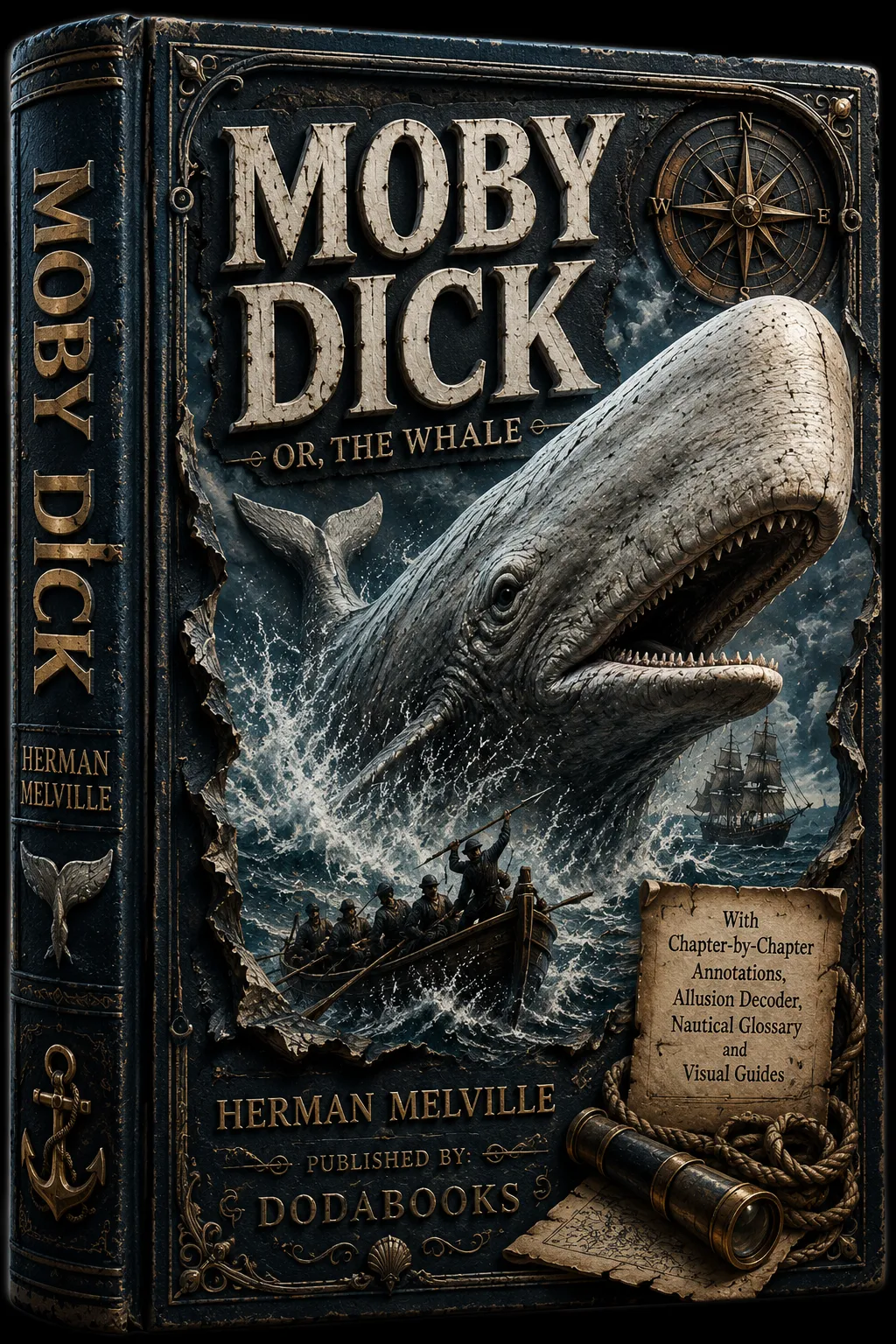
The annotated edition of Moby-Dick at DodaBooks includes extensive historical notes on whaling — explaining the technology, the economics, and the human cost of the industry. For readers who want to understand the real world behind the novel, these notes are invaluable. Get the annotated edition →
❓ Frequently Asked Questions
Was 19th-century whaling as dangerous as the novel suggests?
Yes — arguably more so. Men died in whaleboat accidents, were crushed by flukes, drowned in towing accidents, and lost their ships in storms and offshore disasters. The Essex catastrophe, in which a whale sank the ship and left survivors adrift for over three months, was the most famous of many tragedies.
Why was sperm whale oil so valuable?
Sperm oil burned brighter and more cleanly than alternatives, with less smoke and odor, and also served as a superior lubricant for fine machinery. That combination of lighting and lubrication made it the most prized oil in the world economy of the mid-1800s.
How many whaleships were there at the height of the industry?
In 1850 the American whaling fleet numbered more than 700 vessels crewed by over 20,000 men, making it one of the largest industrial fleets in the world at the time.
What finally ended American whaling?
A combination of factors converged in the 1860s and 70s: the rise of petroleum and kerosene as cheaper lighting fuel, the destruction of much of the fleet in the Civil War, and the overhunting that made whales scarce. By 1900 the industry was essentially finished.
Was the Pequod's crew realistically diverse?
Yes. Real whaling crews were drawn from all over the world — Americans, Pacific Islanders, Africans, and many others — making them among the most ethnically mixed workplaces in nineteenth-century America, exactly as Melville portrays Ishmael’s shipmates.
Experience Moby-Dick Like Never Before
Don’t struggle through Melville’s masterpiece alone. Our annotated edition of Moby-Dick includes:
- Complete, unabridged text of the novel
- Hundreds of explanatory footnotes clarifying obscure references
- Historical context on 19th-century whaling and Nantucket culture
- Literary analysis of key chapters and passages
- Victorian vocabulary definitions and nautical terminology
- Biblical and literary allusion guides
Get the annotated edition at DodaBooks →
📚 Related Articles
🎯 Stop Struggling. Start Understanding.
The annotated edition of Moby-Dick gives you everything you need to finally get Melville’s masterpiece:
- ✅ Complete, unabridged text — every word of the original 1851 edition
- ✅ Hundreds of explanatory footnotes — no more Googling every other page
- ✅ Historical context — the Essex disaster, Nantucket whaling, Melville’s life
- ✅ Literary analysis — chapter-by-chapter commentary on themes and symbols
- ✅ Victorian vocabulary — obsolete words and nautical terms defined inline
- ✅ Biblical & literary references — every allusion traced to its source