The true story behind Moby-Dick. The whaleship Essex was attacked by a sperm whale in 1820, inspiring Melville’s novel. Discover the real events and how Melville transformed them into literature.
This article is part of our annotated Moby-Dick guide, designed to help readers unlock the full depth of Melville’s masterpiece through comprehensive notes and analysis.
🐋
The Real Moby-Dick: The True Story of the Whaleship Essex
The true story behind Moby-Dick. The whaleship Essex was attacked by a sperm whale in 1820, inspiring Melville's novel. ...
A True Story More Terrifying Than Fiction
Before Moby-Dick was a novel, it was a real event. On November 20, 1820, the Nantucket whaleship Essex was attacked and sunk by a sperm whale in the Pacific Ocean. The story of the Essex — the survival ordeal that followed, the cannibalism, the few survivors — became one of the most famous maritime disasters of the 19th century. When Herman Melville heard it, he knew he had found the seed of his masterpiece.
The Attack
📖 Want the complete annotated experience?
👉 Get the Annotated EditionThe Essex was a 238-ton whaling ship under the command of Captain George Pollard Jr. On the morning of November 20, the crew spotted sperm whales and launched three whaleboats in pursuit. First mate Owen Chase remained on the ship to make repairs.
While the boats were away, Chase saw an enormous sperm whale — estimated at 85 feet — behaving strangely. It lay motionless on the surface, then began swimming directly toward the ship at full speed. It struck the hull with tremendous force, then swam away. The ship was badly damaged but not yet sinking.
As Chase and the crew struggled to assess the damage, the whale returned. It struck the ship a second time, stoving in the bow. Water poured in. Within minutes, the Essex began to sink. The crew barely had time to launch the remaining whaleboats and salvage what provisions they could.
The Ordeal at Sea
Twenty men escaped in three small whaleboats, with minimal food and water. They were thousands of miles from land. The boats became separated in a storm. What followed was 90 days of unimaginable suffering: starvation, dehydration, exposure, and eventually, drawing lots to decide who would be killed and eaten.
Only eight men survived. The survivors were rescued by other ships after three months at sea. One of the boats had been adrift for 93 days.
Melville’s Connection to the Essex
Herman Melville met the son of Owen Chase, the first mate of the Essex, in 1840. He read Chase’s published narrative, which had become a bestseller, and was deeply affected by it. The idea of a whale deliberately attacking a ship — of an animal behaving with what appeared to be intent — haunted him.
Years later, when Melville began writing Moby-Dick, the Essex story became its factual backbone. He read everything he could find about whales and whaling, but the Essex remained the central inspiration. The novel’s most dramatic moment — a whale ramming a ship — came directly from real life.
What Melville Changed
While the Essex provided the seed, Melville transformed the story in crucial ways:
First, the real whale did not survive. The Essex was sunk by a whale, but the whale was not a recurring figure. Melville created Moby-Dick as a legendary animal that appears throughout the novel — a whale with a history and a reputation.
Second, the real captain, George Pollard, did not pursue the whale for revenge. He was simply trying to run a whaling ship. Melville invented Ahab as a figure of mythic obsession, transforming a tragic accident into a story about deliberate choice.
Third, the real survivors were not united in a single purpose. They were desperate men trying to survive. Melville created Ishmael as a witness who survives to tell the tale — a narrator whose survival gives meaning to the destruction.
The Legacy of the Essex
The story of the Essex lives on beyond Moby-Dick. Nathaniel Philbrick’s In the Heart of the Sea (2000) tells the complete story and won the National Book Award. It was adapted into a film in 2015.
But it was Melville who transformed this terrible true story into something universal. The Essex was a tragedy. Moby-Dick is a myth. The difference is what happens when a great writer takes raw experience and shapes it into art.
The Essex Was a Ship, Not a Whale
It is worth being precise about what the word “Essex” refers to, because the real story both is and is not what you expect. The Essex was not named after a whale, and it was not a mythological beast that hunted ships. It was a 238-ton Nantucket whaling vessel that sailed from Nantucket in August 1819 with a crew of twenty under a young captain, George Pollard Jr., with first mate Owen Chase at his side. The voyage was meant to be a routine multi-year hunt for sperm whales — the ordinary, brutal business of American whaling at the height of the industry. Nothing about the expedition was unusual until a whale made it so.
Because the voyage was so ordinary, the disaster became so shocking. Whalers regularly faced dangerous animals, storms, and shipwreck; what no one anticipated was a whale deliberately, repeatedly attacking a ship far out in the Pacific. The Essex’s fate entered maritime history not as a freak accident but as a warning about the ocean’s indifference to human plans — and, later, as the seed of one of the great American novels.
📖 Owen Chase’s Narrative
The single most important document in connecting the Essex to Moby-Dick is Owen Chase’s own account, Narrative of the Most Extraordinary and Distressing Shipwreck of the Whale-Ship Essex, published in 1821, within a year of the disaster. Chase had the presence of mind to keep a journal during the ordeal and to write his account soon after, and his plain-spoken description of the whale’s first unprovoked strike became a sensation. It was his book that Herman Melville’s family owned, and it was Chase’s son — whom Melville met in the 1840s, when the younger Chase was captain of a whaling ship called the Acushnet — who handed Melville a copy. That meeting and that book are usually credited as the moment Melville’s imagination seized on the story.
Chase’s narrative is often praised for its restraint and honesty. He describes the whale’s strange, deliberate behavior — swimming at the ship with what looked like intent, striking, circling, and striking again — without dramatizing it, which is part of what makes it so chilling. For Melville, the idea of a whale acting with what appeared to be malevolence was magnetic. It blurred the line between animal and agent, and that blurring became the heart of Ahab’s madness.
🏝️ The Ordeal, in More Detail
The scale of the survival ordeal is hard to grasp. After the whale sank the ship, twenty men climbed into three small whaleboats, roughly two thousand miles from the nearest land. The three boats stayed together for a time, then became separated in a storm, and each faced its own version of the same nightmare: dwindling provisions, tropical sun, thirst, and the slow realization that rescue was unlikely.
The survivors made for the islands of the South Pacific, landing on Henderson Island in search of fresh water and food, and finding almost none. The men then split up, some remaining on the island while the boats pushed on. What followed — the drawing of lots, the deaths, and the documented cannibalism — is one of the most harrowing chapters in maritime history. Only eight of the twenty men lived to be rescued, and some survived only through the terrible decisions made on the open water. The details are grim but established historical record, and they help explain why the story burned so vividly in Melville’s imagination — and why our analysis of the novel’s themes keeps returning to the darkness at the edges of the hunt.
🏛️ Why the Story Mattered in 1820
It is easy to read the Essex disaster as a distant curiosity, but it struck contemporaries with tremendous force. The 1820s were the golden age of American whaling, when Nantucket ships supplied the whale oil that lit the lamps of the new nation, and a whaler lost to a whale seemed to upend the natural order. Chase’s account suggested that the hunt itself could turn — that the prey could strike back with a kind of purpose. The story was told and retold in port towns for years before Melville made it literary.
The disaster also showed how thin the line was between a thriving industry and catastrophe. Whaling was dangerous work; ships vanished constantly, and the Essex’s fate became a cautionary tale about pride and the fathomless power of the sea. When Moby-Dick appeared in 1851 — and bombed commercially — readers did not need the whale’s attack on the ship explained; they had heard that story before. For more on that strange publishing history, see how Moby-Dick flopped before it became a classic.
❓ Frequently Asked Questions
Was the Essex really attacked by a sperm whale?
Yes. On November 20, 1820, the whaleship Essex was struck twice by a large sperm whale estimated at around 85 feet. The attacks stoved in the ship’s bow, and the vessel sank. The event is documented in Owen Chase’s published narrative and corroborated by the testimonies of the survivors.
How many men survived the Essex disaster?
Of the twenty-man crew, eight survived. The survivors were rescued from two of the three boats and from an island one group had chosen to remain on. The ordeal lasted roughly three months.
Did cannibalism really happen on the Essex?
It is documented history, though the grim specifics are often sanitized in retellings. After provisions ran out, some of the survivors resorted to drawing lots on the open water. The events were described in Owen Chase’s account and are treated as matters of historical record.
Did the real survivors pursue the whale for revenge like Ahab?
No. The real captain, George Pollard, was simply trying to run a whaling ship and then to survive the aftermath. The obsessive, vengeful captain of Moby-Dick is entirely Melville’s invention — a fictional transformation of a real tragedy.
How did Melville learn about the Essex?
Melville met the son of first mate Owen Chase while whaling in the 1840s and was given a copy of Chase’s 1821 narrative. He read widely about whales and whaling, but the Essex story, with its whale that struck a ship with apparent intent, became the factual seed of his novel.
The Essex in the Annotated Edition
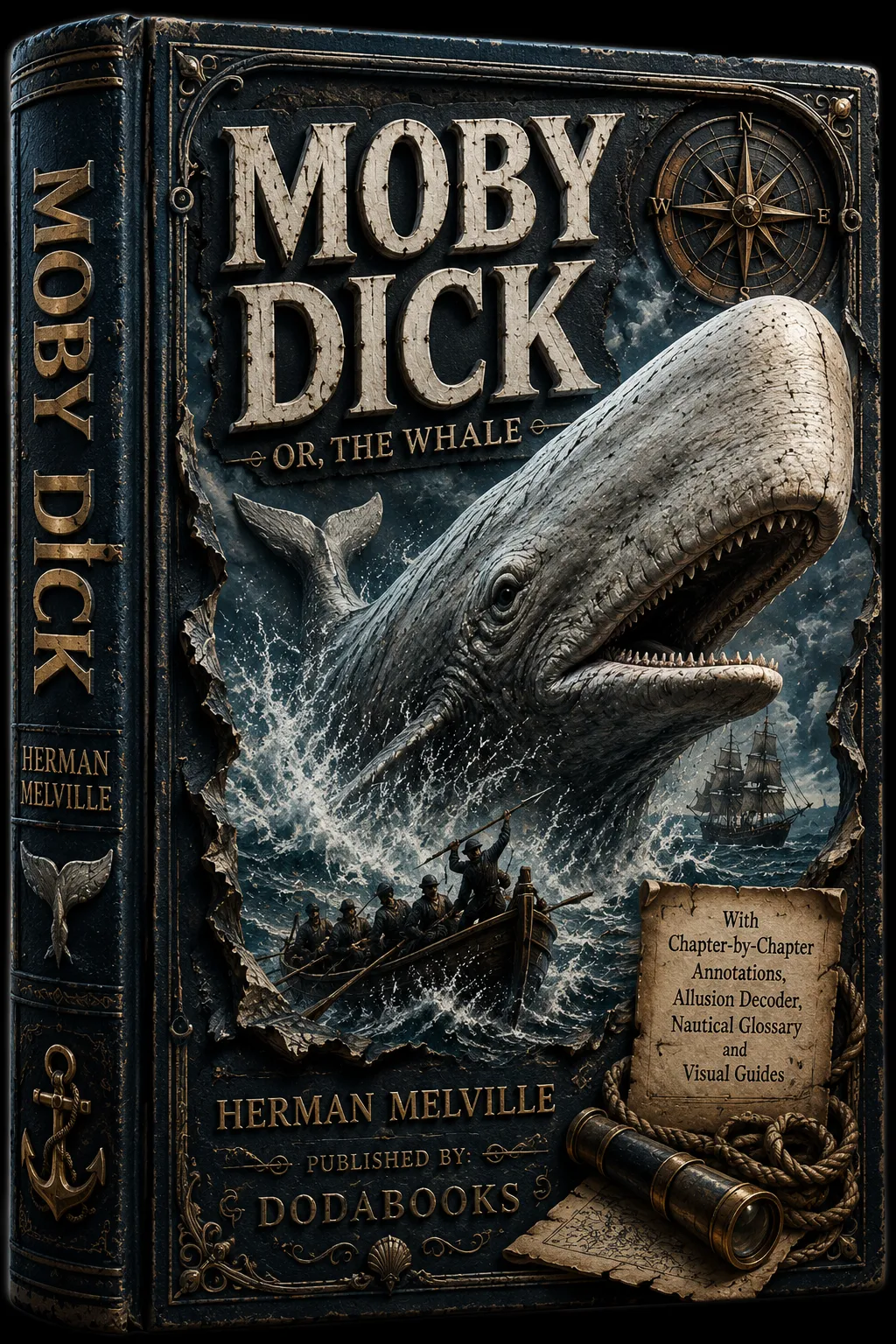
Our annotated edition of Moby-Dick includes a complete appendix on the Essex disaster, allowing readers to compare the real events with Melville’s fictional treatment. This comparison reveals just how brilliantly Melville transformed fact into literature — and why his version has outlasted the real story in the cultural memory. Get the annotated edition →
Experience Moby-Dick Like Never Before
Don’t struggle through Melville’s masterpiece alone. Our annotated edition of Moby-Dick includes:
- Complete, unabridged text of the novel
- Hundreds of explanatory footnotes clarifying obscure references
- Historical context on 19th-century whaling and Nantucket culture
- Literary analysis of key chapters and passages
- Victorian vocabulary definitions and nautical terminology
- Biblical and literary allusion guides
Get the annotated edition at DodaBooks →
📚 Related Articles
🎯 Stop Struggling. Start Understanding.
The annotated edition of Moby-Dick gives you everything you need to finally get Melville’s masterpiece:
- ✅ Complete, unabridged text — every word of the original 1851 edition
- ✅ Hundreds of explanatory footnotes — no more Googling every other page
- ✅ Historical context — the Essex disaster, Nantucket whaling, Melville’s life
- ✅ Literary analysis — chapter-by-chapter commentary on themes and symbols
- ✅ Victorian vocabulary — obsolete words and nautical terms defined inline
- ✅ Biblical & literary references — every allusion traced to its source