Complete chapter-by-chapter guide to Moby-Dick’s 135 chapters. Navigate the novel’s structure and understand how each section contributes to Melville’s masterpiece.
This article is part of our annotated Moby-Dick guide, designed to help readers unlock the full depth of Melville’s masterpiece through comprehensive notes and analysis.
🐋
Moby-Dick Chapter by Chapter: Complete Summary Guide to All 135 Chapters
Complete chapter-by-chapter guide to Moby-Dick's 135 chapters. Navigate the novel's structure and understand how each se...
Navigating the Whale
Moby-Dick has 135 chapters, ranging from a single paragraph to more than 20 pages. The chapter structure is one of the novel’s most distinctive features — and one of its most challenging for first-time readers. This guide breaks down the novel into its major sections and explains what each contributes.
Because of the novel’s length, we organize the chapters by the novel’s major structural sections rather than summarizing each of the 135 chapters individually.
Part One: Ishmael Goes to Sea (Chapters 1-15)
📖 Want the complete annotated experience?
👉 Get the Annotated EditionThe novel opens with Ishmael arriving in New Bedford. He meets Queequeg at the Spouter-Inn, and the two become friends. They travel to Nantucket and sign onto the Pequod.
These chapters establish the novel’s voice. Ishmael is curious, philosophical, and warm. The friendship with Queequeg gives the novel an emotional foundation. We also learn about whaling as an industry and Nantucket as a community.
Part Two: Ahab Emerges (Chapters 16-30)
The Pequod departs. Ahab remains hidden for the first several days at sea. The crew whispers. Finally, in Chapter 28, Ahab appears on deck. In Chapter 36 (“The Quarter-Deck”), he reveals his true mission.
This section includes some of the novel’s most dramatic writing. Ahab’s speech to the crew is theatrical and commanding. Starbuck’s quiet resistance provides a moral counterpoint. The gold doubloon nailed to the mast becomes a symbol of the crew’s complicity.
Part Three: The Voyage (Chapters 31-80)
The Pequod sails across the Atlantic and into the Indian Ocean. This is the longest section of the novel, and it includes most of the cetology chapters. The crew encounters other whaling ships — “gams” — each with news of the white whale.
This section also includes some of the novel’s most important philosophical chapters: “The Whiteness of the Whale” (Chapter 42), “The Try-Works” (Chapter 96), and “The Doubloon” (Chapter 99). These chapters deepen the novel’s themes without advancing the plot.
An annotated edition is especially helpful during this section, as many of the cetology chapters contain references and terminology that modern readers will need help understanding.
Part Four: The Approaching Doom (Chapters 81-120)
The tension escalates. Ahab refuses to help the Rachel find its lost sailors. He smashes his quadrant. A typhoon strikes. The compass is damaged. Every sign points toward disaster, but Ahab presses on.
This section also includes some of the novel’s most extraordinary set pieces: “The Try-Works” describes the process of rendering whale blubber into oil; “The Candles” features a dramatic scene with corposants (electrical discharges) on the ship’s masts.
Part Five: The Chase (Chapters 121-135)
The white whale is sighted. The three-day chase begins. This section is the shortest of the novel but also the most concentrated. Each day brings more destruction. On the third day, the whale rams the Pequod. Ahab dies, tangled in his harpoon line. Ishmael survives on Queequeg’s coffin.
The epilogue reveals Ishmael’s rescue by the Rachel. The novel ends with one of the most beautiful sentences in American literature.
How to Use This Guide
Use this guide to orient yourself as you read. When you feel lost in the cetology chapters, remember that you are in Part Three, and the narrative will return. When the tension feels unbearable, you are in Part Four, and the end is approaching.
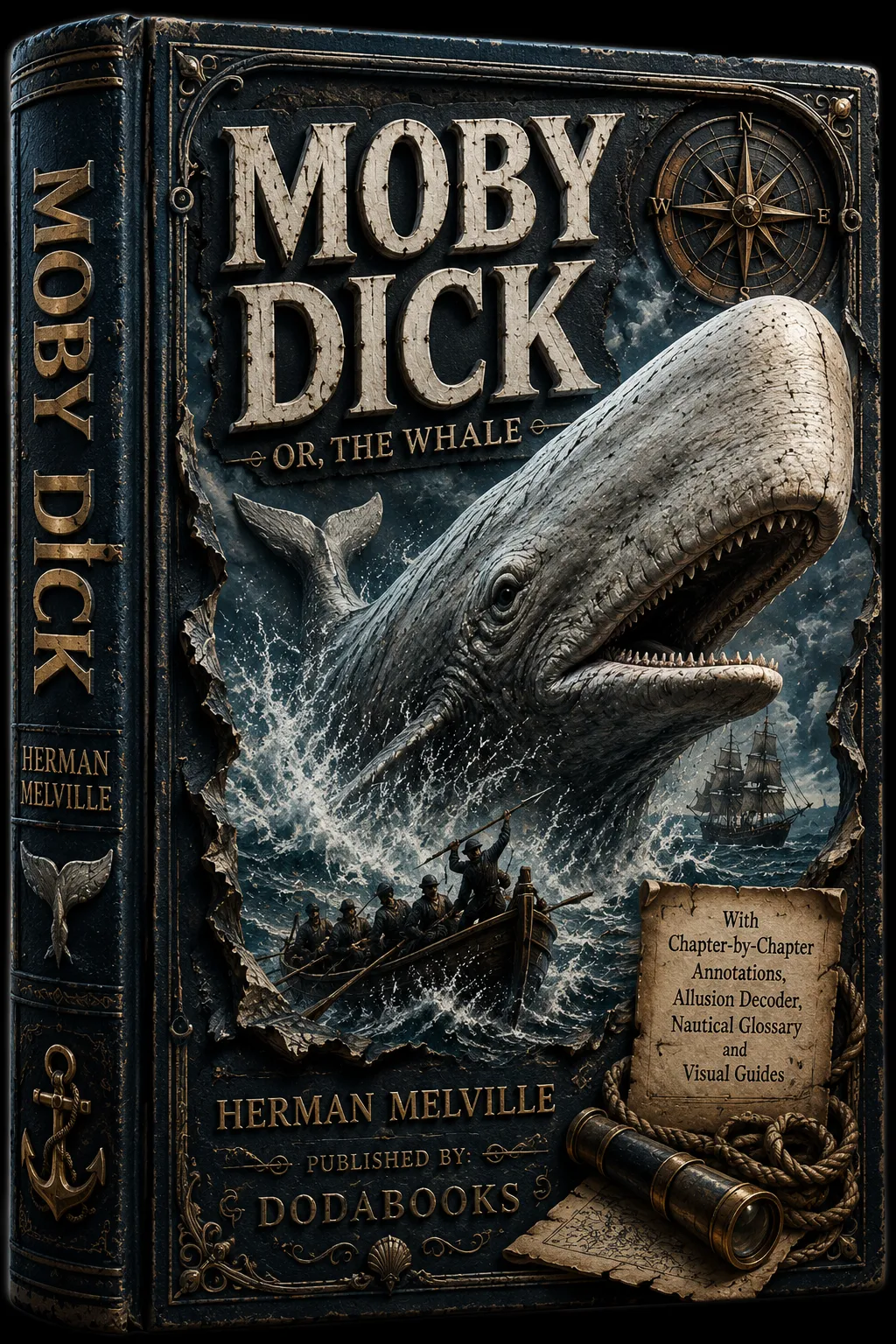
The DodaBooks annotated edition of Moby-Dick includes a more detailed chapter guide with summaries of each chapter, designed to help you navigate without spoiling the experience. Get the annotated edition →
🧭 The Major Structural Landmarks
If you want to read Moby-Dick chapter by chapter rather than skimming, it helps to know the landmarks that break the 135 chapters into readable units. The first chapter, “Loomings,” introduces Ishmael and gives him one of the most quoted opening lines in English. If you want a focused close reading of how the book begins, our analysis of Chapter 1 walks through it line by line.
From there the narrative builds toward Ahab’s first appearance on deck in Chapter 28, one of the hinges of the entire book — the moment the mysterious captain finally emerges from his cabin. Our look at Chapter 28 explains why that scene matters so much. The other great turning point is Chapter 41, where the white whale is finally fully revealed. For a deep dive, see our guide to Chapter 41. These three chapters — 1, 28, and 41 — are the best places to slow down and pay extra attention.
The cetology chapters (the ones about whales and whaling as an industry) are the section where most readers get lost. They run through the heart of the novel, and they are deliberately encyclopedic. Our explained guide to the cetology chapters separates the essential narrative chapters from the ones you can skim without losing the thread — a huge time-saver if you are reading for plot.
🎓 How to Read It Chapter by Chapter
Moby-Dick rewards different strategies at different stages. In the opening stretch (Chapters 1–15), read slowly and enjoy the voice — Ishmael’s warmth and curiosity set the tone for everything that follows, and the friendship with Queequeg gives the novel its emotional core. If you are new to the book, our beginner’s guide to Moby-Dick is a gentle on-ramp that sets up the characters and context before you dive in.
In the middle voyage (roughly Chapters 31–80), do not feel obligated to master every page of cetology on a first read. Identify the philosophical landmarks — “The Whiteness of the Whale” (Chapter 42), “The Try-Works” (Chapter 96), and “The Doubloon” (Chapter 99) — and give those your full attention, while letting the encyclopedic chapters wash over you. When Ahab’s obsession hardens in Part Four, the pacing accelerates, and readers who have persevered are rewarded with the most gripping stretch of the novel. The three-day chase in Part Five barely lets you pause for breath.
For an even tighter overview before you commit, try our five-minute summary of Moby-Dick or the complete plot overview. If you would rather split the book in two, the first-half summary (Chapters 1–50) and the second-half summary (Chapters 51–135) give you chapter-group by chapter-group breakdowns.
🏛️ Historical & Cultural Context: Melville’s 1850s
Moby-Dick was published in 1851, at the height of the American whaling industry. In the decades before the Civil War, whale oil lit the lamps and greased the machinery of a rapidly industrialising nation, and Nantucket and New Bedford were among the wealthiest towns in America. Melville drew directly on this world — he had sailed on whaling voyages himself, including the Acushnet in 1841 — and the novel is stuffed with the real details of the trade.
The book also reflects its moment in darker ways. Melville wrote during a period of intense American self-questioning about slavery, expansion, and national identity, and Moby-Dick is shot through with anxieties about fate, free will, and the limits of human knowledge that resonated with his contemporaries. The famous sinking of the whaleship Essex in 1820 — a real ship stove in by an enraged sperm whale in the Pacific — provided grim source material, and the novel is suffused with that disaster’s memory. Understanding this context transforms the reading experience, which is why the annotated edition’s historical notes on 19th-century whaling, Nantucket culture, and Melville’s life are so valuable.
📖 Why It Still Matters
Moby-Dick endures because it is so much larger than its plot — a revenge tragedy, a whaling textbook, a philosophical meditation, and a doomed adventure rolled into one. Its unconventional chapter-by-chapter structure is a big part of why it still feels modern. Read at the right pace, with the right signposts, the book stops being a chore and becomes one of the most rewarding experiences in American literature. That is exactly what this guide is designed to help you do — without spoiling the story.
❓ Frequently Asked Questions
How long is Moby-Dick and how many chapters does it have?
Moby-Dick has 135 chapters plus a short epilogue, and most editions run between 650 and 700 pages. The chapters vary wildly in length — some are a single paragraph while others run more than twenty pages — which is part of what makes the structure feel so unusual.
Do I need to read every cetology chapter to follow the plot?
No. The cetology chapters (roughly Chapters 32–80) are essential to the novel’s texture and themes, but on a first read you can skim many of them and skip none of the narrative momentum. Our guide to the cetology chapters tells you exactly which ones to read closely and which to skim.
What are the most important chapters to read carefully?
Pay special attention to Chapter 1 (“Loomings”), Chapter 28 (Ahab’s first appearance), Chapter 36 (“The Quarter-Deck,” where Ahab reveals his mission), Chapter 41 (the white whale revealed), Chapter 42 (“The Whiteness of the Whale”), and the closing chase chapters from around 121 to 135.
Why is the chapter structure so uneven in length?
Melville deliberately varied chapter length to shift tone and pace — a short chapter can land a moment of high drama, while a long one can expand into encyclopedic or philosophical digression. This variety is an intentional part of the novel’s rhythm rather than a flaw.
Is there an ending worth reading even if I skim the middle?
Absolutely. The three-day chase (Part Five) is among the most celebrated stretches of American prose, and the epilogue contains one of the most famous final sentences in literature. Even readers who skim the cetology chapters should slow down for the ending.
What happens in the epilogue after Chapter 135?
The brief epilogue reveals that Ishmael survives the Pequod’s destruction and is rescued by the Rachel, the ship that earlier asked Ahab for help in finding its lost sailors. It closes the novel on a note of survival and solitude, mirroring the opening.
Experience Moby-Dick Like Never Before
Don’t struggle through Melville’s masterpiece alone. Our annotated edition of Moby-Dick includes:
- Complete, unabridged text of the novel
- Hundreds of explanatory footnotes clarifying obscure references
- Historical context on 19th-century whaling and Nantucket culture
- Literary analysis of key chapters and passages
- Victorian vocabulary definitions and nautical terminology
- Biblical and literary allusion guides
Get the annotated edition at DodaBooks →
📚 Related Articles
🎯 Stop Struggling. Start Understanding.
The annotated edition of Moby-Dick gives you everything you need to finally get Melville’s masterpiece:
- ✅ Complete, unabridged text — every word of the original 1851 edition
- ✅ Hundreds of explanatory footnotes — no more Googling every other page
- ✅ Historical context — the Essex disaster, Nantucket whaling, Melville’s life
- ✅ Literary analysis — chapter-by-chapter commentary on themes and symbols
- ✅ Victorian vocabulary — obsolete words and nautical terms defined inline
- ✅ Biblical & literary references — every allusion traced to its source