New to Moby-Dick? This comprehensive beginner’s guide covers strategies for reading, what to expect from the difficult parts, and how an annotated edition transforms the experience.
This article is part of our annotated Moby-Dick guide, designed to help readers unlock the full depth of Melville’s masterpiece through comprehensive notes and analysis.
🐋
How to Read Moby-Dick: A Beginner's Guide to Melville's Masterpiece
New to Moby-Dick? This comprehensive beginner's guide covers strategies for reading, what to expect from the difficult p...
Why Moby-Dick Is Worth Your Time
Moby-Dick has a reputation as the most difficult classic in American literature. It is long (135 chapters, 200,000 words). It has chapters about whale anatomy that seem to have nothing to do with the story. The language is dense 19th-century prose. The structure shifts without warning from narrative to essay to drama to poetry.
So why read it?
Because it is also one of the most rewarding books ever written. Moby-Dick is not a book you consume — it is a book that consumes you. Its themes — obsession, fate, the limits of knowledge — stay with you long after you finish. It contains more ideas, more beauty, and more power than almost any other novel.
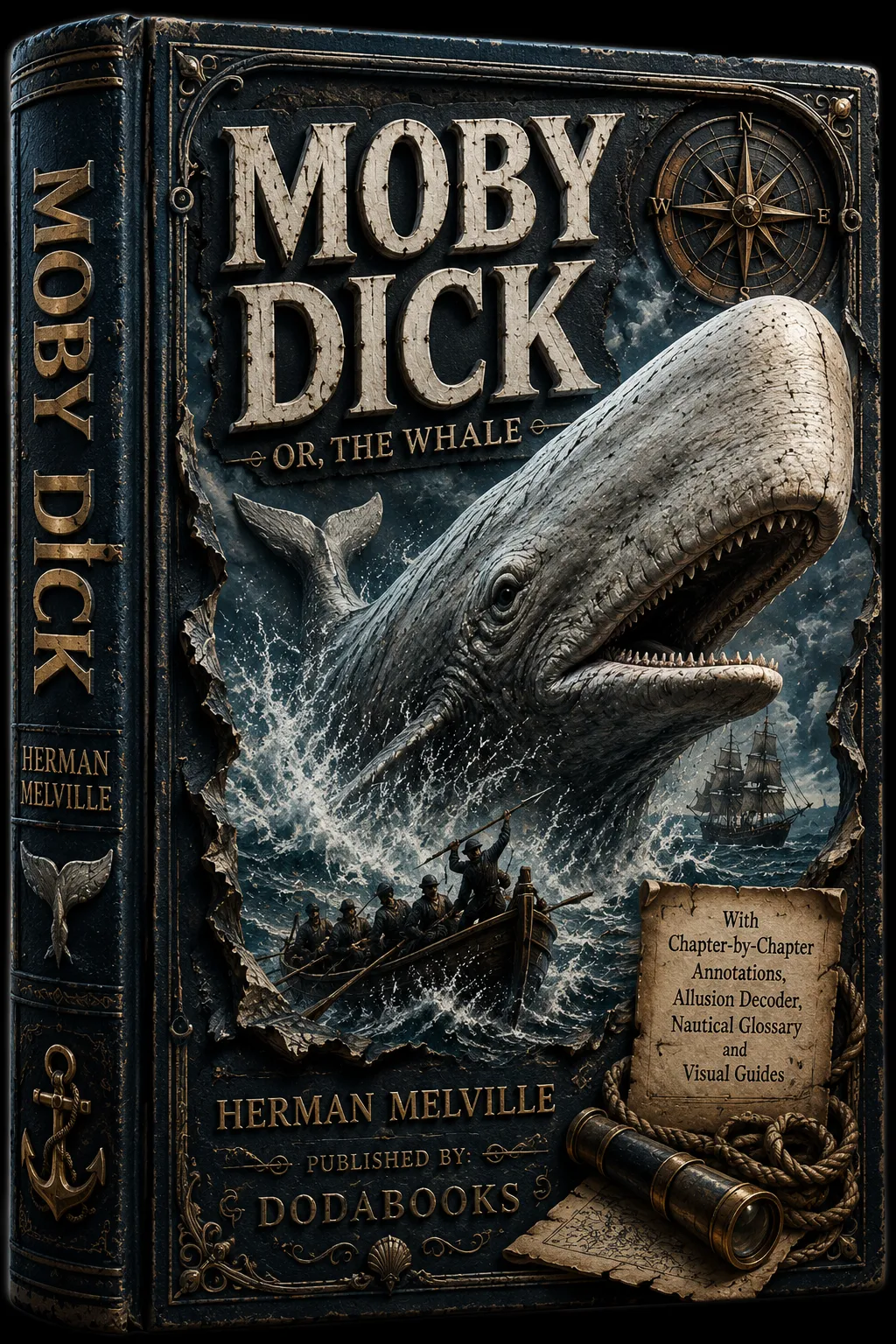
The annotated edition of Moby-Dick at DodaBooks is designed specifically for first-time readers. It provides the context and guidance you need without interrupting your reading experience. But even without it, the right approach makes all the difference.
Strategy 1: Read in Small Doses
📖 Want the complete annotated experience?
👉 Get the Annotated EditionDo not try to read Moby-Dick in a weekend. The novel was written to be savored. Read a chapter or two a day — about 15-20 minutes. Let the book’s world build slowly around you. A chapter a day means finishing in about four months, which is a reasonable pace for a book of this depth.
The chapter structure of Moby-Dick actually supports this approach. Most chapters are self-contained — they have a beginning, middle, and end. You can read “The Quarter-Deck” (Chapter 36) and feel that you have experienced a complete dramatic scene. The next day, you can read “Sunset” (Chapter 37) — a brief, poetic chapter that deepens your understanding of Ahab. The novel accumulates rather than rushes.
Strategy 2: Skip What You Need To
This advice might seem heretical, but it is practical: feel free to skim or skip the cetology chapters on your first reading. Chapters like “Cetology” (Chapter 32), “The Fossil Whale” (Chapter 104), and “The Measurement of the Whale’s Skeleton” (Chapter 103) are more like encyclopedia entries than narrative. Read a page or two to get the flavor, then move on.
On a second reading, these chapters reveal their genius. They are not digressions — they are the novel’s claim to completeness, its attempt to contain all knowledge about its subject. But on a first reading, they can stop momentum. Give yourself permission to skip.
Strategy 3: Read Ahab’s Speeches Aloud
Melville wrote dialogue with a dramatic quality that comes alive when spoken. Read Ahab’s soliloquies aloud. Feel the rhythm of the language. Hear the rage and the poetry.
Try it with this passage from Chapter 37: “I leave a white and turbid wake; pale waters, paler cheeks, where’er I sail. The envious billows sidelong swell to whelm my track; let them; but first I pass.”
When you hear these words spoken, you understand why the crew follows Ahab. His language is music.
Strategy 4: Use an Annotated Edition
This is the single most important strategy. Moby-Dick was written in 1851 for an audience that shared its references. Modern readers miss a tremendous amount without annotation.
What do annotated editions provide?
Whaling terminology. Do you know the difference between a “gam” and a “try-works”? Between “sounding” and “breaching”? The novel assumes you do. An annotated edition explains these terms without breaking your immersion.
Biblical references. The novel is saturated with the Bible. Ahab is named after a king of Israel. Ishmael is the biblical outcast. The chapter titles reference Job, Jonah, and the Psalms. Without understanding these references, you miss half the meaning.
Historical context. The novel references real events (the Essex disaster, the history of Nantucket whaling) that Melville’s first readers would have known. An annotated edition provides this context.
Literary analysis. Some passages are genuinely difficult — “The Whiteness of the Whale” (Chapter 42) is a philosophical essay that prefigures existentialism. A good annotated edition helps you navigate these passages without doing all the interpretive work yourself.
Strategy 5: Track the Structure
Moby-Dick is not a linear narrative. It alternates between:
- Narrative chapters that advance the plot (the departure from Nantucket, the encounters with other ships, the three-day chase)
- Cetology chapters that describe whales and whaling (whale anatomy, classification, behavior)
- Dramatic chapters that are written as play scripts (“The Quarter-Deck,” “The Candles”)
- Philosophical chapters that meditate on the novel’s themes (“The Whiteness of the Whale,” “The Try-Works”)
Paying attention to these shifts helps you understand what Melville is doing. The novel’s structure is not random — it is designed to create a total experience that mirrors the totality of whaling life.
Strategy 6: Keep a Character Sheet
One of the most practical habits for a first-time reader is to keep a simple list of the crew as you go. Moby-Dick has a large cast — Ahab, Ishmael, Queequeg, Starbuck, Stubb, Flask — and the deck of the Pequod can feel crowded at first. Jot down one line per character as they appear: who they are, what they believe, and their role on the ship. This pays off enormously, because Melville turns the crew from a list of names into a chorus of attitudes — every member reacts to Ahab’s quest differently, and those reactions are part of the book’s argument about obedience, fear, and faithfulness.
You do not need a formal system — a spare page in a notebook or a note on your phone is enough. If you would rather have the work done for you, our guide to the characters of Moby-Dick lays out the full crew in one place.
📖 The Famous Opening Line
You have likely heard the novel’s most famous words before you begin: “Call me Ishmael.” These three short words are a masterstroke, and they matter far more than their brevity suggests. Ishmael is not the novel’s hero — Ahab is — and the name deliberately echoes the biblical outcast who wanders the wilderness. By telling us only “call me Ishmael,” Melville signals that this is a first-person account, that its narrator is an outsider, and that the story is being told by a survivor. It is an epic promise folded into a sentence. Our deep dive on the opening line unpacks what those words do.
📚 Find a Reading Companion
Moby-Dick rewards company. It can feel overwhelming alone, and it becomes far more enjoyable when you share your confusion and discoveries with someone else — an informal friend, a book club, or one of the online groups that read the novel chapter by chapter. A companion also builds accountability: knowing you will discuss “The Quarter-Deck” on Thursday is remarkably effective at getting you there.
If you prefer structure without a group, a companion text works just as well. A simple-English guide — like our plain-English Moby-Dick — or a chapter-by-chapter summary lets you check your understanding without spoiling the experience. For beginners who want commitment, a 30-day reading plan turns the 135 chapters into a manageable daily habit.
🗓️ A Short, Realistic Reading Plan
Here is a plan that actually works for first-time readers. Weeks 1–2: read chapters 1–28, from Ishmael’s arrival in New Bedford through Ahab’s speech in “The Quarter-Deck,” which introduces every major character and the central conflict. Weeks 3–6: read chapters 29–100 at a relaxed pace, skimming the encyclopedic cetology chapters freely — this long middle is where the world of the whaling ship takes over. Weeks 7–8: read chapters 101–135, the accelerating run toward the final chase. That is roughly two months of steady, enjoyable reading — far more realistic than a doomed weekend attempt. If you want an even more structured approach, Moby-Dick for Beginners and the 30-day schedule can be adjusted to your pace.
What You Will Gain
Readers who finish Moby-Dick report the same experience: they are not the same person they were when they started. The novel changes how you think about obsession, about fate, about the relationship between humanity and nature. It gives you a vocabulary for thinking about the biggest questions.
The annotated edition at DodaBooks makes this transformation accessible. It does not replace the experience of reading the novel — it enhances it. For readers who want to truly understand Melville’s masterpiece, it is the difference between reading and experiencing. Get the annotated edition →
Experience Moby-Dick Like Never Before
Don’t struggle through Melville’s masterpiece alone. Our annotated edition of Moby-Dick includes:
- Complete, unabridged text of the novel
- Hundreds of explanatory footnotes clarifying obscure references
- Historical context on 19th-century whaling and Nantucket culture
- Literary analysis of key chapters and passages
- Victorian vocabulary definitions and nautical terminology
- Biblical and literary allusion guides
Get the annotated edition at DodaBooks →
❓ Frequently Asked Questions
Do I really have to read every chapter of Moby-Dick?
No. The cetology chapters about whale anatomy are encyclopedic and can be skimmed or skipped on a first reading. The narrative chapters — the departure, the encounters with other ships, and the three-day chase — are the heart of the story. You can always come back to the “skip” chapters on a second read, when their genius becomes clear.
How long does it take to read Moby-Dick?
The novel runs roughly 200,000 words across 135 chapters. Most readers take four to eight weeks reading a chapter or two a day. A realistic two-month plan that skims the encyclopedic sections is far more sustainable than trying to finish in one weekend.
Is Moby-Dick actually about a whale?
On the surface, yes — it is the story of a whaling voyage and Captain Ahab’s hunt for the great white whale. But the whale is also a symbol, and critics have read the novel as being about obsession, fate, the limits of knowledge, and the relation between humanity and nature. You can enjoy it as an adventure and discover the deeper layers gradually.
What is the best way to get through the difficult chapters?
Give yourself permission to skim, read the dramatic speeches aloud, and use a summary to orient yourself before each stretch. An annotated or plain-English edition removes the friction of constantly looking up nautical terms and references, which is the single biggest barrier for first-time readers.
Should I read Moby-Dick alone or with help?
Both can work, but the novel rewards company. A book club, an online group, or a companion guide gives you accountability and helps you catch what you might miss alone. Reading Moby-Dick is an experience best shared — the confusion is part of the fun, and the discoveries are richer when someone else is making them alongside you.
📚 Related Articles
🎯 Stop Struggling. Start Understanding.
The annotated edition of Moby-Dick gives you everything you need to finally get Melville’s masterpiece:
- ✅ Complete, unabridged text — every word of the original 1851 edition
- ✅ Hundreds of explanatory footnotes — no more Googling every other page
- ✅ Historical context — the Essex disaster, Nantucket whaling, Melville’s life
- ✅ Literary analysis — chapter-by-chapter commentary on themes and symbols
- ✅ Victorian vocabulary — obsolete words and nautical terms defined inline
- ✅ Biblical & literary references — every allusion traced to its source