The most famous Moby-Dick quotes analyzed in detail. From ‘Call me Ishmael’ to ‘From hell’s heart I stab at thee,’ understand what these lines really mean.
This article is part of our annotated Moby-Dick guide, designed to help readers unlock the full depth of Melville’s masterpiece through comprehensive notes and analysis.
🐋
Moby-Dick Quotes: 15 Famous Lines Analyzed in Depth
The most famous Moby-Dick quotes analyzed in detail. From 'Call me Ishmael' to 'From hell's heart I stab at thee,' under...
Why Moby-Dick Quotes Endure
Moby-Dick is one of the most quotable novels in English. Its language is so rich, so powerful, that individual lines have entered the cultural vocabulary. But many famous Moby-Dick quotes are also misunderstood — taken out of context, stripped of their original meaning. Here are the most important lines, with their full context and analysis.
1. “Call me Ishmael.”
📖 Want the complete annotated experience?
👉 Get the Annotated EditionThe most famous opening line in American literature. Three words that establish the narrator, his voice, and his provisional identity. The narrator is not revealing his name — he is inviting us to call him by a name he has chosen. Ishmael is the biblical outcast, the wanderer, the survivor. By invoking this figure, Melville signals that the novel is about exile, survival, and the search for meaning.
2. “He tasks me; he heaps me.”
Ahab’s explanation for his quest in Chapter 36. He does not simply hate the whale. He feels tasked by it, as if the whale has a moral responsibility for Ahab’s suffering. This line reveals the core of Ahab’s psychology: he sees the whale as a moral agent, not a dumb animal. The whale is guilty of a crime, and Ahab is the instrument of justice.
3. “I’d strike the sun if it insulted me.”
Perhaps the most revealing line Ahab speaks. The sun — the source of life, the symbol of divine order — is not safe from Ahab’s rage. This is Promethean defiance on a cosmic scale. It establishes that Ahab’s quarrel is not with the whale but with existence itself.
4. “From hell’s heart I stab at thee.”
Ahab’s final words in Chapter 135. The line is pure hatred — a man who refuses to repent even as he dies. But note the precision: “from hell’s heart” suggests that Ahab’s hatred comes from the deepest part of him, a place beyond reason or redemption.
5. “Towards thee I roll, thou all-destroying but unconquering whale.”
The whale is “all-destroying” because it destroys everything Ahab sends against it. But it is “unconquering” because it has never sought conquest — it simply exists. The paradox is intentional: Ahab attributes agency to the whale, but the whale is just being a whale.
6. “The little lower layer.”
Ahab’s response to Starbuck’s rational arguments in Chapter 36. There is always a deeper truth beneath conventional wisdom. This is Ahab’s motto and his justification: he goes deeper than other men, sees what they cannot see. It is both his strength and his fatal flaw.
7. “It is not down on any map; true places never are.”
Ishmael’s reflection in Chapter 12. The most interesting destinations are not the ones marked on charts — they are the ones we discover for ourselves. This line speaks to the novel’s theme of exploration, both physical and spiritual.
8. “The drama’s done.”
The final three words of the novel (before the epilogue). The struggle is over. The whale has won. The ship is gone. All that remains is the story. This line, simple and devastating, echoes the end of a literary tragedy.
9. “Ishmael was a survivor.”
Not a direct quote but the essence of the epilogue. Ishmael’s survival — alone among the crew — is the novel’s final statement. Storytelling itself is an act of survival. As long as the story is told, the storyteller lives.
10. “A good heart is better than all the heads in the world.”
Queequeg’s wisdom, offered quietly in contrast to Ahab’s intellectual fury. It is a reminder that the novel contains not one but two value systems: Ahab’s driven, intellectual obsession and Queequeg’s quiet, embodied goodness.
🌊 The Whale of a Book Behind the Lines
When you read these quotes in isolation, they can feel like fragments of a long, serious novel. Reading them in context is a different experience entirely. Moby-Dick (1851) shifts register constantly — one chapter a dense lecture on whale skeletons, the next a rollicking sea adventure, the next a meditation on existence. The famous lines sit inside a book that is by turns comic, encyclopedic, and tragic, which is exactly why they resist easy summary.
“Call me Ishmael” is a book’s worth of opening in three words, but it only pays off if you follow the narrator through the whole voyage. And “From hell’s heart I stab at thee” lands with full force because it is the end of a 135-chapter run of obsession. Context turns a memorable line into a meaningful one — one reason readers keep returning to our guide to the characters who speak these lines as they work through the book.
🏛️ Historical & Cultural Context of the Language
Part of why these lines feel so powerful is that Melville was writing at a specific historical moment. In 1851, American whaling was at its peak — Nantucket and New Bedford ships ranged across the Pacific in search of sperm whales, a brutal industry Melville himself had worked on. The 1820 sinking of the whaleship Essex had already shown that a sperm whale could destroy a ship, a fact to keep in mind when Ahab speaks of the whale as an adversary. You can read the fuller story in our account of the real Essex disaster.
The biblical echoes matter just as much. Ishmael is the outcast son of Abraham from Genesis; Ahab is the king of Israel who worshipped false gods and met a violent end. Melville loads these names with meaning, then lets them collide with the plain speech of a whaling ship — a layering that makes the novel’s language so distinctive.
🔥 Reading These Quotes as One Story
The four most-quoted lines, read in order, tell the whole arc of the novel. It opens with “Call me Ishmael” — a survivor introducing himself, already hinting that he will live to tell the tale. Midway, Ishmael reflects that “it is not down in any map; true places never are” — a quiet argument that the most meaningful destinations are internal ones, framing the voyage as a journey of the soul as much as the body. And the novel hurtles toward “From hell’s heart I stab at thee” — Ahab’s last defiance, the anti-Ishmael, a man who refuses to learn anything from suffering except how to hate.
There is a fourth famous line worth knowing, spoken in a lighter moment. With a storm gathering overhead, Ahab says, “I know not all that may be coming, but be it what it will, I’ll go to it laughing” (Chapter 130). On the surface it sounds like gallows humor; in context it is one of the few flashes of Ahab’s humanity — a bleak, resolute cheerfulness that makes his later destruction all the more tragic.
📖 A Closer Look at the Two Philosophies
Set side by side, the quotes reveal that Moby-Dick contains two competing value systems. Ahab’s lines — “He tasks me; he heaps me,” “I’d strike the sun if it insulted me,” “From hell’s heart I stab at thee” — are all about defiance and an ego that refuses to accept a universe it cannot control. Queequeg’s “A good heart is better than all the heads in the world” is the exact opposite: a belief that connection and kindness outweigh intellect and will. Melville never tells you which to choose; he shows you Ahab’s path ending in the vortex and Ishmael’s path surviving to tell the story. That unresolved tension is the real engine of the novel’s power, and our analysis of obsession, revenge, and fate explores it chapter by chapter.
❓ Frequently Asked Questions
Is "Call me Ishmael" really the most famous opening line in literature?
It is routinely cited as one of the greatest opening lines ever written, often alongside those of A Tale of Two Cities and The Great Gatsby. Its power comes from its apparent simplicity: three words that establish a narrator, a voice, and a deliberate choice of identity — the narrator is not telling you his name, he is inviting you to call him by it.
Why does Ishmael use a biblical name?
Ishmael was the son of Abraham sent into the wilderness — the archetype of the outcast and the wanderer. By choosing the name, Melville signals from the first line that the novel is about exile, survival, and the search for belonging. It also quietly hints that the narrator, like the biblical Ishmael, will live through hardship to tell the tale.
Does Ahab really say "From hell's heart I stab at thee"?
The full line, spoken in the final chapter as he is dragged to his death, runs: “Towards thee I roll, thou all-destroying but unconquering whale; to the last I grapple with thee; from hell’s heart I stab at thee; for hate’s sake I spit my last breath at thee.” The phrase “from hell’s heart I stab at thee” is the most famous fragment of that speech and has taken on a life of its own.
What does "It is not down in any map; true places never are" mean?
Ishmael is reflecting on the idea that the most meaningful places we visit are not the ones marked on charts — they are the ones we discover for ourselves, or the interior places a journey opens up. The line speaks to the novel’s theme of exploration, both geographic and spiritual.
Are these quotes difficult to read in the original?
Some are deceptively simple — “Call me Ishmael” asks you to do nothing but keep reading. Others, like Ahab’s speeches, are dense with archaic phrasing and biblical rhythm that repay a second look. An annotated edition helps by glossing the vocabulary and tracing the allusions so the force of the language is never lost.
The Full Context
Each of these lines gains power from its context. To understand why “from hell’s heart I stab at thee” is so devastating, you need to have followed Ahab through 135 chapters of mounting obsession. To understand the weight of “Call me Ishmael,” you need to have accompanied the narrator through his journey of survival.
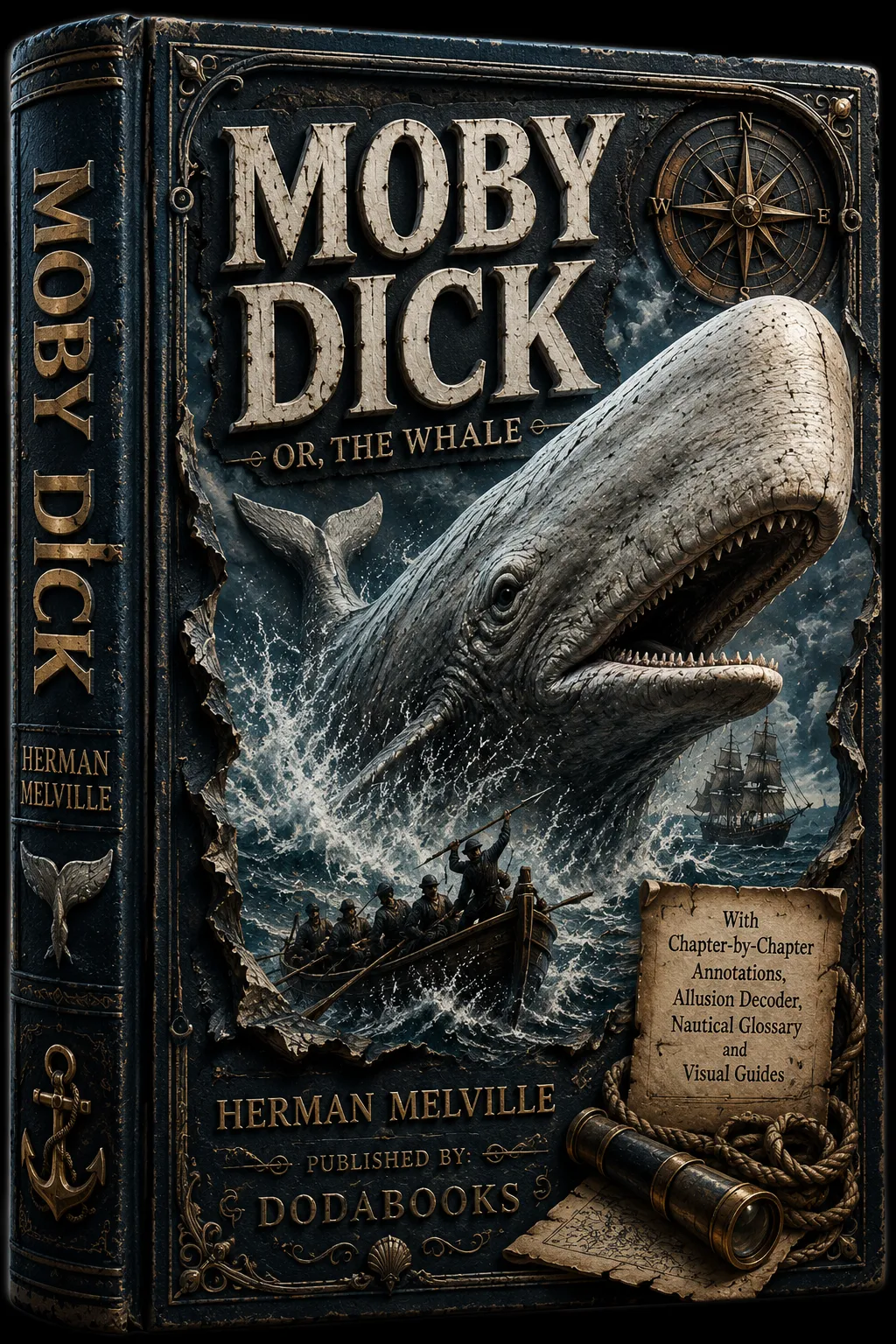
The DodaBooks annotated edition provides this context for every major passage, showing how the lines function within the novel as a whole and tracing their echoes in later literature. Get the annotated edition →
Experience Moby-Dick Like Never Before
Don’t struggle through Melville’s masterpiece alone. Our annotated edition of Moby-Dick includes:
- Complete, unabridged text of the novel
- Hundreds of explanatory footnotes clarifying obscure references
- Historical context on 19th-century whaling and Nantucket culture
- Literary analysis of key chapters and passages
- Victorian vocabulary definitions and nautical terminology
- Biblical and literary allusion guides
Get the annotated edition at DodaBooks →
📚 Related Articles
🎯 Stop Struggling. Start Understanding.
The annotated edition of Moby-Dick gives you everything you need to finally get Melville’s masterpiece:
- ✅ Complete, unabridged text — every word of the original 1851 edition
- ✅ Hundreds of explanatory footnotes — no more Googling every other page
- ✅ Historical context — the Essex disaster, Nantucket whaling, Melville’s life
- ✅ Literary analysis — chapter-by-chapter commentary on themes and symbols
- ✅ Victorian vocabulary — obsolete words and nautical terms defined inline
- ✅ Biblical & literary references — every allusion traced to its source