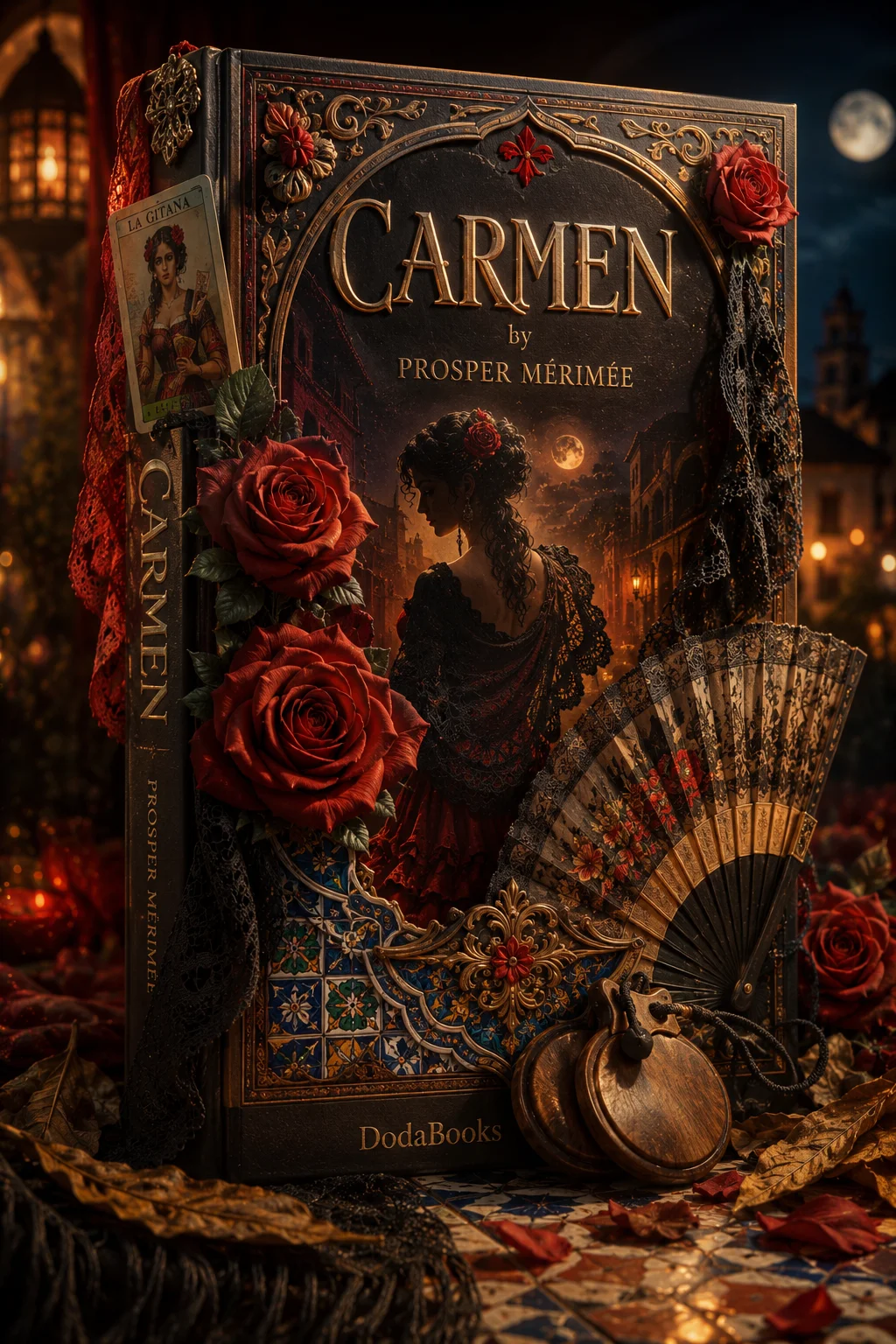
Prosper Mérimée’s Carmen is the fiery novella that inspired one of the world’s most famous operas — a brutal tragedy of obsession, freedom, and a woman who refuses to be tamed. Published in 1845, this compact masterpiece is darker, more cynical, and more violent than Bizet’s beloved adaptation, offering a raw portrait of desire and destruction in 1830s Spain.
💃
Carmen
A brutal tragedy of obsession and freedom — the fiery novella behind Bizet's world-famous opera.
| Author | Prosper Mérimée |
| Published | 1845 |
| Genre | Romantic novella, tragedy, adventure |
| Chapters | 4 |
| Setting | 1830s Spain — Seville, the Andalusian mountains, and bandit hideouts |
| Legacy | Source for Bizet’s world-famous opera Carmen |
📖 The Story of Don José and Carmen
The novella is narrated by an unnamed archaeologist traveling through Andalusia who meets the Basque soldier Don José at a bridge outside Seville. José, once a promising young officer in a cavalry regiment, agrees to tell the narrator how his life was ruined. His story is one of a single woman — Carmen.
Carmen is a Romani factory worker in Seville, beautiful and dangerous, who enchants José with her boldness and sensuality. When Carmen is arrested for wounding a fellow worker, José is assigned to escort her to prison. She persuades him to let her escape, and he pays for his leniency with his own demotion and imprisonment. Released from prison, José abandons his career and his fiancée to follow Carmen into the mountains, where she introduces him to her lover, the smuggler García, known as “the One-Eyed.”
José’s jealousy and obsession grow as he realizes Carmen no longer desires him. When García is killed in a fight, José believes Carmen will return to him — but she reveals she has fallen in love with the matador Lucas. The story hurtles toward its inevitable conclusion: José, consumed by passion and rage, confronts Carmen outside the arena of Córdoba and demands she return to him. When she refuses, declaring she will never be free while he controls her, José stabs her to death. He buries her body and surrenders to the authorities.
Mérimée strips the story to its essentials. There are no sympathetic subplots, no redemption, no escape. The narrator’s dry, observational tone contrasts with the violence of the events, creating an effect that is chilling in its restraint. This is not Bizet’s passionate opera — it is something leaner, colder, and ultimately more devastating.
🎭 Key Characters
Carmen
A Romani woman of fierce independence and unapologetic desire. Carmen lives entirely on her own terms, refusing to be possessed by any man. Her freedom is not romanticized — it is presented as a fundamental aspect of her nature that will destroy anyone who tries to constrain it. She is both the novella’s most vivid character and its most complex.
Don José
A Basque soldier whose encounter with Carmen destroys his life. José begins as a decent young man with a promising career, but his obsession with Carmen strips away everything — his honor, his career, his moral compass. He is both victim and villain, destroyed by his inability to accept that Carmen will never belong to him.
The Narrator
An unnamed French archaeologist traveling through Andalusia. His detached, scholarly perspective provides a counterpoint to the passionate events of José’s story. He is a listener rather than a participant, recording José’s confession with clinical precision.
García (The One-Eyed)
Carmen’s partner and fellow smuggler. García is a brutal, taciturn man whose violent death at José’s hands removes the last restraint on José’s obsession. He represents the criminal underworld that Carmen inhabits and that José ultimately cannot escape.
📖 Literary Significance
Carmen is a masterpiece of compression. In just four chapters, Mérimée creates a world of sun-baked Spanish landscapes, dusty roads, and shadowy mountain hideouts, populated by characters whose passions drive them toward destruction. The novella’s lean prose and refusal to sentimentalize its characters make it shockingly modern — a 19th-century story that reads like noir fiction.
The work’s influence on opera is well known, but its impact on literature is equally significant. Mérimée’s portrayal of Carmen as an autonomous woman — dangerous, free, and ultimately unknowable — challenged the conventions of romantic fiction. She is not a femme fatale in the traditional sense; she is simply a woman who refuses to be what men want her to be. This radical honesty made the novella controversial in its time and keeps it relevant today.
The novella also reflects Mérimée’s fascination with Spanish culture, which he encountered during his travels. His depiction of Romani life, bandit culture, and Spanish customs is vivid and detailed, drawn from personal observation rather than imagination. This grounding in reality gives the story an authenticity that enhances its power. Carmen remains one of the finest French novellas ever written — a work whose brevity belies its enormous emotional and thematic weight.
✨ What Makes the DodaBooks Edition Special
This is the original 1845 text, carefully prepared for modern readers without distractions or clutter.
Zero Distractions
No ads, no license pages, no project boilerplate — just the original novel, clean and uninterrupted.
Smart Typography
Curly quotes, em-dashes, proper ellipsis — typeset with care for a premium reading experience.
Chapter Navigation
Full table of contents with back-to-chapter links in every section — jump between all 4 chapters effortlessly.
Cleaned & Polished
All Gutenberg boilerplate stripped, consistent formatting throughout the text.
No DRM
You own your copy — read on any device, anytime, forever.
Instant Download
EPUB + PDF + AZW3 formats included, delivered instantly after purchase.
🏛️ Historical Context: France, Spain, and the Romantics
Mérimée was not primarily a novelist — he was one of France’s inspectors of historical monuments and a serious student of the ancient world — and Carmen grew directly out of his travels in 1830s Spain, where he filled notebooks with dialects, local customs, and extravagant stories. Published in 1845, the novella rode two currents of its moment. Romantic readers were hungry for exotic settings and extreme feeling, so Spanish bandits and Romani fortune-tellers were irresistible material. But Mérimée the scholar kept the sensation in check, grounding Carmen’s world in documented detail: the Seville cigar factory, the smugglers’ mountain passes, the Andalusian roads he had walked himself. The story lands with the authority of reporting, which is precisely why it unsettled its first readers — and why it still does.
🔮 Freedom, Fate, and the Cards: What It Means
Run your finger down Carmen and three ideas keep resurfacing. Freedom is Carmen’s entire law — she obeys no one, not even her own best interest, and she tells José plainly that she will do as she pleases. Fate is the story’s other pole: Carmen reads her own death in the turn of the cards and walks toward it anyway, while José’s speech is one long surrender to destiny. Between the two stands possession — the belief, written into José from the start, that to love a woman is to own her. Mérimée never moralises; he sets the three forces in motion and calmly shows the wreckage. That refusal to explain Carmen away is what lifts the novella above the melodrama of its era.
💃 Carmen vs. Bizet’s Opera
Everyone knows the opera; far fewer have met the novella. Bizet’s Carmen (1875) softened nearly everything. His heroine is a stage siren with a famous Habanera, a chaste sweetheart named Micaëla is added to give José an escape route, and the toreador Escamillo acquires a swagger the book never grants him. Mérimée’s Carmen is harder, colder, and more honest: she smokes, fights, lies, and loves only while she chooses to. The opera mourns a lost enchantress; the novella charts a woman’s liberty against a man’s need to control it. They are both masterpieces, but they are telling different stories — and reading the novella after hearing the opera’s tunes is one of the great culture shocks in literature.
✍️ Reading Tips for Maximum Impact
Carmen is meant to be read in a single sitting — it is barely a hundred pages, and the momentum is the point. Let the frame narrator be your guide: he is a scholar, not a romantic, and his detached astonishment is designed to make you feel José’s heat by contrast. The final chapter, a discursive essay on Romani customs, can be read as what it is — Mérimée the antiquarian back on duty. Then keep the run going with other French originals: Manon Lescaut is the earlier, sadder portrait of a woman society refuses to forgive, and The Count of Monte-Cristo shows the same era at full-blast melodrama. If the opera is your way in, our guide to The Phantom of the Opera explores another French original remade by a famous adaptation.
❓ Frequently Asked Questions
How does the novella differ from Bizet's opera?
The novella is far darker and more cynical. Carmen is more violent, José is more desperate, and the ending is more brutal. Bizet softened the story considerably, adding romantic elements and a more sympathetic Carmen. Mérimée’s version is leaner and more unsettling.
Is Carmen a villain or a victim?
Neither — she is something more complex. Carmen is a woman who refuses to be possessed by any man, and her insistence on freedom is presented as both admirable and destructive. She is neither villainized nor sentimentalized, which is what makes her one of literature’s most compelling characters.
How long is the novella?
Carmen is a short work — typically around 100 pages. Most readers finish it in a single sitting of two to three hours. Its brevity is part of its power; there is not a wasted word.
Is the Spanish setting important?
Absolutely. Mérimée traveled through Spain and drew on his observations to create the novella’s vivid setting. The landscapes, customs, and culture of Andalusia are integral to the story’s atmosphere and the characters’ behavior.
Why is this novella considered a classic?
Carmen compressed an enormous amount of emotional and thematic complexity into a remarkably short work. Its portrayal of obsession, freedom, and cultural difference was revolutionary, and its influence on opera, film, and literature has been immeasurable.
Does Carmen ever love José?
Carmen is drawn to José for a time — she delights in his pride and his difference — but her desire is never permanent, and she says so. When he demands that she follow him, she answers that she belongs to no one. The tragedy is that José reads her honesty as betrayal.
Why does the novella have a narrator at all?
The scholarly narrator is Mérimée’s signature trick. By framing José’s confession inside a traveller’s notebook, Mérimée makes violent events feel like verified report rather than romance — and the narrator’s detachment steadies the tale, letting José’s passion burn without the author tipping his hand.
Should I read the story before or after seeing the opera?
Either way works, but read the novella first — it takes two hours and it is the truer original. When Bizet’s version softens Carmen into a stage enchantress, you will be able to measure exactly what was added, and the opera’s triumphant melodies will carry the shadow of Mérimée’s bleaker, more honest tale.
📚 Related Articles
📖 Read the Original Classic
Carmen is one of the most influential novellas ever written. The DodaBooks edition preserves the complete original text in a clean, distraction-free format:
- ✅ Complete 4-chapter novella — every word of the 1845 edition
- ✒️ Smart typography — curly quotes, em-dashes, proper ellipsis
- 📜 Full table of contents with chapter navigation
- 🔒 DRM-free — read on any device, anytime
- 📥 Instant download — EPUB + PDF + AZW3 formats