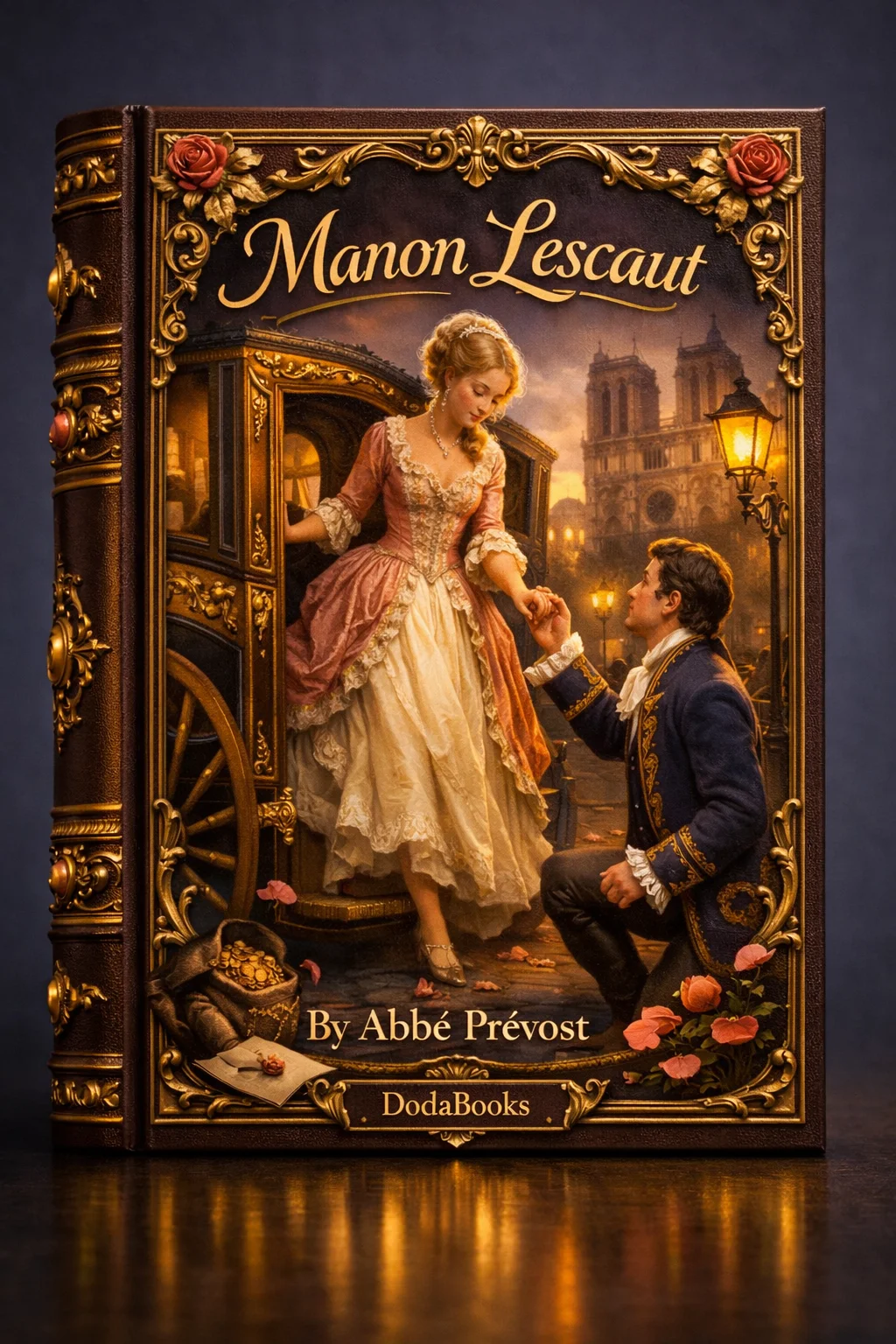
Manon Lescaut follows the Chevalier des Grieux, a young nobleman whose passionate, destructive love for the beautiful and fickle Manon Lescaut leads him from the salons of Paris to the prisons of the Bastille and ultimately to the desolate wilderness of Louisiana — one of literature’s most devastating love stories.
💔
Manon Lescaut
The tragic tale of the Chevalier des Grieux and his passionate, destructive love for the beautiful and fickle Manon Lescaut — a story of obsession, betrayal, and redemption set against the glittering backdrop of 18th-century Paris and the wilds of Louisiana.
| Author | Abbé Prévost (Antoine François Prévost d’Exiles) |
| Published | 1731 |
| Genre | Tragic romance, memoir-novel |
| Chapters | 13 |
| Setting | Paris, the Bastille, and the Louisiana colony |
| Legacy | Inspired operas by Puccini and Massenet; a landmark of French literature |
💔 The Story
When the Chevalier des Grieux first lays eyes on Manon Lescaut at a Parisian inn, he is instantly captivated. She is young, beautiful, and enchanting — but she is also being escorted to a convent by armed guards. In a moment of reckless passion, des Grieux helps her escape, and thus begins one of literature’s most devastating love stories.
From the salons of Paris to the prisons of the Bastille and ultimately to the desolate wilderness of Louisiana, des Grieux follows Manon through every twist of fortune. She is flighty and unfaithful, drawn to wealth and pleasure, yet he cannot break free from his love for her. Their story is a masterful exploration of the madness of love, the nature of obsession, and the cost of following one’s heart without reason.
📖 Literary Significance
First published in 1731 as part of Prévost’s multi-volume Mémoires et Aventures d’un Homme de Qualité, Manon Lescaut caused an immediate scandal. Its frank portrayal of passion, its morally ambiguous heroine, and its unflinching look at the destructive power of love challenged the conventions of 18th-century French literature.
The novel was condemned by the Church and banned in France — which only increased its popularity. It became one of the most widely read novels of the century and has never been out of print since.
Manon Lescaut has inspired two of the world’s most beloved operas: Massenet’s Manon (1884) and Puccini’s Manon Lescaut (1893). It has been adapted for film, television, and stage countless times, and its influence can be seen in everything from La Traviata to Moulin Rouge.
✨ What Makes the DodaBooks Edition Special
This edition presents Prévost’s classic in a clean, distraction-free format.
Zero Distractions
No ads, no license pages — just the complete text, clean and uninterrupted.
Smart Typography
Curly quotes, em-dashes, proper ellipsis — typeset with care for a premium reading experience.
Chapter Navigation
Full table of contents with navigation to each of the 13 chapters — easily jump between them.
Cleaned & Polished
All Gutenberg boilerplate stripped, consistent formatting throughout the text.
No DRM
You own your copy — read on any device, anytime, forever.
Instant Download
EPUB format included, delivered instantly after purchase.
💔 The Story, More Closely
Des Grieux is barely a teenager when the novel opens, a promising student on the verge of entering the Church. One day in Amiens he meets Manon Lescaut, a girl a little younger than himself, being escorted by her brother to a convent. Within minutes the two have agreed to run away together — an act that costs des Grieux his family, his inheritance, and his respectability in one stroke. That first headlong decision is the template for everything that follows: every time des Grieux must choose between an honourable life and Manon, he chooses Manon, and pays the price.
The pattern repeats with variations throughout the book. Des Grieux tries to gamble their way to wealth and is cheated. Manon’s brother uses her beauty to attract wealthy patrons, and des Grieux finds himself sharing her affections with a succession of rich rivals. When des Grieux’s father has him abducted, Manon quickly consoles herself with another admirer — and the cycle of jealousy, reconciliation, and ruin continues. Prévost’s genius is to keep the reader feeling both emotions at once: horror at des Grieux’s weakness and genuine sympathy for his heartbreak, since Manon, for all her flightiness, clearly returns his love in her own way.
The novel’s final movement carries the pair to the Louisiana colony as transported criminals — an expatriation, not a fresh start. In the wilderness, with the money gone and the suitors gone, Manon and des Grieux are finally alone together, and Prévost gives us the novel’s one sustained stretch of peace. It cannot last: Manon falls ill in the desolate country and dies in des Grieux’s arms, and he sinks to the ground beside her grave, waiting to die. It is one of the great deathbed scenes in European fiction, and its quietness is exactly the point — all the drama and glamour stripped away, leaving only the love that started it all.
🏛️ The World Behind the Novel: Regency France
Manon Lescaut was published in 1731, and you can feel the nervous energy of its moment in every page. Prévost wrote during the Regency that followed the death of Louis XIV, a period of moral looseness in which the old aristocratic restrictions loosened, money and pleasure moved to the centre of social life, and scandal was a form of entertainment. The France of the novel is a world of gambling, libertine aristocrats, fashionable convents, and the Bastille looming over anyone who overreached. Des Grieux’s ruin is not just personal — it is a picture of how the new money-world of the 1720s devoured a young man of good family but insufficient sense.
The novel also channels a specific literary fashion: the “memoir-novel,” in which a character narrates his own adventures as if they were true. Prévost published Manon Lescaut as an embedded story within his larger Mémoires d’un homme de qualité, and its intimate confessional tone was part of the scandal — a narrator describing his own moral collapse from the inside, without any authorial judgment passed on him. That refusal to moralise is the novel’s most radical quality and the reason the Church banned it. For more on how this tradition of confessional European romance evolved, our guide to the love letters of Mary Wollstonecraft shows a later author wrestling with love and reputation in the same literary territory.
🎓 How to Read It
Manon Lescaut is short, fast, and emotionally relentless, so a single focused sitting works beautifully — most editions read in four to six hours. Let the first-person narration work its spell: you are inside des Grieux’s head, and his capacity for self-deception is half the tragedy. Watch how Prévost refuses to condemn Manon even as she behaves badly; noticing where the story invites judgment and then withholds it is the key to the book. On a second reading, linger on the narrator’s frame — the novel opens with des Grieux telling his story to a stranger years later, which quietly signals how much his life has been hollowed out. If Manon’s mixture of attraction and ruin reminds you of that other great tale of a man destroyed by love, our guide to Carmen makes a fascinating comparison piece.
📖 Why It Still Matters
Nearly three centuries on, Manon Lescaut remains essential reading because it asks a question that has never stopped being urgent: what are we willing to sacrifice for love, and what does it do to us when we cannot walk away? Des Grieux is not a hero and not a villain — he is a cautionary example of desire without boundaries, and readers still recognise him. The novel’s afterlife is equally remarkable: as the source for operas by Massenet and Puccini, as one of the founding texts of the romance novel, and as a touchstone for how European fiction learned to take passion seriously. Few books this short have left this long a shadow.
❓ Frequently Asked Questions
Is Manon Lescaut based on a true story?
Prévost claimed the story was based on real events, and some scholars believe he drew on actual scandals of the French Regency period. However, the novel is generally considered a work of fiction inspired by the moral and social climate of 18th-century France.
Why was the novel banned?
The Church condemned Manon Lescaut for its frank portrayal of passion and its sympathetic treatment of morally ambiguous characters. The heroine Manon is unfaithful, manipulative, and materialistic, yet Prévost refuses to judge her — a radical stance for 1731.
How is the novel connected to the operas?
Massenet’s Manon (1884) and Puccini’s Manon Lescaut (1893) are both based on Prévost’s novel. Puccini’s version was his first major success and remains one of the most performed operas in the world. Both operas focus on the most dramatic episodes of the story.
How long does it take to read?
At 218 pages across 13 chapters, most readers finish in 4-6 hours. The fast-paced narrative and gripping emotional intensity make it a quick but unforgettable read.
Who is the Chevalier des Grieux?
He is the narrator and protagonist — a young nobleman who abandons his family, his inheritance, and a promising church career for love of Manon. His first-person account of his own ruin is the moral and emotional engine of the novel.
Why is Manon such a controversial heroine?
Because Prévost refuses to judge her. Manon is unfaithful, materialistic, and manipulative, yet the author presents her as human rather than monstrous. For a novel published in 1731, treating a “fallen woman” with sympathy rather than condemnation was genuinely radical.
How does the novel end?
The final section is set in the Louisiana colony, where Manon and des Grieux are transported criminals. After a brief period of peace, Manon falls ill and dies in the wilderness; des Grieux collapses beside her grave, intending to die there too. The surviving epilogue reveals he was eventually rescued.
📚 Related Articles
💔 Read the Tragic French Classic
Manon Lescaut is one of the most devastating love stories ever written — a tale of obsession, passion, and redemption that has captivated readers for nearly three centuries. The DodaBooks edition presents Prévost’s masterpiece in a clean, distraction-free format:
- ✅ Complete 13-chapter text — every word of the classic novel
- ✒️ Smart typography — curly quotes, em-dashes, proper ellipsis
- 📜 Full table of contents with chapter navigation
- 🔒 DRM-free — read on any device, anytime
- 📥 Instant download — EPUB format