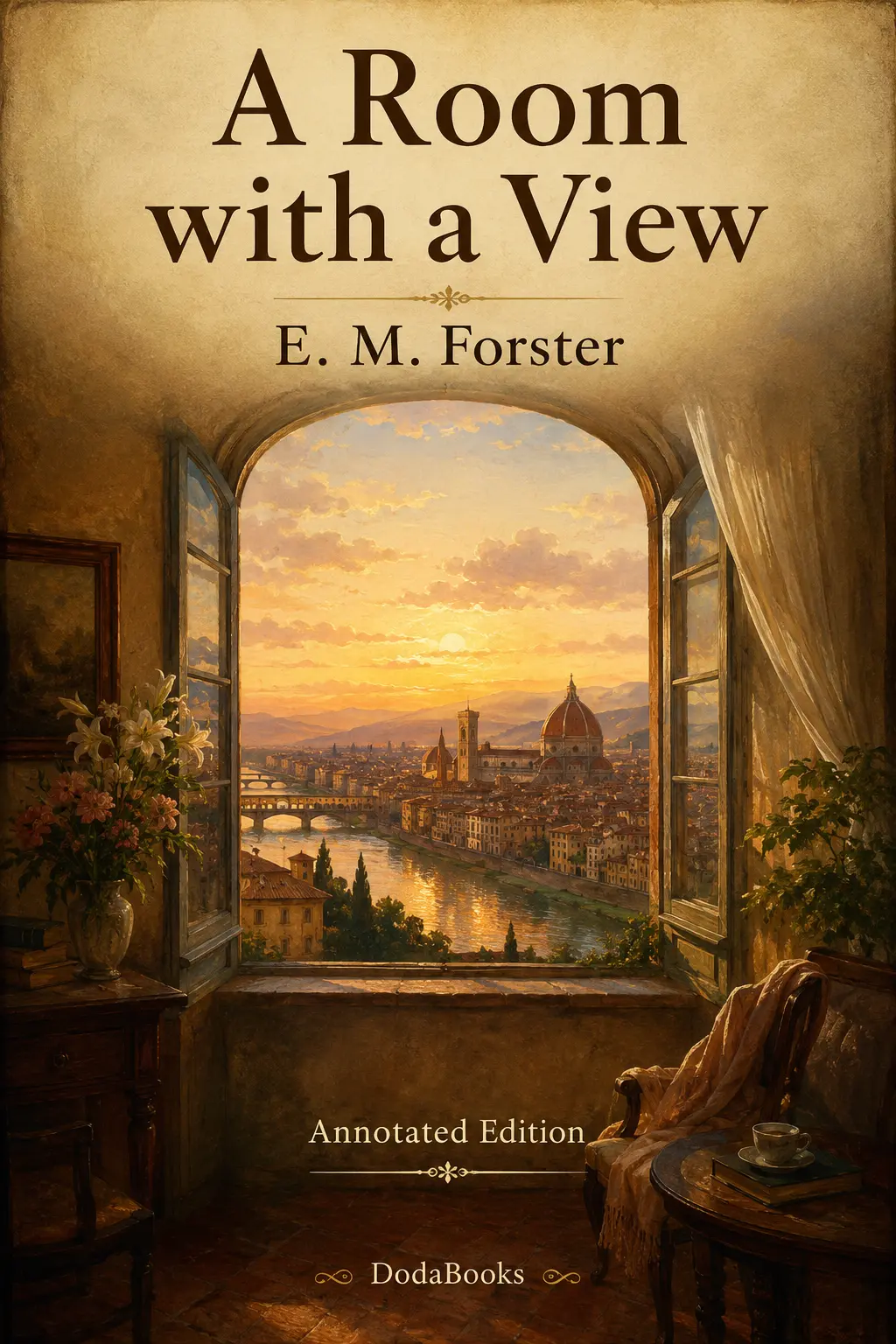
The fully annotated edition of A Room with a View enriches Forster’s sparkling comedy of manners with chapter introductions, vocabulary definitions, historical context, literary analysis, and discussion questions.
📚
A Room with a View — Fully Annotated Edition
Forster's sparkling comedy of manners, enriched with chapter introductions, vocabulary, historical context, and discussion questions.
| Author | E. M. Forster |
| Published | 1908 (annotated edition) |
| Genre | Bildungsroman, romance, social comedy (annotated edition) |
| Chapters | 20 |
| Setting | Early 1900s Florence, Italy and Surrey, England — Pension Bertolini, Santa Croce, Fiesole, Windy Corner, and Summer Street |
| Legacy | Forster’s most cheerful and accessible novel; a witty critique of Edwardian social conventions and a celebration of passion over propriety |
| Annotations | Vocabulary, context, analysis for every chapter |
🇮🇹 The Story
Lucy Honeychurch, a proper young Englishwoman, travels to Florence with her domineering cousin Charlotte Bartlett. They are lodged at the Pension Bertolini, a guesthouse full of eccentric English tourists. Lucy’s planned view of the Arno is blocked, and two gentlemen — the warm, unconventional Mr. Emerson and his intense son George — offer to swap rooms so the women can have the view they want.
Charlotte is scandalized by the offer from such “peculiar” men, and she forces the Honeychurches to refuse. But Lucy is drawn to the Emersons’ warmth and honesty. In Florence, a series of events — a concert by a Miss Alan, a moonlit visit to the Piazza della Signoria, and most dramatically, an assault on Lucy by a young Italian man — draw her closer to George Emerson. They share a kiss among the violets at Fiesole.
Charlotte, horrified, spirits Lucy back to England. Lucy engages herself to the respectable but insufferable Cecil Vyse, determined to live a safe, conventional life. But George reappears — his father has moved to Summer Street, near the Honeychurches — and Lucy must confront the truth: she loves George, not Cecil. In a comic climax at the pension’s summer garden, Lucy finally chooses passion and Italy over convention and Surrey.
🎭 Key Characters
Lucy Honeychurch
Lucy is the novel’s protagonist — charming, musical, and deeply conventional, but harboring a passion she doesn’t fully understand. Her journey is from the “room with a view” of others’ opinions to a room with a view of her own heart. She is often compared to Jane Austen’s heroines — proper on the surface, complex underneath.
George Emerson
George is the novel’s romantic hero — intense, brooding, and honest to the point of social awkwardness. He falls in love with Lucy at first sight and never wavers. His emotional directness contrasts sharply with the stiff conventionality of English society.
Mr. Emerson
George’s father is a philosopher and idealist who believes in the “superman” — someone who can transcend social convention. He is warm, generous, and completely oblivious to social rules. His accidental matchmaking is one of the novel’s great comic elements.
Charlotte Bartlett
Charlotte is Lucy’s cousin and chaperone — a “professional spinster” who is obsessed with propriety and terrified of scandal. She blocks Lucy’s romance with George at every turn, but her motivations are complex: she may have loved George herself once.
Cecil Vyse
Cecil is Lucy’s fiancé — intellectual, literary, and utterly wrong for her. He sees Lucy as a prize to be won, not a person to be known. His snobbery and emotional coldness make him the novel’s most obvious antagonist, though Forster treats him with sympathy.
📖 Literary Significance
A Room with a View is Forster’s most accessible and entertaining novel. Unlike the darker Howards End or A Passage to India, it is a comedy — warm, witty, and optimistic. Yet beneath the humor lies a sharp critique of English society.
Forster contrasts Italy and England as states of mind. Italy represents passion, spontaneity, and emotional honesty. England represents convention, repression, and social propriety. Lucy’s journey is from England to Italy and back again — and the novel asks whether she can bring Italy’s lessons home.
The novel’s structure is elegant. Florence and Surrey mirror each other, and many scenes in the second half echo or invert scenes in the first. The famous scene at the Piazza della Signoria — where George, Lucy, and Mr. Emerson witness a murder — is the novel’s turning point: an eruption of raw reality into a world of polite conversation.
Forster wrote A Room with a View before Howards End and A Passage to India, and it shows his early mastery of comedy. His narrator is playful, ironic, and occasionally interrupts the story to address the reader directly — a technique that gives the novel its distinctive lightness.
✨ What Makes the DodaBooks Annotated Edition Special
This fully annotated edition enriches Forster’s text with everything you need to understand and appreciate the novel — whether you’re reading it for the first time or studying it in depth.
Chapter Annotations
Vocabulary definitions, historical context, and literary analysis for every chapter.
Chapter Introductions
Concise overviews of themes and structure before each chapter to guide your reading.
Discussion Questions
Thought-provoking questions for each chapter, perfect for book clubs and classroom use.
Key Passages
Important passages highlighted and analyzed for deeper understanding.
Historical Context
Edwardian society, Italy travel, and women's roles explained in detail.
No DRM
EPUB + PDF + AZW3 — you own your copy forever.
🏛️ Edwardian England and the Italian Dream
Forster wrote A Room with a View in 1908, when two Englands — stuffy and emancipated — were arguing on every page. On one side are the Charlotte Bartletts, for whom appearing respectable is the highest duty. On the other is a generation of young women, Lucy among them, pushing at the edges of chaperoned England. Forster had travelled to Italy in 1901–02 and knew that a season in Florence was the standard rite of passage for genteel families: chaperons, pensions, and guidebooks stuffed with dates. The novel’s real subject is the gap between them — what happens when a sheltered English girl meets a country where people find passion perfectly normal.
🔮 Rooms, Views, and Water: The Symbolism
Forster builds the book from a handful of symbols and repeats them until they carry enormous weight. The room without a view stands for the life Lucy is expected to settle for: pleasant, respectable, curtained. The view stands for the world the Emersons offer — emotional honesty, physical connection, and the willingness to be surprised. Water does comparable work: the bathing scene where George, Freddy, and the vicar swim naked is the novel’s happiest image of naturalness, and George’s rescue when Lucy is overcome at the Santa Croce is the same instinct in human form. Violets mark romance; the novels Lucy reads at Windy Corner mark escape. Once you notice the pattern, every scene doubles — Florence and Surrey mirror each other, and the second half deliberately rhymes with the first.
🎓 Why Forster Still Matters
Most readers meet Forster’s story through the Merchant Ivory film, which is a near-perfect adaptation — but the book offers what the film cannot: the narrator’s dry running commentary, the gentleness, the sheer playfulness of the prose. And its question has not aged a day. Is a safe, conventional life really a life? Should we accept the room we are given, or fight for the view? In an age of algorithm-shaped respectability, Lucy’s choice feels freshly urgent. Forster’s answer is radical in the best way: connection, honesty, and ordinary joy are not luxuries — they are the point.
✍️ Reading Tips for a Deeper Read
A Room with a View rewards a relaxed first read; it is short, funny, and almost entirely sunlit. On a second pass, watch for mirrors: the two meals at the pension, the two proposals, the two views of the Arno and of the Surrey lawn. The annotated edition’s chapter introductions flag these echoes before each scene, and its discussion questions are made for book clubs. If you enjoy the comedy of English manners, Forster is writing in the tradition Austen perfected — our Pride and Prejudice guide helps you trace it — and The Enchanted April, Elizabeth von Arnim’s own Italian-sunshine classic, is the perfect follow-up. For a full plot briefing before you start, see our guide to A Room with a View.
❓ Frequently Asked Questions
What does the title mean?
“A Room with a View” refers to Lucy’s room in the Pension Bertolini — she wants one with a view of the Arno, and the Emersons offer to swap. But the title also works metaphorically: the novel is about seeing life clearly, from the “view” of your own heart rather than the “view” of social convention.
How long does it take to read the annotated edition?
The annotated edition runs 410 pages — roughly 80 more than the original. Most readers spend 12–16 hours with it, depending on how deeply they engage with the annotations.
Is it a comedy?
Yes — Forster’s most cheerful and funniest novel. While it deals with serious themes (social repression, emotional honesty, the constraints on women), the tone is light, witty, and optimistic. The ending is genuinely happy.
Should I watch the 1985 film?
Yes — the Merchant Ivory film starring Helena Bonham Carter and Julian Sands is considered one of the finest literary adaptations ever made. It’s faithful to the novel and beautifully filmed in Florence and Surrey.
Is Forster's message still relevant?
Absolutely. The tension between convention and passion, between safety and authenticity, is timeless. Forster’s critique of social hypocrisy and emotional repression resonates as powerfully in 2026 as it did in 1908.
What is Lucy's character arc in one paragraph?
Lucy begins as a young woman who pours her passion into the piano while keeping her real life timid and proper. Over the course of the novel she learns that the ardour she saves for Beethoven can also be spent on living — choosing George means choosing her own view of things over everyone else’s.
Is the annotated edition good for book clubs?
Yes. Every chapter includes discussion questions designed for exactly that, and the chapter introductions give every member the same context before the conversation starts. The vocabulary and historical notes also settle the factual questions that usually interrupt a book-club evening.
The title mentions a view — what view does Lucy finally get?
On the literal level, the Emersons offer the Bertolini room that looks out over the Arno. On the deeper level, Lucy ends the novel facing her own life directly — the “view” is the courage to see people as they are and to act on what she sees, instead of through the curtain of convention.
📚 Related Articles
📚 Get the Fully Annotated Edition
The annotated edition of A Room with a View enriches Forster’s masterpiece with everything you need for a deeper reading — whether you’re studying the novel or simply want to understand it more fully:
- ✅ Complete 20-chapter novel — every word of the 1908 original
- 📖 Chapter annotations — vocabulary, context, and analysis for every chapter
- 🎨 Chapter introductions — overviews of themes and structure before each chapter
- 📝 Discussion questions — thought-provoking prompts for each chapter
- 🔍 Key passages highlighted — important scenes analyzed in depth
- 🔒 DRM-free — read on any device, anytime