Reading Robert Burns poems in modern English removes the biggest barrier to enjoying them. Here are full modern English translations of his most famous poems, with the original text alongside.
Robert Burns Poems in Modern English (Examples & Guide)
See Robert Burns poems in original Scots alongside modern English translations — line-by-line comparisons that make Scotland's national poet instantly understandable.
👉 Get the Annotated Edition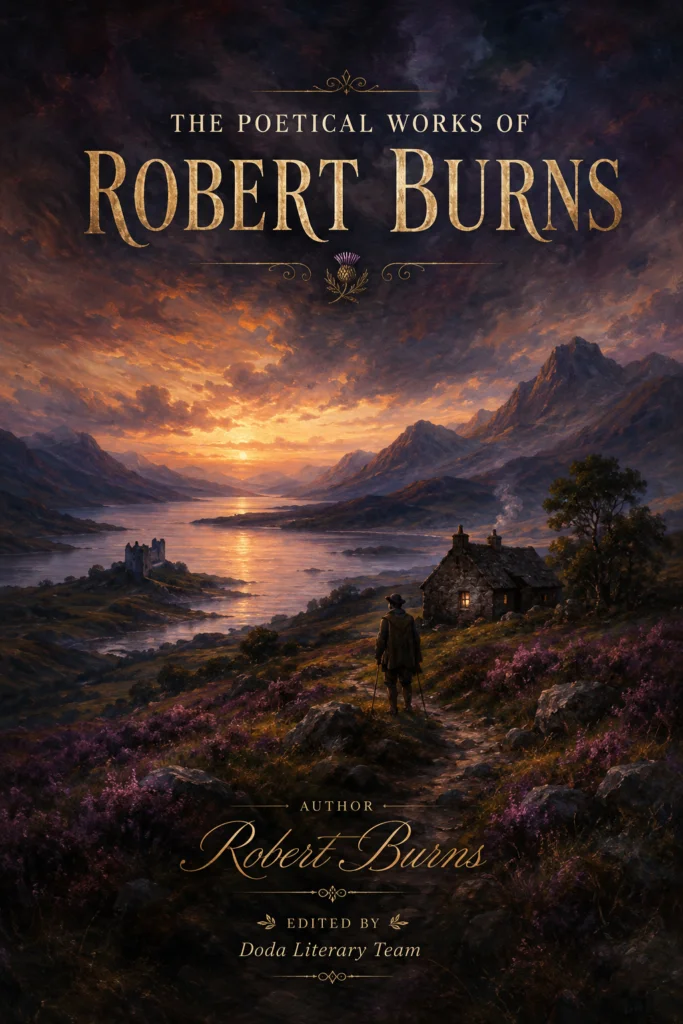
| Poet | Robert Burns (1759–1796) |
| Translations | Real examples from famous poems |
| Scots Words Covered | 20+ common terms |
| Purpose | Remove the language barrier |
| Edition | All 539 poems with modern English |
🌹 “A Red, Red Rose” — Modern English
Stanza 1 (Original): “O my Luve is like a red, red rose / That’s newly sprung in June”
Modern English: “My love is like a red, red rose / That has just bloomed in June”
Stanza 2 (Original): “As fair art thou, my bonnie lass / So deep in luve am I”
Modern English: “You are as beautiful, my pretty girl / As deeply in love as I am”
Stanza 4 (Original): “And I will come again, my luve / Tho’ it were ten thousand mile”
Modern English: “And I will return, my love / Even if it were ten thousand miles”
🐭 “To a Mouse” — Modern English (Opening)
Original: “Wee, sleekit, cow’rin, tim’rous beastie / O, what a panic’s in thy breastie!”
Modern English: “Small, sleek, cowering, timid little creature / Oh, what a panic is in your little chest!”
💋 “Ae Fond Kiss” — Modern English (Key Stanza)
Original: “Had we never lov’d sae kindly / Had we never lov’d sae blindly / Never met or never parted / We had ne’er been broken-hearted”
Modern English: “If we had never loved so gently / If we had never loved so blindly / If we had never met or never parted / We would never have been heartbroken”
📚 Translation Glossary
| Original Scots | Modern English |
|---|---|
| luve | love |
| bonnie | pretty, beautiful |
| gang | go |
| aft | often |
| agley | wrong, askew |
| nae | no, not |
| dinna | do not |
| canna | cannot |
| ken | know |
| monie | many |
📚 Get all 539 poems with complete translations
👉 Get the Annotated Edition🎓 What the Annotated Edition Unlocks
Full Modern English Translations
Every difficult line in all 539 poems is paraphrased in modern English — not just the famous ones.
500+ Scots Glossary
A complete A-to-Z glossary of Scots words with definitions, parts of speech, and poem cross-references.
Side-by-Side Comparisons
Original text and modern English presented together so you can see exactly what Burns wrote and what it means.
Teacher's Insights
Analysis of why Burns chose specific Scots words and what effects they create that English equivalents cannot replicate.
Translation Notes
Explanations of Scots grammar and idioms that don't translate directly — so you learn the language, not just the words.
Works on All Devices
Compatible with Kindle, Apple Books, Google Play Books, Kobo, and Foliate for study anywhere.
🔄 How Facing-Page Translations Work
A good Burns translation is not a substitute for the poem — it’s a pair of glasses. The method is simple: you keep the original Scots on one side and a plain modern-English version on the other, reading each stanza twice — once in each language — and letting the translation explain the parts the original can’t pause to explain.
That’s how the annotated edition works: the original poem first, a clear modern paraphrase beside it, and a glossary cross-referenced to the exact spot where each Scots word appears. You never leave the poem to go fishing for a dictionary; the help lives in the margins. Facing-page reading does something subtle: it teaches you Scots as a language rather than a pile of obstacles. After a few poems, words like ken, nae, and ganging stop being barriers and start being furniture.
The strategy matters because Burns is never just meaning — he’s also sound. Our guide to why Burns’s poems are so hard to read says it plainly: the difficulty is friction between you and the dialect, not difficulty in the ideas themselves.
⚖️ What Gets Lost — and What Gets Gained
Translation buys you clarity and charges you music. What you gain is instant access: you finally understand “To a Mouse,” “Ae Fond Kiss,” “Tam o’ Shanter” — the whole argument and feeling of each poem, in minutes instead of an afternoon of dictionary work.
What you lose is harder to price. Take the most famous line in Burns: “Wee, sleekit, cow’rin, tim’rous beastie.” A translation gives you “small, sleek, cowering, timid little creature” — accurate, and utterly stripped of the music. The original snakes along with its hissing s sounds and its clipped, urgent rhythm, and sleekit carries a nuance no single English word holds: the creature is both pathetic and faintly sly, deserving pity and a little suspicion at once. That double tone is Burns’s signature, and no plain-English rendering carries it intact.
The honest way to use translations is to take meaning from them and music from the original. Read “Ae Fond Kiss” in Scots aloud — “Had we never lov’d sae kindly / Had we never lov’d sae blindly” — and even without knowing every word you feel the ache in the rhyme of kindly and blindly. The translation tells you what the ache is about; the original tells you how it aches. That balance is the whole art, and our plain-English readings of Burns’s poems unpack the trade-offs line by line.
🐭 A Closer Look: “The Best-Laid Schemes”
The most-quoted half-stanza in Burns is also a perfect training exercise. From “To a Mouse”:
The best laid schemes o’ Mice an’ Men Gang aft agley, An’ lea’e us nought but grief an’ pain, For promis’d joy.
The only genuinely Scots words are gang (“go”), aft (“often”), agley (“askew, wrong”), lea’e (“leave”), and nought (“nothing”). Know those five and the whole stanza opens: “The best-laid plans of mice and men / often go badly wrong, / and leave us nothing but grief and pain / instead of the joy we were promised.”
Notice what happens to that final rhyme. The poem needs a word that rhymes with joy, and Scots agley provides it; modern English simply has no neat equivalent for agley, so any translation must give up either the rhyme or the exact shade of meaning. This is why a facing-page edition beats either extreme: the original holds the rhyme, the translation holds the sense, and you get to keep both. We walk through the whole poem this way, word by word, in our plain-English reading of To a Mouse.
🌱 A Method That Works: Read, Translate, Re-read
Here is a simple loop that turns any Burns poem from a chore into a pleasure. First, read the original aloud and let the sounds wash over you. Second, read the modern translation straight through to get the story. Third — the step most people skip — read the original aloud again, slowly, with the meaning now in your head. The difference between the first and third readings is the whole point: the second pass supplies the meaning, so the third pass finally lets you hear the poem.
Learn vocabulary in small batches — ten words per poem is plenty — and because the same common Scots words recur constantly, your second poem will be dramatically easier than your first. If you’d like short, famous texts to practise on, simple-English versions of the best-loved Burns poems are the ideal training ground.
📖 About This Edition
The annotated edition is built around the method above. Every one of the 539 poems and songs carries a line-by-line modern English paraphrase, printed beside the original so the work of comparison never interrupts your reading. A 500-plus-word Scots glossary is cross-referenced to the exact poems where each word appears, and translation notes explain the grammar and idioms that won’t lift across languages directly. Start with “A Red, Red Rose” and you can be reading “Tam o’ Shanter” fluently within a few sittings — and, eventually, read Burns aloud in Scots, at the pace of song.
❓ Frequently Asked Questions
Is a modern English translation the same as the original?
No. The translation captures the meaning but loses the rhythm, rhyme, and Scots character. Use translations as a bridge to understanding, not a replacement for the original.
Can I just read Burns in modern English?
You can, but you’ll miss the music of the Scots language and the cultural identity embedded in it. The annotated edition gives you both side by side.
How much of Burns is in Scots vs English?
About 60-70% of Burns’s vocabulary is shared with English. The remaining 30-40% is Scots — which is why unannotated reading is so frustrating.
Is Scots just badly spelled English?
No. Scots is a distinct language with its own vocabulary, grammar, and pronunciation. Words like sleekit (sly/sleek) and drouthy (thirsty) have no direct English equivalent.
What's the best way to learn Scots while reading Burns?
Use the glossary-first method: learn 10 Scots words before each poem, then read with the glossary beside you. The annotated edition’s cumulative glossary makes this easy.
How long will it take me to read Burns comfortably?
With an annotated edition, most readers feel comfortable after 3-4 poems. The first poem takes time — but by poem five, you’ll recognise the most common Scots words automatically.
What does "Auld Lang Syne" actually mean?
It’s Scots for “old long since” — roughly “the days long ago.” Burns reshaped an older folk fragment in the late 1780s, and the version he produced is the one the world now sings to end the year. A single song like this shows how much of Burns’s fame rides on melody as much as meaning.
Should I read the translation first or the original first?
Original first, aloud, even if you don’t fully understand it. Then read the translation, then re-read the original slowly. That order lets you collect the meaning without losing the sound; the reverse tends to lock your ear onto the modern English and makes the Scots feel like a puzzle rather than a poem.
Does the annotated edition translate every one of the 539 poems?
Yes. Every poem and song receives a line-by-line modern English paraphrase, so you rarely meet a Burns work you can’t read comfortably. The famous poems get the fullest treatment, with the glossary and translation notes cross-referenced throughout.
📚 Related Articles
Read every Burns poem in modern English
Poems and Songs of Robert Burns — The Annotated Edition
All 539 poems with line-by-line modern English translations, complete Scots glossary, and analysis.
👉 Get the Annotated Edition{ .cta-button }