If you like romantic poetry, start with Robert Burns. He is not technically a Romantic poet — he died in 1796, just before the Romantic movement fully took off — but his work contains everything Romantic poetry readers love.
If You Like Romantic Poetry, Start with Robert Burns
If you love Romantic poetry, start with Robert Burns — the Scottish poet who anticipated the Romantics with his intense emotion, connection to nature, celebration of ordinary people, and passion for freedom.
👉 Get the Annotated Edition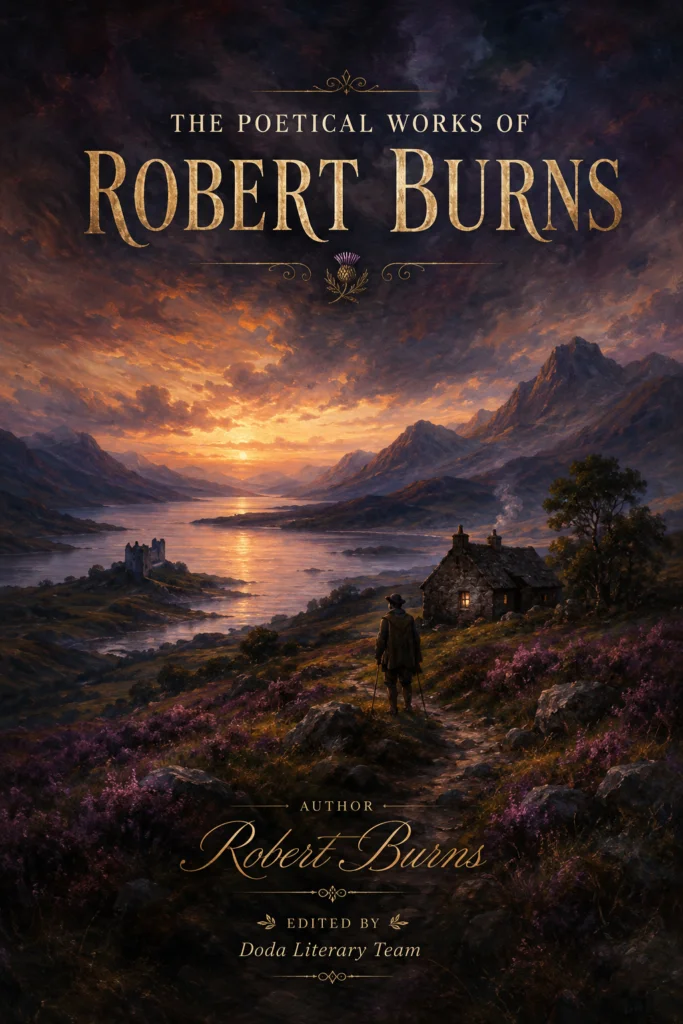
| Poet | Robert Burns (1759–1796) |
| Era | Pre-Romantic (proto-Romantic) |
| Shared With Romantics | Emotion, nature, equality, freedom |
| Unique To Burns | Humour, musicality, Scots language |
| Best Starting Poems | 5 recommended below |
❤️ What Burns Shares with the Romantics
Emotion over reason. Wordsworth said poetry is “the spontaneous overflow of powerful feelings.” Burns was doing that before Wordsworth wrote it down. His poems are driven by emotion — love, anger, grief, joy — not by intellectual argument.
Nature as a teacher. Like Wordsworth and Coleridge, Burns found wisdom in the natural world. But Burns’s nature is grittier. He worked the land. His poems about animals and landscapes come from real experience, not observation.
Ordinary people matter. The Romantics celebrated the common person. Burns did too, but he went further — he wrote in the language ordinary people actually spoke (Scots) rather than the formal English of educated poetry.
Freedom and equality. Romantic poets believed in political freedom. Burns wrote “A Man’s a Man for A’ That,” which argues that character matters more than class. It could be a Romantic anthem.
🎭 Where Burns Differs
Burns is funnier than most Romantics. He wrote satires, drinking songs, and comic poems that feel closer to folk tradition than high literature. Romantic poetry can feel serious and elevated. Burns can feel like a friend telling you a story in a pub.
He is also more musical. Burns wrote most of his poems to existing folk tunes. The Romantics wrote for the page; Burns wrote for the voice.
📋 Which Poems to Start With
If you love Romantic poetry, read these Burns poems first:
- “A Red, Red Rose” — as beautiful as any Romantic love poem
- “To a Mouse” — empathy for a small creature that rivals Wordsworth’s best nature poetry
- “Ae Fond Kiss” — emotional intensity that equals Keats’s odes
- “A Man’s a Man for A’ That” — Shelley’s political passion without the abstract language
- “My Heart’s in the Highlands” — pure Romantic longing for a wild landscape
📚 Discover the poet who inspired the Romantics
👉 Get the Annotated Edition🎓 What the Annotated Edition Unlocks
Line-by-Line Explanations
Every poem explained in plain English — understand the emotional and technical aspects of Burns's craft.
500+ Scots Glossary
Complete glossary makes Burns's language accessible — the same way the Romantics made everyday language poetic.
Literary Context
See how Burns influenced Wordsworth, Coleridge, Keats, Shelley, and the entire Romantic movement.
Teacher's Insights
Analysis of Burns's proto-Romantic techniques — emotional intensity, nature imagery, and celebration of ordinary life.
Comparison Notes
Ready-made comparisons between Burns and major Romantic poets — perfect for essays and discussion.
Study Anywhere
Works on Kindle, Apple Books, Google Play Books, Kobo, and Foliate.
🎵 Why Burns Is the Perfect Starting Point
If you already enjoy Romantic poetry, the hardest part of picking up Burns is usually just deciding he is worth your time. He is. Here are the three concrete reasons so many readers find him the natural gateway to the whole Romantic tradition.
Because Burns wrote for the voice. Most poetry of the 1700s was written to be read silently on the page, often in formal heroic couplets. Burns worked in a different tradition entirely — he was a passionate collector and restorer of Scottish folk songs, and he set the majority of his own poems to existing tunes. This means nearly everything he wrote is meant to be sung or read aloud, with a beat you can tap and a rhyme you can feel coming. If you are someone who reads poetry aloud, or who likes hearing it performed, Burns will click instantly in a way that more academic verse might not. That song-culture background also explains why his lines are so memorable — they were designed to be remembered without a book in your hand.
Because he moves seamlessly between Scots and English. The Romantics, for all their talk about “the language really used by men,” mostly wrote in educated standard English. Burns genuinely wrote in the language of the people — his poems mix Scots dialect with English, sometimes within a single line. That can look intimidating at first (“O my Luve is like a red, red rose” is easy, but “but I to manhood am taen” is not), yet it is precisely this texture that makes him so alive. You get the musicality and earthy directness of Scots alongside the clarity of English. If you want to ease in, our guide to reading old English and Scots poetry explains the common patterns, and a good glossary — like the 500+ entry one in the annotated edition — does the rest.
Because he addresses emotion directly. Romantic poetry is famous for his emotional intensity, but the Romantics often reached it through long meditative passages. Burns gets to the feeling immediately. He does not philosophise his way toward grief or joy; he names it, then lets it swell. This directness is why his shortest poems hit so hard — a point we explore further in our analysis of Ae Fond Kiss, his devastating farewell verse.
🏛️ Burns’s Scotland and the 1780s Literary Scene
To understand why Burns feels Romantic before Romanticism, it helps to picture the world he came from. He was born in 1759 in Alloway, Ayrshire, the son of a tenant farmer who could barely afford his schooling — yet who insisted his children be educated at all. Burns grew up among ploughing, harvests, and animals in one of the poorest and most marginal layers of Scottish rural life. This is not a poet observing nature from a country house window; this is a man who knew the cold, the mud, and the endless physical labour of a working farm.
In the 1780s, Edinburgh was enjoying a golden age of learning and philosophy known as the Scottish Enlightenment. Alongside it, there was a growing literary interest in “folk” culture, ballads, and the vernacular. Burns’s first volume, the Kilmarnock edition published in 1786, arrived into this moment and was an immediate sensation. His genius lay in taking the raw material of folk song and rural life and shaping it into polished verse — without ever losing the plain, unpretentious voice that made it authentic. He was at once a working farmer and a self-taught intellectual, and that unusual double identity made his poetry so magnetic.
This matters for Romantic readers because it explains Burns’s directness. The English Romantics were often educated gentleman reacting against a literary establishment. Burns was a labourer writing from lived experience, and that is why his emotion feels earned rather than performed. He anticipated the Romantic emphasis on individual feeling, the natural world, and the dignity of ordinary people — but he arrived at it through a completely different door.
💫 Why It Still Matters and How to Read Him
Here is the good news for a new reader: Burns is the rare “gateway” poet who stays rewarding. Because his poems are short, narrative, and musical, you can genuinely read all the famous ones in an afternoon. Do not read in publication order on your first pass. Instead, start with a short list like the one above, read each poem aloud twice, and only then look up what you missed. The pleasure of Burns comes first from sound and feeling; the annotation is there to deepen it, not to gatekeep it. When you are ready to branch out, Tam o’ Shanter shows his comic range, and his love poems gather his romantic verse in one place.
❓ Frequently Asked Questions
Was Burns a Romantic poet?
Technically, he is considered a pre-Romantic or proto-Romantic poet. He died in 1796, just as the Romantic movement was beginning. But his work contains many of the qualities that define Romantic poetry.
How did Burns influence the Romantic poets?
Wordsworth and Coleridge read Burns and admired his use of everyday language, his celebration of ordinary people, and his emotional honesty. Burns proved that poetry didn’t need classical forms or elevated subjects.
What makes Burns different from Wordsworth?
Burns is funnier, more musical, and more direct. Wordsworth’s nature poetry is contemplative; Burns’s is gritty and experiential. Burns also wrote in dialect, while Wordsworth wrote in standard English.
Which Burns poem is most like a Romantic poem?
“My Heart’s in the Highlands” has the strongest Romantic feel — it’s a poem of longing for a wild landscape that could have been written by Wordsworth or Byron.
Do I need to read Burns before the Romantics?
Not necessarily, but reading Burns first makes the Romantics more interesting. You’ll see where some of their ideas came from — and you’ll see what Burns did differently.
Can I read Burns if I've only read Romantic poetry?
Absolutely. Burns is the perfect next step. He’s harder in one way (the Scots language) but easier in others (shorter poems, clearer narratives, more humour).
Is Burns considered a Romantic poet or a pre-Romantic one?
He is usually called a pre-Romantic or proto-Romantic poet. He died in 1796, right as the Romantic movement was gathering momentum, so he belongs to the generation before it. But his work contains nearly every quality the Romantics would later claim as their own — which is exactly why he is such a good starting point.
What is the best way to handle the Scots dialect as a new reader?
Do not try to translate every word on the first read. Let the rhythm and emotion carry you through, then use a glossary for the trickier lines. Within a few poems you will find the Scots patterns becoming familiar — especially once you realise many of the differences (like luve for love or a’ for all) are simple spelling variations.
Should I read Burns aloud or silently?
Read him aloud whenever you can. Because most of his poems were written to existing folk tunes, they are built for the voice, and hearing them aloud reveals the musicality that silent reading can miss. Even reading a single stanza softly to yourself changes how the poem lands.
📚 Related Articles
Start your Romantic poetry journey with Burns
Poems and Songs of Robert Burns — The Annotated Edition
All 539 poems with line-by-line explanations, Scots glossary, and the literary context you need.
👉 Get the Annotated Edition{ .cta-button }