Complete biography of Herman Melville, author of Moby-Dick. From his early life at sea to his literary rise, his devastating failure, and his posthumous triumph as America’s greatest novelist.
This article is part of our annotated Moby-Dick guide, designed to help readers unlock the full depth of Melville’s masterpiece through comprehensive notes and analysis.
🐋
Herman Melville Biography: The Life of the Moby-Dick Author
Complete biography of Herman Melville, author of Moby-Dick. From his early life at sea to his literary rise, his devasta...
The Early Years
Herman Melville was born in New York City on August 1, 1819, into a family of distinguished lineage but declining fortune. His father, Allan Melville, was an importer of French luxury goods. His mother, Maria Gansevoort, came from a prominent Dutch colonial family. The family lived comfortably until 1830, when Allan’s business failed. He died two years later, leaving the family in debt.
The sudden reversal marked Melville for life. He left school at 12 to work as a clerk. The contrast between his family’s social standing and their financial desperation gave him a lifelong sensitivity to class and injustice.
Life at Sea
📖 Want the complete annotated experience?
👉 Get the Annotated EditionAt 19, in 1839, Melville signed onto a merchant ship, the St. Lawrence, bound for Liverpool and back. The experience of the sea was transformative. He discovered a world beyond the narrow confines of New York society — a world of diverse races, cultures, and languages — and he saw the harsh realities of the forecastle, where a common sailor lived cheek-by-jowl with men of every class and nation. The voyage would later feed his early autobiographical novel Redburn.
In 1841, he joined the crew of the whaler Acushnet, sailing for the South Pacific. The voyage took him around Cape Horn and into the Pacific. After 18 months, he jumped ship in the Marquesas Islands and lived for a time among the Typee people — a Polynesian tribe with a reputation for cannibalism. His escape from the island and his roamings through the South Seas gave him the strange, adventurous material that made his name.
Melville’s experiences became the material for his early novels. Typee (1846) and Omoo (1847) were based on his time in the Marquesas and Tahiti. They were adventure stories with exotic settings, and they were popular successes — at the time, more successful than anything he would ever write again. For a brief moment, Herman Melville was one of the most widely read authors in America.
The Rise to Fame
Melville returned to New York and married Elizabeth Shaw, the daughter of the chief justice of Massachusetts. He settled in the Berkshires, where he became friends with Nathaniel Hawthorne, the most celebrated American novelist of the era.
Under Hawthorne’s influence, Melville’s ambitions deepened. He began to see literature not as entertainment but as a calling. He wanted to write something that would last — a book as great as the literary masterpieces he was reading with such intensity.
Between the travel adventures and the great novel, Melville kept up a remarkable pace. He followed Omoo with Mardi (1849), a strange allegorical voyage that puzzled the readers who had loved his simpler sea stories; then Redburn (1849), his semi-autobiographical account of that first merchant voyage; and White-Jacket (1850), a novel of life aboard a man-of-war that drew on his experiences aboard a United States Navy frigate on his return from the Pacific. The commercial disappointments of Mardi chafed against the staying power of the more straightforward books, and Melville grew increasingly restless with the demands of the marketplace. He wanted to write something that would last, even if it meant risking everything.
The Writing of Moby-Dick
Melville began Moby-Dick in early 1850. Originally conceived as a straightforward adventure story about whaling, the novel transformed under his hands into something far stranger and more ambitious. He completed the 135-chapter novel in about 18 months, writing with feverish intensity.
The book that emerged was unlike anything published before. It mixed genres, voices, and tones. It was part novel, part encyclopedia, part play. It contained chapters of whale anatomy, philosophical meditations, dramatic monologues, and a three-day chase that rivals any thriller.
Melville dedicated the book to Hawthorne “in token of my admiration for his genius.”
The Failure
Moby-Dick was published in 1851. The reception was devastating. British reviewers called it “wild” and “weird.” American critics were harsher — one called it “sad stuff, dull and dreary.” The public stayed away. (In London, where it appeared as The Whale, it fared no better.) Melville’s next novels — Pierre (1852), Israel Potter (1855), and The Confidence-Man (1857) — sold progressively worse, with Pierre in particular puzzling and alienating even his remaining admirers.
In the same desperate stretch, Melville turned to the short story and magazine fiction, producing some of the finest pieces of his career — including “Bartleby, the Scrivener” (1853) and “Benito Cereno” (1855), the latter a haunting, layered tale of a slave-ship revolt that has become a staple of American literature courses. Yet even these masterpieces earned him little money and less recognition. He wrote for Putnam’s Monthly and Harper’s, grinding out stories to pay the bills, and the irony of producing some of his most lasting work during his steepest decline would not be appreciated for generations.
Melville was deeply wounded. He felt that he had given everything to his art and that the world had rejected him. He stopped writing fiction at 38. He turned to poetry — long narrative poems about the Civil War and a monumental 16,000-line poem about the Holy Land (Clarel, 1876). These too were ignored.
The Long Obscurity
Melville spent his final decades working as a customs inspector on the New York docks — a job he held for 19 years. He continued to write, but for a tiny audience. When he died in 1891, his obituary in the New York Times mentioned him as the “author of Typee.” Moby-Dick was not even cited.
He left behind an unpublished manuscript: Billy Budd, Sailor. It was discovered among his papers and published in 1924. It is now considered one of the greatest novellas in English.
The Rediscovery
In the 1920s, a generation of critics and writers rediscovered Moby-Dick. D.H. Lawrence called it “one of the strangest and most wonderful books in the world.” By the 1940s, the novel was established as a masterpiece of American literature.
Today, Moby-Dick is widely considered the Great American Novel. It is taught in universities worldwide. It has never gone out of print since its rediscovery. The story of Melville’s life — his ambition, his failure, his vindication — adds a dimension of tragedy to the novel itself.
🕯️ Why Melville’s Life Still Matters
Melville’s biography resonates far beyond literary history because it is a parable about the gap between ambition and recognition. He wrote the book we now regard as the great American novel at a moment when the public wanted lively travel yarns — and he was punished for it, spending nearly two decades as a forgotten customs inspector. That arc makes him a hero to anyone who has ever created something ahead of its time: proof that obscurity in the moment is not the same as failure.
His life also shaped the book itself. The whale hunt was not invention but memory — Melville really did sail on the Acushnet, really did know the violent, weird, multiracial world of the nineteenth-century whale fishery. Readers who want the full picture of that true-life background should read about the real disaster of the whaleship Essex, whose sinking helped inspire the novel. And for everything Melville wrote beyond the one great book, our guide to Melville’s other works beyond Moby-Dick walks you through Typee, Omoo, Bartleby, Benito Cereno, and more — the rest of a career that is far richer than a single novel.
📖 How to Read Melville Today
Approaching Melville for the first time can be intimidating, but his biography is a generous on-ramp: every strange digression in Moby-Dick has a root in lived experience, and knowing that makes the strangeness feel intentional rather than accidental. Read with a willingness to get lost — the dips into whale anatomy and philosophy are part of the design. A good annotated edition is worth its weight here, explaining the era’s sailing terms, biblical allusions, and whaling practice so the prose stays vivid instead of opaque. And if you’re wondering whether the novel was always brilliant-or-bombed, the story of how Moby-Dick bombed and then became a classic is one of the strangest second acts in literary history.
❓ Frequently Asked Questions
What is Herman Melville most famous for?
Melville is best known as the author of Moby-Dick (1851), now considered the Great American Novel. In his own lifetime he was far more famous for his early South Seas adventure books, Typee and Omoo.
Did Melville ever go to sea?
Yes, and it shaped everything he wrote. He sailed to Liverpool on a merchant ship in 1839, joined the whaler Acushnet in 1841, jumped ship in the Marquesas Islands, and later served aboard a Navy frigate on his way home. These voyages became the material for nearly all his major works.
Was Moby-Dick a success when it was published?
No. It was published in 1851 to poor reviews and weak sales, appearing in London as The Whale. Melville spent decades in obscurity afterward. It was only rediscovered and celebrated in the 1920s and 1940s.
Did Melville write anything besides Moby-Dick?
Plenty — including the novels Typee, Omoo, Mardi, Redburn, White-Jacket, and Pierre, the great short stories “Bartleby, the Scrivener” and “Benito Cereno,” the posthumously published novella Billy Budd, and substantial poetry including Battle-Pieces and the epic Clarel.
How did Melville die?
Herman Melville died in New York in 1891, at the age of 72, largely forgotten. He was buried in the Woodlawn Cemetery in the Bronx. His novella Billy Budd was discovered among his papers and only published in 1924, decades after his death.
Reading Melville Today
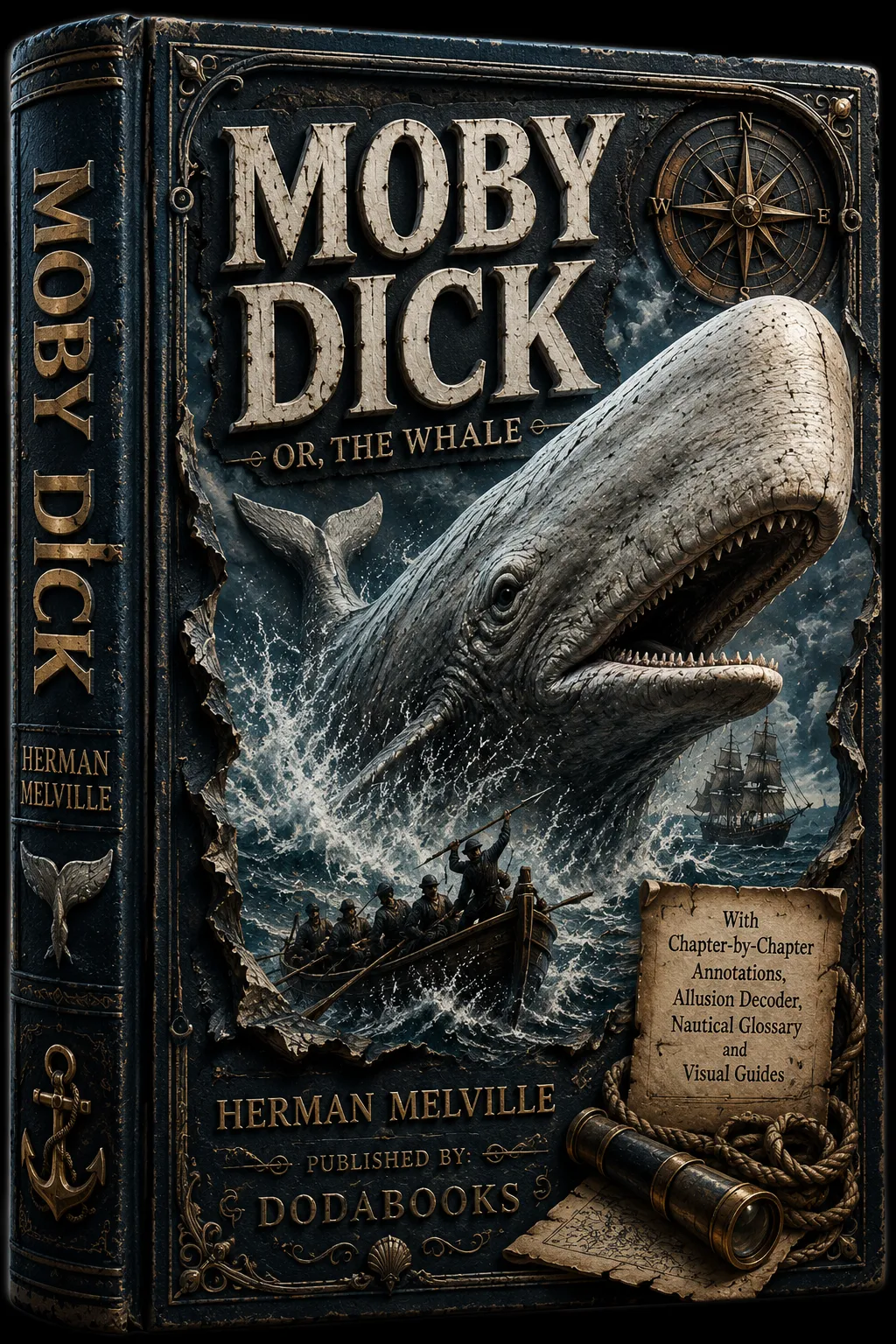
The annotated edition of Moby-Dick at DodaBooks includes a comprehensive biographical introduction that traces Melville’s life in detail, showing how his experiences at sea shaped the novel and how his friendship with Hawthorne influenced its creation. For readers who want to understand the man behind the masterpiece, this introduction is essential. Explore the annotated edition →
Experience Moby-Dick Like Never Before
Don’t struggle through Melville’s masterpiece alone. Our annotated edition of Moby-Dick includes:
- Complete, unabridged text of the novel
- Hundreds of explanatory footnotes clarifying obscure references
- Historical context on 19th-century whaling and Nantucket culture
- Literary analysis of key chapters and passages
- Victorian vocabulary definitions and nautical terminology
- Biblical and literary allusion guides
Get the annotated edition at DodaBooks →
📚 Related Articles
🎯 Stop Struggling. Start Understanding.
The annotated edition of Moby-Dick gives you everything you need to finally get Melville’s masterpiece:
- ✅ Complete, unabridged text — every word of the original 1851 edition
- ✅ Hundreds of explanatory footnotes — no more Googling every other page
- ✅ Historical context — the Essex disaster, Nantucket whaling, Melville’s life
- ✅ Literary analysis — chapter-by-chapter commentary on themes and symbols
- ✅ Victorian vocabulary — obsolete words and nautical terms defined inline
- ✅ Biblical & literary references — every allusion traced to its source