Where to Buy The Secret Agent: Best Editions and Buyer's Guide
First published in book form in September 1907 by Methuen & Co. in London, Joseph Conrad’s The Secret Agent: A Simple Tale is widely regarded as one of the supreme achievements of early modernist fiction. It is also one of the most layered, subtle, and deceptive novels in the English language.
Because Conrad weaves together non-linear flashbacks, bureaucratic police politics, 19th-century anarchist theory, and French diplomatic phrasing, choosing the right edition is crucial. Many modern budget paperbacks use outdated, flawed reprint plates or omit Conrad’s vital 1920 Author’s Note, while free digital downloads frequently suffer from mangled punctuation that obscures Conrad’s delicate irony.
Whether you are an undergraduate studying political modernism, a dedicated Conrad enthusiast, or an espionage reader discovering this masterpiece for the first time, this comprehensive buyer’s guide breaks down the best available editions of The Secret Agent.
| Edition / Publisher | Text Authority | Annotations & Notes | 1920 Author’s Note | Best Suited For |
|---|---|---|---|---|
| DodaBooks Annotated Edition | Definitive 1907 Book Text | Exhaustive historical, psychological, and police footnotes | Included with critical commentary | Readers seeking an accessible, richly annotated, DRM-free EPUB |
| Cambridge University Press | Definitive Scholarly Text (from manuscripts) | Monumental academic textual apparatus & variant readings | Included with full genetic history | University libraries, graduate researchers, and textual scholars |
| Oxford World’s Classics | Authoritative Paperback | Excellent critical introduction by John Lyon & explanatory notes | Included | College literature students and general paper readers |
| Penguin Classics | Dependable Mass-Market | Informative introduction by Michael Newton & chronology | Included | General readers looking for an affordable, widely available paperback |
| Project Gutenberg (Free Public Domain) | Raw Volunteer OCR | Zero annotations or historical guidance | Frequently omitted | Budget readers willing to tolerate raw formatting and no footnotes |
🏛️ The Complex Textual History of The Secret Agent
To choose the best reading edition, one must understand how The Secret Agent was written, revised, and expanded between 1906 and 1920.
The 1906 Ridgway’s Magazine Serial vs. The 1907 Book Text
Conrad originally wrote The Secret Agent as a short story entitled Verloc. As the concept expanded, he agreed to serialize it in an American periodical called Ridgway’s: A Militant Weekly for God and Country between October 1906 and January 1907.
Because Ridgway’s was a fast-paced popular magazine, the editors demanded aggressive cuts. Conrad rushed to meet deadlines, producing a condensed, plot-heavy version.
However, when preparing the text for the 1907 Methuen first edition in London, Conrad undertook a massive authorial expansion. He rewrote entire chapters, expanding the novel by nearly twenty thousand words:
- He added the crucial psychological depths of Chapter 8 (Winnie’s mother traveling to the almshouse).
- He dramatically expanded the bureaucratic rivalry between Chief Inspector Heat and the Assistant Commissioner in Chapter 7.
- He deepened Winnie’s silent domestic agony in Chapter 11, transforming a conventional melodrama into a psychological tragedy.
Any modern edition based on the 1906 serial is incomplete. Readers must ensure they are reading the expanded 1907 book text.
The Essential 1920 Author’s Note
In 1920, for the collected edition of his works published by Heinemann, Conrad composed a famous Author’s Note. In this personal essay, Conrad recounts the genesis of the novel:
- His casual conversation with novelist Ford Madox Ford about the real 1894 Greenwich Park bombing.
- The brief, bizarre newspaper account of French anarchist Martial Bourdin blowing himself to pieces with his own bomb.
- His reflection that the true subject of the novel was not politics or police work, but the silent domestic tragedy of Winnie Verloc.
An edition that lacks the 1920 Author’s Note deprives the reader of Conrad’s own definitive statement on his artistic intentions.
📚 Detailed Breakdown of the Best Editions
1. The DodaBooks Annotated Digital Edition (Recommended)
The DodaBooks Annotated Edition is specifically designed for modern digital readers who want to experience Conrad’s intricate prose without getting lost in Victorian police jargon or historical obscurities.
Conrad’s style relies heavily on unspoken assumptions: he assumes his readers understand the difference between the Criminal Investigation Department and the Special Crime Division; he alludes to 1890s anarcho-syndicalist splits; and he plays ironic games with Cesare Lombroso’s phrenological vocabulary. The DodaBooks edition resolves these barriers by embedding comprehensive, non-intrusive footnotes directly on the digital page.
Why Choose DodaBooks:
- Authoritative Text: Faithfully reproduces the complete, unabridged 1907 Methuen first edition, including the full 1920 Author’s Note.
- Deep Contextual Footnotes: Over 250 annotations explaining the real 1894 Greenwich bombing, London geography (Soho, Brett Street, the Silenus beer-hall), and Edwardian foreign policy.
- Psychological & Thematic Cards: Clear analytical commentary unpacking Conrad’s non-linear chronology, withheld information, and pervasive irony.
- 100% DRM-Free Ownership: Delivered in clean, open EPUB format, allowing you to read on Kindle, Kobo, Apple Books, Android, or desktop with permanent personal ownership.
Experience Conrad's complex masterpiece with comprehensive annotations and DRM-free freedom.
📖 Get the Annotated Edition at DodaBooks →2. Cambridge University Press (The Cambridge Edition of Joseph Conrad)
Edited by Bruce Harkness and S. W. Reid, the Cambridge University Press critical edition is the undisputed pinnacle of academic textual scholarship.
The editors conducted a heroic, forensic collation of all surviving manuscripts, typescripts, serial proofs, and first editions. The Cambridge edition establishes the most accurate textual record ever created for The Secret Agent, accompanied by over 150 pages of textual apparatus, rejected drafts, detailed maps of 1890s London, and exhaustive historical commentary.
- Strengths: Peerless textual authority; comprehensive documentation of Conrad’s revisions; indispensable for academic research and university libraries.
- Drawbacks: Extremely high price ($45–$95); heavy, scholarly format designed for specialists rather than casual reading.
3. Oxford World’s Classics
Edited with an introduction and notes by John Lyon, the Oxford World’s Classics edition is widely considered the finest physical mass-market paperback for students and general readers.
Lyon’s critical introduction is insightful, lucid, and engaging, examining Conrad’s deep suspicion of both revolutionary terrorism and state bureaucracies. The edition includes a detailed historical chronology of Conrad’s life, a selected bibliography of critical scholarship, and concise explanatory notes at the back of the book.
- Strengths: Authoritative text; excellent critical introduction; accessible price point.
- Drawbacks: Endnotes require constant flipping to the back of the book during reading; lightweight paper stock prone to dog-earing.
4. Penguin Classics
Edited by Michael Newton, the Penguin Classics paperback is another dependable, widely available physical edition. Newton’s introduction provides excellent historical context on the rise of anarchist terrorism in late-Victorian London, exploring the intellectual climate of dynamite bombings and public paranoia.
- Strengths: Inexpensive; widely available in brick-and-mortar bookstores; helpful glossary of foreign phrases.
- Drawbacks: Explanatory notes are less detailed than Oxford’s; mass-market paper quality.
5. Free Digital Scans & Project Gutenberg (Caveat Emptor)
While The Secret Agent is in the public domain and freely available online, free downloads carry major risks:
- No Explanatory Footnotes: Without annotations, first-time readers easily lose the thread of Conrad’s non-linear chronology and subtle irony.
- Omission of the 1920 Author’s Note: Many free scans omit Conrad’s vital 1920 essay entirely.
- Broken Formatting: Volunteer OCR scans often scramble French phrases, omit italics, and create confusing paragraph wraps during dialogue.
🎯 Buyer’s Decision Checklist: How to Choose
Choose DodaBooks If:
You read on digital devices (Kindle, Kobo, iPad) and want instant on-page footnotes, complete 1907 text, and 100% DRM-free files.
Choose Cambridge If:
You are a university literature professor, graduate student, or Conrad scholar needing full manuscript collation and textual variants.
Choose Oxford If:
You want a handsome, portable physical paperback with John Lyon's excellent critical introduction for a college seminar.
Check for 13 Chapters:
Verify that your edition contains all 13 chapters of the 1907 book text, not the truncated 1906 magazine serial.
Confirm the 1920 Author's Note:
Always verify that the edition includes Conrad's essential 1920 Author's Note discussing the Greenwich bombing.
Insist on DRM-Free:
Avoid proprietary closed formats that prevent you from backing up, converting, or sharing your digital library.
❓ Frequently Asked Questions
What is the difference between the 1906 serial and the 1907 book edition?
The 1906 serial published in *Ridgway's Magazine* was a rushed, condensed version designed for quick weekly reading. Conrad expanded the 1907 book edition by nearly 20,000 words, adding crucial psychological scenes—including Winnie's mother's departure to the almshouse and the bureaucratic conflict between Heat and the Commissioner.
Why is the 1920 Author's Note so important?
Conrad's 1920 Author's Note reveals the real-life inspiration behind the novel (the 1894 Greenwich Park explosion and French anarchist Martial Bourdin). Most importantly, Conrad explicitly identifies Winnie Verloc—not Adolf Verloc or the anarchists—as the true central protagonist of the book.
Is The Secret Agent an easy book for first-time Conrad readers?
Compared to Conrad's complex sea epics like *Lord Jim* or *Nostromo*, *The Secret Agent* is more direct, domestic, and plot-driven. However, its non-linear chronology and pervasive irony make an annotated edition strongly recommended for first-time readers.
Can I read the DodaBooks edition on my Kindle?
Yes. The DodaBooks Annotated Edition is delivered as a standard DRM-free EPUB file that can be sent to your Kindle device or Kindle app in seconds via Amazon's Send to Kindle service, or opened directly on Kobo, Apple Books, and Android.
Are there illustrations in the original edition of The Secret Agent?
Unlike Mark Twain's *A Connecticut Yankee*, *The Secret Agent* was published without interior illustrations. Conrad relied entirely on atmospheric verbal descriptions of Victorian London's fog, gaslight, and shadows.
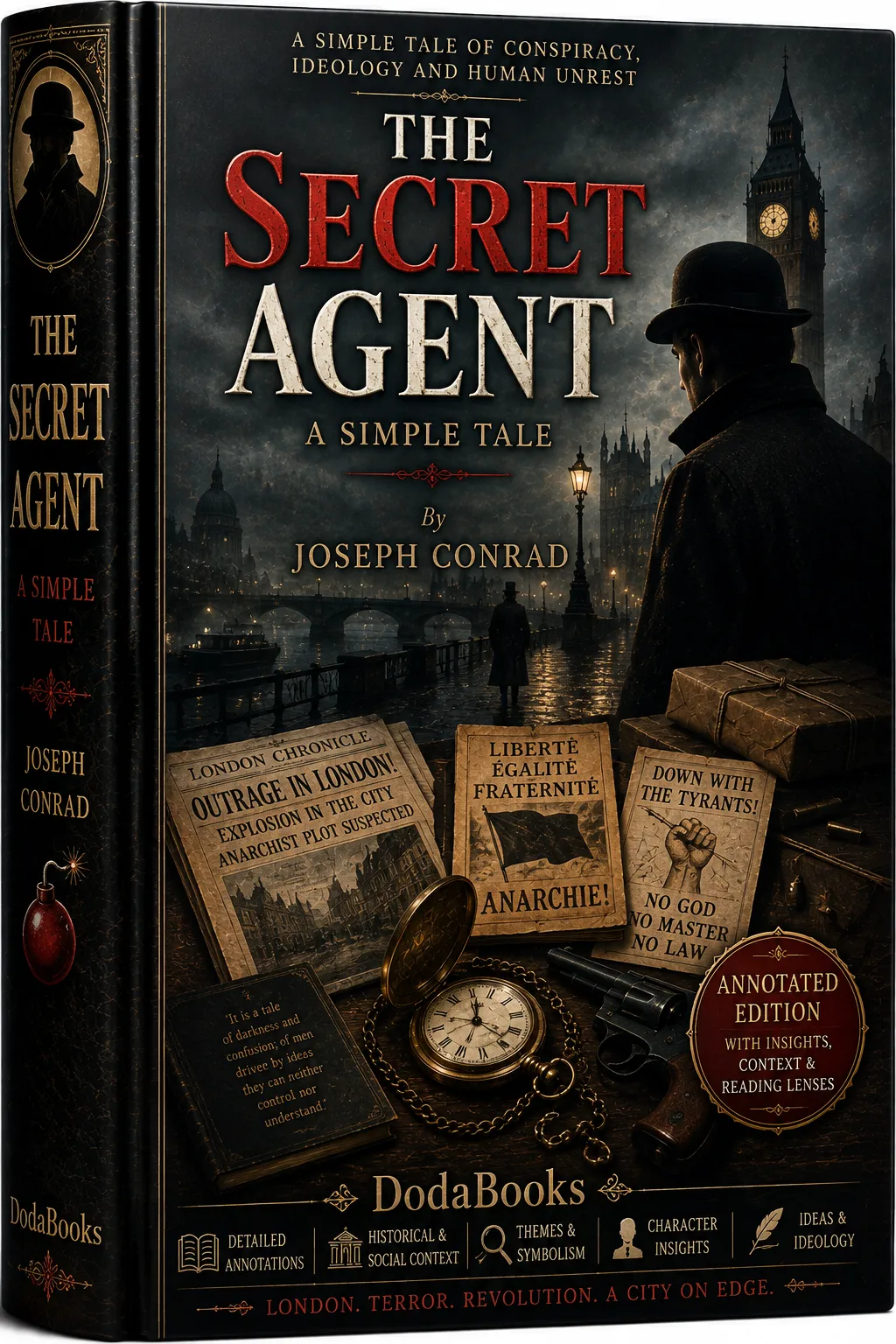
⚗️ Get the Definitive Annotated Edition of Conrad’s Thriller
Experience Joseph Conrad’s dark espionage masterpiece with complete textual clarity. The DodaBooks Annotated Edition of The Secret Agent delivers:
- ✅ Complete Unabridged 1907 Text — All 13 chapters plus the essential 1920 Author’s Note
- 📜 Over 250 Contextual Footnotes — Decoded police politics, anarchist history, and London geography
- ✒️ Designed for Digital Readers — Beautiful typography, clean chapter links, and responsive tables
- 🔒 100% DRM-Free Ownership — Yours permanently across Kindle, iPad, Kobo, and Android
- 📥 Instant EPUB Delivery — Download your digital copy immediately