Where to Buy The Moonstone: Best Editions & Collector Guide
Wilkie Collins’s 1868 masterpiece The Moonstone stands as the monumental fountainhead of English detective fiction. When readers decide to experience this historic jewel mystery, they are immediately confronted with a bewildering marketplace: hundreds of editions populate booksellers, ranging from cheap five-dollar print-on-demand paperbacks riddled with automated OCR typos to dense eight-hundred-page academic volumes weighed down by scholarly apparatus.
Because The Moonstone operates as a forensic jigsaw puzzle told through fourteen distinct firsthand witnesses, the specific edition you choose will dramatically dictate your reading pleasure. If you pick up an unannotated bargain copy, Collins’s subtle Victorian medical theories on laudanum somnambulism, 1840s British imperial looting in India, and the intricate legal mechanics of London money-lenders will sail completely past you. Conversely, an edition with clumsy formatting can garble Collins’s essential timelines, diary timestamps, and shorthand delirium transcripts.
This comprehensive buying guide evaluates and ranks the top editions of The Moonstone available today, comparing their textual fidelity, explanatory annotations, typography, and binding quality to help you choose the perfect copy for your personal library.
⚡ Best The Moonstone Editions: At a Glance
- #1 Best Digital / Overall Reading Edition: DodaBooks Annotated Edition — Features interactive color-coded annotation cards decoding Victorian opium pharmacology, colonial Indian history, narrative trust mapping, and complete DRM-free EPUB formatting.
- Best Scholarly Print Paperback: Oxford World's Classics (Edited by John Sutherland) — Exhaustive critical introduction, notes on the real-life 1860 Road Hill House murder case that inspired Sergeant Cuff, and historical appendices.
- Best Cultural Context Paperback: Penguin Classics (Edited by Sandra Kemp) — Outstanding analysis of Victorian racial anxiety, imperial guilt, and Collins's personal battle with laudanum addiction.
- Best Heirloom Hardcover: The Folio Society / Everyman's Library — Elegant clothbound presentations featuring period illustrations and sewn bindings built for lifelong shelf display.
📊 Comprehensive Editions Comparison Matrix
+--------------------------------------------------------------------------------------------------------------------+
|                                      TOP THE MOONSTONE EDITIONS EVALUATED                                          |
+----------------------+-----------+--------------------+---------------------+------------------+-------------------+
| EDITION              | FORMAT    | ANNOTATIONS & NOTES| SPECIAL FEATURES    | BEST FOR         | PRICE RANGE       |
+----------------------+-----------+--------------------+---------------------+------------------+-------------------+
| DodaBooks Annotated  | Digital   | Integrated         | Narrator trust map, | Immersive reading| $4.99 – $7.99     |
| Edition              | (EPUB)    | color-coded cards  | opium science guide,| on Kindle, Kobo, | (DRM-Free)        |
|                      |           | on law & medicine  | forensic timeline   | iPad, and phone  |                   |
+----------------------+-----------+--------------------+---------------------+------------------+-------------------+
| Oxford World's       | Mass      | Comprehensive      | Road Hill murder    | University study,| $10.00 – $15.00   |
| Classics (Sutherland)| Paperback | academic endnotes  | dossier, legal &    | English majors,  |                   |
|                      |           | & critical intro   | serial variant notes| close analysis   |                   |
+----------------------+-----------+--------------------+---------------------+------------------+-------------------+
| Penguin Classics     | Trade     | Detailed cultural  | Essays on imperial  | General readers  | $11.00 – $16.00   |
| (Sandra Kemp)        | Paperback | & historical notes | guilt, Victorian    | wanting deep     |                   |
|                      |           | at back of volume  | medical opium crisis| cultural context |                   |
+----------------------+-----------+--------------------+---------------------+------------------+-------------------+
| Everyman's Library   | Cloth     | Scholarly preface  | Acid-free paper,    | Lifelong home    | $22.00 – $30.00   |
| Hardcover            | Hardcover | & brief chronology | sewn ribbon marker, | libraries, gifts |                   |
|                      |           | only               | handsome dust jacket| & purists        |                   |
+----------------------+-----------+--------------------+---------------------+------------------+-------------------+
| Cheap Print-on-Demand| Paperback | None               | None; frequently    | Avoid: high risk | $6.00 – $9.00     |
| (Amazon / Generic)   | / Kindle  | (Raw public domain)| contains OCR errors | of typos & bad   |                   |
|                      |           | unedited scan)     | and broken diaries  | line breaks      |                   |
+----------------------+-----------+--------------------+---------------------+------------------+-------------------+
🏆 In-Depth Reviews of the Best Editions
1. DodaBooks Annotated Edition (Top Recommendation for Modern Readers)
For contemporary readers who want to experience Wilkie Collins’s gripping detective narrative without losing momentum or stumbling over arcane Victorian medical jargon, the DodaBooks Annotated Edition stands as the definitive modern choice.
When reading a 500-page mystery where every clue matters, standard print endnotes force the reader to perpetually flip hundreds of pages back and forth, completely destroying the narrative suspense. Unassisted public domain digital editions are even worse: they present a flat, undifferentiated wall of text where crucial clues regarding dates, opium dosage, and character reliability are easily missed.
The DodaBooks edition resolves these challenges through purpose-built features:
- Interactive, Color-Coded Annotation Cards: Contextual notes appear directly within the narrative flow, allowing readers to inspect historical, legal, and medical references without leaving their reading screen:
- Blue Cards (Forensic Science & Opium Pharmacology): Decodes 1840s medical theory regarding somnambulism, laudanum tinctures, the physiological writings of Dr. William Carpenter, and the mechanics of Ezra Jennings’s famous medical experiment.
- Rose Cards (Narrator Reliability & Character Biases): Highlights the subtle omissions and self-serving rationalizations in Drusilla Clack’s pious tracts, Gabriel Betteredge’s chauvinistic superstitions, and Godfrey Ablewhite’s false philanthropy.
- Gold & Purple Cards (Colonial History & Victorian Etiquette): Details the 1799 Siege of Seringapatam, Tipu Sultan’s palace, the sacred temple of Somnath, 19th-century diamond-cutting practices in Amsterdam, and London moneylending laws.
- Visual Case Dossier & Character Timelines: Includes chronological charts tracking the movement of the Moonstone from June 21, 1848, to June 1849, cross-referencing who possessed the jewel at every pivotal hour.
- Complete, Authoritative Text: Carefully prepared from the three-volume 1868 first book edition, preserving all of Collins’s original chapter divisions, French phrases, and epistolary headings.
- DRM-Free Universal Compatibility: Delivered instantly in high-standard EPUB format, compatible with Kindle (Paperwhite, Scribe, Oasis), Kobo e-readers, Apple Books, Google Play Books, Boox, and desktop reading suites.
2. Oxford World’s Classics Edition (Edited by John Sutherland)
If your primary objective is formal academic study, college coursework, or deep textual scholarship, the Oxford World’s Classics paperback edition edited by prominent Victorian specialist John Sutherland is the premier physical volume.
- The Road Hill House Connection: Sutherland’s critical introduction brilliantly traces how Collins based Sergeant Cuff on Inspector Jonathan Whicher, who investigated the sensational 1860 Constance Kent child murder case. Sutherland explains how Whicher was publicly humiliated and ostracized for suspecting the young daughter, exactly as Cuff is disgraced when he suspects Rachel Verinder.
- Exhaustive Scholarly Apparatus: Sutherland provides hundreds of meticulous endnotes explaining 1840s Yorkshire dialect, Victorian railway timetables, the Indian mutiny of 1857, and Collins’s agonizing gout symptoms during the composition of the novel.
- Textual Chronology & Variant Readings: Documents the minor textual variations between the All the Year Round serialized run and the three-volume book edition.
- Drawbacks for Leisure Readers: Compact paperback typography and dense back-matter endnotes can make casual reading clunky, requiring frequent page-flipping.
3. Penguin Classics Edition (Edited by Sandra Kemp)
The Penguin Classics paperback, edited with an introduction and notes by Victorian literature scholar Sandra Kemp, offers an exceptionally rich cultural and political reading experience.
- Focus on Imperial Guilt and Colonialism: While Sutherland focuses heavily on the detective puzzle, Kemp explores the profound political undercurrents of the novel. She details how Collins used the stolen Indian diamond to criticize British imperialism and the looting of sacred cultural heritage (drawing parallels to Queen Victoria’s acquisition of the Koh-i-Noor diamond in 1850).
- Collins’s Opium Reality: Kemp examines Collins’s severe addiction to laudanum—Collins was consuming enormous quantities of opium daily while writing the novel to combat blinding rheumatic pain, and later admitted he could not remember writing large sections of Franklin Blake’s narrative.
- Readable Trade Formatting: Features Penguin’s comfortable trade paperback margins and clear type, making it a pleasant physical companion for marathon reading sessions.
4. Everyman’s Library Collector Hardcover Edition
For readers looking for a beautiful, permanent physical volume for their home bookshelf, the Everyman’s Library clothbound hardcover is an exceptional choice:
- Heirloom Craftsmanship: Bound in rich cloth with gold foil stamping, an integrated satin ribbon marker, acid-free cream paper, and durable Smyth-sewn binding that lies perfectly flat on your desk.
- Subtle Scholarly Context: Includes a succinct, thoughtful introduction and a historical timeline placing Collins’s life alongside major Victorian historical events.
- Drawbacks: Contains minimal explanatory footnotes throughout the text. If you encounter an unfamiliar 1840s medical or legal term, you will have to consult an external dictionary.
🚫 Critical Traps: What to Avoid When Buying The Moonstone
Because The Moonstone is in the public domain, storefronts like Amazon, Barnes & Noble, and Kobo are inundated with hundreds of low-quality, predatory print-on-demand copies. Before purchasing, beware of these red flags:
1. Garbled OCR Scans of Shorthand Transcripts
In Chapter 9 of the Second Period, Ezra Jennings pieces together Dr. Candy’s delirium using a visual grid of broken phrases and shorthand dots. Cheap print-on-demand copies scraped from unformatted text repositories routinely collapse this grid into unintelligible blocks of run-on text, completely ruining the central scientific revelation of the novel.
2. Missing Prologue or Epilogue
Certain budget print editions and truncated audiobooks omit the 1799 Seringapatam Prologue or Mr. Murthwaite’s 1850 Indian Epilogue, treating them as optional “introductory matter.” This ruins the thematic arc of the entire book: without the Prologue and Epilogue, the story loses its profound framing of colonial retribution and the restoration of sacred heritage.
3. Cramped 7-Point Type in Pocket Reprints
Some budget publishers attempt to minimize paper costs by cramming Collins’s 190,000-word novel into an ultra-compact pocket format. The result is microscopic font sizes, zero margin space, and heavy ink show-through that causes severe eyestrain.
💡 Buyer’s Recommendation Checklist
To determine which edition best suits your reading habits:
- If you read on an iPad, Kindle, Kobo, or mobile phone: Choose the DodaBooks Annotated Edition. The integrated color-coded cards explain the medical opium theories and colonial context without flipping pages, and the DRM-free format guarantees lifelong ownership.
- If you are an English literature student or academic researcher: Choose the Oxford World’s Classics paperback. John Sutherland’s analysis of Inspector Whicher and the Road Hill murder case provides unparalleled scholarly insight.
- If you prefer an insightful physical paperback for personal enjoyment: Choose the Penguin Classics edition. Sandra Kemp’s essays on Victorian imperial guilt and laudanum addiction provide fascinating depth.
- If you want a luxurious physical keepsake for your home library: Choose the Everyman’s Library clothbound hardcover.
❓ Frequently Asked Questions
Which edition of The Moonstone has the best annotations for general readers?
The DodaBooks Annotated Edition is widely considered the most accessible and engaging edition for general readers. Instead of burying explanations in academic endnotes at the back of a thick book, DodaBooks embeds non-intrusive, color-coded annotation cards directly in the text to clarify 1840s opium science, narrative reliability, and historical allusions in real time.
Is The Moonstone better to read in digital or print format?
Because The Moonstone is nearly 500 pages long and incorporates fourteen shifting perspectives, digital editions offer significant advantages in weight, portability, and typography scaling. A dedicated digital edition like the DodaBooks Annotated Edition provides modern digital convenience paired with deep scholarly enrichment.
What real-life murder case inspired Sergeant Cuff?
Sergeant Cuff was directly inspired by Inspector Jonathan Whicher of Scotland Yard, who investigated the famous 1860 Road Hill House murder case in Wiltshire. Whicher correctly deduced that sixteen-year-old Constance Kent had murdered her younger brother, but he was dismissed and ridiculed by the public when he failed to find the missing bloody nightgown—a detail Collins immortalized with Franklin Blake’s stained nightgown.
How does The Moonstone connect to Wilkie Collins's The Woman in White?
Both novels are masterpieces of Victorian sensation fiction that employ multiple first-person narrators to tell a forensic mystery. To compare Collins’s techniques, read our complete guide: The Woman in White Summary by Epoch & Chapter.
Where can I purchase the complete DodaBooks Annotated Edition?
You can purchase and download the edition directly from the DodaBooks Storefront. It comes with instant digital delivery, zero DRM restrictions, and lifetime compatibility across all your devices.
📚 Related Articles
Exploring classic Victorian detective fiction and sensation novels? Discover our The Hound of the Baskervilles Guide and our The Strange Case of Dr. Jekyll and Mr. Hyde Guide.
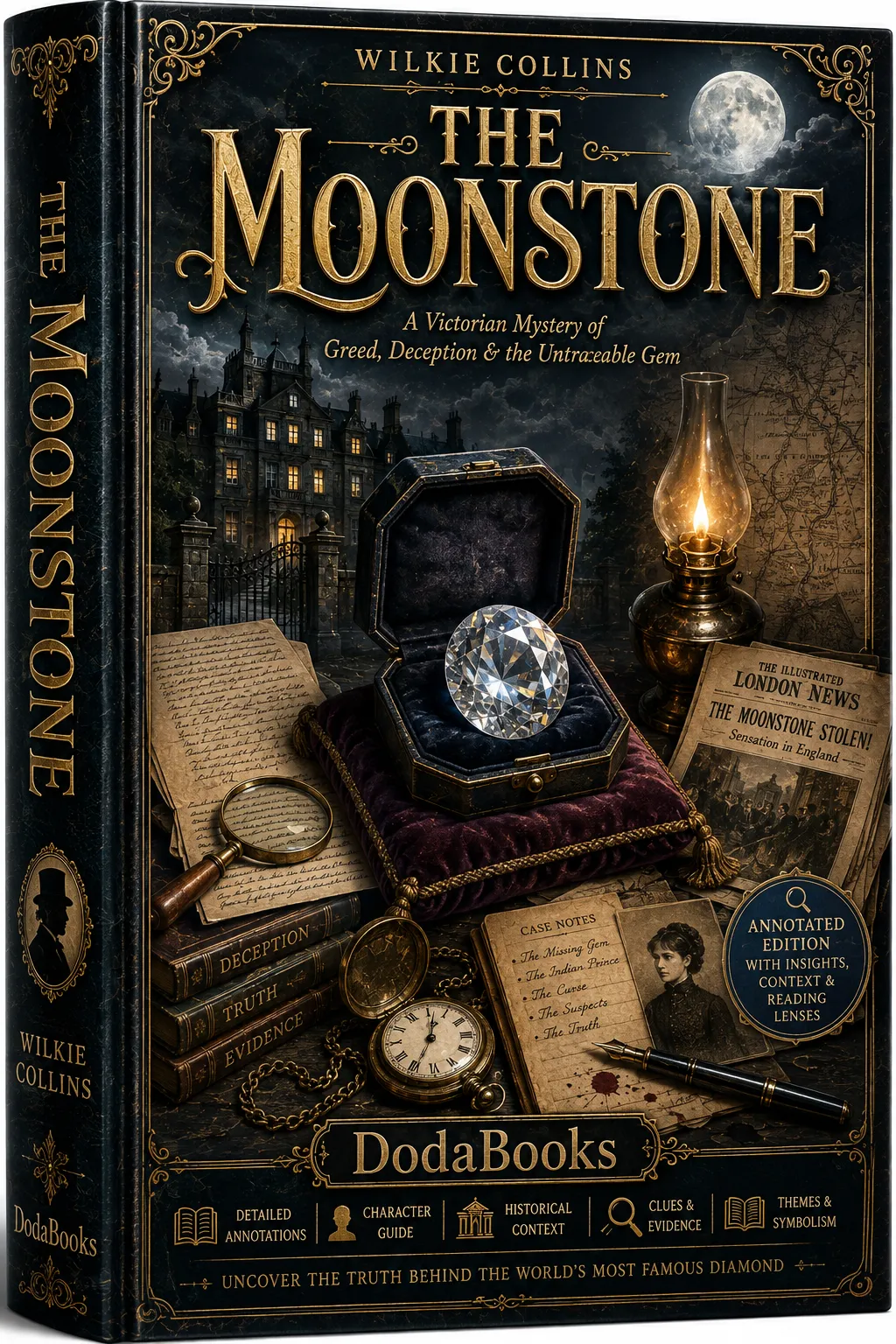
💎 Experience Collins’s Detective Masterpiece Fully Annotated
Read the novel that founded detective fiction in an authoritative, distraction-free edition:
- ✅ Complete, unabridged 1868 text across all fourteen narrators and testimonies
- ⚖️ Victorian medical & colonial context decoded — understand the opium science and Seringapatam theft
- 🗂️ Passage-specific annotation cards revealing character credibility and narrative clues
- 🔒 DRM-free EPUB format — readable on any Kindle, Kobo, iPad, or mobile device
- 📥 Instant digital download delivered directly after checkout