Where to Buy Hamlet: Best Editions, Textual Variants, and Buying Guide
William Shakespeare’s The Tragedy of Hamlet, Prince of Denmark is the most printed, performed, and critically debated dramatic text in the history of the English language. First printed in a corrupt “bad” quarto in 1603 (Q1), followed by the authoritative Second Quarto in 1604–1605 (Q2), and the theatrical First Folio in 1623 (F1), Hamlet presents modern readers and scholars with unique textual challenges. Today, hundreds of different editions populate the marketplace, ranging from cheap 99-cent digital conversions to massive, multi-volume university critical editions.
However, reading Shakespeare without adequate textual guidance can be an exercise in frustration. Because Early Modern English syntax, Elizabethan theatrical slang, and Renaissance philosophical idioms are largely unfamiliar to modern readers, choosing the right edition can make the difference between struggling through obscure verse and experiencing the visceral power of Shakespeare’s drama. This comprehensive buying guide reviews the top editions of Hamlet available today, assessing their textual authority, annotation depth, physical design, and digital readability.
| Best For | Top Recommendation | Format | Key Strength |
|---|---|---|---|
| Best Overall & Best Digital | DodaBooks Annotated Edition | DRM-Free EPUB | Comprehensive line-by-line Early Modern glosses, Q1/Q2/F1 apparatus, clean typography |
| Best Academic & Research | Arden Shakespeare Third Series (Ed. Ann Thompson & Neil Taylor) | Paperback (2 Vols) | Definitive scholarly apparatus; separate volumes for Q2 and Q1/F1 texts |
| Best Student & High School | Folger Shakespeare Library (Ed. Barbara A. Mowat & Paul Werstine) | Paperback | Clear facing-page notes, modern scene summaries, classroom friendly |
| Best Performance & Theater | Cambridge School Shakespeare (Ed. Richard Andrews & Rex Gibson) | Paperback | Staging activities, actor-centric blocking notes, rehearsal questions |
| Best Classic Library Hardcover | Everyman’s Library Edition | Hardcover | Beautiful cloth binding, gold foil stamping, classic Tony Tanner introduction |
🏆 Top 5 Editions of Hamlet: Detailed Reviews
1. DodaBooks Annotated Edition (Best Overall & Best Digital)
For modern digital readers, theater practitioners, and literature students seeking an immersive, distraction-free reading experience, the DodaBooks Annotated Edition is the undisputed top recommendation. While most digital Shakespeare eBooks on platforms like Amazon or Apple Books are automated, unverified scans riddled with mangled line breaks and missing verse formatting, DodaBooks has meticulously engineered a digital edition specifically optimized for modern reading devices.
Key Features:
- Comprehensive Line-by-Line Early Modern Glosses: Over 1,200 curated footnotes explain archaic Elizabethan vocabulary (e.g., hebenon, unhouseled, fardels, bourn, quiddities), complex puns, and double entendres without requiring the reader to flip back and forth to an appendix.
- Textual Apparatus (Q2 vs. F1): Clarifies major textual disputes—such as whether Hamlet speaks of his “too too solid flesh” (Folio) or “sullied flesh” (Quarto)—and marks lines cut from the Folio for stage performance (such as Hamlet’s entire fourth soliloquy, “How all occasions do inform against me”).
- Globe Staging & Performance Notes: Detailed commentary explaining how scenes were originally blocked and performed on the Elizabethan stage without modern lighting, sets, or intermissions.
- 100% DRM-Free Ownership: Delivered as an open, universal EPUB file. You permanently own your book and can freely transfer it to your Kindle, Kobo, iPad, reMarkable tablet, or desktop Calibre library without restrictive digital locks.
Verdict: The premier choice for readers who want scholarly depth combined with beautiful digital typography and complete cross-device freedom.
2. The Arden Shakespeare: Third Series (Best for Academic Research)
Edited by renowned Shakespearean scholars Ann Thompson and Neil Taylor, the Arden Shakespeare Third Series edition of Hamlet is the gold standard for graduate students, literary scholars, and university professors.
Key Features:
- Two-Volume Textual Achievement: Recognizing that combining Q2 (1604) and F1 (1623) creates a bloated, hybrid text that Shakespeare never staged, Thompson and Taylor published the authoritative Second Quarto as Volume 1, and the First Quarto (1603) and First Folio (1623) in a dedicated companion Volume 2.
- Exhaustive Footnotes: The bottom two-thirds of virtually every page is packed with detailed textual collations, historical word origins, performance histories, and competing editorial interpretations.
- Massive 150-Page Critical Introduction: Explores the dating of the play, the lost Ur-Hamlet, Renaissance revenge conventions, gender dynamics, and 400 years of global staging history.
Drawbacks: The sheer density of the footnotes can overwhelm casual readers, and the physical two-volume set is relatively expensive ($40–$50).
3. Folger Shakespeare Library Edition (Best for Students and Beginners)
Edited by Barbara A. Mowat and Paul Werstine, the Folger Shakespeare Library edition has served as the staple high school and undergraduate introductory text across North America for decades.
Key Features:
- Facing-Page Annotation Layout: In the print edition, Shakespeare’s verse appears on the right-hand page, while definitions, scene synopses, and contextual illustrations appear directly opposite on the left-hand page.
- Accessible Language Glosses: Focuses strictly on words whose meanings have shifted dramatically between 1600 and the present day.
- Introductory Essays: Includes a clear guide to Shakespeare’s poetic language (iambic pentameter, inverted syntax, puns) and a brief history of the Elizabethan theater.
Drawbacks: Annotations tend to be basic, often omitting deeper philosophical, religious, and dramaturgical debates.
4. Cambridge School Shakespeare (Best for Performance & Drama Teachers)
Designed specifically for drama classes, high school English courses, and rehearsal rooms, the Cambridge School Shakespeare edition approaches Hamlet not merely as a literary poem, but as a living piece of theater.
Key Features:
- Actor-Centric Classroom Prompts: Margin notes prompt students to make directorial decisions: “How should Hamlet deliver ‘To be or not to be’—whispered to himself, shouted to the audience, or aimed at the hidden eavesdroppers?”
- Visual Staging Illustrations: Packed with production photographs featuring celebrated actors—including Laurence Olivier, Kenneth Branagh, David Tennant, and Maxine Peake—illustrating diverse interpretations of Elsinore.
- Exploration of Subtext: Prompts readers to analyze non-verbal body language and silent reactions during the “Mousetrap” play and the duel.
Drawbacks: The numerous classroom worksheets and theater exercises clutter the text, making it distracting for quiet personal reading.
5. Generic Public Domain & Budget Print Reprints (What to Avoid)
Because Shakespeare’s works have been in the public domain for centuries, online marketplaces are flooded with cheap print-on-demand books and 99-cent Kindle downloads. Readers should exercise extreme caution before buying these editions.
Common Hazards of Cheap Knockoffs:
- Broken Iambic Pentameter: Automated conversions frequently collapse Shakespeare’s poetic line breaks into solid prose blocks, destroying the rhythmic cadence of the soliloquies.
- Textual Confusion: Cheap editions indiscriminately splice lines from Q1, Q2, and F1 together without notation, creating contradictory character dialogue and unstageable scenes.
- Zero Explanatory Glosses: Lacking footnotes, young readers find themselves hopelessly baffled by lines like “unhous’led, disappointed, unanel’d” or “a vice of kings, a cutpurse of the empire.”
- Mangled Character Speeches: OCR software regularly misattributes speech prefixes, assigning Hamlet’s lines to Horatio or Polonius.
📊 Comprehensive Hamlet Editions Comparison Matrix
| Edition | Format | Footnote Type | Textual Base | Best For | Price Range |
|---|---|---|---|---|---|
| DodaBooks Annotated | Digital (EPUB) | Line-by-line popups & inline | Q2 / F1 hybrid with clear apparatus | Digital readers, self-study, book clubs | $4.99–$7.99 |
| Arden Third Series | Paperback / Hardcover | Exhaustive scholarly footnotes | Separate Q2 and Q1/F1 volumes | Scholars, university students, professors | $22.00–$45.00 |
| Folger Library | Paperback / Kindle | Facing-page vocabulary glosses | Modernized eclectic text | High school students, introductory readers | $8.00–$12.00 |
| Cambridge School | Paperback | Margin prompts & staging notes | Edited performance text | Drama students, teachers, actors | $12.00–$16.00 |
| Oxford World’s Classics | Paperback | Comprehensive endnotes & intro | Authoritative edited text | Undergraduate literature courses | $10.00–$14.00 |
| Pelican Shakespeare | Paperback | Minimal bottom-of-page glosses | Modernized scholarly text | Clean, lightweight reading copy | $7.00–$10.00 |
| Budget OCR Knockoffs | Paperback / Kindle | None | Corrupted public domain scans | Not Recommended | $0.99–$4.99 |
🔍 Buyer’s Checklist: What to Look for Before Buying
Before investing in a copy of Hamlet, verify that your edition fulfills these criteria:
- Textual Basis Clarity: Ensure the editor explicitly states whether they are using the Second Quarto (1604) or First Folio (1623) as their base text, and whether they preserve famous passages cut from the Folio.
- Accessible Vocabulary Glosses: Check that archaic words like fardels, quietus, and calumny are defined directly on the page or via instant digital popups.
- Scene-by-Scene Guidance: Verify that the edition includes clear scene breakdowns. Review our comprehensive Hamlet Summary Act by Act to ensure your copy includes all 20 scenes.
- Character Analysis: A strong edition provides psychological context for complex dynamics. Review our guide to Hamlet Characters Explained to evaluate character notes.
- DRM Freedom for eBooks: If buying digitally, avoid proprietary vendor lock-in by purchasing DRM-free EPUB editions that can be read on any device.
❓ Frequently Asked Questions
What is the difference between the Quarto (Q2) and Folio (F1) editions of Hamlet?
The Second Quarto (Q2, 1604) is the longest and most literary text, likely printed directly from Shakespeare's working draft ("foul papers"). The First Folio (F1, 1623) is approximately 230 lines shorter, reflecting cuts made for theatrical performance at the Globe Theatre—including Hamlet's famous fourth soliloquy (*"How all occasions do inform against me"*). Most modern reading editions create an "eclectic" text combining the best readings of both.
Which edition of Hamlet is best for a high school or college student?
For print copies, the Folger Shakespeare Library edition is ideal due to its facing-page glosses and accessible commentary. For digital study on Kindle, iPad, or computer, the DodaBooks Annotated Edition is the superior choice, delivering comprehensive inline footnotes and DRM-free convenience.
Is the Arden Shakespeare too difficult for a beginner?
Yes. The Arden Third Series is an extraordinary academic resource, but its microscopic footnotes and dense textual collations often take up more than half the page, making it intimidating and disruptive for someone encountering Shakespeare's tragedy for the first time.
Can I read the DodaBooks edition on my Kindle or e-reader?
Yes. The DodaBooks Annotated Edition is formatted as a universal DRM-free EPUB file that functions seamlessly across all modern reading devices, including Amazon Kindle (via "Send to Kindle"), Kobo, Apple Books, and Android e-readers.
How difficult is Hamlet compared to Shakespeare's other plays?
Hamlet is generally considered one of Shakespeare's most intellectually demanding works (difficulty rating 8.5/10), due to its philosophical soliloquies and dense wordplay. For a full breakdown of linguistic hurdles and reading time, consult our guide: Is Hamlet Hard to Read?.
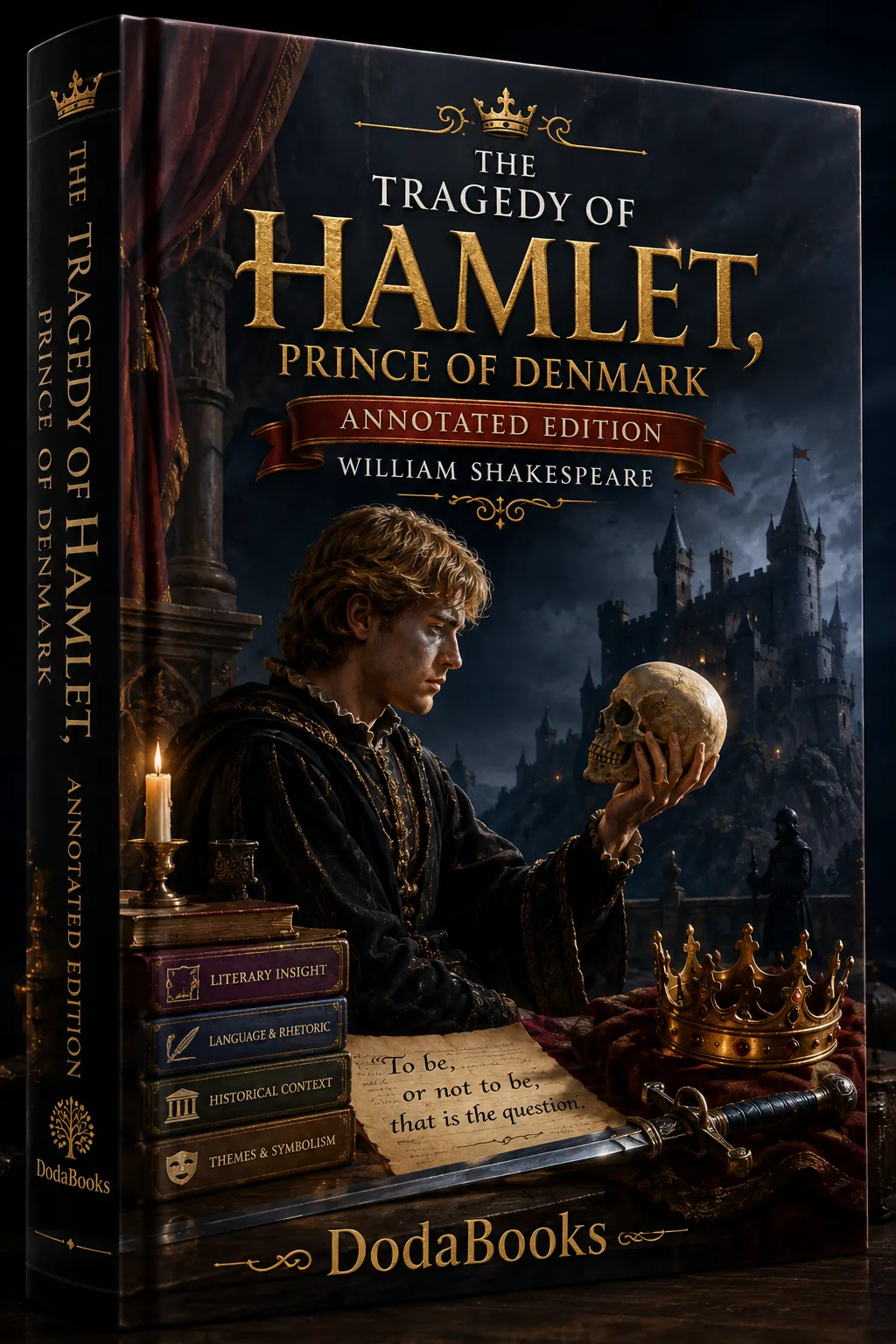
👑 Read Hamlet in Its Purest, Most Enriching Form
Avoid broken OCR scans and cryptic language barriers. Experience Shakespeare’s crowning tragedy with the authoritative DodaBooks Annotated Edition of Hamlet.
- 📖 Complete Uncut Text — Beautifully typeset verse preserving Shakespeare’s authentic meter
- 📜 Over 1,200 Line-by-Line Glosses — Instant explanations of Early Modern words and puns
- 🎭 Staging & Textual Apparatus — Notes on Quarto and Folio variants and Globe Theatre performance
- 🔒 100% DRM-Free — Read freely on your Kindle, Kobo, iPad, or phone without restrictions
- ⚡ Instant Delivery — High-resolution digital EPUB available immediately upon checkout
For a comprehensive exploration of setting, themes, and literary significance, visit our master Hamlet Guide.